Is Türkiye Really a Top-10 Arms Exporter? Rank vs Revenue

No – not on the only independent league table that exists. SIPRI’s March 2026 fact sheet, covering 2021–25, ranks Türkiye 11th among the world’s arms exporters, with 1.8 per cent of global transfer volume, behind Spain on 2.3 per cent. Türkiye’s Presidency of Defence Industries (SSB) said on 17 November 2026 that the country had climbed out of 11th place and into the top 10. That claim rests on a different number: roughly $11.4 billion of defence and aerospace export revenue in the twelve months to October 2026. Both figures are real. They count different things, and only one of them is ranked by anybody outside Ankara.
DefenceTürkiye data box
Subject: Türkiye’s position in the global arms export market
Independent ranking: 11th, 1.8% of world arms transfer volume, 2021–25 (SIPRI, March 2026)
Previous period: 0.9% in 2016–20 – a 122% rise in volume
Türkiye’s own figure: $11.37bn in the 12 months to October 2026
2026 so far: $8.05bn in January–October, up 20% year on year
Share of all Turkish exports: 3.91% (January–October 2026), from 1.46% in 2020
Largest export sub-sector: civil aviation (SASAD, 2023 – latest published breakdown)
Top three customers by volume: Pakistan 16%, UAE 12%, Ukraine 8.4% (SIPRI, 2021–25)
Official target: $11.5bn of exports in 2027
The claim, and who made it
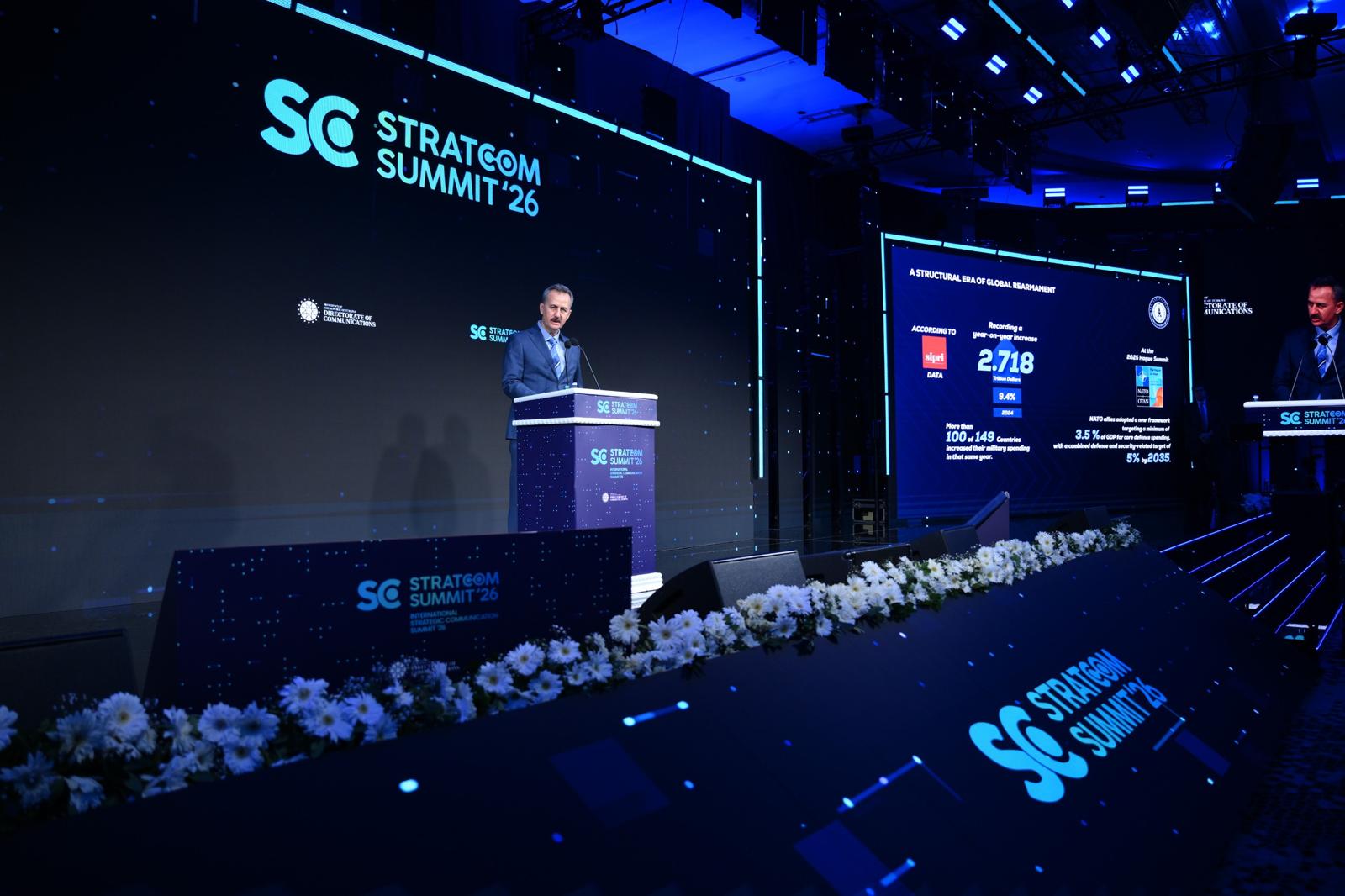
Speaking at a provincial defence industry meeting in Manisa on 17 November 2026, SSB President Haluk Görgün said Türkiye had moved from 11th place into the top 10 of global defence exporters. The surrounding figures he gave were: about $11 billion of exports over the previous twelve months, roughly $56 billion cumulatively since 2012 with about $30 billion of that in the last three years, more than $16 billion of contracts signed during 2026, and a target of $20 billion. He also said 56 per cent of exports go to NATO members and allied states, and put the industrial base at more than 4,000 companies and close to 135,000 jobs. These remarks are reported by the SSB bulletin; SSB’s own website was not reachable from outside Türkiye while this piece was being checked.
Two of those numbers are routinely confused in coverage of the Turkish industry, and the distinction decides whether the top-10 claim holds. Contracts signed are orders taken in a year. Exports are goods and services that actually crossed the border and were paid for. The $16 billion and the $20 billion are contract figures. The $11 billion is an export figure. A country cannot be ranked as an exporter on the strength of orders it has not yet shipped – and the gap between the two is precisely what Türkiye’s order book is made of.
What SIPRI actually says
The Stockholm International Peace Research Institute publishes the only widely used independent ranking of arms exporters. Its Trends in International Arms Transfers, 2025 fact sheet, issued in March 2026 and covering the five years 2021–25, places Türkiye 11th with 1.8 per cent of global transfer volume, up from 0.9 per cent in 2016–20. The increase in volume is 122 per cent – among the eleven largest suppliers, only Italy grew faster, at 157 per cent. Türkiye’s three largest customers over the period were Pakistan (16 per cent of Turkish exports), the United Arab Emirates (12 per cent) and Ukraine (8.4 per cent).
The company it keeps is instructive. Tenth place belongs to Spain on 2.3 per cent and ninth to South Korea on 3.0 per cent, while the five largest suppliers – the United States, France, Russia, Germany and China – between them account for 70 per cent of all arms exports, with the United States alone on 42 per cent. The distance from 11th to 10th is small. The distance from 11th to the top five is a different order of magnitude, and nothing in the 2026 data closes it.
SIPRI’s measure has a well-known limitation that cuts in Türkiye’s favour and should be stated plainly. Its trend-indicator value covers major conventional weapons only – aircraft, armoured vehicles, artillery, missiles, ships, sensors and engines. It does not count small arms, most ammunition, electronic warfare boxes, communications kit, maintenance contracts, training or services. A good deal of what Türkiye sells, from ammunition to subsystem exports, therefore never enters the ranking at all. Eleventh place is a floor for Türkiye’s commercial position, not a ceiling.
Why it matters
For a foreign buyer, the ranking itself is almost irrelevant – nobody procures a weapon because its maker is tenth rather than eleventh. What matters is what sits underneath the number. A supplier whose export revenue is heavily weighted towards civil aerospace subcontracting has a different industrial profile, and a different surge capacity for military orders, than one whose revenue is all platforms. Reading the headline figure as a measure of how much military hardware Türkiye can ship you in 2028 will mislead you in both directions.
Where Türkiye’s own number comes from
The $11.4 billion figure is not an SSB calculation. It is the monthly export registration line for “Savunma ve Havacılık Sanayii” – defence and aerospace industry – published by the Turkish Exporters’ Assembly (TİM) in its monthly sector workbooks. That can be checked rather than taken on trust. TİM records October 2026 defence and aerospace exports of exactly $1,140.0 million, which is the $1.14 billion reported in the Turkish press, and 61 per cent above October 2025’s $707.6 million, which is the reported growth rate. Adding the ten months of 2026 to November and December 2025 gives $11,367.4 million – the “$11.36 billion over twelve months” that has been quoted since. Every official figure in circulation reproduces from one public spreadsheet.
The same series appears under another name. The defence industry association SASAD reports what it calls foreign sales revenue, and in its 2023 sector performance report that figure is $5,545,622,000. TİM’s defence and aerospace line for 2023 is $5,545.6 million. They are the same series to the dollar. SASAD also put the sector at 2.5 per cent of all Turkish exports that year; dividing TİM’s own numerator by TİM’s own denominator gives 2.50 per cent. There is, in other words, one Turkish export number, not several.
What is inside the $11.4 billion
Two things about the composition of that number should temper any ranking claim built on it.
The first is the mix. SASAD’s 2023 report – the most recent breakdown the association has published on its own site – states that the civil aviation sub-sector had the largest share of the industry’s foreign sales, ahead of weapons, ammunition and missiles in second place and land platforms in third. Turkish Aerospace, TEI and a long tail of machining and composites firms sell work packages into Airbus, Boeing and engine programmes, and those sales are booked in the same customs line as an armoured vehicle. No public breakdown has been issued for 2024, 2025 or 2026, so the current split is unknown. Treating the whole $11.4 billion as arms exports overstates arms exports by an amount nobody outside the industry can currently quantify.
The second is the shape of the twelve-month window. December 2025 alone recorded $2,571.0 million of defence and aerospace exports – more than three times the normal monthly run rate, and a quarter of that entire year. Any trailing twelve-month total that still contains that month is carrying an unusually heavy single contribution, and it will drop out of the window at the end of December 2026. Readers who want the growth rate without that distortion should use the like-for-like comparison: January to October 2026 produced $8,050.0 million against $6,698.9 million in the same ten months of 2025, a rise of 20.2 per cent. That is the real underlying growth, and it is strong without needing the outlier.
| Year | Exports | Share of all Turkish exports |
|---|---|---|
| 2020 | $2,279.0 m | 1.46% |
| 2021 | $3,224.8 m | 1.56% |
| 2022 | $4,396.0 m | 1.94% |
| 2023 | $5,545.6 m | 2.50% |
| 2024 | $6,734.8 m | 2.98% |
| 2025 | $10,016.3 m | 4.22% |
| 2026 Jan–Oct only |
$8,050.0 m | 3.91% |
The share column is the part that is hard to argue with. Defence and aerospace went from under 1.5 per cent of everything Türkiye sells abroad in 2020 to just under 4 per cent in 2026. For a country whose total exports are dominated by vehicles, textiles, steel and chemicals, that is a structural shift rather than a good year.
Why national export figures cannot be ranked against each other
The deeper problem with any revenue-based top-10 claim is that no two countries publish the same thing.
South Korea is the clearest comparison, because it is the nearest emerging exporter above Türkiye on SIPRI’s table. Its Defense Acquisition Program Administration reported defence exports of about $15.4 billion for 2025, a 60 per cent rise, after $17.3 billion in 2022 and $7.25 billion in 2021. Those swings are the signature of an order figure, not a delivery figure – shipped revenue does not fall by more than half and then double. Germany publishes export licence approvals, which are permissions to sell rather than sales. France reports order intake. Türkiye reports customs-registered shipped revenue including civil aerospace. Lining those four numbers up and reading off a rank produces a ranking of accounting conventions.
This is why SIPRI’s volume measure, for all its gaps, remains the reference: it applies one method to every supplier. It is also why the honest version of the Turkish claim is narrower than the headline. Türkiye may well be inside the top ten by some revenue measure. Nobody publishes that league table, so the claim cannot be checked – and a claim that cannot be checked is not the same as one that is wrong. We set out the same problem from the customer side in our comparison of the three different answers to “who buys the most Turkish weapons”, and the asymmetry with Seoul in Türkiye versus South Korea as rising exporters.
| Measure, and what it counts | Where Türkiye stands |
|---|---|
| SIPRI volume share Transfer volume of major conventional weapons, priced in SIPRI’s own trend-indicator values, not money |
11th, 1.8 per cent of world exports, 2021–25 |
| Türkiye’s own export figure Customs-registered export revenue for the whole “defence and aerospace” sector, civil aviation work included |
$11.37bn in the 12 months to October 2026 |
| Company revenue Annual defence revenue reported by individual firms, domestic sales included |
Five Turkish firms in the Defense News Top 100, $14.9bn combined |
The third measure: company revenue
A third way of sizing the industry ignores borders and counts firms. The 2026 edition of the Defense News Top 100 includes five Turkish companies: ASELSAN 40th, up from 43rd, on about $4.46 billion of defence revenue; Turkish Aerospace 48th; ARCA Defense 53rd as a new entry on about $3.0 billion; ROKETSAN 64th; and MKE 81st. Together they report roughly $14.9 billion of defence revenue, as we covered when the list appeared. Baykar, which is private and does not publish accounts, is absent – a reminder that this measure has holes of its own.
Note that $14.9 billion of company defence revenue sits above $11.4 billion of national defence and aerospace exports. There is no contradiction: company revenue includes very large domestic sales to the Turkish armed forces. The two numbers answer different questions, and neither is a ranking of export performance.
Buyer view
What a procurement analyst should take from the export numbers, rather than from the rank:
- Scale is mid-sized and rising fast. 1.8 per cent of world volume is real but modest; 122 per cent growth over five years is the second fastest among the top eleven suppliers.
- The revenue headline is not a hardware capacity signal. Civil aviation work is inside it. Judge delivery capacity from production capacity and the order backlog instead.
- Signature and delivery are years apart. The $16bn of 2026 contracts will appear in export figures across several future years, not this one.
- Customer concentration is high. Pakistan, the UAE and Ukraine took 36 per cent of Turkish transfer volume in 2021–25; European orders are new and still small by comparison.
- The industry still imports. SASAD recorded $3.30bn of sector imports in 2023 against $5.55bn of exports – context in what Türkiye still buys.
Open-source editorial analysis. DefenceTürkiye does not advise governments or companies on procurement.
What would make the claim true
On SIPRI’s measure, overtaking Spain would require roughly a third more transfer volume, which a handful of large platform deliveries could produce. The 2021–25 window already reflects a substantial drone and armoured vehicle export programme; the frigate, trainer aircraft and air defence contracts signed over the past two years have mostly not been delivered yet, and those are exactly the heavy items SIPRI counts. A 2024–28 window could plausibly look different. Equally, Spain and South Korea are not standing still, and Russia’s 64 per cent collapse – which created much of the space Türkiye moved into – is a one-off that cannot repeat.
On the revenue measure, Türkiye’s own 2027 Presidential Annual Programme sets a target of $11.5 billion of defence exports, as we reported when the programme was published. The trailing twelve-month figure is already at $11.37 billion. Either the target was set conservatively, or the official expectation is that the December 2025 spike will not be repeated. That tension is worth watching more closely than the ranking.
FAQ
Is Türkiye in the top 10 arms exporters?
Not according to SIPRI, whose March 2026 fact sheet covering 2021–25 ranks it 11th with 1.8 per cent of global arms transfer volume, behind Spain on 2.3 per cent. SSB said in November 2026 that Türkiye had entered the top 10, but that claim is based on export revenue, and no organisation publishes a revenue-based ranking of countries.
How much does Türkiye earn from defence exports?
Turkish Exporters’ Assembly data records $11.37 billion of defence and aerospace exports in the twelve months to October 2026, and $8.05 billion in the first ten months of 2026 alone. The full-year 2025 figure was $10.02 billion.
Why do Turkish defence export figures differ between sources?
Mostly because of what is counted and when. SIPRI measures the volume of major conventional weapons, not money. Türkiye’s own figure is customs-registered revenue for defence and aerospace combined. Contract and order figures – such as the $16 billion signed in 2026 – are larger again and refer to future deliveries.
Does the $11.4 billion include civil aviation?
Yes. SASAD’s 2023 performance report, the most recent published breakdown, identifies civil aviation as the largest single sub-sector in the industry’s foreign sales, ahead of weapons, ammunition and missiles. No newer breakdown has been released.
Who buys the most Turkish weapons?
By SIPRI transfer volume for 2021–25, Pakistan at 16 per cent, the UAE at 12 per cent and Ukraine at 8.4 per cent. Revenue and contract measures produce different leaders.
Is the growth real or an accounting effect?
Real. Stripping out the unusually large December 2025 month and comparing like with like, January–October 2026 exports were 20.2 per cent above the same period of 2025, and the sector has gone from 1.46 per cent of all Turkish exports in 2020 to 3.91 per cent in 2026.
Sources
- SIPRI, Trends in International Arms Transfers, 2025, fact sheet, March 2026 – Table 1, the 25 largest suppliers of major arms.
- Türkiye Exporters’ Assembly (TİM), monthly export figures by sector – workbooks for December 2020–2025 and October 2026.
- SASAD, Sector Performance Report 2023 – turnover, foreign sales revenue, R&D, imports and employment.
- Defense News Top 100, 2026 edition – company defence revenue.
- Seoul Economic Daily on DAPA’s 2025 defence export total.
- SSB bulletin report of Haluk Görgün’s remarks, 17 November 2026.
- For Turkish-language readers: Envanter Medya’s data-driven review of how Türkiye’s defence export series has changed since 2013, and its report of Görgün’s export remarks at NATO EDGE 26.