Inside KORKUT, the Twin-Barrel Gun Built for the Cheap Drone Problem

Most talk about Türkiye’s air defence starts with missiles. KORKUT starts with a gun. It is a twin-barrel 35 mm system from ASELSAN, designed to travel with armoured and mechanised units, and over the past two years it has become the company’s lead exhibit for one awkward problem: drones that cost far less than anything you can fire at them.
This guide covers what KORKUT is, how its airburst ammunition works, how many have been delivered, and why the family has split into wheeled, 25 mm and European-built versions. For the most recent live-fire event, see our report on the KORKUT 35 demonstration for 12 nations.
What exactly is the KORKUT air defence gun?
KORKUT is a self-propelled anti-aircraft gun system developed by ASELSAN for the Turkish Land Forces. The original version rides on a tracked chassis derived from FNSS’s ACV-30 armoured vehicle. Its job is short-range air defence for manoeuvre units: helicopters, low-flying aircraft, cruise missiles, air-to-ground missiles and, increasingly, small unmanned aircraft.
| Item | Detail |
|---|---|
| Developer | ASELSAN (prime contractor); FNSS supplied the tracked platform |
| Type | Self-propelled short-range air defence gun |
| Main armament | Twin 35 mm cannon in a stabilised, remotely operated turret, built under licence by MKE |
| Rate of fire | 2 x 550 rounds per minute, about 1,100 combined |
| Effective range | Up to about 4 km |
| Ammunition | ATOM 35 mm programmable airburst, plus high-explosive incendiary and tracer practice rounds |
| Sensors | 3D search radar on the command vehicle; tracking radar and electro-optical package on each gun vehicle |
| Tracked-vehicle mobility | 600 hp diesel, 65 km/h on road, amphibious at about 6 km/h |
| Serial contract | Signed between SSB and ASELSAN on 19 May 2016 |
| Deliveries | 13 systems handed over by November 2019, according to the SSB president |
| Family members | KORKUT 140/35 (tracked and 8×8), KORKUT 100/25 SB, KORKUT 25, GÖKDENİZ naval version |
Why did Türkiye build a gun to replace old Dusters?
KORKUT was conceived to replace the ageing M42 Duster guns that had long covered Turkish armoured formations. The requirement was plain: something that keeps pace with tanks and infantry fighting vehicles, finds targets on its own and does not need a missile for every shot.
According to Army Technology’s profile, the Undersecretariat for Defence Industries chose ASELSAN as prime contractor and FNSS as subcontractor in 2011, and the two companies signed their development contract that June. Prototypes were tested through 2016. The serial production contract followed on 19 May 2016, and the first serial delivery came in March 2019, according to Anadolu Agency’s report at the time.
By November 2019 the SSB president, İsmail Demir, said 13 systems had reached the armed forces. He also described the programme as a source of work for small firms and sub-suppliers. We have not found an official total for deliveries since then, so any fleet figure beyond 13 should be treated as unconfirmed.
How does a 35 mm airburst round stop a drone?
A small drone is a hard target for a conventional shell. It is fast, low and tiny, and a direct hit is a matter of luck. KORKUT’s answer is ATOM, ASELSAN’s own 35 mm programmable round.
The fuze is set as the round leaves the barrel, taking muzzle velocity into account. The shell then detonates at a pre-set distance from the target and throws out a cloud of tungsten pellets. One pellet does little. Dozens of hits on wings, control surfaces or sensors are meant to bring the aircraft down. ASELSAN says the ammunition resists electromagnetic jamming, which matters against fuzes that rely on radio signals.
The principle is not new. Rheinmetall’s AHEAD round works on the same idea. The ATOM round is reported to be a 35 x 228 mm cartridge with a muzzle velocity around 1,020 m/s. What ASELSAN offers is a domestic version, tied to its own radars and fire control.
KORKUT’s automatic linkless feed can hold two ammunition types at once. ASELSAN says the gunner can switch between them in under 15 seconds, which lets the same turret use airburst rounds against aircraft and drones and high-explosive rounds against light ground targets.
What does a KORKUT battery look like in the field?
In the tracked configuration delivered to the Land Forces, a team consists of three weapon vehicles and one command and control vehicle linked by radio. According to the SSB, this distributed layout was specified by the Land Forces Command.
The command vehicle carries the 3D search radar, an electro-optical package with TV and thermal cameras and a laser rangefinder, and an IFF system. It evaluates threats and assigns them to gun vehicles, and it can link to higher-echelon command units. Each weapon vehicle adds its own tracking radar and electro-optical sensors for the final engagement.
The tracked hull offers STANAG 4569 Level 4 protection against small arms, according to Army Technology, and the vehicle can fire on the move. That matters: the system is meant to accompany a column rather than sit on a hilltop.
Why are there now wheeled, 25 mm and Tatra versions?
The tracked KORKUT suits heavy armoured formations. Export customers, and many NATO armies, run wheeled brigades. ASELSAN showed the gun on an 8×8 vehicle for the first time outside Türkiye at Eurosatory in June 2024, and in September 2026 it fired the wheeled KORKUT 35 at drones and a moving ground target for delegations from 12 countries, according to Defence Industry Europe. Other trade reports identify the vehicle as Otokar’s ARMA II.
The family has grown in other directions too:
- KORKUT 100/25 SB. Unveiled at DSEI in London in September 2025, this lighter mobile counter-drone system uses 25 mm ATOM airburst ammunition with radar, electro-optical sensors and AI-assisted tracking, plus a soft-kill element.
- KORKUT 25. In a May 2026 live-fire event in Konya attended by delegates from 15 countries, ASELSAN paired ATOM 25 rounds with an AESA-based radar called AURA for hard-kill engagements, and used KANGAL FPV jammers for electronic soft-kill.
- KORKUT on Tatra. On 4 February 2026, Czech firm Excalibur International, part of the CSG group, and ASELSAN announced a strategic cooperation agreement to set up an EU-based joint venture. The first product is KORKUT integrated on a Tatra Force 6×6 truck, with production planned at CSG facilities in the Czech Republic and Slovakia.
The Tatra deal is the clearest sign that KORKUT is being positioned as a product for European buyers rather than only for Türkiye’s own forces. We have not found an announced order.
Is a gun really cheaper than a missile against drones?
That is the sales pitch. Excalibur International’s chief executive, Miloš Šivara, said when announcing the Tatra venture that the programmable ammunition makes the cost of stopping one drone comparable to the cost of the drone itself, something he said missile-based systems cannot match. It is a company claim, not an independent cost study, and nobody has published a per-shot price for ATOM.
The logic holds up in broad terms. A few dozen rounds fired at a cheap drone cost far less than a guided interceptor. The limits are just as clear. Effective range is about 4 km, so KORKUT protects a column or a site, not a city. Saturation is a problem for any gun with a finite ammunition load and a limited number of barrels. And gunfire does nothing against targets that stay out of range or fly above it.
That is why KORKUT is presented as the bottom rung of a ladder. Above it sit missiles such as SUNGUR for short-range work, the wider layering described in our Steel Dome explainer, and hybrid gun-plus-missile concepts like ASELSAN’s GÜRZ.
Where does the naval GÖKDENİZ fit in?
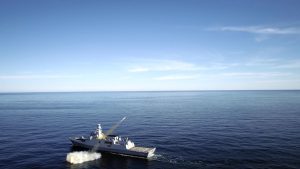
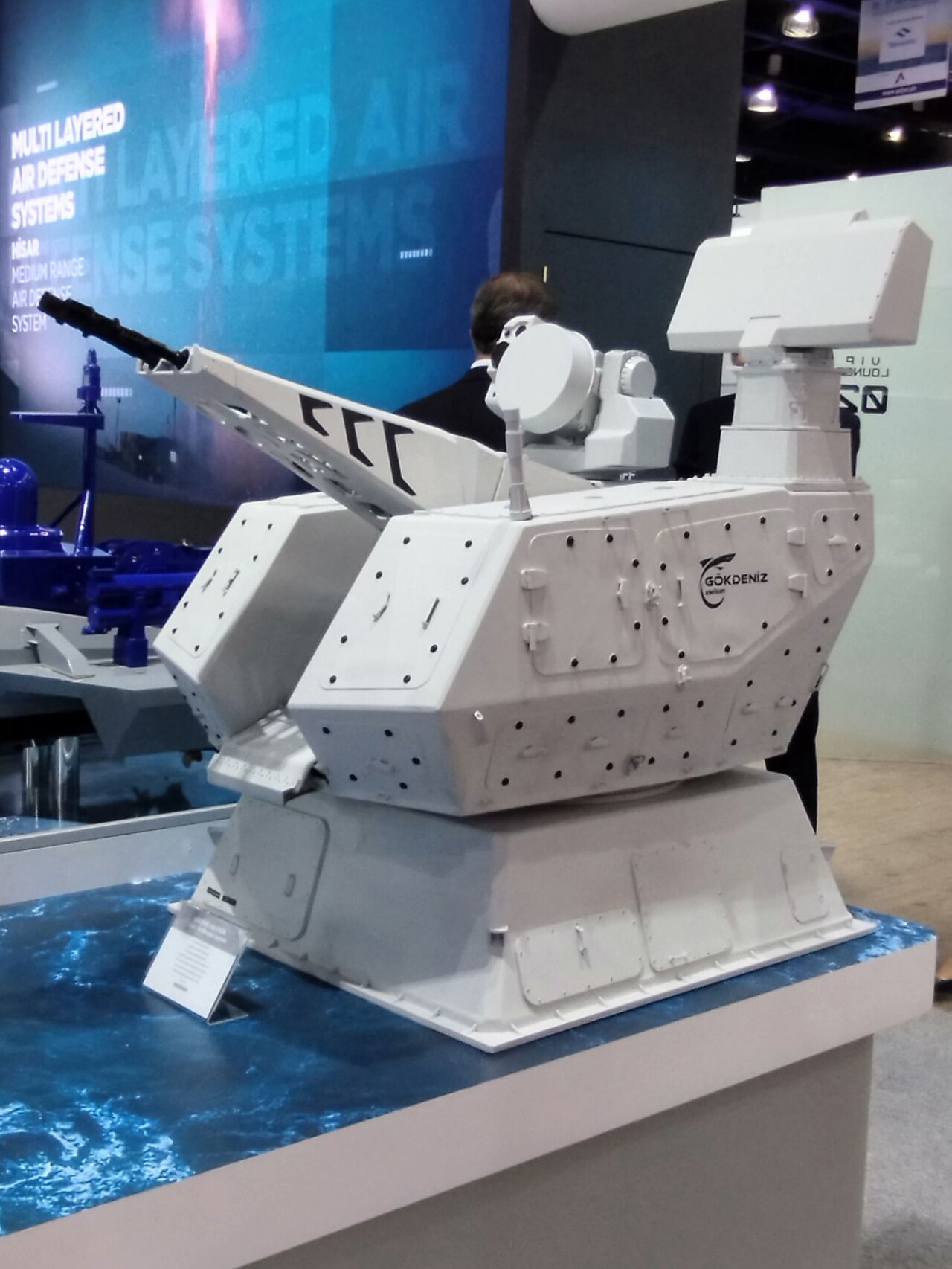
GÖKDENİZ is the ship-borne relative of KORKUT. It is a twin 35 mm close-in weapon system that fires the same ATOM round, with the same 2 x 550 rounds per minute and an effective range of about 4 km, according to ASELSAN data as summarised in public references. Its job is to shoot down anti-ship missiles, drones and small boats that get through a ship’s outer defences.
Public listings name the Turkish Navy’s Istanbul-class frigates among its users, along with several foreign navies. The shared ammunition and fire-control lineage matters commercially: a customer that adopts KORKUT on land and GÖKDENİZ at sea can stock one round for both.
Who has bought KORKUT so far?
The Turkish Land Forces are the confirmed user. Reports also name Pakistan as a user, without published contract details. Export figures for the wheeled and 25 mm variants are not public.
Broader context on who buys Turkish air defence sits in our look at Turkish air defence exports. For KORKUT, the next thing to watch is whether the Tatra version or the 8×8 demonstrations turn into signed contracts.