Can Three New Turbofans Free Türkiye’s Combat Aircraft From Foreign Engines?

Türkiye builds its own drones, radars, missiles and warships. Its combat aircraft still breathe foreign air. The KIZILELMA unmanned fighter flies on an imported Ukrainian turbofan, and the KAAN fighter flies on an American one. Three Turkish turbofans, the TF6000, the TF10000 and the TF35000, are meant to end that arrangement, and they are at very different stages of getting there.
Together they form a ladder. The first two are relatively modest engines that teach Turkish engineers how to design, build and test a modern jet core. The third is the one that has to power a stealth fighter. Whether the ladder holds depends on how quickly the lower rungs turn into flying hardware.
Why does Türkiye need its own turbofan family?
Engines are the hardest part of an aircraft to localise. Airframes, avionics and weapons can be developed in parallel and swapped out. A military turbofan takes decades of materials research, test infrastructure and accumulated failure data, and the few countries that master it rarely share the knowledge.
That leaves Turkish programmes exposed. The Bayraktar KIZILELMA is reported to use the Ivchenko-Progress AI-322F, while the TUSAŞ ANKA-3 flying wing is reported to use the AI-25TLT. Both are Ukrainian designs, and the war there has put their supply chain under strain. The pressure is not academic, since Indonesia has agreed to buy KIZILELMA aircraft, reportedly with options reaching 60 units, and an export customer expects a dependable engine supply. The KAAN prototypes, meanwhile, fly on General Electric F110 engines, which means US export approval sits behind every engine delivery.
Türkiye has not been starting from zero. TEI, based in Eskişehir, spent decades manufacturing parts and assemblies for Western engines. More recently it moved into its own designs, starting with the PD170 piston engine and the TS1400 turboshaft that powers the T625 GÖKBEY helicopter. A turbofan is the next and much harder step. For a wider view of who does what in the sector, see our guide to Türkiye’s aircraft engine makers.
What is the TF6000?
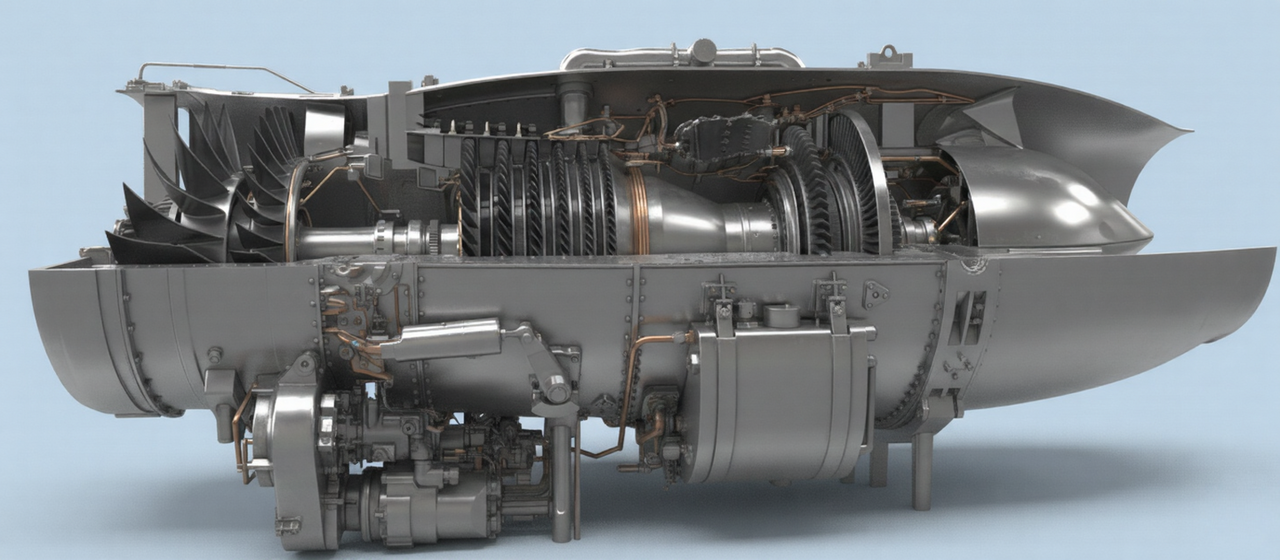
The TF6000 is a low-bypass turbofan in the 6,000 lbf (about 26.7 kN) class without afterburner. TEI describes the family’s architecture as a two-stage fan, a six-stage axial compressor and a single-stage high-pressure and low-pressure turbine, with a bypass ratio of about 1.08 and variable stator vanes.
Its timeline is the most concrete of the three. The Presidency of Defence Industries (SSB) and TEI announced the first ignition in March 2024. The engine was shown at TEKNOFEST later that year, and in September 2025 it ran in public on a mobile test stand at TEKNOFEST in Istanbul. Defence press reports put the thrust reached in testing at roughly 5,900 lbf.
The next step is integration. TEI chief Mahmut F. Akşit has said the company plans to hand TF6000 prototypes to Baykar and TUSAŞ in early 2027, so that each firm can run pre-integration tests and confirm airworthiness before the engine goes into an airframe. The platforms named for it are the ANKA-3 and the KIZILELMA.
That is a hand-over for ground tests, not a first flight. Public reports do not show any Turkish-designed turbofan flying on an aircraft yet.
TEI has also been quoted as saying the TF6000 core could be adapted into turboshaft, marine gas-turbine and power-generation engines. That matters commercially: a single core that serves drones, ships and generators is easier to justify financially than one built only for a pair of aircraft.
Why is the TF10000 the important one for KIZILELMA?
The TF10000 is built on the TF6000 core and adds an afterburner. TEI gives it 6,000 lbf dry and 10,000 lbf with afterburner, in a package measuring 860 by 1,150 by 3,150 mm. It was first shown as a mock-up at Türkiye Innovation Week in December 2022, and TEI pitched it at KIZILELMA-class unmanned combat aircraft as well as other military and civil uses.
An afterburner is what turns a capable subsonic engine into a supersonic one, and it is the piece of know-how Türkiye has never built on its own. TEI has called the TF10000 effort a way to gain the experience needed for an advanced combat-aircraft engine. The TF10000 is partly a product and partly a rehearsal for the TF35000.
The schedule for this step is further out. TEI’s management has targeted the first ignition test with the afterburner section for late 2027, according to published accounts. If that holds, it would be the first time a Turkish-designed military turbofan runs with reheat.
How far along is the TF35000 for KAAN?
The TF35000 is a different class of engine. It is a 35,000 lbf (roughly 155.7 kN) design intended for the KAAN fighter, larger than the F110 that currently powers it. TEI has said it is meant to be a new fifth-generation design, not a scaled-up TF10000.
The programme has an unusual ownership structure. SSB signed a development agreement with TRMotor in November 2018. TRMotor had been set up in 2017 by SSTEK, a company owned by SSB, and TEI and TRMotor formalised their partnership in early 2021. The intellectual and industrial property rights sit with SSB.
In August 2026 that structure changed. According to Janes and Turkish press, TRMotor was renamed TEI Teknoloji, operating as TEITECH, and the TF35000 and TS3000 turboshaft programmes moved under it. TEI keeps manufacturing, deliveries and mature programmes such as the TS1400 and PD170. The stated aim was to speed development and use engineering staff more efficiently, and the engineers working on the projects at TEI were to continue within TEITECH.
On the engineering side, TEI said in February 2026 that the engine had passed its preliminary design review and entered the critical design review (CDR). That is the stage where the design is frozen and manufacturing of the first prototype is authorised. The engine was still a paper design at that point.
Is the KAAN engine schedule slipping?
The dates do not line up neatly. TEI leadership said in mid-2025 that prototype production was planned for the end of 2025, tests for 2026 and KAAN integration around 2032. Since then the CDR has been reached rather than completed, and reports in late August 2026 quoted TUSAŞ General Manager Mehmet Demiroğlu as saying testing of the Turkish engine would not start until about 2032. We covered that statement in our report on the KAAN engine delay.
The practical consequence is that the first production KAAN jets, the Block 10 batch expected in the 2028 to 2030 window, will use the F110-GE-129. Reports say the US State Department cleared a proposal for roughly 80 further F110 engines in June 2026. Later blocks are expected to move to the Turkish engine, but only after it has been tested, which is why the engine question now shapes how much of KAAN can be called independent.
The three engines side by side
| Engine | Thrust class | Named platforms | Status reported |
|---|---|---|---|
| TF6000 | 6,000 lbf dry | ANKA-3, KIZILELMA | First ignition March 2024, public test September 2025, prototype hand-over to Baykar and TUSAŞ planned for early 2027 |
| TF10000 | 6,000 lbf dry, 10,000 lbf with afterburner | KIZILELMA-class aircraft | Shown as a mock-up in December 2022, first afterburner ignition targeted for late 2027 |
| TF35000 | About 35,000 lbf class | KAAN | Entered critical design review in February 2026, testing reported at around 2032 |
What decides whether the plan works?
Three things stand out.
First, the TF6000 has to fly. Bench running proves a design, but an airframe proves the whole system: inlet, fuel, controls, cooling and reliability over hundreds of hours. The 2027 pre-integration tests are the first real check on that.
Second, the afterburner has to work. The TF10000’s reheat section is where Turkish engineers will learn the thermal and control problems that the TF35000 cannot avoid. A slip here passes straight through to KAAN.
Third, the TF35000 needs its own hardware. Between a completed CDR and a flight-qualified engine lie prototype manufacture, component testing, core and full-engine runs, altitude testing and certification. Every one of those stages takes time, and a testing start around 2032 leaves little room before a service date. That is our reading of the reported dates, not an official schedule.
For now, the honest picture is split. On the drone side, a Turkish engine may be in prototype aircraft within a few years. On the fighter side, American power will carry KAAN for a long time yet. The three engines matter because each one removes a different foreign dependency, and none of them has yet done so in service.