Turkey’s Ateş Serbest-2026 Puts a Laser Weapon Through Its First Live Drone Kill

Turkey’s armed forces fired 104 weapons and systems from the national inventory at the General Nahit Şenoğlu Firing and Training Area in Polatlı, outside Ankara, on October 13, in a live-fire exercise that doubled as the most concentrated public showcase of the domestic defence industry this year. Fifty-three of the systems or activities on display, according to Anadolu Agency’s coverage of the event, were performed for the first time.
The exercise, called Ateş Serbest-2026 (“Free Fire”), is an annual combined-arms demonstration run by the Turkish General Staff. This year’s Distinguished Observer Day drew Defence Minister Yaşar Güler, Chief of General Staff Orgeneral Selçuk Bayraktaroğlu, the commanders of the Land and Air Forces, and two notable foreign guests: Azerbaijan’s Chief of General Staff, Orgeneral Kerim Veliyev, and Qatar’s land forces commander, Tümgeneral Jassim Bin Ali Al Attiyah. Their presence underlines how closely Turkey’s two largest defence-export relationships are tied to its own force-modernisation calendar.
A laser weapon joins the firing line
The single most significant technical milestone came from state-owned manufacturer Makina ve Kimya Endüstrisi (MKE). Its TOLGA short-range air defence system, firing an integrated 20-kilowatt fibre laser module for the first time in a public exercise, destroyed a drone target at a reported range of 760 metres. MKE’s own materials describe TOLGA’s laser as capable of three distinct effects against small drones — dazzling sensors, permanently blinding them, or physically destroying the airframe — layered on top of the system’s existing radar, electro-optics and gun armament. Turkish outlets differ on the exact engagement ranges for each mode, so those figures should be treated as approximate pending a fuller MKE technical release. TOLGA itself is not new — it has gone through kinetic and jamming trials over the past year — but this was its first demonstrated hard-kill with the laser module live and loaded.
Counter-drone work was a theme of the day rather than a single system. Alongside TOLGA, the ASELSAN-developed GÖKBERK laser-warning and dazzle system, the EJDERHA high-power electromagnetic system and the ALKA directed-energy jammer-and-laser combination all worked threat scenarios built around swarms of small, low-cost drones — the same category of target that has driven much of the recent growth in Turkey’s counter-UAS export business. These systems sit under the lower tiers of Çelik Kubbe, Turkey’s layered national air defence architecture, which also showed some of its higher-tier components on the day.
Drones doing the shooting, not just getting shot down
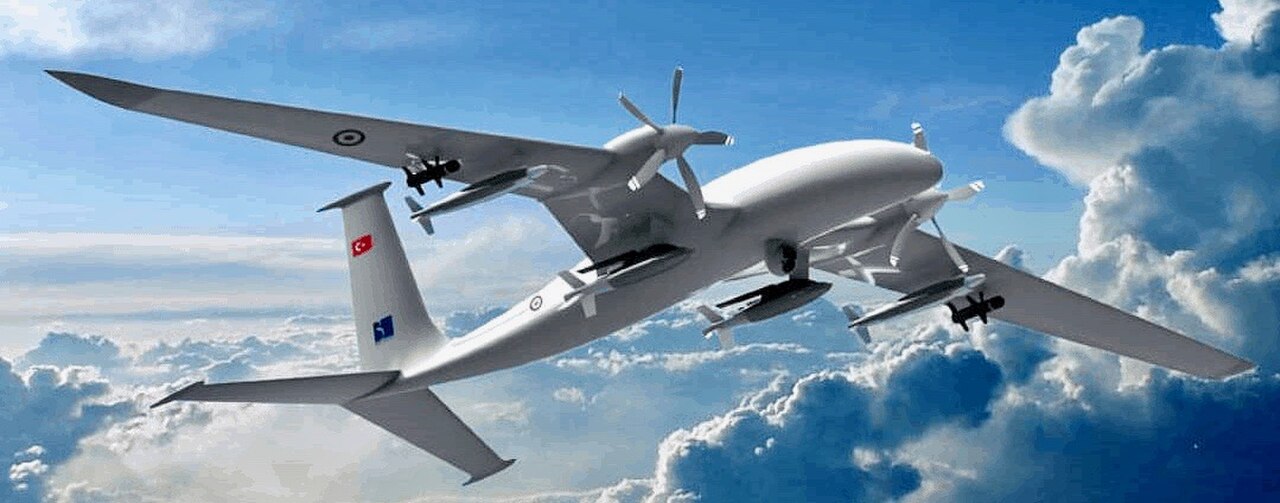
Baykar’s Bayraktar TB2 released KEMANKEŞ precision munitions against designated targets, while the larger AKINCI unmanned combat aircraft dropped Roketsan’s TEBER and ASELSAN’s TOLUN guided munitions from different release altitudes. Turkish Aerospace Industries (TUSAŞ) used the day to give its new AYAZ loitering munition its first public outing. AYAZ is a jet-powered, autonomy-capable kamikaze drone that TUSAŞ says has moved into serial production; the company disclosed the start of that production run in early October, and Ateş Serbest-2026 was the type’s first appearance in front of outside observers, including the visiting Azerbaijani and Qatari delegations.
Ground fires were carried by MKE’s FIRTINA 155mm and BORAN 105mm howitzers, while domestically produced KNT-76, BORA-12 and KN-12 sniper rifles engaged targets out to roughly a kilometre. The firing range itself is one of several dedicated proving grounds that Turkish industry uses to qualify new weapons before export customers ever see them. ATAK attack helicopters worked a counter-drone scenario in a simulated rear-area incursion, CH-47 Chinooks inserted motorcycle-mounted commando teams, and two F-16s flew close air support and reconnaissance profiles. Four AI-assisted Uçangöz systems — described by organisers as autonomous smoke-generation platforms — screened a simulated river-crossing operation, and chemical, biological, radiological and nuclear (CBRN) decontamination teams ran a parallel drill.
Why a firing range matters to export customers
Turkey’s defence exports have increasingly been sold on the argument that its hardware is combat-tested rather than merely paper-qualified, whether in Nagorno-Karabakh, Libya, Ukraine or Syria. A nationally televised exercise that puts dozens of systems through live engagements in front of the general staffs of two active or prospective customers serves a similar purpose without the complications of an actual conflict. Azerbaijan is already Turkey’s closest defence-industrial partner outside NATO, hosting an ASELSAN precision-munitions plant under construction in Nakhchivan; Qatar has bought Turkish armoured vehicles, naval craft and drones and hosts a Turkish military base. Both relationships give Ateş Serbest-2026 an audience with buying power, not just TSK personnel rotating through a training cycle.
For systems like TOLGA and AYAZ, a demonstrated first — a laser kill, a public unveiling — is also simply useful marketing ahead of the next exhibition season. Turkey has leaned on directed-energy and loitering-munition sales as a growth category as competition stiffens in the more mature armoured-vehicle and towed-artillery markets; a verified hard-kill laser engagement, even an early one with specifications still being finalised, gives Turkish industry a claim that few other exporters outside the United States and Israel can currently make in public.
What is still unconfirmed
None of the Turkish outlets covering the Distinguished Observer Day published an official Ministry of National Defence or Presidency of Defence Industries (SSB) statement with quotable figures beyond the headline counts of 104 systems and 53 firsts, and reporting on specific technical details — laser engagement ranges in particular — is inconsistent from one outlet to another. TOLGA’s full integration status, whether the laser module is now standard across production units or remains an upgrade path, has not been specified. Readers should treat the event as a demonstration of capability and industrial breadth rather than as confirmation of new contracts, export orders or operational fielding dates.
Sources: Anadolu Agency; Turkish Ministry of National Defence event coverage; Yeni Şafak; Sondakika.com.