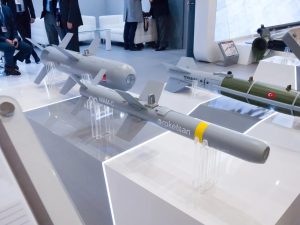
SOM Cruise Missile Shed Its French Engine and Gained a Stealthier Sibling

SOM is the weapon that let the Turkish Air Force hit targets hundreds of kilometres away without flying into range of the defences guarding them. It is an air-launched cruise missile developed by TÜBİTAK SAGE and built by Roketsan, and it is usually described as Türkiye’s first indigenous missile of its kind. The name stands for Stand-Off Missile, and the programme has run for two decades, from a 2006 development contract to a live-warhead test of the newest variant in March 2026.
The story has three threads. One is a family of missiles, SOM-A, SOM-B1 and SOM-B2, that entered service. Another is a foreign engine that turned into an export problem. The third is SOM-J, a smaller and stealthier sibling first drawn up for the F-35 and now being matched to Türkiye’s own aircraft.
| Field | Detail |
|---|---|
| Type | Air-launched cruise missile (stand-off land-attack and anti-ship) |
| Developer | TÜBİTAK SAGE |
| Serial producer | Roketsan |
| Contracting authority | Presidency of Defence Industries (SSB) |
| Variants | SOM-A, SOM-B1, SOM-B2, SOM-J |
| Range (SOM-A/B family) | Over 250 km |
| Range (SOM-J) | About 275 km (150 nautical miles), as reported |
| Warhead (SOM-B1) | About 230 kg high-explosive fragmentation; SOM-B2 uses a tandem penetrator |
| Warhead (SOM-J) | About 140 kg penetrating blast-fragmentation |
| Speed | High subsonic, about Mach 0.94 cruise for the SOM-B family |
| Guidance | INS/GPS, terrain-referenced navigation, imaging infrared seeker, two-way datalink |
| Engine | Microturbo TR-40 (France) in earlier missiles; Kale KTJ-3200 in newer production |
| Known export customer | Azerbaijan (SOM-B1) |
What Is the SOM Cruise Missile and Why Did Türkiye Want One?
The requirement came from the Turkish Air Force. It wanted a precision weapon for fixed and mobile targets of high value that could be launched from outside the reach of surface-to-air missiles. A bomb dropped from overhead forces the pilot to get close. A cruise missile launched from 250 km away does not.
Development began in 2006 under TÜBİTAK SAGE, the defence research institute of the state science agency. Reporting on the programme puts the original development contract at about $80 million and dates it to March 2006. The missile was shown publicly for the first time at Çiğli Air Base in İzmir on 4 June 2011, during the Air Force’s centenary events.
Roketsan became the production partner. A production contract was signed in early 2013, with manufacturing starting in July that year. The first batch of SOM-A missiles was delivered in the second half of 2015, and the project moved to the SSB in December 2016. Roketsan’s own profile is covered in our ROKETSAN company profile.
How Do the SOM-A, SOM-B1 and SOM-B2 Differ?
The basic airframe is a low-flying, subsonic missile with pop-out wings, built for terrain-hugging and sea-skimming profiles. The variants differ mostly in guidance and warhead.
- SOM-A relies on inertial navigation and GPS, with terrain-referenced navigation to refine its path. It was the first version delivered.
- SOM-B1 adds an imaging infrared seeker. Near the target it compares what it sees with pre-loaded imagery, so it no longer depends on GPS alone for the final moments. The SSB announced the first seven SOM-B1 missiles delivered on 4 January 2018.
- SOM-B2 keeps the B1 guidance but swaps the warhead for a two-stage tandem penetrator aimed at hardened structures. A September 2019 test was reported to show it defeating concrete bunker targets.
A new serial production contract followed on 26 October 2018. It covered more than just buying missiles. It also funded localisation, meaning that components previously imported were to be designed or built in Türkiye with SAGE’s help. Industry reporting puts the supply chain at more than 50 domestic and foreign suppliers.
The missile was cleared for F-4E and F-16 aircraft. Published figures for the B-family vary slightly between sources: a mass of roughly 600 to 620 kg, a length between 3.7 and 4 metres, a 230 kg warhead and a range beyond 250 km. Treat those as approximate rather than as official datasheet values.
Why Did the French Engine Matter?
Early SOM missiles were powered by the Microturbo TR-40 turbojet, a French engine from Safran. That was workable for Turkish use. It became a problem for exports.
Azerbaijan signed a formal contract for SOM-B1 missiles on 20 February 2021, at a Türkiye-Azerbaijan business forum. The obstacle was a French export licence for the engine. A request made in 2017 was reported not to have been approved by France’s procurement agency. The contract was finally signed after roughly five years of talks.
The fix was to build the engine at home. Kale Group developed the KTJ-3200, a turbojet of about 50 kg with a maximum thrust of around 3.2 kN. Its first test took place in 2018, the first batch reached Roketsan on 21 November 2020, and mass-production engines were delivered in early 2022. The same engine powers the ATMACA anti-ship missile, which we examine in where ATMACA fits in the global anti-ship missile market. Kale describes the KTJ-3200 as free of American-controlled content, which keeps ITAR licensing out of the picture. A broader look at the firms behind these engines is in who builds Türkiye’s aircraft engines.
In April 2025, news reports said Azerbaijan had received SOM missiles fitted with the Turkish engine and had conducted a launch test. Those reports came from media rather than from an official statement, so they should be read with that caveat. One defence outlet also reported acceptance testing of a KTJ-3200-powered SOM-B1 for the Turkish Air Force in July 2026; we could not confirm this against an official source.
What Is SOM-J and How Is It Different?
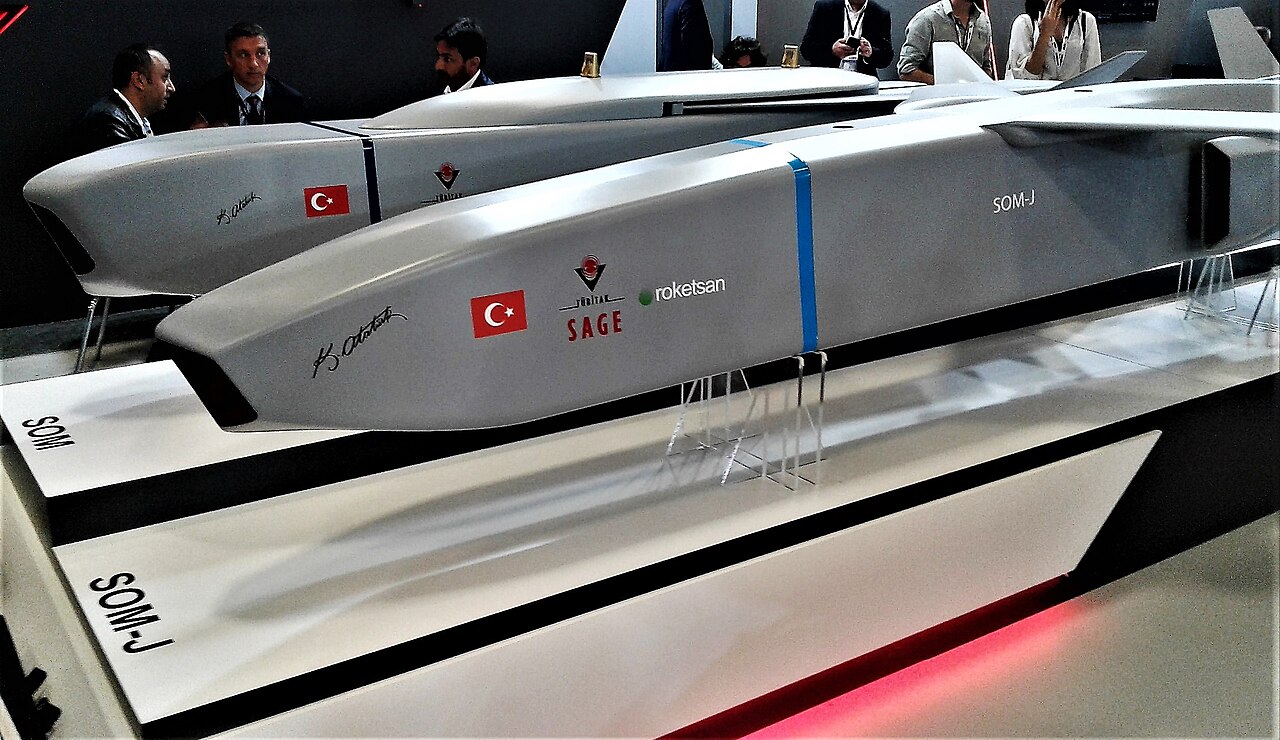
SOM-J is the compact version. It weighs about 540 kg, runs roughly 3.9 metres long, and carries a penetrating blast-fragmentation warhead of around 140 kg. Its wings and fins fold so that it fits inside an internal weapons bay, and its shaping is meant to reduce radar signature. Range is reported at about 275 km.
The origin is the F-35. Roketsan and Lockheed Martin signed a teaming agreement on 24 October 2014 to adapt the missile for the jet’s internal bays. Türkiye was removed from the F-35 programme in 2019 after buying the Russian S-400, and the export route to that aircraft closed. The design did not die with it. SOM-J was kept alive for Turkish platforms instead.
Compared with the B-family, SOM-J is tuned more heavily toward ships. Reporting on the missile says it adds anti-surface-warfare abilities the older versions lack, including an ability to be retargeted or called off after launch through its datalink.
What Did the SOM-J Tests Show?
The first publicly confirmed firing came on 21 March 2025. The Minister of Industry and Technology, Mehmet Fatih Kacır, released video of an F-16 from the 401st Test Squadron at Eskişehir launching the missile at a floating target at sea. The missile was not carrying a live warhead, which Janes inferred from the lack of an explosion at impact. TÜBİTAK SAGE said the test earned full marks for datalink control, maximum range, accuracy and engagement capability.
A year later, on 21 March 2026, Kacır announced a live-warhead test against a representative ship target, again from an F-16. The firing also included radar cross-section measurements to verify the low-observable claims. On 26 March 2026, The Defense Post reported that serial production had started, although no quantities were given.
Which Aircraft Will Carry SOM-J?
The F-16 is the platform that has actually fired it. The longer-term plan points to Turkish-designed aircraft. Industry reporting lists the KAAN fighter, Baykar’s KIZILELMA unmanned jet and the ANKA-III unmanned combat aircraft as intended carriers. After the March 2025 test, SSB chief Haluk Görgün also pointed to compatibility with KAAN and KIZILELMA.
KAAN is the obvious fit because its internal bays were designed around stealth. A missile that hides its own signature on the way in makes the most sense when carried inside a low-observable airframe. Where KAAN stands today, including its engine timeline, is set out in our KAAN fighter programme guide, and the unmanned jet is profiled in Bayraktar KIZILELMA. Integration on any of them has been stated as a plan, not as a completed certification.
How Does SOM Sit Beside Türkiye’s Other Cruise Missiles?
SOM is the air-launched member of a growing set. ATMACA is the ship-launched anti-ship missile. KARA ATMACA is its land-attack cousin, described in KARA ATMACA, ROKETSAN’s land-attack cruise missile. Çakır is a smaller cruise missile that Roketsan has test-fired from a ground launcher. The KTJ-3200 turbojet is reported to power both SOM and ATMACA, which is the practical payoff of the engine effort.
SOM’s niche is range and launch height. Released from a jet at altitude, it gains reach a ground launcher cannot match, and it can be aimed at targets across a sea or a border.
What Remains Unclear?
Production numbers for any SOM variant are not public. Some aggregated figures circulate online, but they are not backed by an official source we could check, so we have left them out. The same goes for the exact dimensions and weights of each variant, which differ by source. Whether the tandem-warhead SOM-B2 is in regular service, and how many SOM-J rounds will be bought, are also not officially stated.
What is established is the direction. A programme that once depended on a French engine now has a Turkish turbojet, a live-fired successor and a path onto Türkiye’s own combat aircraft.