ASELSAN’s KORKUT 25 Downs a Shahed-Style Drone While Firing on the Move

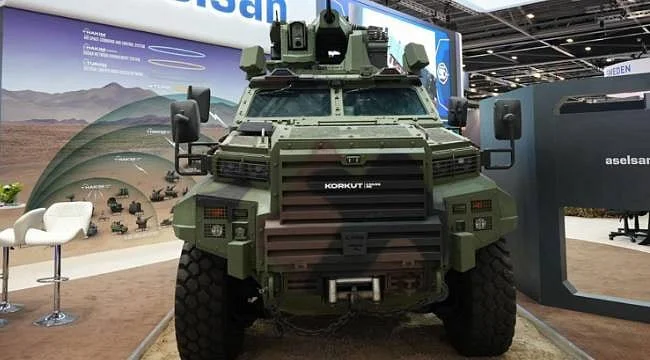
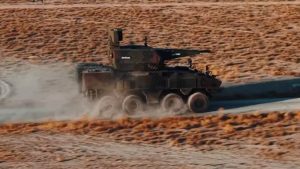
ASELSAN says its KORKUT 25 counter-drone gun system destroyed both a rotary-wing drone and a fixed-wing target built to mimic the Shahed-136 loitering munition during live-fire trials announced on October 12, with the system’s 4×4 vehicle firing while on the move rather than from a stationary position. The trial is the latest in a run of public tests ASELSAN has released this month for its growing family of gun-based counter-drone systems.
According to the company’s account, reported by Times of Defence and ShiftDelete.Net Global, KORKUT 25 is mounted on a high-mobility 4×4 tactical wheeled vehicle and built around a 25 mm automatic cannon firing ASELSAN’s ATOM programmable airburst ammunition, which is set to detonate near the target rather than requiring a direct hit. Target detection and tracking come from an AESA radar plus electro-optical and infrared sensors, with AI-assisted software handling threat classification and the fire-control solution. ASELSAN did not disclose where the trial took place, the number of rounds fired, or the engagement range.
Built for the Shahed problem, not just generic drones
The choice of target matters. Shahed-136-type one-way attack drones — slow, cheap, delta-winged, and usually launched in numbers rather than one at a time — have become the defining low-end air threat of the past three years, used extensively by Russia against Ukraine and, in derivative forms, by Houthi forces in the Red Sea and Gulf of Aden. Western militaries have struggled with the economics of countering them: a single Patriot interceptor can cost well over a million dollars against a drone worth a small fraction of that. A 25 mm airburst round is a different proposition entirely, and that cost gap is the commercial argument ASELSAN and other Turkish manufacturers have been making at defence shows for the past two years.
Firing on the move is the other half of the pitch. A counter-drone gun that only works from a stationary position cannot protect a moving convoy or a mobile command post, which is precisely the kind of target one-way attack drones are used against. ASELSAN’s statement frames KORKUT 25’s ability to compute firing solutions while its own vehicle is in motion as a direct answer to that mobility gap.
Where KORKUT 25 fits in ASELSAN’s lineup
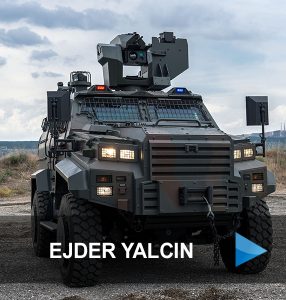
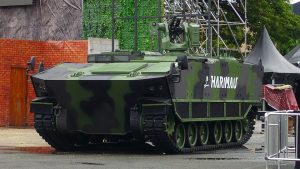
KORKUT 25 is the newest and smallest member of the KORKUT family, which began with a 35 mm twin-barrel gun on a tracked chassis built to replace Türkiye’s ageing M42 Duster air defence guns. ASELSAN has since split the line into a wheeled 35 mm variant, a naval 35 mm version called GÖKDENİZ, and the 25 mm KORKUT 25/100-25, which is light enough to mount on 4×4, 6×6 or 8×8 vehicles and is aimed specifically at Class 1 and Class 2 drones rather than aircraft or cruise missiles. The system made its international debut at DSEI in London in September 2025, mounted on a Nurol Makina Ejder Yalçın 4×4, and ASELSAN has since shown the 35 mm version engaging drones for a 12-nation audience and the wider family alongside other gun-based systems such as GÜRZ.
The October 12 trial is the first KORKUT 25-specific test ASELSAN has publicised against a Shahed-profile target rather than a generic small drone, and it comes as the company runs a steady drumbeat of counter-drone demonstrations — including a separate test of its GÖKALP hit-to-kill interceptor drone earlier the same week — that line up with Türkiye’s wider Çelik Kubbe (“Steel Dome”) layered air defence programme.
Still a demonstration, not a sale
ASELSAN has not named a customer, confirmed a production contract specific to KORKUT 25, or disclosed unit pricing. The claims in this report come from ASELSAN’s own statement and video release, relayed by Turkish and international trade press; Defense Türkiye found no independent test data on the system’s performance, hit probability or engagement envelope. What the trial does establish is that ASELSAN is actively marketing a lower tier of its counter-drone portfolio specifically against the Shahed-type threat profile that has shaped Western air defence procurement debates since 2022 — a positioning likely aimed as much at export customers evaluating options next to Western systems as at the Turkish armed forces.