
Turkish Defence Order Book: How Long Is the Delivery Queue?

Türkiye’s defence primes have sold far more work than they can currently build. ASELSAN alone closed September 2026 with an order backlog of $30.7 billion against 2025 defence revenue of about $4.5 billion — roughly seven years of output already committed. ROKETSAN’s order book is reported at around $10 billion on revenue of just over $2 billion. For a government evaluating a Turkish system in 2026, that arithmetic matters more than any brochure figure: you are not buying from spare capacity, you are joining a queue, and where you sit in it is now the central commercial question.
This page sets out what Turkish defence companies have actually disclosed about their order books, what those numbers do and do not include, and how far ahead they stretch. For the measured intervals between signature and first delivery on individual export contracts, see our companion study of Turkish defence delivery times.
DEFENCETÜRKIYE DATA BOX
Largest disclosed backlog: ASELSAN, $30.7bn (30 September 2026)
ASELSAN book-to-bill, 9M 2026: 4.4 (2.5 a year earlier)
Second-largest reported: ROKETSAN, about $10bn (not audited)
TEI total order volume: $8.2bn (SSB, January 2026)
Sector turnover: above $20bn (2024-25 basis)
New contracts signed sector-wide: $17.8bn in 2025; $15bn in 2026 to 18 October
Outstanding domestic orders: above $13.4bn (SSB, October 2026)
Companies publishing an audited backlog: ASELSAN and other Borsa İstanbul listings only
What “backlog” means in a Turkish defence disclosure
Backlog, or order book, is the value of signed contracts a company has not yet delivered and therefore not yet booked as revenue. It is a demand measure, not an output measure. A company with a large backlog has persuaded customers to commit; whether it can build what it sold is a separate question, which we examine in our assessment of how much Türkiye’s defence industry can actually build.
Three features of the Turkish disclosure environment shape what an outside analyst can see.
First, only listed companies report a backlog on a regular, audited cycle. ASELSAN files quarterly with the Public Disclosure Platform (KAP) and publishes an English earnings release with the headline figure. Otokar, also Borsa İstanbul-listed, discloses individual contracts. The large unlisted players — Baykar, TUSAŞ, HAVELSAN, STM, the shipyards — do not publish a comparable number.
Second, Turkish contract announcements often omit the customer, the delivery schedule, or both. We have set out the reasons behind that practice separately in our explainer on why Turkish defence contracts say “customer undisclosed”. The practical effect is that a backlog figure can rise by billions without the public learning which country placed the order or when the hardware is due.
Third, memoranda and framework agreements are not backlog. The Indonesian commitment to 48 KAAN fighters, signed as a government-to-government agreement on 11 June 2025 and followed by a commercial contract on 26 July 2025, carries no officially disclosed value — the roughly $10 billion figure in circulation comes from reporting, not from either government. It does not appear in any published order book, because TUSAŞ does not publish one.
The order books, company by company
The table below collects every order-book figure Turkish primes or the Secretariat of Defence Industries (SSB) have put into the public record, set against the most recent independently compiled revenue figure for the same company — the 2026 Defense News Top 100, which is built from audited disclosures. The right-hand column is our own calculation and should be read as an order of magnitude, not a delivery schedule.
| Company | Disclosed order book | As of | 2025 defence revenue | Years of revenue committed | Quality of figure |
|---|---|---|---|---|---|
| ASELSAN | $30.74bn | 30 Sep 2026 | $4.46bn | ~6.9 | Audited, KAP-filed |
| ROKETSAN | ~$10bn | 2026 (reported) | $2.37bn | ~4.2 | Executive statement, unaudited |
| TEI (TUSAŞ Engine Industries) | $8.2bn total order volume | Jan 2026 | Not separately listed | Not calculable | Stated by SSB president |
| TUSAŞ | Not published | — | $3.65bn | — | No company-wide figure exists |
| Baykar | Not published | — | $2.5bn revenue (self-stated) | — | Private, no audited accounts |
| Otokar | No aggregate; $1.47bn single export contract | 1 Oct 2026 | Not in Top 100 | — | KAP-filed per contract |
| Supplier base (sector-wide) | >$13.4bn outstanding domestic orders | 18 Oct 2026 | — | — | SSB president, aggregate |
Revenue column: Defense News Top 100 (2026 edition, 2025 defence revenue). Years-of-revenue column: DefenceTürkiye calculation, backlog divided by 2025 defence revenue. It assumes flat revenue and so overstates the queue for companies growing as fast as these are.
Add the three published figures together and Turkish industry has disclosed roughly $49 billion of committed, undelivered work — against combined 2025 defence revenue of $14.9 billion for the five Turkish firms in the Defense News Top 100, a ranking we analysed when it appeared in our piece on the five Turkish firms inside the global top 100. Baykar, TUSAŞ, HAVELSAN, STM, FNSS, Nurol Makina and every shipyard are missing from that $49 billion, because none of them publishes a backlog. The real figure is larger, and nobody outside Ankara knows by how much.
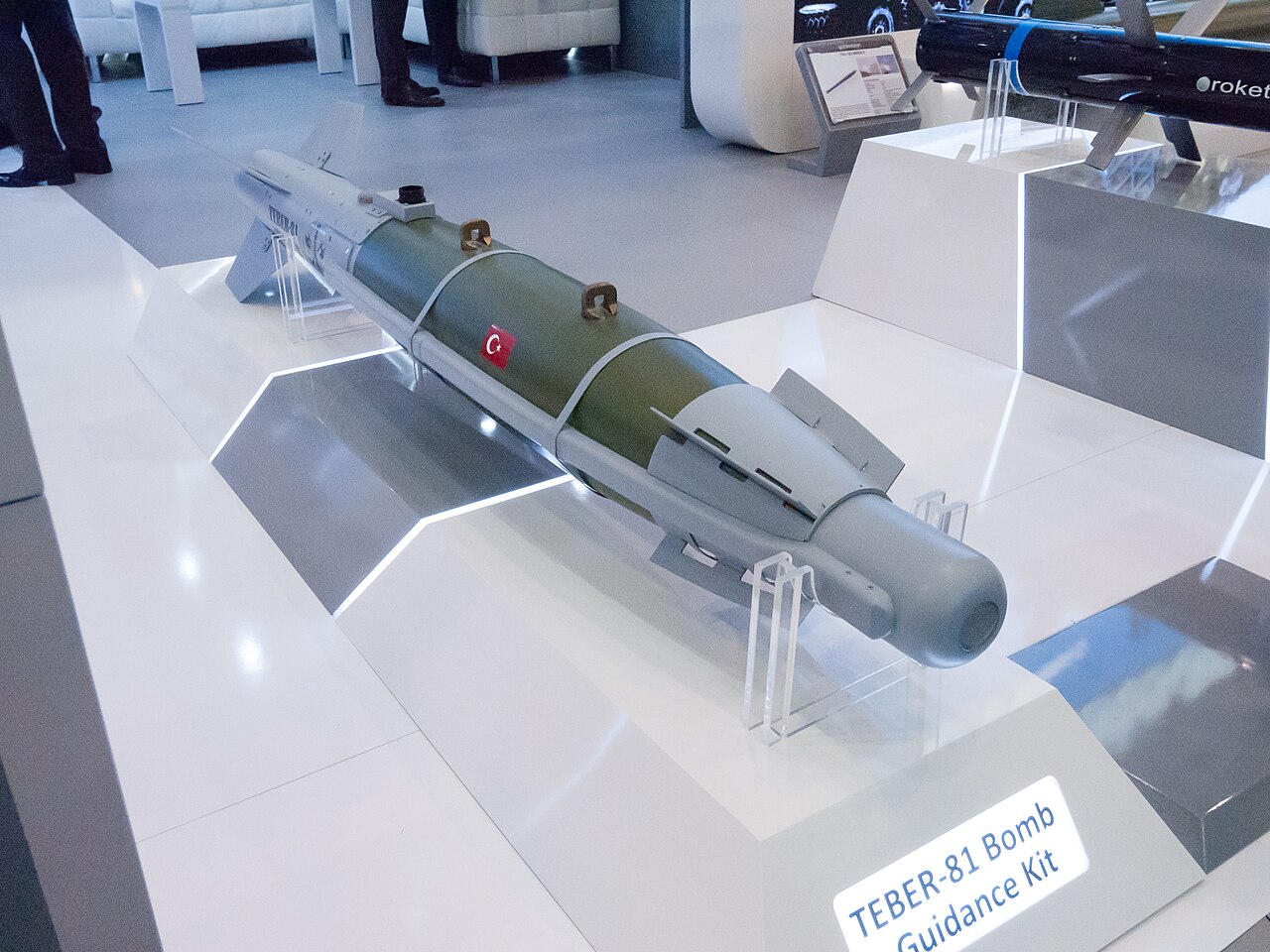
Signing is outrunning shipping
ASELSAN is the only Turkish prime whose order book can be tracked quarter by quarter, and its trajectory is the clearest evidence available of what is happening across the sector.
The two figures that matter in that series are not the backlog at all. They are the ratio between what the company signs and what it ships.
In 2025, ASELSAN signed $2.1 billion of new export contracts — and physically completed $958 million of direct and indirect international deliveries. It sold rather more than twice what it shipped. In the first nine months of 2026 it signed another $1.9 billion of export contracts, up 34 percent. Across all business, the company’s book-to-bill ratio ran at 2.2 for 2025 and reached 4.4 for the first nine months of 2026, against 2.5 in the same period a year earlier. For every dollar of revenue recognised, the company took on $4.40 of new obligations. Our news desk covered the quarter itself when the figures landed on 27 October, in ASELSAN’s order backlog topping $30 billion for the first time.
Chief executive Ahmet Akyol did not frame the result as unqualified good news. In the company’s own earnings release he described the book-to-bill ratio as evidence of “a substantial order pipeline extending well into the future”, then added: “Our primary responsibility moving forward is to convert this portfolio into timely deliveries, expanded production capacity, and sustained technological superiority.” That is a chief executive naming delivery risk in a results statement.
WHY IT MATTERS
Türkiye spent a decade persuading foreign governments that it could supply them. That argument is now won: the sector signed $17.8 billion of new contracts in 2025 and $15 billion more by October 2026. The binding constraint has moved from demand to delivery.
For a buyer, this reverses the usual negotiating position. Turkish exporters have historically competed on availability — kit in months, not years, while Western production slots were full. A backlog of seven years’ revenue at the largest prime means that advantage is narrowing, and the schedule in the contract is now worth as much scrutiny as the price.
Where the backlog meets the delivery date
Backlog depth is an abstraction; the interval between signature and first hardware is not. We examined that interval across every Turkish export contract with two public dates in a separate study of Turkish defence delivery times, which found a range from about five months at the fast end to two or three years at the slow end, with most large contracts landing between seven and seventeen months. That page is the dataset; this one is the constraint behind it.
Three recent contracts show how differently the order book bears on different kinds of work.
- Mature hardware moves on schedule. Otokar’s $1.47 billion wheeled armoured vehicle contract, disclosed to Borsa İstanbul on 1 October 2026, begins delivering in 2027 and completes in batches over three years, with the contract in force for seven. Roughly a year to first delivery, from a line already running. The conditions attached are set out in our report on the Otokar export contract.
- Support work converts fastest. TEI’s $2.95 billion order for spares and maintenance across 22 engine programmes, announced in January 2026, began delivering the same year. This is why sustainment is the quietest growth engine in several Turkish order books — and why it inflates a backlog figure without implying a long hardware queue.
- Developmental platforms are the real wait. The Turkish Air Force’s 20-aircraft KAAN contract, signed on 6 May 2026, delivers between 2028 and 2030 — and the Turkish Air Force is first in line.
The KAAN arithmetic is the sharpest illustration of what a backlog does to a schedule. TUSAŞ holds contracts for 68 aircraft — 20 Turkish and 48 Indonesian. A TUSAŞ deputy general manager told Anadolu Agency in May 2026 that the existing assembly line can produce six to nine aircraft a year, with a newly designed plant intended to add capacity for 24 more annually. At the current line rate alone, 68 airframes is eight to eleven years of production. The programme status is tracked in our KAAN fighter programme page.
A buyer ordering spares, ammunition or an in-production vehicle is looking at months to a year. A buyer ordering an aircraft still in qualification is looking at the back half of the decade, behind Türkiye’s own armed forces.
How Türkiye is trying to close the gap
The response has three visible strands, and the money behind them is disclosed.
Capital spending. ASELSAN raised investment in capacity and high-technology infrastructure by 228 percent in the first nine months of 2026, to $684 million, having already doubled serial-production investment to $372 million in 2025. The Oğulbey Technology Base outside Ankara — described by the company as the largest single-phase defence industry investment in the republic’s history, on a 1.5 million square metre site due to open fully in 2028 — had its first phase commissioned this year. Akyol’s framing was explicit: “we do not wait for orders to outpace our capacity.”
The supplier base. SSB president Haluk Görgün said in October 2026 that ASELSAN, ROKETSAN, TUSAŞ, HAVELSAN and STM had placed more than $20 billion of orders with over 16,000 domestic companies in three years, and that above $13.4 billion of those domestic orders remained outstanding. ASELSAN increased orders to domestic suppliers by 82 percent in 2025 alone. Whether the subcontractor layer can scale is, on these numbers, the real bottleneck — a point we developed when Görgün put 2026 contracting at $15 billion.
Offshore production. Several recent export packages move assembly to the customer: Turkish lines in Indonesia for KAAN work, plants in Azerbaijan and Egypt, and co-production arrangements across the Gulf. These relieve the domestic queue and serve industrial-participation demands at the same time.
BUYER VIEW
Open-source editorial analysis, not procurement advice. Questions a backlog of this depth should prompt in a tender evaluation:
Slot, not date. Ask where in the production sequence your order sits, not only when delivery is promised. Turkish domestic programmes and earlier export customers already occupy the near slots.
Mature versus developmental. An in-production vehicle, radar or munition behaves differently from a platform still in qualification. The backlog is not evenly distributed across the two.
Subcontractor exposure. With more than $13.4 billion outstanding below the primes, schedule risk sits in a supplier layer no buyer can audit.
Local production as schedule insurance. Offshore assembly has become Türkiye’s standard answer to a full domestic line; it is negotiable and increasingly offered.
Support alongside hardware. Spares and maintenance move faster than platforms, and sustainment terms are where a long delivery interval is survived. See our guide to who supports Turkish weapons after the sale.
What these numbers cannot tell you
Several limits apply, and they are substantial.
Only ASELSAN’s backlog is audited and filed, and Envanter Medya’s Turkish-language summary of ASELSAN’s 2025 annual report shows how much detail a listed company puts on the record compared with its unlisted peers. The ROKETSAN figure of roughly $10 billion rests on public statements by general manager Murat İkinci and secondary reporting of them, not on a published annual report. TEI’s $8.2 billion was stated by the SSB president rather than by the company, in Anadolu Agency’s report of the $2.95 billion engine order. Baykar publishes revenue and export totals but no backlog and no audited accounts.
Contract values themselves are often contested. Spain’s HÜRJET order — 30 aircraft contracted in Madrid in April 2026, with a further 15 under discussion — has been reported at figures ranging from €1.56 billion to €2.6 billion, and its delivery end-date variously between 2035 and 2036, none of it settled by an official disclosure from either government. We set out the competitive context in where HÜRJET fits in the advanced jet trainer market. A backlog built from numbers like these inherits their uncertainty.
Backlog is also a dollar value, not a delivery schedule. It mixes multi-decade support work with near-term hardware, and a company can carry a large order book without any single customer facing a long wait. Our years-of-revenue column assumes flat revenue, which is plainly wrong for companies growing at these rates — ASELSAN’s dollar revenue growth in the third quarter of 2026 alone accelerated to 42 percent, from 29 percent a year earlier. Treat the ratio as a scale indicator.
Finally, no official aggregate exists for the Turkish defence sector’s total order book. The closest public figures are flows rather than stocks: $17.8 billion of new contracts in 2025, $15 billion by October 2026 against a $20 billion full-year target, and defence and aerospace exports of $10.05 billion in 2025 by Görgün’s January accounting — $9.87 billion in goods and $184 million in services, although a figure of $10.56 billion also circulates in sector reporting from the same period. Exports reached $6.92 billion in the first nine months of 2026, up 15.6 percent.
What comes next
Three things are worth watching into 2027. ASELSAN’s fourth-quarter results, due early in the year, will show whether the $9 billion-plus of third-quarter contract signing was a one-off concentration or a new run rate; a second quarter like it would push the backlog past $35 billion. The Oğulbey site’s phased commissioning through 2028 is the test of whether capital spending converts into throughput on the timescale the order book requires. And the first Otokar deliveries in 2027, against a contract signed in October 2026, will be an early read on whether Turkish industry can still hold a one-year interval from signature to hardware at this level of load.
If those three go well, the backlog is a strength — committed revenue, visible for years, funding the capacity that delivers it. If they slip, the number becomes what every defence industry eventually discovers a large order book can be: a schedule problem with a balance-sheet disguise.
FAQ
What is Türkiye’s total defence order backlog?
No official sector-wide figure is published. Adding the three disclosed company figures — ASELSAN’s $30.74 billion, ROKETSAN’s reported $10 billion and TEI’s $8.2 billion — gives about $49 billion, but that excludes Baykar, TUSAŞ, HAVELSAN, STM and every shipyard, none of which publishes a backlog.
How large is ASELSAN’s order backlog?
$30.744 billion as of 30 September 2026, disclosed to KAP on 27 October 2026. It rose $7.5 billion in that quarter alone, from $23.191 billion at the end of June, and stood at $20.4 billion at the close of 2025.
What does a book-to-bill ratio of 4.4 mean?
It means that for every dollar of revenue ASELSAN recognised in the first nine months of 2026, it signed $4.40 of new contracts. A ratio above one indicates a growing order book; 4.4 is an extreme reading, and it implies the backlog will keep lengthening unless deliveries accelerate sharply.
How long would a new customer wait for a Turkish system?
It depends entirely on maturity. On contracts where both dates are public, most large Turkish export deals have reached first delivery in seven to seventeen months, with in-production vehicles and spares at the fast end — Otokar’s October 2026 contract begins delivering in 2027. Developmental platforms run far longer: the Turkish Air Force’s own KAAN order, signed in May 2026, delivers from 2028. The full interval dataset is in our study of Turkish defence delivery times.
Do Turkish defence companies publish delivery schedules?
Rarely, and often not even the customer’s name. Listed companies disclose contract values to Borsa İstanbul with limited schedule detail; unlisted ones disclose at their own discretion. Buyers with signed contracts see schedules, outside analysts generally do not.
Is a large backlog good or bad for an export customer?
Both. It signals that other governments have committed, that the product line will be supported for years, and that the manufacturer is financially stable. It also means available production slots are further out than they were, and that the schedule clause deserves the same scrutiny as the price.
Which Turkish defence company has the fastest-growing order book?
On disclosed figures, ASELSAN: its backlog rose 46 percent in 2025 and a further 72 percent in the first nine months of 2026. ROKETSAN’s general manager has said the company aims to grow revenue, exports and order backlog by a further 50 percent in 2026, though that target is not independently verifiable.
Sources
- ASELSAN, Q3 2026 earnings release (backlog, new contracts, book-to-bill, investment, CEO remarks)
- ASELSAN, 2025 annual earnings release (FY2025 backlog, export contracts, international deliveries)
- ASELSAN, H1 2026 earnings release (June 2026 backlog)
- Daily Sabah, Türkiye signs $15B in new defense contracts in 2026 so far, 18 October 2026 (Görgün on contracts, exports and outstanding domestic orders)
- Defence Turkey, General Assessment of the Turkish Defense and Aerospace Industry in 2025 (sector turnover, 2025 contract volume, delivery schedules)
- Anadolu Agency, TEI receives $2.95 billion engine order, January 2026 (TEI total order volume)
- Envanter Medya, Turkish defence exports 2025-2026, destinations and the $10 billion year (export destination breakdown)
- Envanter Medya, ASELSAN 2025 annual report summary (Turkish-language breakdown of revenue, profit and export figures)
- Defense News Top 100, 2026 edition (2025 defence revenues), summarised in our own analysis of the ranking
- ROKETSAN order-book and revenue figures as reported from general manager Murat İkinci’s public statements; see also our ROKETSAN company profile


