Who Builds Türkiye’s Military Satellites? TÜBİTAK, TUSAŞ, ASELSAN

Four organisations build almost every Turkish military satellite. TÜBİTAK UZAY designs and builds the spacecraft themselves, including the İMECE reconnaissance satellite now in Air Force service. Turkish Aerospace (TUSAŞ) owns the only facility in the country where a full-size satellite can be assembled and environmentally tested, and since 2026 leads the HÜRSAT family. ASELSAN supplies the payloads — optical and radar sensors, communications units, encryption. Roketsan is building the launch vehicle Türkiye still does not have. Above them sit the procurement authority (SSB) and the military operator (the Air Force); below them, a fast-growing private layer led by Fergani Space and CTech.
That division of labour is the single most useful thing to understand about Turkish space, because it explains both what Ankara can now do on its own and what it still buys, borrows or waits for. Türkiye assembles, integrates and tests satellites at home, and writes most of their software and electronics. It does not yet launch them, and the sharpest camera it operates in orbit was built in Italy.
DEFENCETÜRKIYE DATA BOX
| Prime builders | TÜBİTAK UZAY (spacecraft), TUSAŞ (integration, test, HÜRSAT), ASELSAN (payloads), Roketsan (launch vehicle) |
| Procurement authority | Presidency of Defence Industries (SSB); Ministry of National Defence as operator-owner |
| Category | Electro-optical and SAR reconnaissance, military satellite communications, PNT (in development) |
| Programme status | İMECE in service; Göktürk-1 and -2 in service; Göktürk-3 (SAR) in development; HÜRSAT-1 and İMECE-2/-3 in build |
| First indigenous build | Göktürk-2, launched 18 December 2012; İMECE, launched 15 April 2023 |
| Known customers | Turkish Ministry of National Defence and Air Force; Türksat A.Ş. for the communications fleet |
| Export status | No Turkish-built satellite has been exported. Ground segment and satcom modems are exported |
| Current milestone | TUSAŞ–Roketsan HÜRSAT-2 contract signed 5 October 2026 at IAC 2026 in Antalya |
TÜBİTAK UZAY: the organisation that actually builds the spacecraft
If a Turkish reconnaissance satellite is described as “indigenous”, TÜBİTAK UZAY almost certainly built it. The institute — part of Türkiye’s national research council, and the same parent organisation that houses the missile house TÜBİTAK SAGE — is a state research institute rather than a company, which is why it rarely appears in defence-industry revenue tables despite being central to the programme.
Its flagship is İMECE, which the institute says began as a project in 2013 and launched on 15 April 2023 from Vandenberg Space Force Base aboard a SpaceX Falcon 9. TÜBİTAK UZAY describes it as Türkiye’s first sub-metre-resolution Earth observation satellite and puts its localisation rate above 90 per cent. After roughly a year of acceptance testing, İMECE was formally taken into the Air Force Command inventory on 22 May 2025 at the Ahlatlıbel Reconnaissance Satellite Command — and renamed GÖKTÜRK-2B under Air Force satellite naming standards. Foreign analysts tracking “İMECE” and “Göktürk-2B” as separate spacecraft are tracking the same satellite.
The institute is now building the follow-on. İMECE-2 and İMECE-3 are being developed under the High-Resolution Satellite Constellation Development Project (TUGEP), on the TstarL platform, and are intended to fly alongside the existing satellite so that the same ground area can be revisited more often. TÜBİTAK UZAY states that the platform, electro-optical camera, flight computer, star tracker, reaction wheel and power management subsystems carry over from İMECE — the clearest evidence that Türkiye is trying to turn a one-off spacecraft into a reusable product line. The two satellites were announced publicly by NATO Deputy Secretary General Radmila Šekerinska at the NATO Summit Defence Industry Forum on 7 July 2026, during the summit Türkiye hosted in Ankara. NATO announced them; it does not fund, own or operate them.
TUSAŞ: the building, and now the product line
Turkish Aerospace’s contribution is less visible than a satellite bus but harder to replace. Its Space Systems Assembly, Integration and Test Centre on the Akıncı campus in Ankara is where Turkish satellites are physically put together and shaken, baked and vacuum-tested before flight. Turkish Aerospace’s own figures give a 3,800 m² ISO-8 cleanroom plus a mobile ISO-6 cleanroom for optics and sensors, inside roughly 10,000 m² of covered space, with capacity for more than one satellite at a time up to a combined five tonnes. The test suite runs to thermal vacuum, vibration on three axes, acoustic, EMC and compact antenna range measurement, to ECSS standards.
The centre exists because of a foreign programme. It was built for Göktürk-1 and inaugurated in May 2015, and Göktürk-1’s advanced integration and environmental testing was its first job. Türkiye bought a satellite from Europe and came away with the building — which is the sort of industrial outcome procurement officials elsewhere spend a long time trying to negotiate.
Since October 2026 TUSAŞ also leads a satellite family of its own. HÜRSAT is a modular design built around a common bus reconfigurable across roughly 200 to 650 kg, with electro-optical and synthetic-aperture radar variants planned. TUSAŞ started the programme with its own resources rather than waiting for a state requirement, and has been explicit that the point is repeatable production at lower unit cost — in other words, a satellite that can be sold more than once. HÜRSAT-1, an optical observation spacecraft of about 200 kg aiming at better than one-metre imagery, is targeted for mid-2027.
ASELSAN: payloads, and the part that goes inside everyone else’s satellite
ASELSAN’s space work sits inside other people’s spacecraft, which is why it is routinely underestimated. The company presented itself at IAC 2026 in Antalya under the slogan “From Chip to Constellation”, and its three publicly described space lines map neatly onto Türkiye’s three satellite needs.
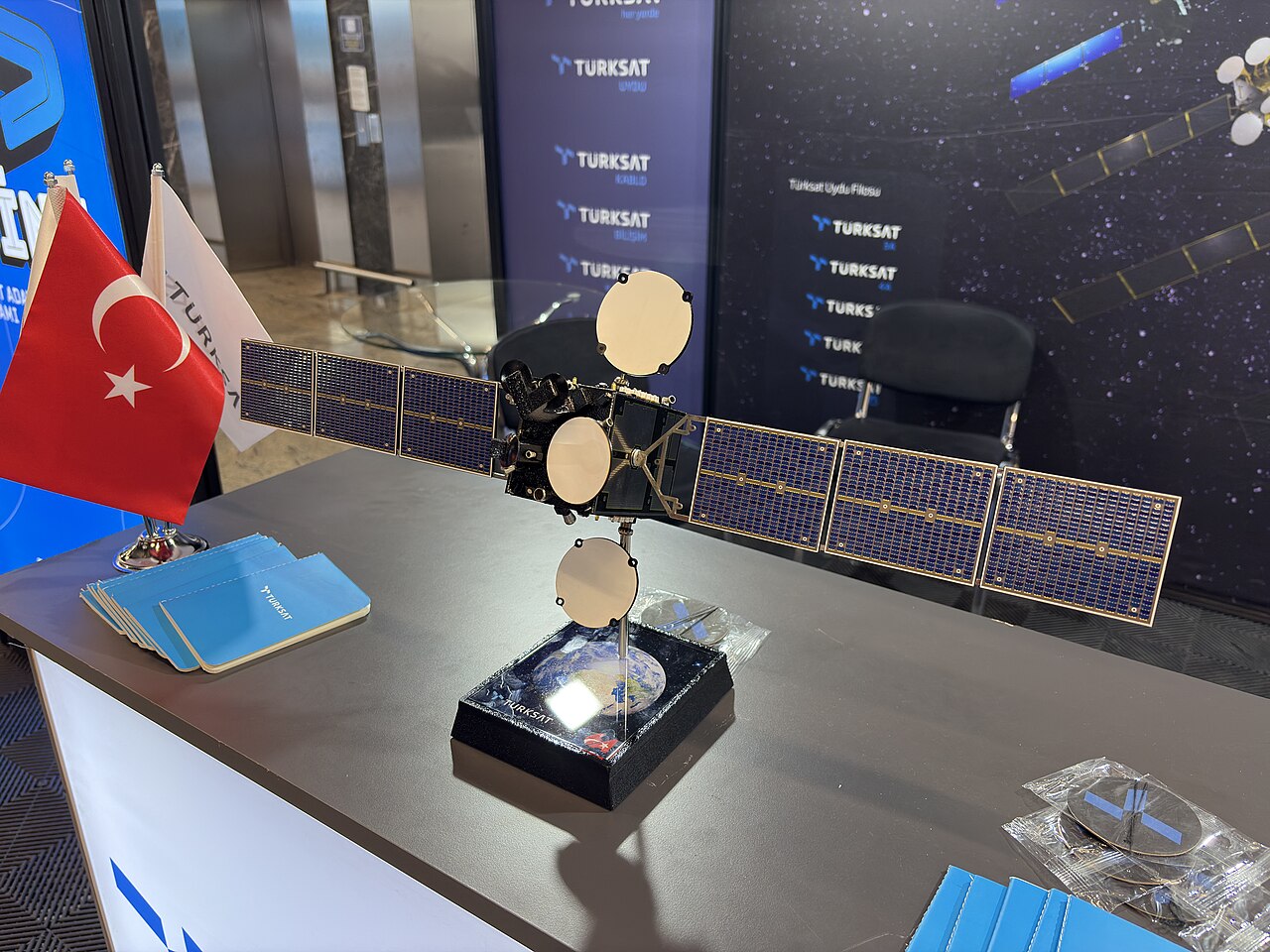
On Göktürk-3, the planned SAR reconnaissance satellite, ASELSAN is responsible for the SAR imaging radar itself, the secure communications equipment that moves large image volumes to the ground, and the spacecraft’s main security unit. That is the payload and the crypto — the two elements a buyer of a foreign satellite is least likely to be allowed to own. On TÜRKSAT 6A, Türkiye’s first domestically built geostationary communications satellite, ASELSAN supplied the Ku-band communications subsystem, and the company says that work is the engineering basis for the next-generation TÜRKSAT 7A. On ASTRALINK, ASELSAN is developing a low-Earth-orbit communications satellite under Türkiye’s LEO Satellites and Military 5G/6G Communications System Project, and has stated a target of building up to four satellites a month.
Treat that last number as an ambition rather than an output rate. ASELSAN has not demonstrated it, and Türkiye as a whole has launched fewer than one military satellite a year across its entire history. But the direction is the point: a company that builds radars for a living is being asked to industrialise satellite manufacture, in much the same way ASELSAN came to dominate Türkiye’s ground and naval radar production.
Roketsan: the missing half of the system
Every Turkish satellite ever flown has flown on someone else’s rocket — a Chinese Long March 2D, a European Vega, an American Falcon 9. Roketsan is the organisation trying to end that.
The HÜRSAT-2 contract TUSAŞ and Roketsan signed on 5 October 2026, with SSB observing, is the first Turkish contract that ties a domestic satellite to a domestic launcher. Roketsan CEO Murat İkinci described it as the first contract for a satellite-launch business intended to serve Turkish and foreign spacecraft alike. The vehicle is ŞİMŞEK-1, an all-liquid-propellant rocket sized to place a 400 kg satellite at roughly 550 km, with a first test flight targeted for 2027; a larger ŞİMŞEK-2 is intended to put up to 1,500 kg into sun-synchronous orbit above 700 km. Roketsan’s demonstrated record so far is sounding rockets that reached 126 km in 2017 and 136 km in 2020 — a long way from orbital velocity, and the company does not pretend otherwise.
HÜRSAT-2 is scheduled to fly on ŞİMŞEK-1 in 2028–2029. Both dates are targets that depend on a rocket that has not flown.
Who builds what: the division of labour
| Organisation | Type | What it actually supplies | Programmes |
|---|---|---|---|
| TÜBİTAK UZAY | State research institute | Complete spacecraft; platform, flight computer, star tracker, reaction wheels, power management | Göktürk-2, İMECE, İMECE-2/-3, TÜRKSAT 6A (lead) |
| TUSAŞ | State-linked prime | Assembly, integration and environmental test; structure, thermal, harness, chemical propulsion; satellite computer and software on HÜRSAT | AIT Centre, Göktürk-1/-2, TÜRKSAT 6A, HÜRSAT, Göktürk-3 |
| ASELSAN | Listed company, SSTEK-controlled | SAR radar payload, Ku-band comms subsystem, secure downlink, main security unit | Göktürk-3, TÜRKSAT 6A/7A, ASTRALINK |
| Roketsan | State-linked prime | Orbital launch vehicles (ŞİMŞEK-1/-2); launch services | HÜRSAT-2 launch, microsatellite launch system |
| CTech | Private SME | Telecommand, telemetry and ranging subsystems; anti-jam satcom modems and terminals | TÜRKSAT 6A; NATO-approved ground segment |
| Fergani Space | Private (Baykar-linked) | Small LEO satellites built and funded privately | Uluğ Bey PNT constellation test satellites |
| Türksat A.Ş. | State operator | Owns and operates the communications fleet and ground stations | TÜRKSAT 5A/5B/6A |
Compiled by DefenceTürkiye from TÜBİTAK UZAY, Turkish Aerospace, ASELSAN and Roketsan statements. Roles reflect publicly disclosed workshare only; undisclosed subcontracting is not captured.
The private layer nobody had five years ago
Fergani Space, part of the Baykar group’s technology arm, is the most consequential newcomer. It has been placing small satellites in orbit at a tempo the state programme cannot match: FGN-100-D3, a 113 kg spacecraft, launched on SpaceX’s Transporter-16 mission on 30 March 2026, and a 160 kg successor followed on Bandwagon-5 in October 2026, reaching an orbit of about 590 km. The company’s stated goal is Uluğ Bey, a Turkish positioning, navigation and timing constellation funded from its own resources. Its public target moved during 2026 from “100-plus satellites within five years” to “200-plus”, which is a measure of ambition rather than of progress. Note also that outlets render the satellite designations inconsistently (FGN- and FRG- both appear); the launches are real, the naming is not standardised. Fergani’s push into orbit is covered separately here.
CTech occupies the quieter and, commercially, the more proven position. It supplied TÜRKSAT 6A’s telecommand, telemetry and ranging subsystems, and its anti-jam satcom modems have reached NATO’s approved product list — making the ground segment, not the spacecraft, the first part of Türkiye’s space industry to actually sell abroad. That pattern is covered in CTech’s route from Turkish units to NATO approval and in where Turkish military satellite communications stands after Türksat 6A.
What is actually in orbit, and what is only on a slide
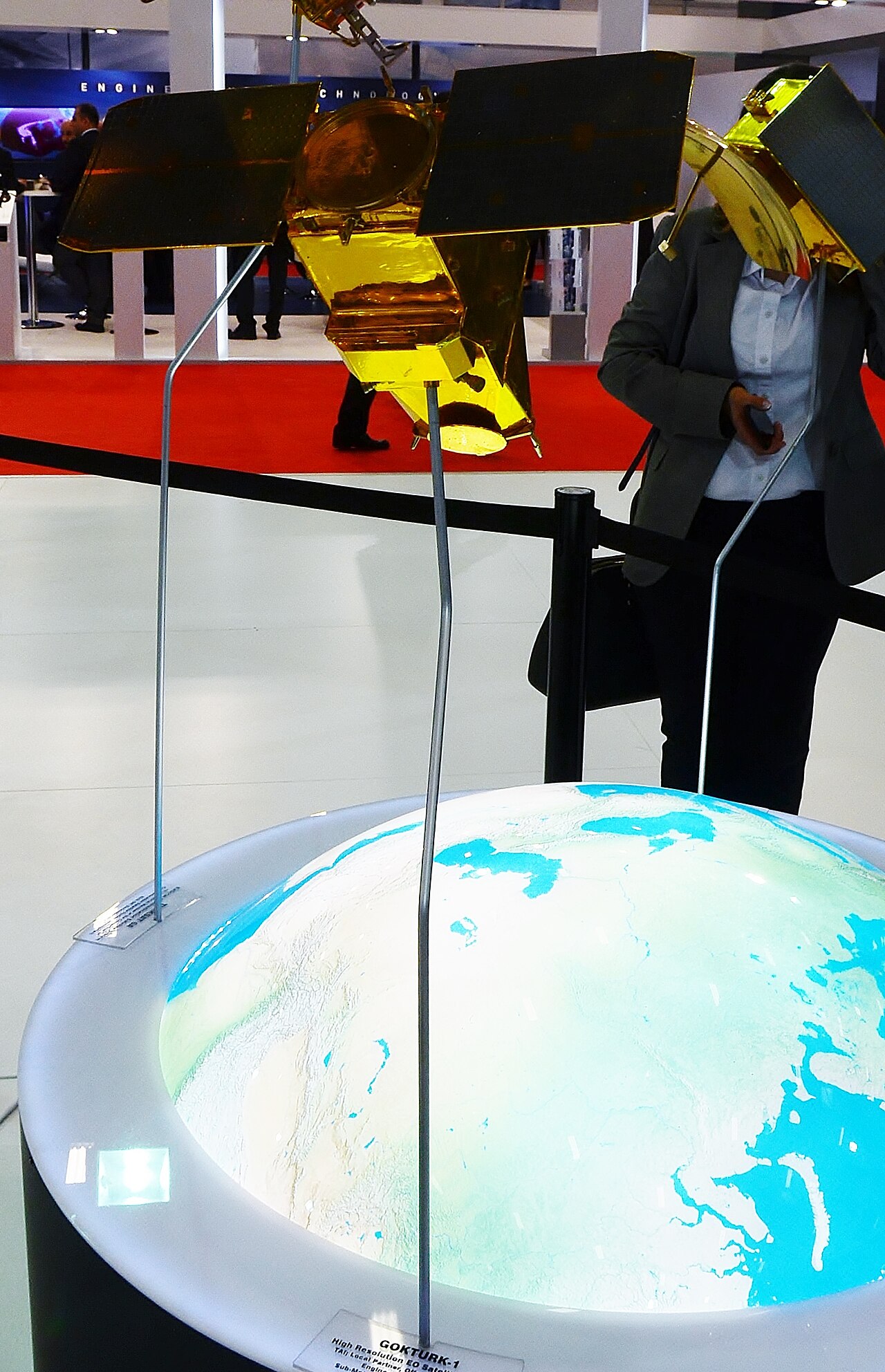
Türkiye operates two dedicated military reconnaissance satellites of its own design lineage and one bought from Europe. Göktürk-2, launched from Jiuquan on a Long March 2D on 18 December 2012, was built by TÜBİTAK UZAY with TUSAŞ and is the programme’s proof that Türkiye could build a satellite at all. Göktürk-1, launched on a Vega from Kourou on 5 December 2016, is the sharpest instrument Türkiye operates in orbit at 0.80 m resolution — and it was designed and developed by Italy’s Telespazio on a Thales Alenia Space bus under a contract signed in 2009 worth more than €250 million, with TUSAŞ and ASELSAN contributing technology. It is operated by the Turkish Ministry of National Defence. The GÖKTÜRK series and the gap before its replacements is covered here.
Göktürk-3, the SAR satellite that would give Türkiye night and all-weather imaging, is the programme to watch and the one to be most careful about. It is real — ASELSAN publicly detailed its workshare at IAC 2026 — but its launch date has moved repeatedly across public sources, from 2026 to 2028 to 2030, and no Turkish official body has published a firm date. Anyone citing a specific Göktürk-3 launch year today is citing a target, not a schedule.
WHY IT MATTERS
Türkiye has spent a decade acquiring the two things that are hardest to buy in space: the ability to assemble and qualify a satellite on its own soil, and the ability to build its own imaging and communications payloads. It has not yet acquired the third — independent access to orbit — and without it every Turkish satellite programme remains hostage to a foreign launch manifest. For a foreign government weighing Turkish space products, that is the whole assessment in one sentence: the hardware is increasingly Turkish, the ride is not, and the HÜRSAT–ŞİMŞEK pairing is the first serious attempt to change that.
What Türkiye still cannot do
A reference page that only lists capabilities is a brochure. Four limitations are worth stating plainly.
No sovereign launch. Not one Turkish satellite has reached orbit on a Turkish rocket. ŞİMŞEK-1 has not flown. Until it does, Türkiye’s space programme depends on American, European and — historically — Chinese launch providers, and on their political willingness to carry Turkish military payloads.
Low build cadence. Türkiye has averaged well under one military satellite a year. A constellation strategy — which is what TUGEP, HÜRSAT and ASTRALINK all describe — requires an order of magnitude more throughput than the country has ever demonstrated.
No operational navigation or early-warning satellites. Turkish forces rely on GPS, with the hardening done at the receiver rather than in orbit — the approach described in Türkiye’s broader national space programme. Uluğ Bey is a privately funded test campaign, not a fielded system.
The best camera is foreign. Ten years after Göktürk-1, no Turkish-built satellite has publicly surpassed its 0.80 m resolution. İMECE is described as sub-metre but no figure has been released, and HÜRSAT-1 targets “better than one metre”, which is a lower bar than it sounds.
BUYER VIEW
Can you buy a Turkish satellite today? No. No Turkish-built spacecraft has been exported, and neither İMECE nor the Göktürk series has ever been offered as a product. What is available for export now is the ground segment — CTech’s anti-jam modems and terminals, ASELSAN communications equipment — and that is already selling into NATO.
What changes that? HÜRSAT is the first Turkish satellite designed from the outset as a repeatable product with foreign customers in mind, and Roketsan has said its launch business is meant to serve foreign spacecraft too. A buyer should watch two events: ŞİMŞEK-1’s first test flight, targeted for 2027, and HÜRSAT-1 reaching orbit and returning imagery at its claimed resolution.
What a procurement officer should ask. Who holds the data rights and the encryption keys; whether the SAR payload can be supplied without ITAR-controlled components; what the launch arrangement is and who controls the manifest; and whether the AIT centre in Ankara can be used for a customer’s own spacecraft. None of these has a published answer yet. This is open-source editorial analysis, not procurement advice.
What comes next
The next three years decide whether Turkish space becomes an industry or stays a research programme. The announced sequence is HÜRSAT-1 in mid-2027, ŞİMŞEK-1’s first test flight in 2027, İMECE-2 and İMECE-3 following İMECE into a constellation, and HÜRSAT-2 flying on a Turkish rocket in 2028–2029. TÜRKSAT 7A follows 6A in the geostationary communications line. Göktürk-3 fills the SAR gap whenever it is ready.
Every one of those dates is a target published by the organisation that would benefit from meeting it. The useful benchmark is not the slide but the pattern: Türkiye built the test facility it needed in 2015, flew a domestic sub-metre satellite in 2023, put a domestic geostationary communications satellite in service in 2025, and signed its first domestic satellite-to-domestic-launcher contract in 2026. That is slower than the announcements and faster than most countries that have attempted the same thing. For a wider benchmark of where Türkiye sits among the states that build their own military spacecraft, Envanter Medya maintains a scored ranking of the world’s largest military satellite manufacturers, and it places Türkiye last of the eight builders it scores — a useful corrective to domestic coverage. Its report on the TUSAŞ–ROKETSAN HÜRSAT-2 contract carries the technical detail of the agreement itself.
Related reading on this site: the HÜRSAT-2 agreement, how TÜBİTAK’s institutes underpin Turkish defence research, and the sister reference pages on who builds Türkiye’s laser weapons.
FAQ
Who builds Türkiye’s military satellites?
TÜBİTAK UZAY builds the spacecraft themselves, TUSAŞ provides assembly, integration and environmental testing and leads the HÜRSAT family, ASELSAN supplies imaging and communications payloads and encryption units, and Roketsan is developing the launch vehicles. Türksat A.Ş. operates the communications fleet; the Ministry of National Defence and the Air Force operate the reconnaissance satellites.
Does Türkiye launch its own satellites?
Not yet. Every Turkish satellite to date has launched on a foreign rocket — a Chinese Long March 2D in 2012, a European Vega in 2016, and SpaceX Falcon 9 vehicles since. Roketsan’s ŞİMŞEK-1, sized for 400 kg to about 550 km, is targeted for a first test flight in 2027.
Is İMECE the same satellite as Göktürk-2B?
Yes. İMECE was taken into the Turkish Air Force Command inventory on 22 May 2025 and renamed GÖKTÜRK-2B under Air Force naming standards. It is one spacecraft with two names, which is a common source of double-counting in foreign order-of-battle lists.
Was Göktürk-1 built in Türkiye?
No. Göktürk-1 was designed and developed by Italy’s Telespazio on a Thales Alenia Space bus, under a contract signed in 2009 worth more than €250 million, with TUSAŞ and ASELSAN contributing technology. It launched on a Vega rocket in December 2016 and is operated by the Turkish Ministry of National Defence. The programme did, however, fund the Ankara assembly and test centre that Türkiye has used ever since.
Can another country buy a Turkish military satellite?
No Turkish-built satellite has been exported. Turkish companies do export space-related ground equipment, including CTech satcom modems that have reached NATO’s approved product list. HÜRSAT is the first Turkish satellite family explicitly designed for repeatable production and foreign sale, but it has not yet flown.
Does Türkiye have a radar imaging satellite?
Not in orbit. Göktürk-3 is the planned synthetic-aperture radar satellite, with ASELSAN supplying the SAR payload, secure downlink and main security unit. Public launch dates for it range from 2026 to 2030 across different sources and no Turkish official body has confirmed one, so it should be treated as in development with no firm schedule.
What is HÜRSAT?
HÜRSAT is a modular satellite family led by Turkish Aerospace, built around a common bus configurable from roughly 200 to 650 kg with electro-optical and SAR variants. TUSAŞ began it with company funds. HÜRSAT-1, about 200 kg and targeting better-than-one-metre imagery, is aimed at mid-2027; HÜRSAT-2 is contracted to fly on Roketsan’s ŞİMŞEK-1 in 2028–2029.
Sources
- TÜBİTAK UZAY — İMECE taken into Air Force Command inventory as GÖKTÜRK-2B
- TÜBİTAK UZAY — İMECE-2 and İMECE-3 under the TUGEP constellation project
- Turkish Aerospace — Space Systems Assembly, Integration and Test Center
- Göktürk-1 programme record (contract, bus supplier, launch, resolution)
- Anadolu Agency — TUSAŞ and ROKETSAN sign for the HÜRSAT family
- Anadolu Agency — Fergani Space’s fifth satellite reaches orbit
- Turkish Space Systems, Integration and Test Center — facility record
Workshare descriptions for Göktürk-3, TÜRKSAT 6A/7A and ASTRALINK reflect ASELSAN’s own presentation at the 77th International Astronautical Congress in Antalya, October 2026, as reported by Global Defense Insight. ŞİMŞEK-1 and HÜRSAT figures are as stated by Turkish Aerospace and ROKETSAN executives at the same event. All forward dates in this article are targets published by the organisations responsible for meeting them.