
STM Shows Portugal’s Turkish-Built Navy Ships at MSPO 2026


STM is using this week’s MSPO exhibition in Kielce to put a model of Portugal’s future navy on the show floor — a reminder that Türkiye’s first military shipbuilding export to an EU and NATO member state is now well into construction. The Turkish state-linked defence company is displaying the Auxiliary Oiler Replenisher and Logistics Support Ship (AOR+) it is building for the Portuguese Navy at MSPO 2026, which opened in Kielce, Poland, on 8 September and runs through 11 September. Both ships ordered under the programme are under construction at ADA Shipyard in Istanbul, with steel already cut on both hulls.
A contract that broke new ground for Turkish shipbuilding
STM signed the contract to design and build two AOR+ vessels for Portugal on 17 December 2024 in Lisbon, with STM acting as prime contractor. The deal marked the first time a Turkish company had sold a military vessel to a fellow EU and NATO member state — a different market than the Gulf, African and South and Southeast Asian customers that have historically bought Turkish warships and patrol vessels.
Construction is proceeding on a public schedule. The steel-cutting ceremony for the first ship was held on 14 November 2025 in Istanbul, and its keel was laid in January 2026. The second vessel followed the same sequence, with its own steel-cutting ceremony on 18 June 2026. STM has named the two ships after Portuguese historical figures with maritime associations: the lead vessel will be NRP Luís de Camões, after the country’s national poet, and the second will be NRP D. Dinis, after the medieval king credited with founding Portugal’s shipbuilding and maritime trade base. Both vessels are scheduled to be launched in 2027, with delivery to the Portuguese Navy planned for 2028.
What the ship actually is
The AOR+ is a 137-metre multirole logistics vessel with a reported displacement above 11,000 tonnes, designed to refuel and resupply other ships at sea while also carrying out amphibious support, humanitarian assistance and command functions. Reported particulars include a maximum speed above 18 knots, a cruising speed of 14 knots, a range in excess of 14,000 nautical miles at cruising speed, and an endurance of around 90 days at sea. Accommodation is sized for roughly 50 core crew plus space for around 100 additional personnel, and the design includes a stern ramp for loading light tactical vehicles, a helicopter landing deck, a hangar sized for unmanned aerial systems, and a self-defence sensor and weapon suite. It is, in short, a naval auxiliary built to operate independently and support other assets for extended periods — the kind of vessel European navies have struggled to recapitalise fast enough as logistics fleets built in the 1990s reach retirement age.
Why an oiler matters more than it sounds
Combat ships get the headlines, but a navy’s ability to sustain operations far from home depends on exactly this class of vessel. Portugal’s decision to buy from Türkiye rather than a Western European yard was, in that sense, as much a statement about price, delivery schedule and STM’s track record as it was about capability. It also gives Turkish shipbuilding a reference project inside the EU regulatory and NATO interoperability environment — a credential that matters when STM, or any other Turkish yard, next bids for a naval logistics or auxiliary contract in Europe.
STM has been here before with export customers outside Europe. The company already builds MİLGEM-derived corvettes for Pakistan under a technology-transfer arrangement, with two of four vessels delivered and the remaining pair under construction at Karachi Shipyard, and the wider İstif-class (I-Class) frigate design STM is showing this week at MSPO underpins the $1 billion agreement signed in January 2026 to supply Indonesia with two frigates through Qatar’s Barzan Holdings, as well as the US Navy’s own evaluation of the design for a future warship programme. The Portugal contract is smaller in tonnage terms than either of those programmes, but it opens a market Turkish yards had not cracked before.
STM’s wider MSPO 2026 stand
Alongside the AOR+ model, STM’s Kielce stand covers most of the company’s current naval and unmanned portfolio: a model of the İstif-class frigate, the STM MPAC fast attack craft, the STM500 shallow-water submarine design, the STM NETA 300 autonomous underwater vehicle, and STM YAKTU, a swarm-capable kamikaze unmanned surface vessel. The unmanned aerial side of the display includes the KARGU loitering munition — now exported to more than a dozen countries — plus the TOGAN mini-UAV, the TUNGA-X anti-drone interceptor, and the long-range KUZGUN one-way strike drone. MSPO is the first of three back-to-back exhibitions on STM’s September calendar, with Africa Aerospace and Defence in South Africa and ADEX in Azerbaijan to follow.
The bigger picture
MSPO 2026 has drawn more than 1,200 exhibitors from over 40 countries to Kielce this year, and Turkish firms have used it before to open doors in Poland — ASELSAN’s own $410 million electronic-warfare export contract with Poland’s State Treasury Armament Agency, signed in December 2025, is the clearest recent example, and one ASELSAN is building on with its own counter-drone and electronic-warfare display at this year’s show. STM’s presence adds a naval-industrial data point to that pattern: a Turkish shipbuilder with an active, on-schedule construction programme for a NATO and EU navy, at a moment when European fleets are under pressure to replace ageing support ships faster than their own yards can deliver. Whether that translates into a second European customer for STM remains to be seen, but the Lisbon contract has stopped being a one-off talking point and become a vessel with steel in the water — or close to it. It also sits inside a broader export run: Turkish defence and aerospace exports reached $511 million in August 2026 alone, part of a push that has helped five Turkish firms break into the global top 100 defence contractors list this year.
Sources: STM (contract and programme details); Naval News, 17 November 2025 and 18 June 2026 coverage of the steel-cutting ceremonies; C4Defence and Joint Forces News on STM’s MSPO 2026, AAD 2026 and ADEX 2026 exhibition calendar; Naval News and Army Recognition on the January 2026 Indonesia İstif-class agreement; theprint.in and Army Recognition on the Pakistan MİLGEM programme.
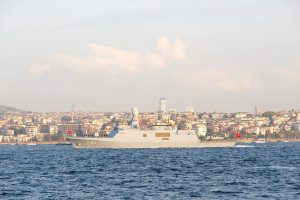



[…] The second rung is a new build in a Turkish yard, which is what Portugal bought. STM signed for two AOR+ auxiliaries in Lisbon in December 2024; steel was cut on the first in November 2025 and on the second in June 2026, with delivery planned for 2028. Roughly three and a half years from signature to delivery for an 11,000-tonne auxiliary is competitive, and it came with the political weight of being the first Turkish military shipbuilding contract with an EU and NATO member. […]