How Many People Work in Türkiye’s Defence Industry?

Türkiye’s defence and aerospace industry employed 90,969 people at the end of 2023, the most recent year covered by the sector association’s own performance report. Government statements put the figure near 100,000 by the end of 2025. The official target, written into Türkiye’s 12th Development Plan, is 158,000 by 2028 — a 74 per cent increase on the 2023 base. That target, rather than the headcount itself, is the number worth studying. It commits the industry to hiring faster than it ever has, and of the four constraints on Turkish defence output it is the one least likely to be solved by capital spending.
DEFENCETÜRKIYE DATA BOX
Sector: Turkish defence and aerospace industry
Employment, end-2023: 90,969 (SASAD, audited sector report)
Employment, end-2025: “nearly 100,000” (Vice President Cevdet Yılmaz, 14 January 2026) — a political statement, not an association figure
2028 target: 158,000 (12th Development Plan, Table 22)
Workforce mix, 2023: 45% technicians and operators · 39% engineers and project specialists · 16% administrative and support
Companies: more than 3,500 (SSB, January 2026), against 56 in 2002
Turnover per employee, 2023: $165,681
Status checked: 14 October 2026
Where the official numbers come from
Two sources matter, and they are not interchangeable.
The first is SASAD, the Turkish Defence and Aerospace Industry Manufacturers Association, which publishes an annual sector performance report compiled with the Presidency of Defence Industries (SSB), the Ministry of Trade, the Turkish Exporters Assembly and the Defence Industry Exporters Association. Its most recent published edition covers 2023. It is the only Turkish source that breaks employment down by job type and reconciles it against turnover.
The second is the 12th Development Plan covering 2024-2028, the government’s own planning document. Its Table 22 sets four defence-sector targets for 2028: turnover of $26bn, exports of $11bn, employment of 158,000 and a localisation rate of 85 per cent — the last of which we examine in detail in our assessment of how independent Turkish defence production really is.
This matters because English-language coverage has been circulating three different 2028 employment figures — 130,000, 150,000 and 158,000. The plan document itself says 158,000. The other two appear to come from paraphrases of secondary reporting rather than from the plan.
The six-year record, and the one year it went backwards
SASAD’s reports give a continuous turnover and employment series from 2018. The third column below is derived by dividing one by the other; SASAD publishes that figure independently for 2022 and 2023, and the derived values match its published ones exactly, which validates the method for the earlier years.
| Year | Turnover ($m) | Employment | Change | Turnover per employee |
|---|---|---|---|---|
| 2018 | 8,761 | 67,239 | — | $130,296 |
| 2019 | 10,884 | 73,771 | +6,532 | $147,538 |
| 2020 | 8,855 | 77,566 | +3,795 | $114,161 |
| 2021 | 10,159 | 75,660 | −1,906 | $134,272 |
| 2022 | 12,196 | 81,132 | +5,472 | $150,328 |
| 2023 | 15,072 | 90,969 | +9,837 | $165,681 |
| 2028 target | 26,000 | 158,000 | +67,031 | $164,557 |
Sources: SASAD Sector Performance Reports (2018-2023 actuals); 12th Development Plan, Table 22 (2028 targets). Turnover-per-employee column derived; 2022 and 2023 values match SASAD’s own published figures.
Three things stand out.
The first is 2021, the only year in the series when the workforce shrank. Employment fell by 1,906 even as turnover recovered from the 2020 slump. The explanation sits in the year before: in 2020, turnover fell by almost 19 per cent while headcount rose by 3,795, pushing turnover per employee down to $114,161, the worst figure in the series. The industry carried staff through a bad year and corrected in the next one.
The second is that growth has not come from headcount alone. Between 2018 and 2023 employment rose 35 per cent while turnover rose 72 per cent. Output per employee improved by 27 per cent over the same period.
The third is what the 2028 plan does with that trend, and it is the most interesting number on the page.
The 2028 plan is a hiring plan, not a productivity plan
Set the plan’s two main targets against the 2023 actuals and they move almost in lockstep. Turnover is planned to rise 72.5 per cent, from $15.07bn to $26bn. Employment is planned to rise 73.7 per cent, from 90,969 to 158,000.
Divide one by the other and the implied 2028 turnover per employee is $164,557 — fractionally below the $165,681 the sector actually achieved in 2023.
In other words, after five years in which Türkiye raised output per worker by more than a quarter, the official plan for the next five assumes none of that continues. Essentially all of the planned growth is to come from adding people.
That is a defensible choice for an industry moving into serial production of large platforms, where labour intensity rises as programmes leave the prototype stage. It is not a criticism. But it does mean the 2028 turnover and export targets rest on the hiring target, and it makes the hiring arithmetic worth checking.
The hiring arithmetic
From the end-2023 base, reaching 158,000 by 2028 requires 67,031 net new people in five years — an average of 13,406 a year. The best single year in the recorded series is 2023, when the sector added 9,837. The plan therefore needs roughly 36 per cent more than its best year ever, sustained for five consecutive years.
The more recent picture is harder. If the end-2025 figure really is close to 100,000, the sector added about 9,000 people across 2024 and 2025 combined — a run-rate near 4,500 a year, well under half the 2023 figure. Clearing the remaining 58,000 over 2026, 2027 and 2028 would mean about 19,300 a year, roughly double the best year on record and more than four times the recent run-rate.
Two caveats are owed here. The ~100,000 figure comes from a political statement rather than from SASAD’s methodology, and the two may not count the same companies. SASAD has not yet published a report covering 2024 or 2025, so the intervening years cannot be checked against audited data. The direction of the gap is clear; its exact size is not.
WHY IT MATTERS
Foreign buyers evaluating Turkish systems usually test production capacity by asking about factory floor space and rated output. Türkiye’s own planning documents point somewhere else. The 12th Development Plan ties a 73 per cent turnover increase to a 74 per cent headcount increase, which makes recruitment — not tooling, not buildings — the variable that decides whether delivery schedules hold. An order placed in 2027 for delivery in 2029 is, in part, a bet on whether Türkiye hires roughly 19,000 defence engineers and technicians a year between now and then.
Who those 91,000 people actually are
SASAD breaks the 2023 total into three groups, and the three figures sum exactly to the headline number:
- Technicians and operators — 40,936 (45 per cent). The largest group by some margin.
- Engineers and project specialists — 35,478 (39 per cent).
- Administrative and support staff — 14,555 (16 per cent).
Turkish defence and aerospace workforce by role, 2023. Dark: technicians and operators (40,936). Mid: engineers and project specialists (35,478). Light: administrative and support (14,555). Source: SASAD Sector Performance Report 2023.
This corrects a claim that circulates widely in English-language write-ups, which is that roughly half the Turkish defence workforce are engineers. On SASAD’s own classification the figure is 39 per cent. Engineers are a large minority, not a majority, and the industry employs more technicians and machine operators than it does engineers.
That distinction has practical weight. Engineering capacity governs how quickly new systems can be designed; technician capacity governs how quickly approved designs can be built in series. Türkiye’s bottleneck over the next five years is the second kind, which is why the recruitment effort described below reaches as far down as vocational high schools.
Research and development spending is high against turnover: $2.62bn in 2023, or 17.4 per cent, up from 16.9 per cent in 2022. That ratio should be read with care — SASAD’s R&D line appears to include customer-funded development work, so it is not comparable with the company-funded R&D percentages Western primes report in their annual accounts. Much of the state-backed research sits in separate institutions; we cover that structure in our guide to TÜBİTAK’s defence research institutes.
Where the people are supposed to come from
The 12th Development Plan’s answer to its own hiring target is a single sentence. Paragraph 520.3 commits the state to strengthening education infrastructure and raising interest in the defence industry through technology competitions and programmes. A separate paragraph, 695.3, adds public-university-private sector cooperation programmes for qualified labour in strategic fields including defence, AI, cyber security and space. That is the whole of it: a 74 per cent headcount increase, with two sentences on method.
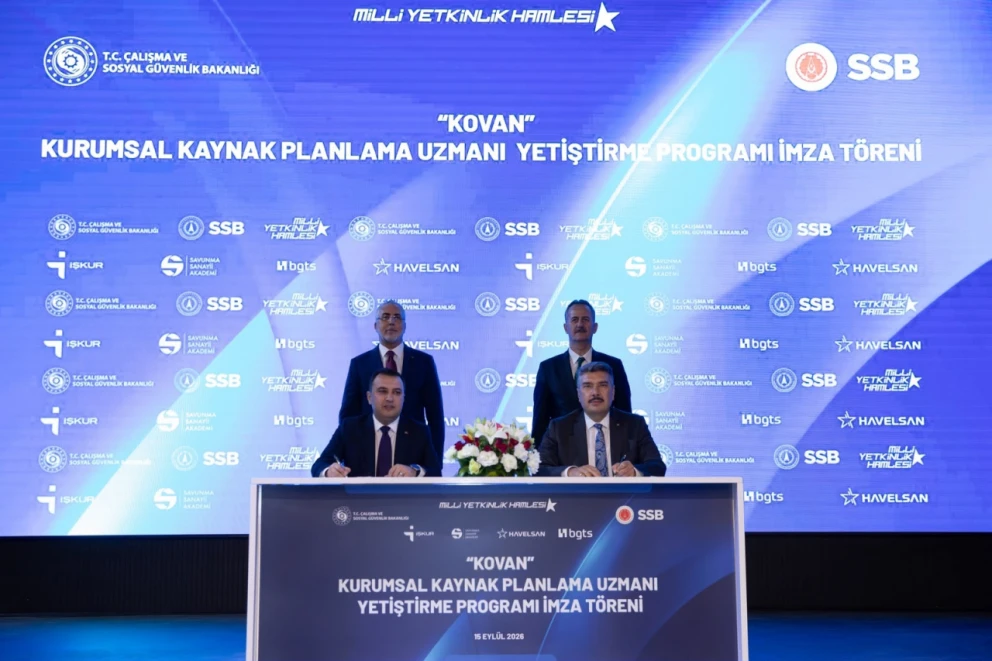
The operational answer has been built since. In August 2024 the Defence Industry Executive Committee launched the Millî Yetkinlik Hamlesi, or National Competence Initiative, coordinated by SSB’s Defence Industry Academy. At its second-anniversary event in Ankara in August 2026, attended by Vice President Cevdet Yılmaz and SSB head Prof. Haluk Görgün, the programme reported reaching approximately 500,000 people across more than 50 projects, organised into four platforms and 11 programmes covering seven target groups from secondary-school pupils to company managers. Reported figures included:
- Defence Industry High School Programme — 2,541 students over five terms
- ELMAS Programme — 7,000 vocational and technical high-school students from 13 schools in 12 cities
- Defence Industry Campus Programme — 3,000 participants in eight cities
- Higher-education modules — 4,991 university students across 288 courses
- Defence Career Platform — about 290,000 users connected with 339 companies
- Defence Development Platform — 665 courses, more than 73,000 users, over 158,000 training hours
The 500,000 headline is reach, not hires, and the officials presenting it described it that way. Reading the figures conservatively, the structured education programmes — high school, ELMAS, campus and university modules — touched roughly 17,500 students over two years. Set against a requirement of 13,400 net new employees a year, the pipeline programmes are the right shape but are not yet, on their own, sized to the target. The platforms that reach hundreds of thousands are job boards and online courses, which is a different thing from a trained entrant.
A second Defence Industry Talent Management Summit was held in Ankara on 14-15 January 2026 under the theme “Talent and Competence”. SSB said that year’s work would focus on engineers specifically, following a first cycle aimed at experienced professionals, and announced a private-sector competence network intended to set competence standards and measurement processes. Those are stated intentions; no outcome has been published against them.
The brain drain, and whether it has turned
Türkiye’s defence sector has a documented history of losing senior engineers abroad. The clearest evidence remains an SSB survey reported by Defense News in January 2019, which identified 272 defence industry officials — mostly senior engineers — who had left Türkiye for jobs abroad. Of the 81 who responded to the survey, 61 per cent were engineers, and the largest single group, 26 per cent, cited limited promotion and professional progress rather than pay as their main reason for leaving.
Officials now say the flow has reversed. At the August 2026 anniversary event, Yılmaz said ASELSAN’s hires from abroad in 2025 ran at about 2.5 times the number of staff leaving for overseas positions. That is an official claim about a single company in a single year, and DefenceTürkiye has not seen the underlying data; it is not the same as a sector-wide reversal. Supporting it, SSB has run Technology and Skills Meetings in Berlin, London, Eindhoven, Rotterdam and Hamburg, which is a recruitment campaign aimed squarely at Turkish engineers already working in European industry.
The honest position is that the 2018-2019 outflow is well documented, the claimed reversal is not independently verified, and no current sector-wide retention figures have been published.
What is not published
Company-level headcounts are the weakest part of this picture, and foreign analysts should treat them with caution. Published figures for the same company in the same period diverge by factors approaching two, depending on whether the source counts the parent company, the consolidated group, or subsidiaries and foreign operations. Third-party workforce datasets built from online profiles differ sharply from company annual reports.
Among the larger employers, the Turkish Armed Forces Foundation (TSKGV) group — which holds stakes in ASELSAN, ROKETSAN, HAVELSAN and others — was described in January 2026 as employing more than 42,000 people, most of them university graduates. If both that figure and the ~100,000 sector total are accurate, a single foundation-owned group accounts for something over 40 per cent of the entire sector workforce, with more than 3,500 other companies sharing the rest. For company-by-company detail, Envanter Medya maintains Turkish-language files including a breakdown of ROKETSAN’s roughly 2,000-strong R&D engineering staff and an explainer on how ASELSAN’s internship and candidate-engineer intake routes work.

Two further figures were given by Industry and Technology Minister Mehmet Fatih Kacır in January 2026: 23,700 people employed across 79 defence R&D and design centres, and 7,900 in 340 technopark start-ups. Neither has been published in a form that allows them to be reconciled against the SASAD classification.
BUYER VIEW
- Ask about the programme team, not the plant. Where capacity is governed by recruitment, the meaningful question is how many engineers and technicians are assigned to your programme and whether they are already hired.
- Queue position is a staffing question. Turkish forces are large customers of the same lines. Where a company is hiring to meet domestic orders, an export order competes for the same new entrants.
- Technician supply governs serial delivery. First-article delivery tests engineering; batch delivery over three to five years tests technician recruitment and retention. Ask for the planned headcount ramp alongside the delivery schedule.
- Local production offers may be a capacity answer. Where Turkish labour is tight, licensed or joint production in the customer country is more likely to be offered — and shifts part of the staffing problem to the buyer. See our guide to what a buyer actually gets from Turkish offsets.
- Watch for the first post-2023 SASAD report. It is the only document that will show whether the 2024-2025 run-rate supports the 2028 target.
This is open-source editorial analysis, not procurement advice.
What comes next
Three things will move this picture, and all three are observable from outside Türkiye.
The first is SASAD’s next performance report. The association has published 2023 as its most recent edition; a 2024 or 2025 edition would settle whether the ~100,000 figure is methodologically comparable and show the real post-2023 run-rate.
The second is the mid-term handling of the 12th Development Plan’s targets. If the 2028 employment figure is revised, that revision will say more about Turkish industrial capacity than any contract announcement.
The third is whether output per employee is allowed to rise. The plan assumes it stays flat. Turkish companies entering serial production on lines whose stated capacity we have examined separately have an obvious incentive to beat that assumption, and any sustained improvement would reduce the hiring requirement. Türkiye’s closest comparator on this measure is South Korea, which reached a comparable export position with a different industrial structure — a contrast we set out in our comparison of two rising defence exporters.
FAQ
How many people work in Türkiye’s defence industry?
90,969 at the end of 2023, according to SASAD’s sector performance report, the most recent audited figure. Officials have described the end-2025 figure as close to 100,000, though that has not been confirmed by an association report.
What is Türkiye’s defence industry employment target for 2028?
158,000 people, set out in Table 22 of the 12th Development Plan covering 2024-2028. The same table targets $26bn in turnover and $11bn in exports. Figures of 130,000 and 150,000 that appear in some English-language coverage do not match the plan document.
How many engineers work in the Turkish defence industry?
35,478 engineers and project specialists in 2023, or 39 per cent of the workforce. Technicians and operators were the larger group at 40,936, or 45 per cent. The frequently repeated claim that about half the workforce are engineers is not supported by SASAD’s own classification.
Which Turkish defence company employs the most people?
No reliable current ranking exists, because company-level headcounts are inconsistently disclosed and third-party datasets disagree widely. The clearest grouped figure is for the Turkish Armed Forces Foundation group, described in January 2026 as employing more than 42,000 people across its holdings, which include ASELSAN, ROKETSAN and HAVELSAN.
Does Türkiye have enough engineers for its defence programmes?
Not at current hiring rates, on the plan’s own arithmetic. Reaching 158,000 by 2028 requires roughly 13,400 net new employees a year from the 2023 base, against a best recorded year of 9,837. Measured from the reported end-2025 figure, the requirement rises to about 19,300 a year. Recruitment programmes exist and are expanding, but no published figure yet shows hiring at the required rate.
Is Türkiye still losing defence engineers abroad?
The outflow is documented for 2018-2019, when an SSB survey identified 272 departures, mostly senior engineers. Officials said in August 2026 that ASELSAN’s hires from abroad in 2025 outnumbered departures by about 2.5 to one. That is a single-company claim for a single year and has not been independently verified; no sector-wide retention data has been published.
How much does the Turkish defence industry spend on R&D?
$2.62bn in 2023, equal to 17.4 per cent of turnover, up from $2.06bn and 16.9 per cent in 2022. The figure appears to include customer-funded development and is therefore not directly comparable with the company-funded R&D ratios reported by Western prime contractors.
Sources
- SASAD, Sector Performance Report 2023 — employment, turnover, workforce composition, R&D spending
- Presidency of Strategy and Budget, 12th Development Plan 2024-2028 — Table 22 (p.109) and paragraphs 520.3 and 695.3
- Anadolu Agency — National Competence Initiative two-year figures, August 2026
- Defense News — SSB survey on departing defence engineers, January 2019
- A News — second Defence Industry Talent Management Summit, January 2026
- Defence Turkey — statements by Vice President Cevdet Yılmaz and Minister Mehmet Fatih Kacır, 14 January 2026