Turkish Defence Firms Now Put AI Between the Target and the Trigger

Artificial intelligence has stopped being a conference slide in Turkish defence. In the space of a few months in 2026, a swarm of loitering munitions struck targets with live ammunition, a drone maker showed strike aircraft that navigate without GPS, and the procurement agency opened a national AI platform to anyone with an e-Devlet login. Each piece sits at a different point in the chain that runs from finding a target to hitting it.
This article looks at where the technology is actually being used, what is documented, and what is still a claim from the manufacturer.
What Is Türkiye’s Defence Industry Doing With AI Right Now?
Three separate tracks are moving at once. The first is infrastructure: the Presidency of Defence Industries (SSB) runs a defence AI platform called SSYZ, and its newest layer, EVREN, went live in the last week of September 2026. The second is weapons that carry their own onboard intelligence, such as mini cruise missiles with optical target recognition and loitering munitions that fly as a group. The third is the people pipeline, where companies such as ROKETSAN are recruiting AI talent through competitions.
These tracks feed each other. A national compute platform trains the models; the models end up in seekers, autopilots and swarm software; and the engineers who write that software come from hackathons and university programmes.
What Does the EVREN Platform Give Defence Firms?
EVREN is hosted at evren.ssyz.org.tr and is reached through the e-Devlet digital-identity system. According to SSB, it is an end-to-end MLOps environment: compute, model libraries and data-labelling tools in one place, with data processing kept on Turkish GPU infrastructure. The inference layer reportedly covers 11 open-weight large language models, with automatic routing between them depending on the query. Our earlier report on the EVREN launch covers the rollout in detail.
The economics are unusual. Users earn credits by uploading datasets, labelling data or sharing trained models, then spend them on GPU time or inference calls. SSB reportedly waived credit deductions for API calls until 1 November 2026, and roughly 7,500 active users signed up in the first days.
EVREN is not a weapon and does not sit in any kill chain itself. Its importance is upstream. Defence firms, academics and students can now train and test models on domestic hardware, which matters for radar signal processing, electronic warfare and unmanned-system autonomy, all areas where Turkish firms have said they want AI. SSB has also signalled plans to train indigenous language, image and audio models and to extend GPU capacity through a distributed setup rather than one large data centre.
The use of open-weight models is a practical choice. Weights can be run inside a closed national network without sending prompts to a foreign cloud provider, which is the main concern for any firm handling export-controlled or classified design data. SSB also says it wants to keep AI talent at home rather than lose it to Western commercial employers, and a credit system that rewards sharing data and models is one way to build a domestic pool of both.
How Are Companies Recruiting AI Talent?
ROKETSAN ran an AI hackathon in Ankara on 25 to 27 September 2026. The company reported 2,457 applications for 72 places, with technical tracks in edge AI, machine learning, large language models, autonomy and data science. Board Chairman Prof. Dr. Faruk Yiğit said the company sees AI as a strategic capability that can transform its whole value chain. The full story is in our ROKETSAN hackathon report.
The ratio of applicants to seats says something about the competition for engineers. A missile maker is no longer just hiring aerodynamicists and propulsion specialists; it is bidding against commercial software firms for people who can build vision models that run on small embedded processors.
What Does an AI-Guided Missile Actually Look Like?
The clearest example is Baykar’s KEMANKEŞ family of mini cruise missiles. Baykar’s own product page describes KEMANKEŞ 1 as having AI-assisted optical guidance and autonomous operation. The published figures are modest and concrete.
| Parameter | KEMANKEŞ 1 (Baykar product page) |
|---|---|
| Manufacturer | Baykar |
| Type | Jet-powered mini cruise missile |
| Operational range | 100 km |
| Maximum take-off weight | 45 kg |
| Payload | 10 kg |
| Dimensions | 1.73 m long, 1.14 m wingspan |
| Terminal guidance | Electro-optical or GNSS |
| Carriers | Bayraktar AKINCI, TB2, TB3 |
The point of the AI is in the last seconds of flight. Instead of steering to a coordinate, the missile is described as recognising its target through its camera, which lets it keep working when GNSS is jammed or the target has moved. A larger KEMANKEŞ 2 with a range above 200 km and the same AI-backed optical seeker has been reported; its development status should be treated as ongoing.
The missile is carried by drones from the company profiled in our Baykar company profile, so a target can be found by one machine, handed to another, and engaged without a pilot in the aircraft. That is the kill chain compressed.
Have Autonomous Swarms Been Used in Live Fire?
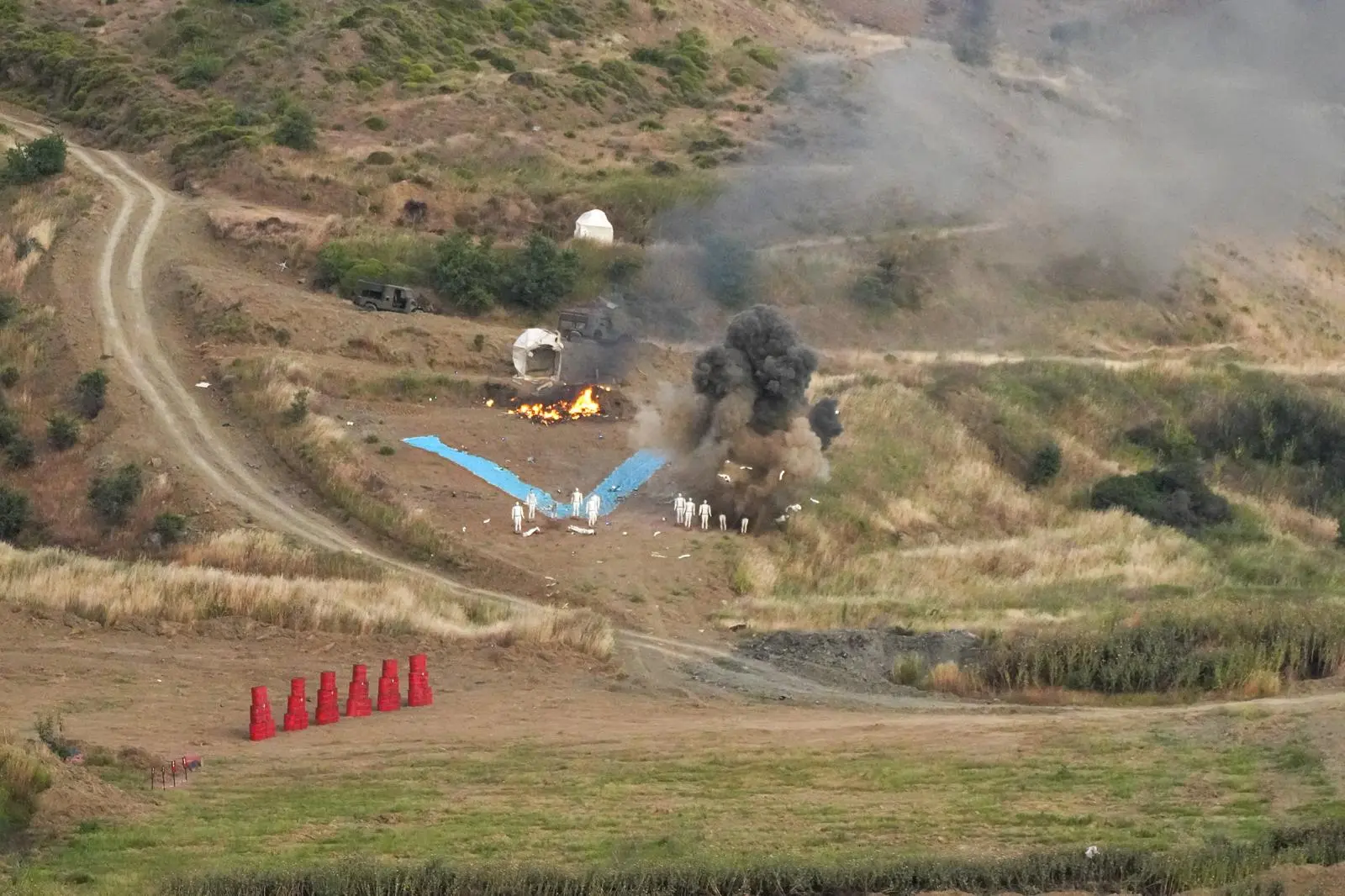
In tests and exercises, yes. On 3 February 2026, STM reportedly demonstrated a swarm of KARGU loitering munitions at the General Nahit Şenoğul Shooting and Training Area in Ankara. According to reports on the test, the drones navigated to the mission area, split into sub-groups and engaged three separate targets under the command of a single operator. Each drone shared data with the others, chose targets by warhead type and could continue the mission if individual units dropped out, using a distributed rather than centralised control design.
In May 2026, STM said a swarm of 20 KARGU munitions neutralised designated targets with live ammunition during the EFES-2026 exercise, describing it as a first in an integrated exercise scenario. That claim comes from the company and has not been independently checked. Background on the technology is in our piece on Turkish drone swarms, and the manufacturer is covered in the STM company profile.
Baykar followed in April 2026 with a demonstration of its K2 kamikaze drones, reported to feature AI-supported swarm autonomy, navigation in GPS-denied environments and automatic target detection. Coverage of that test does not detail how much human oversight sits in the loop, and neither company has published its rules for when a person must approve an engagement.
Where Does the Human Stay in the Loop?
This is the open question. The documented STM test describes one operator commanding the group, which points to a model where a human assigns the mission and the swarm handles the execution: routing, spacing, target allocation within a set area. That is different from a system that decides on its own what counts as a target.
Several points are worth separating:
- Navigation autonomy. Flying without GPS or a data link appears in the products described above and is the least controversial use.
- Target recognition. Optical seekers that identify a vehicle or vessel type are the step in KEMANKEŞ. Manufacturers have not published how much the operator selects before launch.
- Engagement authority. Whether a swarm may choose among targets on its own is a policy decision, and Türkiye has not published a doctrine statement on it in the material reviewed for this article.
Bayraktar KIZILELMA, covered in our unmanned combat aircraft guide, adds the air-to-air dimension, with reports of autonomous close-formation flight in 2026. Formation flying is coordination, not combat autonomy, but it is the same software skill that later underpins collaborative engagements.
What Is Still Missing?
Three gaps stand out. Independent verification is thin: most performance claims come from the manufacturers. Production numbers for AI-guided munitions have not been published. And the regulatory side, including export conditions for autonomous weapons and the treatment of human control in international talks, has not been addressed by Ankara in detail.
What can be said is that the building blocks are in place. A state platform provides training compute, companies are competing for engineers, and fielded or near-fielded weapons already use onboard recognition and swarm coordination. The next signals to watch are whether EVREN’s planned domestic foundation models appear, whether KEMANKEŞ 2 reaches firing tests, and whether the services publish any rule on autonomous engagement.