TÜBİTAK SAGE Designs the Missiles Türkiye’s Industry Builds

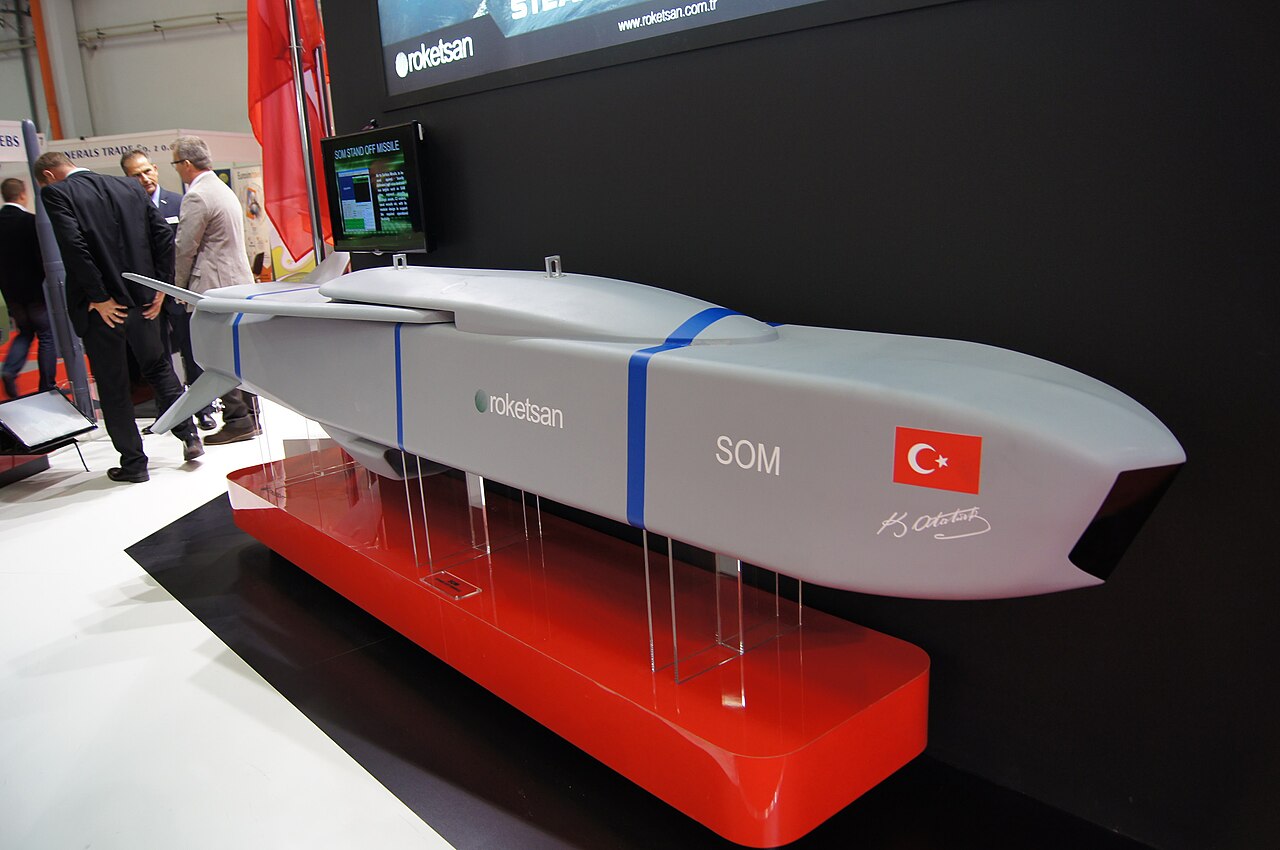
Most people who follow Turkish defence know the names on the side of the missile: Roketsan, Aselsan, Baykar. Far fewer know the institute that drew many of those missiles in the first place. TÜBİTAK SAGE, a state research body on the outskirts of Ankara, holds the design work behind the SOM cruise missile, the Bozdoğan and Gökdoğan air-to-air missiles, and a family of bomb guidance kits that turned unguided bombs into precision weapons.
It does not run a big production line, and it does not chase headlines. It builds prototypes, runs tests and hands the result to industry. That division of labour explains a lot about how Türkiye’s missile sector works today.
| Full name | TÜBİTAK Defense Industries Research and Development Institute (SAGE) |
|---|---|
| Parent body | Scientific and Technological Research Council of Türkiye (TÜBİTAK) |
| Established | 1972 (as the Guided Vehicles Technology and Measurement Center, GATÖM) |
| Main campus | Lalahan, Elmadağ district, about 30 km northeast of Ankara (moved there in 1993) |
| Core work | Missiles, cruise missiles, guidance kits, munitions, navigation and electro-optical subsystems |
| Best-known designs | SOM, Bozdoğan, Gökdoğan, HGK, KGK |
| Main production partner | Roketsan (for SOM) |
| Website | sage.tubitak.gov.tr |
What Is TÜBİTAK SAGE and Where Did It Come From?
SAGE began in 1972 under a name that tells you what it was for: the Guided Vehicles Technology and Measurement Center, known by its Turkish acronym GATÖM. It was renamed the Ballistics Research Institute in 1983 and took its current name in 1988. For years it worked out of the Beşevler district in central Ankara, where the old site later became home to a wind tunnel.
In 1993 the institute moved to Lalahan, in Elmadağ district, some 30 km northeast of the capital. That is still its main campus. According to the institute’s own website, SAGE also has facilities in Eskişehir, Kocaeli, Muğla and Konya.
The institute describes its mission as giving the defence industry competitive, high-value technologies through R&D. In practice it occupies a specific slot. Universities do basic research. Companies such as Roketsan and Aselsan build and sell systems in volume. SAGE sits between them, taking a missile concept through design, subsystem development and flight testing until it is mature enough to hand over.
Why Does a Research Institute Design Missiles Instead of a Company?
The answer is partly money and partly ownership. A state institute can carry a high-risk programme for years without having to show quarterly profit. It can also keep the intellectual property inside the public sector, which matters when a country wants to sell a weapon without asking anyone’s permission.
The model has a cost. A design authority that is not a manufacturer depends on an industrial partner to turn drawings into hardware at scale. The Bozdoğan and Gökdoğan programmes show how that can slow things down, as discussed below. But for a country that spent decades buying missiles abroad, having a public body that can design one from scratch is a capability in itself.
How Did SOM Become Türkiye’s Standard Stand-Off Missile?
SOM, short for Stand-Off Munition, is the institute’s most visible success. Development began in 2006, and the missile was revealed publicly in June 2011. Its first guided flight over the Black Sea came in August 2011, covering more than 100 nautical miles, according to open sources. It entered service in 2017.
The basic numbers, as reported: a length of about 3.66 metres, a launch weight of roughly 620 kg for the early variants, a 230 kg warhead, and a range of more than 250 km. Guidance combines inertial navigation and GPS with terrain-referenced navigation, with an imaging infrared seeker for the final approach. SAGE holds the design authority; Roketsan handles production and export marketing.
The engine is the story within the story. Early SOM missiles used a French Microturbo TRI-40 turbojet. A Turkish engine from Kale, the KTJ-3200, is reported to have replaced it in later production. That swap is exactly the sort of dependence Ankara has been trying to remove across its missile inventory. Our detailed piece on SOM and its stealthier sibling covers the engine change and the newer variant.
SOM-J is the derivative developed with Lockheed Martin for carriage inside the F-35’s weapons bay. It is lighter, at about 500 kg, and carries a semi-armour-piercing warhead suited to ships. Türkiye’s removal from the F-35 programme in 2019 left its integration status uncertain. Azerbaijan is the only reported foreign operator of SOM, alongside the Turkish Air Force.
What Are HGK, KGK and the Other Guidance Kits?
Not every weapon SAGE designs is a missile. Its guidance kits are cheaper and arguably more widely used, because they work with bombs the air force already owns.
- HGK is a GPS and inertial guidance kit that converts Mk-82, Mk-83 and Mk-84 series bombs, roughly 227 kg to 907 kg, into all-weather precision weapons.
- KGK adds wings to the concept. The wing-assisted kit lets Mk-82 and Mk-83 bombs glide beyond 100 km depending on release conditions, so the aircraft can stay well away from air defences.
- GÖZDE and GÖKÇE are listed by the institute as new-generation kits.
- KGK-82-SİHA is a winged kit designed for unmanned combat aircraft.
The institute’s munitions list goes further. It includes the NEB-84, SARB-83 and SERT-82 penetrator bombs, thermobaric variants named NEB-T, VOLKAN and TENDÜREK, and small guided munitions for drones, among them KUZGUN, KAYI and BOZOK. The range shows that SAGE handles the whole arc, from warhead to fuze to seeker, not only airframes.
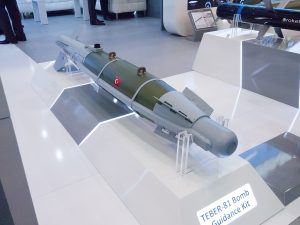
Roketsan developed its own laser-guided kit, TEBER, so the two organisations overlap at the edges. Aselsan has entered the same field too, with its own guided munitions.
What Did SAGE Build for Air-to-Air Combat?
The GÖKTUĞ programme, which started in 2013, is SAGE’s answer to a long-standing gap. Turkish fighters have flown with imported missiles. The programme produced two weapons.
Bozdoğan is a short-range, infrared-guided missile with an imaging seeker and all-aspect capability. Reported range is over 25 km, with speed above Mach 4. Its first live firing came in April 2021, when it destroyed a target drone.
Gökdoğan is the beyond-visual-range weapon, guided by an active radar seeker on a fire-and-forget basis. Reported range is more than 65 km for the baseline version, with extended-range versions projected beyond that. Its first flight test dates to 2018, and a hit on an aerial target followed in February 2025.
Both were reported to have entered the inventory on 30 July 2024. The contracts show how small the start is. In October 2023 the Defense Industry Agency (SSB) signed a project under which SAGE would integrate both missiles with the F-16 in its PO-III configuration and produce a low initial batch: 25 of each missile and 14 launchers, with first delivery planned for 2025. On 19 October 2025, both missiles were test-fired from an F-16 and reportedly hit target drones.
The intended list of carriers is long: F-16, the Hürjet trainer, the KAAN fighter, the JF-17 Thunder and unmanned aircraft such as Bayraktar AKINCI and Kızılelma. Whether production can scale to match that list is the open question. Our analysis of the two missiles goes into why numbers lag behind capability.
A third design, GÖKHAN, is a ramjet-powered air-to-air missile still in development. Ramjets give a missile more energy late in flight, which matters against manoeuvring targets at long range. No fielding date has been confirmed.
Does SAGE Work on Air Defence as Well?
Yes, though the institute’s role is harder to trace here. SAGE lists GÖKDEMİR, described on its site as a critical member of the Steel Dome, and GÖKSUR, a close-range air defence missile for naval platforms. It also lists PARM, a 35 mm airburst ammunition type, which fits the gun-based layer of the same architecture.
The long-range SİPER system is described in public sources as developed jointly with Aselsan and Roketsan, with SAGE involved. Public detail on who does what inside SİPER is thin, so treat that attribution as general rather than precise. For the system itself, see our explainer on SİPER and our overview of how the Steel Dome works.
How Does SAGE Fit With Roketsan and Aselsan?
Think of SAGE as the R&D bench and Roketsan as the factory floor, though the boundary is not clean. Roketsan has its own design teams and products, from ATMACA to TAYFUN, and produces SOM under SAGE’s design authority. Our Roketsan company profile covers the production side.
The institute also sells services. Its website lists testing, calibration, material analysis and environmental testing for defence organisations and private clients. Anyone who has built a component for a missile knows why that matters: a part is useless until it survives vibration, heat and shock.
For the wider question of how far Ankara really controls its own supply chain, from engines to seekers, the piece on whether Türkiye is fully independent in defence production is a good companion. SAGE’s designs are Turkish, yet some subcomponents have historically come from abroad, which is why the SOM engine swap drew so much attention.
What Should Readers Watch Next?
Three things. First, whether Bozdoğan and Gökdoğan move from small initial lots to full production, and who builds them at volume. Second, how the wing-assisted and penetrator families fare on unmanned platforms, where cheap stand-off weapons are in demand. Third, whether GÖKHAN reaches a public test.
SAGE’s quiet style means news usually arrives through SSB announcements or a test-firing video rather than a press tour. Test footage tends to appear first on SSB and ministry channels, with company confirmation trailing behind. Watching those channels tells you more about Turkish missile progress than most trade-show brochures do.