
Two Decades After Its Contract, HÜRKUŞ Finally Joins the Turkish Air Force

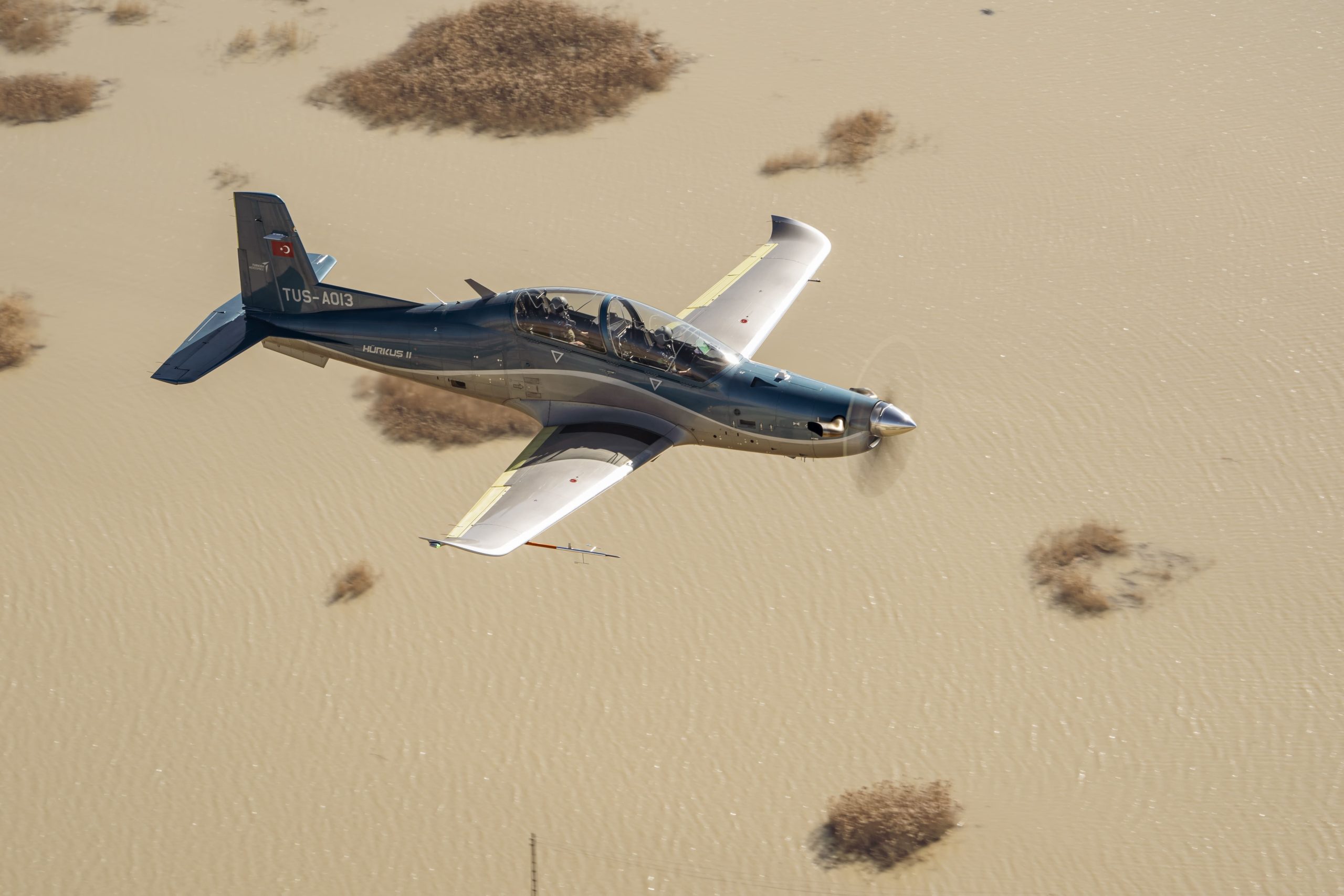
Turkish Aerospace (TUSAŞ) signed the contract for a home-designed primary trainer on 15 March 2006. The first prototype flew in August 2013. The Turkish Air Force formally accepted its first two production-standard aircraft on 28 September 2026. Few Turkish aircraft programmes have taken as long to get from paper to the flight line as the HÜRKUŞ, and few say as much about how the country learned to certify its own aircraft.
Anyone searching for the HURKUS trainer aircraft today will find a family of related designs rather than one airframe. This guide covers how the programme began, what the aircraft can do, how the variants differ and who flies it.
| Manufacturer | Turkish Aerospace (TUSAŞ), Ankara |
|---|---|
| Type | Tandem two-seat, low-wing, single-engine turboprop trainer and light attack aircraft |
| Engine | Pratt & Whitney Canada PT6A-68T, 1,600 shp |
| Wingspan / length / height | 10.86 m / 11.35 m / 3.66 m (TUSAŞ figures, new-generation trainer) |
| Maximum take-off weight | 3,300 kg (7,275 lb) |
| Maximum cruise speed | 288 kt (533 km/h) |
| Service ceiling | 39,270 ft (11,970 m) |
| Maximum range | 589 nm (1,190 km) |
| G limits | +7 / -3 |
| Ejection seats | Martin-Baker Mk T16N zero-zero |
| First flight | 29 August 2013 |
| Variants | HÜRKUŞ-A, HÜRKUŞ-B, HÜRKUŞ-C, HÜRKUŞ-II |
Why Did Türkiye Build Its Own Basic Trainer?
A fighter pilot’s first flying hours are the cheapest hours an air force buys, and also the ones that shape habits for a career. For decades Türkiye filled that slot with imported turboprops. The HÜRKUŞ was meant to end that dependence, and the name says as much. It honours Vecihi Hürkuş, the aviator who built the first Turkish-designed aircraft.
The development agreement between the Presidency of Defence Industries (SSB) and TUSAŞ dates to March 2006. SSB president Haluk Görgün described it in April 2024 as a contract to develop a Turkish initial and basic training aircraft, and noted that two HÜRKUŞ-A prototypes were built under it. TUSAŞ committed to design, build and certify the aircraft to the European CS-23 standard. That meant the company had to satisfy a civil regulator before any air force could call the design sound.
The schedule slipped, as first-of-a-kind aircraft programmes tend to. Early forecasts had the prototype flying in 2009. It was rolled out in Ankara in June 2012 and finally left the ground on 29 August 2013 from Akıncı Air Base, on a 33-minute flight.
What Does the HÜRKUŞ Actually Do in Training?
The aircraft is built for the stretch of a pilot’s syllabus between first lessons and conversion to a fast jet. According to TUSAŞ, it covers every stage from basic training to fighter-lead-in work, and can also fly close air support in a pinch.
The cockpit is where that ambition shows. Both seats have good forward and downward visibility, pressurisation, an anti-G system and an on-board oxygen generation system, so students do not depend on bottled oxygen. The instructor and student sit on Martin-Baker zero-zero ejection seats. TUSAŞ also lists a 30-second inverted flight capability, high-shock-absorbing landing gear for repeated training landings, a simulated combat training system and a dedicated flight simulator.
The avionics philosophy matters as much as the airframe. SavunmaSanayiST reported that the cockpit and avionics architecture was designed as one piece with other national platforms, so a student who moves on to the HÜRJET jet trainer and later the KAAN fighter meets an evolved version of a familiar layout rather than a foreign one. That continuity is the real argument for a national trainer.
Flight testing covered the usual ground. TUSAŞ says the early aircraft flew about 1,500 sorties and 3,200 hours, reached 356 knots and 35,500 feet, and were cleared through stall, spin, engine-out, aerobatic and high-speed tests.
How Do HÜRKUŞ-A, B, C and II Differ?
The family has grown in layers, and the letters are easy to mix up.
- HÜRKUŞ-A is the baseline aircraft that went through civil certification.
- HÜRKUŞ-B is the military trainer, reported to carry integrated avionics with a head-up display, multifunction displays and a mission computer, laid out along the lines of an F-16 cockpit. The SSB contract for the Air Force’s first 15 aircraft was signed on 26 December 2013.
- HÜRKUŞ-C is the armed version for light attack. Turkish defence ministry photographs from 2017 showed it with Roketsan UMTAS anti-tank missiles, Cirit laser-guided rockets and an electro-optical pod, and a live UMTAS firing was reported that April.
- HÜRKUŞ-II, officially the new-generation basic trainer, is a redesign of the B. It is the version now being delivered.
The II is more than a facelift. Reporting on the programme says it sheds roughly 450 to 500 kilograms through wider use of composites, with a reshaped nose, spinner, intake, nose gear, canopy, winglets and tail. Several systems, including cooling, hydraulic pump, radio and IFF, were switched to national suppliers. TUSAŞ itself dates the start of design and production work on the new-generation aircraft to a contract amendment with SSB on 3 May 2021.
How Did the 2016 Certificate Change the Programme?
On 11 July 2016 the Turkish Directorate General of Civil Aviation issued the HÜRKUŞ a type certificate, TT32. The European Union Aviation Safety Agency (EASA) validated it the same day. TUSAŞ says the campaign needed 545 documents sent to the two authorities and that the HÜRKUŞ became the first Turkish aircraft to earn an EASA-recognised type certificate.
That was a civil paper trail for what is mostly a military aircraft, but it gave TUSAŞ an internationally readable record. A decade later the military side caught up. In September 2026 the HÜRKUŞ-II became the first aircraft cleared through Türkiye’s own military airworthiness system, a process we covered in detail in our report on the HÜRKUŞ-II military type certificate.
What Has the Air Force Ordered?
The order history shows how slowly the programme moved, and how it then sped up. The Defence Industry Executive Committee decided in September 2013 to open contract talks for 15 new-generation basic trainers, and the HÜRKUŞ-B contract followed that December. On 18 April 2024 a second contract added 40 more aircraft, bringing the total to 55. Görgün said at the time that the 55th aircraft was planned for delivery in June 2027 and that many subsystems would be nationalised.
The delivery date itself moved. The 2024 plan called for the first aircraft in May 2025. Acceptance finally took place at TUSAŞ’s Kahramankazan facility on 28 September 2026, when two aircraft were handed over. We followed that ceremony in our piece on the first two HÜRKUŞ-II deliveries. Görgün has said TUSAŞ plans to build 12 to 14 aircraft in 2026 and that part of that output will go abroad.
Who Else Flies It?
Exports came before the Air Force deliveries. In May 2023 TUSAŞ marketing head Bertan Kurt told Anadolu Agency that the company had sold the HÜRKUŞ to two countries and delivered three aircraft to Chad and two to Niger. Treat those counts as a 2023 snapshot.
The first export contract for the HÜRKUŞ-II followed in late September 2026. At the ADEX defence exhibition in Baku, TUSAŞ and Azerbaijan’s Ministry of Defence Industry signed a government-to-government agreement, and Görgün said 14 aircraft will be built for Azerbaijan alongside the 55 for the Turkish Air Force, according to SavunmaSanayiST. Some of the Azerbaijani aircraft could arrive within 2026, he indicated.
Where Does HÜRKUŞ Sit Next to HÜRJET?
The two trainers are not rivals. The HÜRKUŞ takes the early and intermediate phases on a turboprop, where an hour costs a fraction of a jet hour, and the HÜRJET takes over for supersonic, fighter-style work. Our comparison of how HÜRKUŞ and HÜRJET split fighter pilot training walks through the handover point.
For TUSAŞ, which is better known abroad for its helicopters, drones and the KAAN fighter, the turboprop is a quieter product. It is also the one that puts a Turkish-built aircraft in front of every new Turkish pilot first. More on the manufacturer is in the Turkish Aerospace company profile.
Specifications above are the figures published by TUSAŞ for the new-generation trainer; earlier HÜRKUŞ variants are reported to differ in dimensions and weights.


