
Roketsan’s BURÇ Fires SUNGUR Missile for the First Time

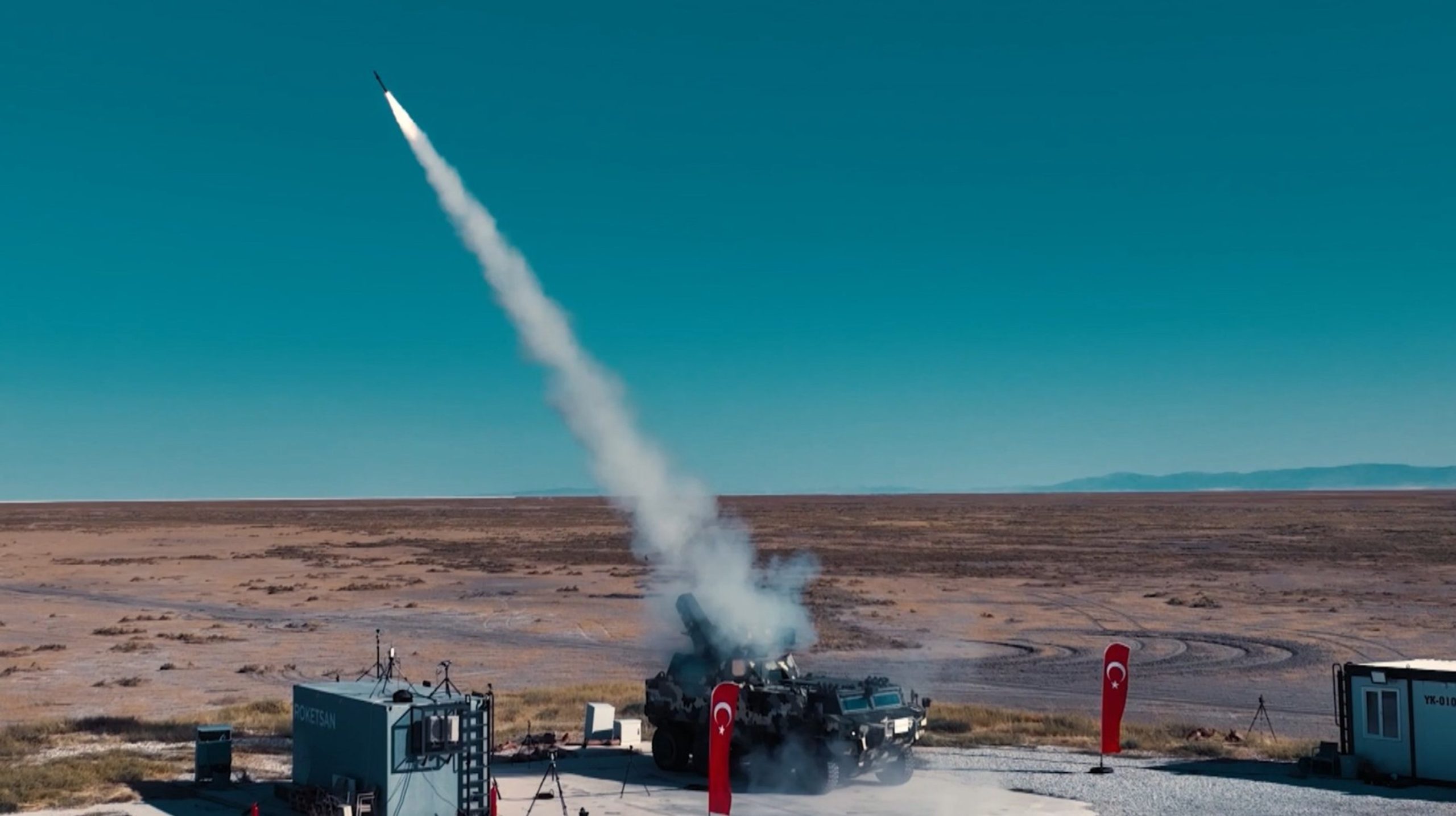
Roketsan fired its SUNGUR short-range air defense missile from the mobile BÜRÇ platform for the first time on September 14, 2026, destroying a moving aerial target and clearing a step the system still needed before it can be offered to the Turkish armed forces or export customers as a complete package.
The Ankara-based missile maker said the test added “a new firing capability” to the vehicle, which mounts the SUNGUR missile alongside a 20/30mm cannon and radar sensors on an FNSS PARS 8×8 chassis. Until now, SUNGUR had been fired and qualified from other launch arrangements, including man-portable and static configurations; a moving air target intercepted from a moving or rapidly deployable vehicle is a different engineering problem, since the fire-control system has to track its own platform’s motion as well as the target’s.
What BÜRÇ Brings to the Table
Roketsan first displayed BÜRÇ at IDEF 2023 as a next-generation, cost-conscious answer to the short-range air defense gap that mobile army and armored units face against drones, helicopters and low-flying fixed-wing aircraft. The turret carries eight SUNGUR missiles in two quadruple launcher pods, backed by a three-barrel 20mm cannon for closer-in or cheaper engagements, and is designed to bolt onto vehicles of 12 tonnes or more, with the PARS 8×8 as the reference platform.
For target detection and tracking, BÜRÇ relies on Meteksan’s Retinar AESA S-band radar, which the company says can pick up small drones with a radar cross-section as low as 0.01 square meters out to about 4 kilometers, and tactical UAVs out to roughly 10 kilometers. SUNGUR itself is Türkiye’s first indigenous man-portable air-defense missile, built around an imaging infrared seeker with lock-on-before-launch and a stated engagement envelope out to 8 kilometers and up to 4 kilometers in altitude.
Layered on a single vehicle, the combination is meant to give a maneuvering brigade or a protected site — an airbase, a command post, a naval facility — an organic, short-range shield rather than relying solely on towed or fixed systems. Roketsan describes BÜRÇ as complementary to, not a replacement for, longer-range Turkish systems such as HİSAR and SİPER.
Filling a Layer in Türkiye’s Steel Dome
Türkiye has spent the past several years assembling Çelik Kubbe (Steel Dome), a layered air defense architecture meant to knit together short, medium and long-range systems, along with radars and command-and-control, into a single national network. SUNGUR already sits at the bottom layer of that architecture in its shoulder-launched and static forms; a validated vehicle-mounted variant extends the same missile’s coverage to units on the move, which is precisely where mobile forces have historically been most exposed to drone and rotary-wing threats.
The test also lands in a crowded field. ASELSAN’s own mobile short-range system, GÜRZ, passed its first live-fire test in early September, pairing a KORKUT 35mm cannon with SUNGUR and HİSAR missiles on a tactical vehicle. Türkiye is effectively running two parallel vehicle-mounted SHORAD tracks from its two largest defense electronics and missile houses — a degree of internal competition that has generally sharpened both programs and given the SSB more than one option to qualify for series production.
Status, Not Yet a Sale
Roketsan’s statement described a successful test shot, not a contract, a service entry or an export order. BÜRÇ has been on the exhibition circuit since 2023 without a confirmed customer, and Monday’s firing is best read as continued qualification work rather than a finished product. Turkish officials have not disclosed how many further tests are planned or when the system might be presented for acceptance by the Turkish Land Forces.
Even so, mobile SHORAD is one of the more actively shopped categories in NATO procurement right now. European militaries rearming since 2022 have been short on exactly this kind of vehicle-mounted, missile-and-gun short-range air defense, and Turkish systems — Korkut, HİSAR-A and now GÜRZ and BÜRÇ — have already found buyers or serious interest among NATO and partner states shopping for counter-drone and low-altitude coverage. A qualified BÜRÇ would give Roketsan a second, gun-and-missile mobile offering to pitch alongside ASELSAN’s GÜRZ into that same market.
Sources
- Anadolu Agency, “Türkiye’s Roketsan test-fires air defense missile from mobile system,” September 14, 2026
- Daily Sabah, “Türkiye tests air defense missile on mobile system for 1st time,” September 14, 2026
- Roketsan, BÜRÇ Mobile Air Defence System product literature


[…] has been broadening its precision-munitions catalogue on several fronts this month, from the BURÇ air-defence system’s first SUNGUR firing to TAYFUN Blok-4 nearing service — see our full profile of Roketsan for the company’s […]
[…] reading: Roketsan’s BURÇ Fires SUNGUR Missile for the First Time, SUNGUR: The Bottom Layer of Türkiye’s Steel Dome Air Defence, Türkiye’s Steel Dome […]
[…] Middle East. Roketsan itself has spent 2026 testing multiple systems against aerial threats: its BURÇ mobile launcher fired the SUNGUR missile for the first time in mid-September, and its LEVENT missile intercepted a high-speed drone the same week. […]