Türkiye–Romania Defence Cooperation: Ships, Plants and Limits

Romania is Türkiye’s largest defence customer inside the European Union. Since late 2024 it has contracted for 1,059 Otokar COBRA II armoured vehicles worth about €857 million, bought a Turkish-built warship for roughly €223 million, and watched Otokar buy a Romanian factory outright for about €85 million. Romania is also where the limits of the relationship are easiest to see. Its €16.68 billion of EU borrowing under the SAFE instrument — the second-largest allocation in the bloc — has so far financed German and other EU-eligible suppliers, not Turkish ones. Türkiye’s response has been to stop selling into Romania from outside and start manufacturing inside it.
DEFENCETÜRKIYE DATA BOX
| Relationship | Türkiye–Romania defence industrial cooperation |
| Largest land contract | 1,059 Otokar COBRA II 4×4, ~RON 4.26bn (~€857m ex-VAT), signed November 2024 |
| Naval contract | One Hisar-class vessel, ~€223m, intergovernmental, signed 3 December 2025 |
| In service | Corvette Contraamiral Roman commissioned 20 June 2026; COBRA II deliveries running |
| Turkish plant in Romania | Otokar-owned Automecanica S.A., Mediaş — 96.77% acquired, ~€85m, completed June 2026 |
| Other Turkish presence | ASELSAN office in Bucharest (opened 2026); systems aboard the corvette |
| Not bought from Türkiye | UAVs, ground-based air defence, infantry fighting vehicles |
| Open items | Second Hisar-class vessel at talks stage only; no signed contract reported |
What Romania has actually bought from Türkiye
Two contracts carry the relationship, and they are very different instruments.
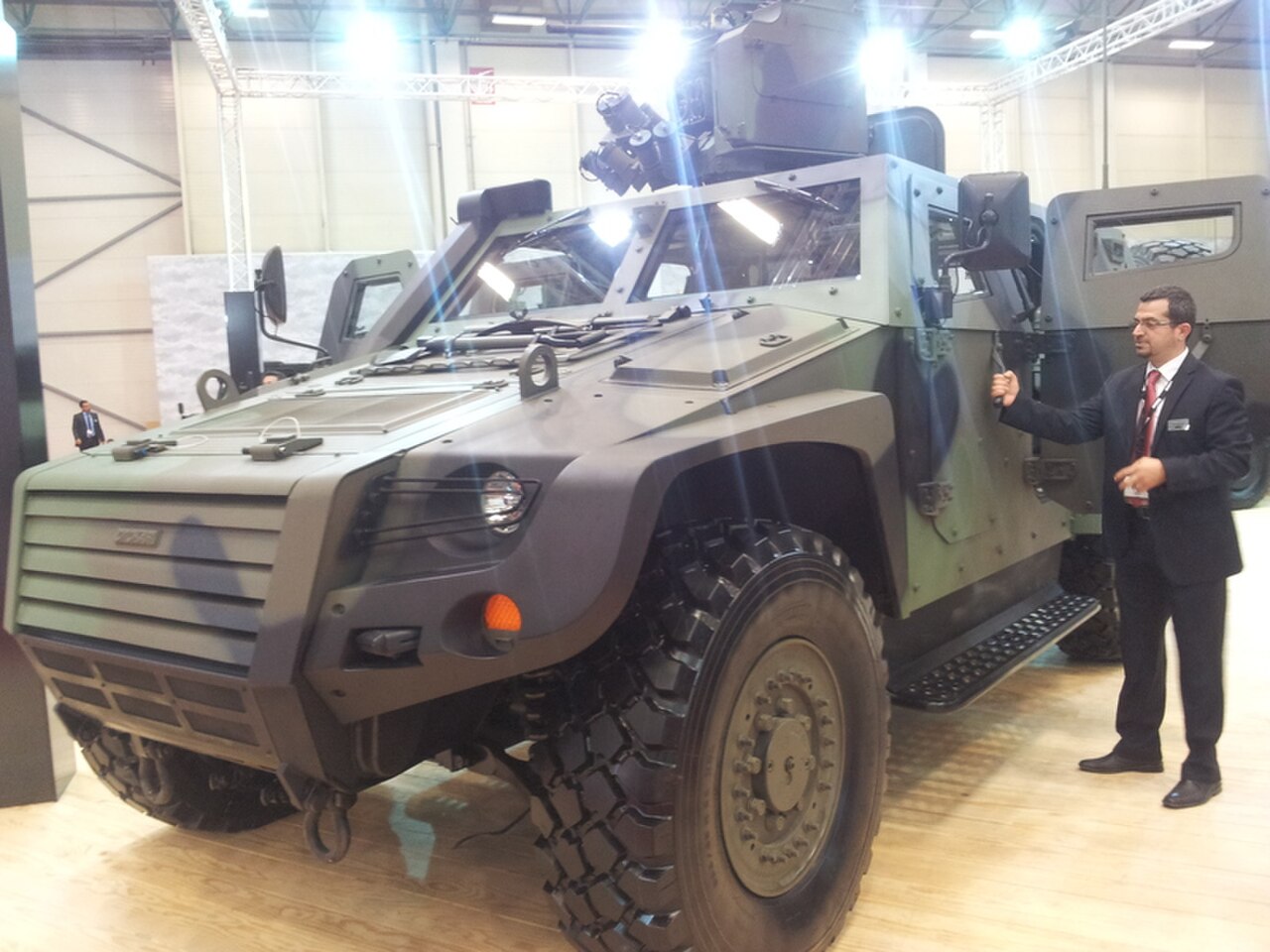
The first is armour. On 27 November 2024 Otokar signed with C.N. Romtehnica S.A., the procurement agency acting for Romania’s Ministry of National Defence, for 1,059 COBRA II 4×4 tactical wheeled light armoured vehicles. Otokar puts the value at approximately 4.26 billion Romanian lei, around €857 million excluding VAT. The structure matters more than the headline: the first 278 vehicles are built in Türkiye and nearly 800 are to be produced in Romania, with deliveries spread across roughly five years. This is the largest land-systems contract a Turkish company has won in Europe, and it is not a straightforward export sale — it is a localisation contract with a Turkish supplier attached.
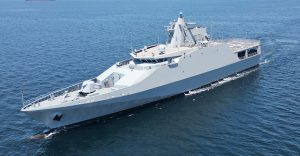
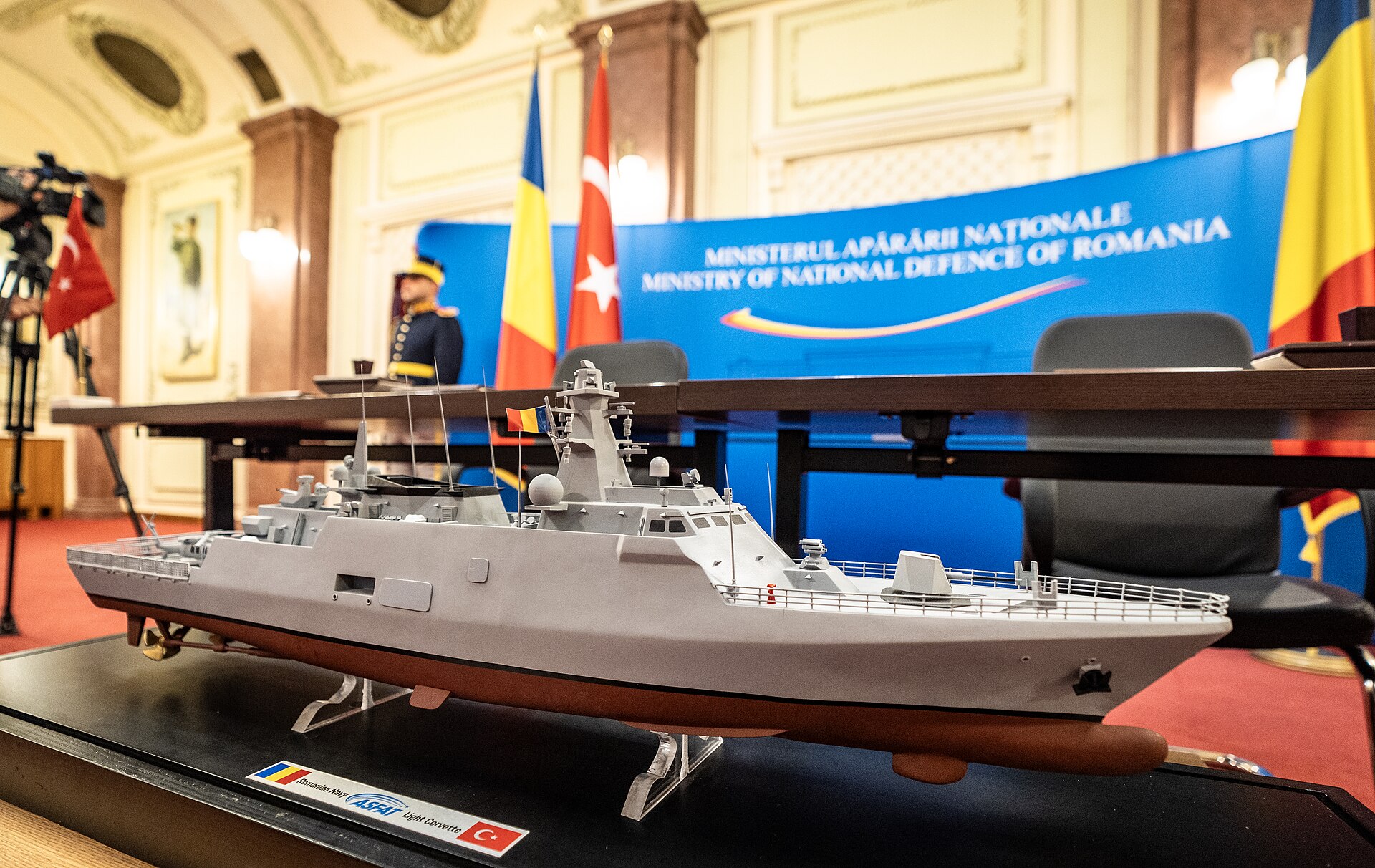
The second is naval, and it is a genuine first. On 3 December 2025 Romania and Türkiye signed an intergovernmental contract, worth about €223 million, for a Hisar-class vessel built by ASFAT, the Turkish defence ministry’s commercial arm. The ship was the lead vessel of the class, laid down at Istanbul Naval Shipyard in August 2021 as TCG Akhisar (P-1220). She was handed over on 20 June 2026 as Contraamiral Roman (Cvt 261) and arrived at Constanța on 10 July 2026. Turkish officials described the transfer as the first export of a Turkish-built naval combatant to a country that is both a NATO and a European Union member — a claim that holds up, and one that matters more for precedent than for tonnage.
It was also, as Romanian commentators noted at the time, the first new large surface combatant to enter the Romanian fleet in more than three decades.
The six-month delivery, and what it does not prove
The corvette was contracted in December 2025 and commissioned in June 2026. Roughly six months from signature to handover is extraordinarily fast by any European standard, and it has been read in some coverage as evidence of Turkish production speed.
That reading is wrong, and it is worth correcting because foreign buyers will draw the wrong conclusion from it. The ship was not built for Romania in six months. She was an existing Turkish Navy hull — laid down in 2021, launched in September 2023, on her maiden voyage in December 2024 — that was diverted to an export customer late in her fit-out. What Romania bought was not Turkish shipbuilding throughput but Turkish willingness to give up a hull from its own order book. That is a real and unusual commercial flexibility, and it is a reason to take Turkish offers seriously. It is not a lead time another customer can expect from a clean-sheet order. Our analysis of how long Turkish defence exports actually take to arrive sets out what the normal figures look like.
The ship also arrived incomplete by design. Romanian plans call for fitting out in Romania with combat systems chosen by the Romanian Navy, in phases. Reporting on the intended end-state varies, and some systems described in secondary sources — vertical launchers, a Gökdeniz close-in weapon system, Naval Strike Missiles replacing Turkish ATMACA — are at various points described as installed, planned or under discussion. Treat the final configuration as unsettled. What is confirmed is that Turkish sensors and effectors from ASELSAN, Meteksan, MKE and Roketsan form the baseline, and that Romania intends to layer Western weapons on top of a Turkish hull and combat system.
That hybrid is itself the interesting part for anyone evaluating Turkish naval exports. The MİLGEM family’s earlier export customers took largely Turkish fits. Romania is the first to treat a Turkish platform as a hull and a bus for someone else’s missiles.
Not everyone in Bucharest was convinced
Honest reporting on this programme has to include the domestic criticism, because it is detailed and it came from Romanians.
In November 2025 the Romania Energy Center (ROEC), a Bucharest think tank, published a 48-page report by George Visan arguing that the purchase was a mistake. Its central claim is a classification point: the Hisar class is “clearly an OPV”, in the report’s words, “a very well armed OPV” — not a corvette, whatever the marketing says. From that follow the specific objections: eight HISAR-D air-defence missiles judged too few for the Black Sea threat picture, a 76 mm gun the report considers too slow-firing for missile defence, a gun-based close-in system the authors would rather see replaced by a missile-based one, no lightweight ASW torpedoes in the baseline, and limited anti-submarine helicopter support. The report also warns that fitting Western weapons in Romanian yards with limited integration experience invites delay, and it is blunt about the procurement logic: “Price, rather than readiness and capabilities, seems to have dictated the procurement.”
None of that is a Turkish-quality argument. It is a requirement argument — whether Romania bought the right category of ship. But a foreign procurement reader should know it exists, and should note the report’s final recommendation, which is to avoid deepening dependence on Turkish naval technology. That view has advocates in Bucharest.
WHY IT MATTERS
Romania is the clearest live test of whether Turkish defence companies can become European manufacturers rather than European suppliers. The distinction is not cosmetic: it decides which pots of money they can reach.
Romania has shown it will buy Turkish equipment when the money is national and the price is right. It has also shown that when the money is European, Turkish companies have not been the ones signing. Both facts come from the same ministry in the same eighteen months.
Where the ceiling is: €16.68 billion of EU money
Romania signed a loan agreement under the EU’s Security Action for Europe instrument on 12 May 2026, worth €16.68 billion — the second-largest national allocation in the bloc, behind Poland’s €43.7 billion. Around €4.2 billion of it is earmarked for road infrastructure; the rest funds defence and security projects. This is now the dominant source of Romanian defence procurement finance, and it is the single most consequential fact for Turkish industry in the country.
SAFE’s eligibility rules are not a content percentage, as most English-language commentary assumes. The operative test is where a contractor is established and controlled; we set out the clause-by-clause position in our analysis of whether Türkiye can take part in the EU’s SAFE defence fund. Türkiye submitted a request to join in July 2025. There has been no formal rejection and no concluded agreement.
The practical consequence is visible in the award record. On 29 May 2026 Romania signed with Rheinmetall for 298 Lynx KF41 infantry fighting vehicles and variants, reported at about €3.337 billion in total, of which 232 vehicles worth roughly €2.6 billion are SAFE-financed and are to be built at Rheinmetall’s Romanian facility in Mediaş. The same month, Romania contracted Rheinmetall’s naval arm NVL for two 96-metre offshore patrol vessels and two 43-metre diver support vessels, €920 million excluding VAT, also under SAFE.
That naval award is instructive. Romania’s defence ministry publicly defended it against a cheaper competing bid — Damen Galaţi had offered two OPV 2600s and two diver support vessels for €457 million — on the grounds that the Dutch offer did not match the SAFE-approved technical specification, omitting fire-control radar, hull-mounted sonar, a full combat management system and several other items. Naval News, reporting the exchange, observed that it remains unclear why Romania did not simply order more Hisar-class ships, which it noted could be armed to corvette standard and are comparable in size to both competing designs.
The answer that fits the evidence is that the Hisar could not be bought with SAFE money. The Turkish ship was procured government-to-government with Romanian national funds. The German ships are procured with EU funds. These are not competing offers in the same market; they are purchases from two different wallets, and Turkish industry currently has access to only one of them.
Romania’s defence awards since 2024, and which money paid
| Programme | Supplier | Reported value | Funding route | Built where |
|---|---|---|---|---|
| 1,059 COBRA II 4×4 | Otokar (Türkiye) | ~€857m | National | 278 Türkiye, ~780 Mediaş |
| 1 Hisar-class vessel | ASFAT (Türkiye) | ~€223m | Intergovernmental, national | Istanbul; fit-out Romania |
| 298 Lynx KF41 IFVs | Rheinmetall (Germany) | ~€3,337m total | SAFE (232) + national (66) | Mediaş |
| 2 OPVs + 2 diver support | NVL / Rheinmetall (Germany) | €920m ex-VAT | SAFE | Mangalia (planned) |
| 34 Vector UAV systems | Quantum Systems (Germany) | ~€31.4m | SAFE | Germany |
| Watchkeeper X / XR UAVs | Elbit Systems (Israel) | Not disclosed here | National (2022 contract) | Chitila, Romania |
DefenceTürkiye analysis compiled from manufacturer announcements, Romanian Ministry of National Defence statements and trade reporting cited below. Values are as reported and are not all on the same VAT or scope basis.
The Mediaş coincidence
One town in Transylvania now hosts armoured vehicle production for both a German and a Turkish prime, and the comparison is the sharpest illustration of the funding problem on this page.
Rheinmetall has operated in Romania since 2024 through Rheinmetall Automecanica SRL in Mediaş, in which it holds 72.5% through Rheinmetall Landsysteme. In April 2026 Otokar signed to acquire 96.77% of Automecanica S.A. — a separate legal entity, also in Mediaş — for about €85 million, completing the purchase in June 2026. Public filings and company statements do not set out how the two entity groups relate to one another, and neither company describes the other as a partner; readers should not assume a connection beyond the shared town and the shared name heritage.
What can be compared is what each plant has been given to build. Otokar’s Mediaş site — about 140,000 square metres, more than 250 staff at acquisition — will produce roughly 780 COBRA II vehicles under a national contract worth €857 million. Rheinmetall’s Mediaş operation will build 232 Lynx IFVs under a SAFE-financed contract worth around €2.6 billion. The Turkish company paid €85 million for its entry ticket. The German company’s single EU-funded order at the same location is worth about thirty times that.
That is not a quality judgement on either vehicle; a COBRA II and a Lynx KF41 are different classes doing different jobs. It is a judgement about access. Otokar got into Romania early, cheaply and with a large order already in hand. It has still not been inside the instrument that is now paying for Romanian modernisation.
The things Romania did not buy from Türkiye
Lists of Turkish export wins tend to omit the categories a customer went elsewhere for, which is where the useful information usually sits.
Romania has not bought Turkish UAVs. Its unmanned aviation has gone to Elbit Systems, which built a facility at Chitila for production, testing and maintenance and flew the first Watchkeeper XR for the Romanian contract in April 2026; to Quantum Systems of Germany, whose 34 Vector systems were Romania’s first SAFE-financed drone purchase; and to a co-production arrangement with Ukraine. This is the clearest contrast with Poland, where the Bayraktar TB2 was the opening of the relationship. In Romania, Turkish drones have not been the door.
Romania has also not bought Turkish ground-based air defence, having advanced a separate programme with other suppliers, and its infantry fighting vehicle requirement went to Rheinmetall. The pattern across all of it is consistent, and it is not really about nationality: Romania rewards suppliers who manufacture in Romania. Elbit built at Chitila. Rheinmetall builds at Mediaş and has bought Mangalia. Otokar bought Automecanica. The companies that understood that requirement have done well in Bucharest regardless of where their headquarters sit.
Mangalia, and what Türkiye did not get
On 19 October 2026 Rheinmetall announced that it and the Swiss shipping company MSC had won the auction for the bankrupt Mangalia shipyard on the Black Sea coast for about €138 million, with completion expected within weeks. The yard, formerly operated by Damen, went to a fifth auction at a reduced reserve after four failed attempts. Rheinmetall says it will develop Mangalia as a dual-use civil and military facility and a hub for further shipbuilding in south-eastern Europe, and the Romanian SAFE-funded vessels are to be built there.
For Turkish naval industry this is the clearest signal of the period. Türkiye supplied Romania’s first new warship in thirty years. Germany acquired Romania’s shipyard, the follow-on order book and the EU financing behind it. Rheinmetall’s own announcement carries the auction history and the dual-use plan for the site.
BUYER VIEW
What the Romanian file tells another European buyer. Turkish suppliers have demonstrated three things here that are hard to fake: a willingness to transfer serial production of a major land platform into the customer’s country, a willingness to release a hull from their own navy’s order book to meet a customer’s timeline, and a tolerance for the customer integrating Western weapons onto a Turkish platform.
What is not demonstrated. No Turkish company has yet been the prime on a SAFE-financed Romanian contract. Unit pricing for the COBRA II has not been published, and Romania has not released a comparative evaluation of the bids it received. The corvette’s final weapons fit is not settled and its integration is being done locally.
What to watch in a negotiation. Ask which funding instrument a programme sits in before comparing offers, because eligibility, not price, may already have decided it. Ask whether a Turkish bidder is offering export from Türkiye or production through an EU-established subsidiary — in Romania those are now two different propositions with different legal consequences. This is open-source editorial analysis, not procurement advice.
Where the money went: five Romanian contracts compared
What comes next
Three things are worth tracking, and only one of them is a contract.
First, a second ship. On 20 October 2026 the Spanish outlet Infodefensa reported, from an interview with ASFAT officials in Ankara, that the company is in technical-level discussions with Romania about a second Hisar-class vessel, and that it is open to technology transfer and to establishing a subsidiary in Romania. ASFAT has confirmed contacts. There is no purchase decision, no contract and no stated value, and Romania’s position will depend on budget and priorities. Treat this as talks. Envanter Medya’s Turkish-language account of those second-ship talks carries the Infodefensa detail in full.
The significant element is not the ship but the subsidiary. An EU-established, Romanian-domiciled entity is the one route by which a Turkish-controlled company can reach prime status on SAFE-financed work, subject to foreign investment screening and member-state guarantees. Otokar has taken that route in land systems. ASFAT is now reported to be considering it in naval.
Second, Otokar’s Mediaş ramp-up. The first Romanian-built COBRA II was shown at BSDA 2026 in Bucharest. The test is whether roughly 780 vehicles come off that line on schedule, because European buyers read delivery performance closely and Romania is now the reference programme. Our survey of where Turkish defence companies manufacture outside Türkiye places Mediaş alongside the other foreign plants.
Third, ASELSAN’s electronic warfare pitch. The company opened its first Romanian office in Bucharest in 2026 and has been marketing KORAL 200, PUHU 3-LT, ANTIDOT pods, EJDERHA AD-200 and TOLUN-series munitions, and expects a Romanian electronic warfare tender. Nothing has been contracted. Its current confirmed Romanian business is the equipment aboard the corvette.
FAQ
Is Romania the biggest Turkish defence customer in Europe?
By contract value in land systems, yes. The 1,059-vehicle COBRA II contract at about €857 million is the largest land-systems order a Turkish company has won in Europe. Poland remains the more diversified relationship, and our overview of Turkish defence exports to Europe compares the two alongside Spain.
Did Romania buy a Turkish corvette or a patrol vessel?
Both descriptions are in use, which is why the question keeps recurring. Türkiye classifies the Hisar class as an offshore patrol vessel; Romania commissioned the ship as a light missile corvette. The Romanian think tank ROEC argues it is an OPV and that calling it a corvette overstates its capability. The displacement is about 2,300 tonnes.
How much did Romania pay for the ship?
The contract signed on 3 December 2025 was worth approximately €223 million. ROEC reports that the figure rises to roughly €265 million once Romanian-specific modifications, which it puts at about €42 million, are included. The final fit-out cost has not been officially published.
Can Turkish companies win SAFE-funded Romanian contracts?
Not as prime contractors under current rules, because SAFE requires contractors to be established and managed inside the EU, EEA EFTA or Ukraine and not controlled from outside. A Turkish-owned but EU-established subsidiary can qualify, subject to screening and guarantees, and Turkish firms can supply below the regulation’s subcontractor thresholds. The clause-level detail is in our SAFE eligibility analysis.
Does Romania operate Turkish drones?
No. Romania’s unmanned aviation procurement has gone to Elbit Systems of Israel, Quantum Systems of Germany and a co-production arrangement with Ukraine. This is the main structural difference between the Romanian and Polish relationships.
What did Otokar actually buy in Romania?
96.77% of the share capital of Automecanica S.A. and its Mediaş production facility, for approximately €85 million. The share purchase agreement was signed on 29 April 2026 and Otokar announced completion in June 2026 following regulatory approvals. The site covers about 140,000 square metres and had more than 250 workers and technical staff.
Is a second Turkish warship for Romania confirmed?
No. As of late October 2026 it is at the level of reported technical discussions between ASFAT and Romania. No contract, decision or value has been announced.
Which other NATO members operate Turkish equipment?
Romania joins a growing list that includes Poland, Albania, Croatia and others; our page on NATO members operating Turkish defence systems tracks it, and the armoured vehicle operator list covers the land side in detail.
Sources
- Otokar, “Otokar Finalizes Automecanica Deal and is Ready to Deliver Romanian Made Cobra II Vehicles”, June 2026 — acquisition terms, plant data, COBRA II contract values.
- Defence Industry Europe, “Otokar completes Automecanica acquisition”, 4 June 2026.
- Naval News, “ASFAT Delivers TCG Koçhisar to the Turkish Navy and CAm. Roman to Romania”, 21 June 2026.
- Naval News, “Romania Justifies Warship Acquisition Through SAFE Over Damen’s Offer”, May 2026 — SAFE allocations, Damen bid detail, Hisar-class comparison.
- George Visan, “How NOT to Rebuild a Navy: the case of Romania’s ‘light corvette’ procurement”, Romania Energy Center, 18 November 2025.
- Rheinmetall, “Rheinmetall to take over the Mangalia shipyard in Romania”, 19 October 2026.
- Rheinmetall, “Welcome Day at Rheinmetall Automecanica SRL”, 22 May 2024 — Mediaş shareholding.
- Defence Industry Europe, “Aselsan expands presence in Bucharest”, 14 May 2026.
- Airforce Technology, “European Commission finalises $19.36bn SAFE defence loan for Romania”, 25 May 2026 — allocation size, signature date and ranking.
- Militarnyi, “Romania Chooses Quantum Systems to Supply Drones Under SAFE Program”.
- Envanter Medya, Turkish-language reconstruction of how the 1,059-vehicle COBRA II contract came together, 28 August 2026.
- Infodefensa reporting of 20 October 2026 on ASFAT’s second-ship discussions, as summarised by Envanter Medya.