How Long Can a Bayraktar TB2 Stay in the Air

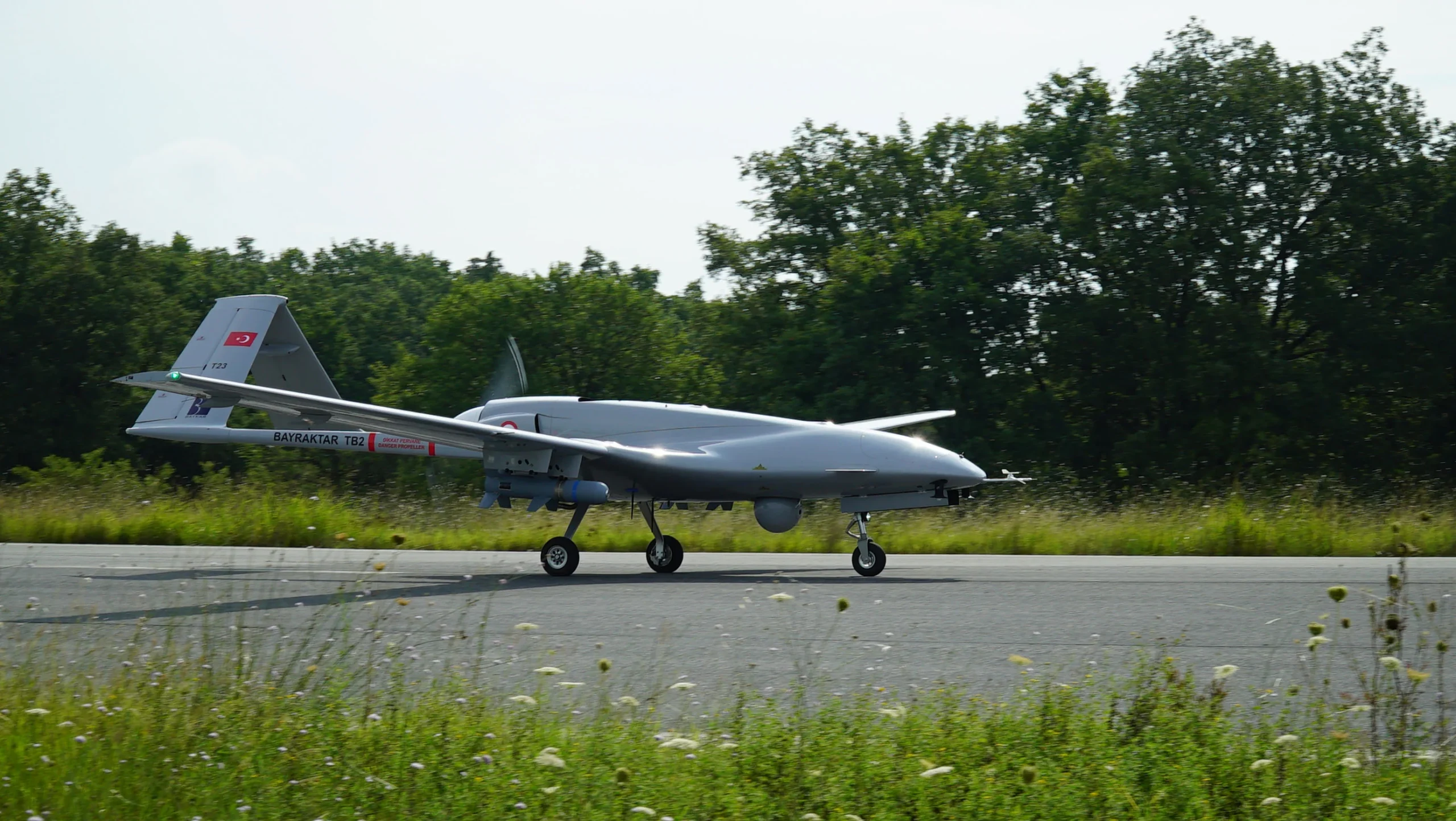
Ask Baykar how long a Bayraktar TB2 can stay in the air and the company gives you two numbers. The official spec sheet says 18-plus hours. The record book says 27 hours and 3 minutes. Both are true, and the gap between them explains most of what people get wrong about drone endurance.
| Item | Figure |
|---|---|
| Manufacturer | Baykar |
| Published endurance | 18+ hours (Baykar spec sheet) |
| Record flight | 27 hours 3 minutes (Kuwait, July 2019) |
| Record altitude | 27,030 feet (Baykar) |
| Service ceiling | 22,000 feet per Baykar; other references list 22,500 to 25,000 feet |
| Maximum takeoff weight | 700 kg |
| Payload | 150 kg |
| Wingspan and length | 12 m and 6.4 m |
| Engine | 100 hp piston engine |
What Is the Official Endurance of the Bayraktar TB2?
Baykar’s product page puts the TB2 at more than 18 hours of endurance, with an operational altitude of 16,000 feet and a service ceiling of 22,000 feet. Third-party references quote higher or lower figures. Wikipedia lists endurance as more than 20 hours, and GlobalSecurity describes the aircraft as able to loiter for more than 24 hours at 22,500 feet.
The spread is not a contradiction. Endurance depends on how the aircraft is configured, how it is flown and what the reference means by “endurance”. A figure with a clean airframe and a light camera ball is not the same as one with four munitions on the wing pylons.
How Did the TB2 Reach 27 Hours and 3 Minutes?
The record comes from a demonstration flight in Kuwait on 16 July 2019. Baykar says the aircraft flew non-stop for 27 hours and 3 minutes in high temperatures and sandstorms, which is a harsh test for a small piston-engined airframe. The company presents it as the longest flight in Turkish aviation history.
It was not the first benchmark. In 2014 the TB2 reportedly stayed aloft for 24 hours and 34 minutes, the earlier Turkish record that the Kuwait flight broke.
A record flight is a demonstration, not a mission profile. Such a sortie is flown to show the airframe, fuel system and datalink can last, and operators should not plan routine tasking around it.
Why Do Operational Sorties Run Shorter?
Several factors pull real-world missions below the record.
- Payload. Weight costs fuel burn. The TB2 can carry four MAM-L and MAM-C smart micro munitions, and an armed sortie has less margin than a pure surveillance flight.
- Transit and loiter distance. Time spent flying to a target area comes out of the loiter time over it.
- Datalink. The TB2 uses line-of-sight control from a ground station, with satellite links available for beyond-line-of-sight operation. Wikipedia gives the line-of-sight range as under 300 km. Where a mission runs past that, the operator needs a relay or a satellite terminal.
- Weather and altitude. Icing, wind and heat change fuel consumption and sensor performance.
- Crew handover. The aircraft can outlast a shift, so ground crews rotate. The ground control station hands off between operators while the drone stays on task.
Those factors are why a plan built on 18 hours and a headline of 27 can both be right about the same aircraft.
How High Can the TB2 Fly?
Altitude and endurance trade against each other, and Baykar is careful to separate the numbers. The 27,030 feet figure is a recorded altitude achievement for Turkish tactical-class aircraft, not the working ceiling. Baykar’s own specification lists 22,000 feet as the service ceiling, and day-to-day missions fly lower, around 16,000 feet.
The aircraft also took a different kind of test in May 2024. Baykar reported an autonomous barrel roll at Keşan, Edirne, with a second TB2 and an AKINCI filming the manoeuvre. It says little about endurance, but it shows the flight-control software handles more than straight-line cruising.
What Powers a 100 Horsepower Drone for a Full Day?
The TB2 runs on a 100 hp internal combustion engine. Wikipedia names the Rotax 912-iS and Baykar’s own TM100 as the options and lists a fuel capacity of around 300 litres, though Baykar’s product page does not break down fuel load, so treat that as a secondary-source figure. Cruise speed is around 70 knots in the same reference, which is the speed band where a light propeller aircraft sips fuel.
The airframe uses a triple-redundant avionics system and handles taxi, takeoff, cruise and landing autonomously, according to the manufacturer. That keeps pilot workload low during the long, boring hours that endurance flying involves.
How Many Hours Has the Fleet Flown?
Endurance on one sortie is only part of the picture. Baykar announced that the TB2 passed 400,000 flight hours, then 1 million flight hours in December 2024, covering about 150 million kilometres by its count. By the company’s own statement it is the first Turkish aircraft to pass the 1-million-hour mark. Baykar’s product page now cites more than 1.25 million operational hours.
The same release says 35 nations use Baykar’s TB2 system, and that the aircraft has been in service since 2014. Those are company figures, and operator counts depend on how deliveries and orders are tallied. For the commercial side, see the price breakdown.
How Does the TB2 Compare With Heavier Baykar Drones?
The TB2 is a tactical aircraft built to be cheap and numerous. If a mission demands more endurance, higher altitude and a bigger payload, the answer is a larger platform. Our AKINCI and TB2 comparison covers where the lighter drone stops being enough, and the AKINCI profile covers the heavy-class option.
For the full history of the type, its operators and export record, see the TB2 programme overview, and for the maker, the Baykar company profile.
So What Is the Honest Answer?
Plan on roughly 18 hours for a typical configuration, and know that a lightly loaded, well-managed airframe has flown for 27 hours and 3 minutes. Anything beyond that is either a different aircraft or an unverified claim.