Türkiye’s Arms Imports: What It Still Buys, and From Whom

Türkiye still imports major weapons, and the three countries that supply most of them are Germany, Spain and Italy. In SIPRI’s data for 2021–25, Türkiye was the world’s 24th-largest importer of major arms, taking 1.2 per cent of global imports, with Germany accounting for 31 per cent of what it bought, Spain 29 per cent and Italy 19 per cent. The United States does not appear in that top three. Türkiye’s import volume fell 9.7 per cent against the previous five-year period, while its exports rose 122 per cent. It is buying less, from a shorter list, and almost all of it from Europe.
DEFENCETÜRKIYE DATA BOX
Subject: Türkiye as an arms importer
World import rank (2021–25): 24th
Share of world major-arms imports: 1.2 per cent
Top three suppliers: Germany 31% | Spain 29% | Italy 19%
Trend: import volume down 9.7 per cent on 2016–20
Export rank over the same period: 11th, 1.8 per cent of world exports, up 122 per cent
Largest import programme under contract: 20 Eurofighter Typhoon Tranche 4+, agreed October 2025, first delivery scheduled 2030
Primary source: SIPRI, Trends in International Arms Transfers, 2025, fact sheet, March 2026
The supplier list changed, and almost nobody noticed
The more interesting finding is not the shares themselves but the fact that they moved. Comparing SIPRI’s two most recent fact sheets — the 2020–24 edition published in March 2025 and the 2021–25 edition published in March 2026 — the order of Türkiye’s three main suppliers inverted completely.
| Supplier | Share 2020–24 | Share 2021–25 | Rank move |
|---|---|---|---|
| Germany | 19% | 31% | 3rd → 1st |
| Spain | 34% | 29% | 1st → 2nd |
| Italy | 24% | 19% | 2nd → 3rd |
| Türkiye’s world import rank | 22nd | 24th | down 2 |
| Share of world imports | 1.1% | 1.2% | — |
Compiled by DefenceTürkiye from SIPRI fact sheets published March 2025 and March 2026. The two windows overlap by four years, so this is a comparison of rolling five-year averages, not of two separate periods.
Because the windows overlap, a single year dropping out and another dropping in can move a share by double digits. That is a methodological caution, not a reason to dismiss the change: the direction is consistent with what happened in the German–Turkish relationship over the same years, and the German figures published nationally point the same way.
What sits behind the German share
Germany spent most of the period after 2019 restricting arms transfers to Türkiye, and then reversed. Der Spiegel reported on 6 October 2024 that the Federal Security Council had approved a package of roughly €336 million — the first large-scale approval in years. The reported components were 100 RAM air-defence missiles from MBDA worth about €100 million, 28 SeaHake torpedoes from ThyssenKrupp’s naval division at about €156 million, material packages for the modernisation of Turkish Type 209 submarines at €79 million, and engine parts for corvettes and frigates at €1.9 million. For comparison, Germany had approved 17 small projects worth €1.22 million in 2023.
The trend continued. Citing a German Economics Ministry answer to a parliamentary question from Left Party MP Ulrich Thoden, Türkiye Today reported in December 2025 that approvals for Türkiye reached €726 million between 1 January and 8 December 2025, the highest annual figure since 1999, placing Türkiye second among recipients behind Norway. Germany’s full-year 2025 approvals then set a record at €13.11 billion, with Ukraine the largest single destination at €2.27 billion; those figures were first reported by Rheinische Post from a government response to a Die Linke question, and Türkiye was named among the major recipients without a published value.
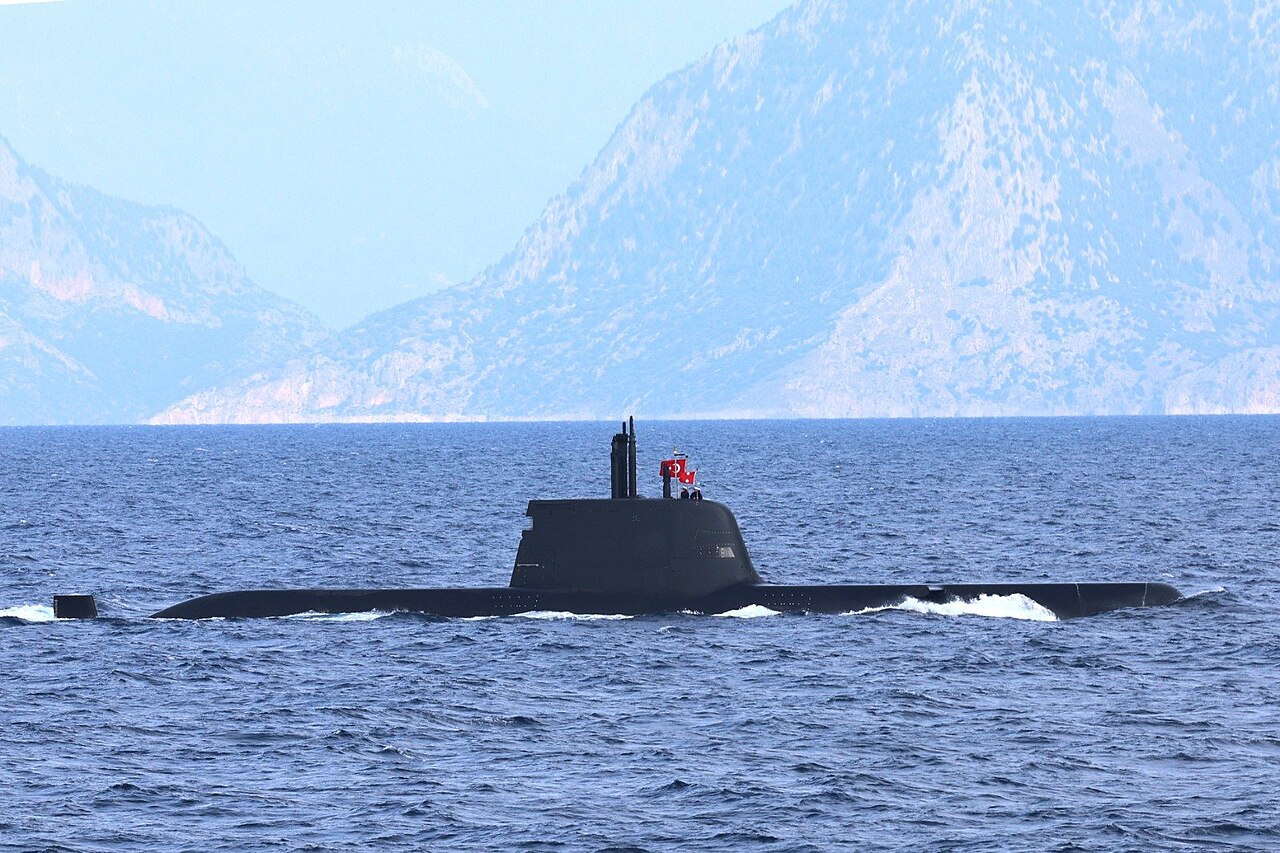
The largest German-linked programme on the books is the Reis class. Six Type 214TN air-independent-propulsion submarines are being built at Gölcük under a €2.06 billion contract signed with the Secretariat of Defence Industries in 2011, using TKMS design and material packages. The lead boat, TCG Piri Reis, was commissioned in August 2024 after long delays. TKMS announced the handover of the second boat, TCG Hızırreis, on 27 November 2025. The remaining boats are due progressively, with the full class of six expected in service by 2028.
What sits behind the Spanish share
Spain’s position is the most unusual relationship in the set, because it runs both ways. Türkiye is Spain’s second-largest arms customer, taking 16 per cent of Spanish major-arms exports in 2021–25, behind Saudi Arabia at 28 per cent. Spain is simultaneously Türkiye’s second-largest supplier. Few countries have a genuinely reciprocal defence trade; this is one.
The anchor is TCG Anadolu, built at Sedef shipyard in Istanbul from a Navantia design derived from the LHD Juan Carlos I, under a contract signed in 2015 and commissioned on 10 April 2023. The import relationship did not end at delivery. A spare-parts supply contract has been in force since 2023, and on 8 April 2026 Navantia and the Turkish Naval Shipyards General Directorate signed a framework agreement in Ankara covering maintenance and repair, on-site and remote technical support, documentation updates and specialised training, for three years with a further three-year option.
That is the part procurement analysts should read twice. A platform can be assembled domestically, counted toward localisation, and still carry a sustainment dependency on the original design authority a decade later.
Italy, and the helicopter that explains the share
Italy’s 19 per cent largely traces to rotary wing. The T129 ATAK is a derivative of the Agusta A129 Mangusta, co-produced by Turkish Aerospace with the Italian partner now inside Leonardo, with Turkish content rising across production batches and intellectual-property terms that allow Turkish export marketing. It is the clearest example of the pattern Türkiye has run for thirty years: licence in, localise progressively, then build a successor — in this case the T929, which carries a far higher proportion of Turkish subsystems.
Envanter Medya’s Turkish-language dossier on the 41-year arc from off-the-shelf purchasing to technology export sets out that progression programme by programme for readers who want the domestic framing.
The supplier that is missing
The most consequential name in Türkiye’s import table is the one that is not in it. The United States supplied 58 per cent of European NATO members’ major arms imports in 2021–25 and 42 per cent of all global transfers. It is not among Türkiye’s top three suppliers. That is the measurable residue of Türkiye’s removal from the F-35 programme and the CAATSA sanctions that followed the S-400 purchase, a position that has not formally changed despite periodic signals of movement. Türkiye is the only sizeable European NATO military whose import profile is essentially non-American.
That has a second-order effect worth naming: it is one reason Turkish industry can market systems to buyers who want to reduce their own exposure to US re-export control. Ankara did not choose the position, but it has used it.
The biggest import is still ahead
Nothing in the 2021–25 data reflects Türkiye’s largest current import commitment. In October 2025 Türkiye agreed to acquire 20 Eurofighter Typhoon Tranche 4+ aircraft, becoming the type’s tenth export customer. BAE Systems began assembling the forward fuselage of the first Turkish aircraft at Samlesbury on 5 November 2026, with Airbus Defence and Space starting centre-fuselage work in Germany; first delivery is scheduled for 2030. A separate training and support contract was signed on 25 March 2026. The consortium has since shown a slide indicating it is pursuing a second batch of 24 new-build aircraft, which is a sales pursuit, not an order. Envanter Medya’s Turkish-language report on the start of forward-fuselage assembly covers the production detail.

When those aircraft deliver, the United Kingdom, Germany, Italy and Spain will all appear in Türkiye’s import column at once, and the import line will rise sharply in the early 2030s even as domestic content elsewhere keeps climbing. Anyone projecting Türkiye’s import trend downward in a straight line should account for that.
WHY IT MATTERS
Türkiye is usually discussed as a seller. The import side tells you where the leverage over Ankara actually sits, and it is not in Washington — it is in Berlin, Madrid and Rome, and soon in London. For European governments weighing export-licence decisions, that is a live policy instrument. For buyers of Turkish equipment, the relevant question is narrower: which European-origin components sit inside the system being offered, and whose licence governs them.
What the numbers do not capture
SIPRI’s trend-indicator value measures transfers of major conventional weapons by military capability, not price paid, and it excludes most components, subsystems and dual-use equipment. A country can therefore show a falling import line while remaining dependent on imported parts. Türkiye is a case in point: the gap is concentrated in propulsion and in a handful of electronic and optical components, which is why the engine question dominates every assessment of Turkish industrial autonomy and why the headline localisation rate measures something narrower than it sounds.
Export-control exposure is also not a volume question. A single blocked licence for a low-value item can stop a high-value programme, which is the mechanism behind most of the restrictions placed on Türkiye since 2019. The import table measures what arrived, not what was refused.
BUYER VIEW
Open-source editorial analysis, not procurement advice.
Why a buyer should care what Türkiye imports: the European content inside Turkish systems is the main route by which a third country’s export policy can reach your delivery schedule. Ask which subsystems are European-origin and whether a re-export authorisation is already held, not merely available.
What the trend suggests: Türkiye’s dependence is narrowing but concentrating. Fewer categories, deeper exposure in each. Propulsion is the one to interrogate.
What is not public: Türkiye does not publish a line-item import list, and SSB does not disclose component-level foreign content by programme. Any supplier breakdown below the SIPRI level is estimate, not record.
What comes next
Three things will move these numbers. Eurofighter deliveries from 2030 will add a large, visible import line. German policy will determine whether the 2024–25 reopening becomes routine or proves to be a window; the approvals are annual decisions, not a treaty. And the domestic substitution programmes — above all engines — will determine whether the component-level dependency that SIPRI does not measure narrows at the same rate as the platform-level one. SSB has set a 2027 target of 84 per cent localisation alongside $11.5 billion in exports; the import side is the half of that equation that gets less attention.
FAQ
What does Türkiye import militarily?
Measured in major conventional weapons, Türkiye’s imports in 2021–25 were dominated by naval platforms and systems and rotary-wing programmes sourced from Germany, Spain and Italy. Its largest contracted future import is 20 Eurofighter Typhoon combat aircraft, agreed in October 2025 for delivery from 2030.
Who is Türkiye’s biggest arms supplier?
Germany, which accounted for 31 per cent of Türkiye’s major-arms imports in 2021–25 according to SIPRI. Spain was second at 29 per cent and Italy third at 19 per cent. Germany had been third in the previous five-year window.
Does Türkiye buy weapons from the United States?
Not at a scale that places the United States among its top three suppliers in 2021–25. Türkiye was removed from the F-35 programme in 2019 and sanctioned under CAATSA in 2020 following its purchase of the Russian S-400 system. It remains a large operator of previously delivered US equipment, principally F-16s.
Are Türkiye’s arms imports rising or falling?
Falling in volume. SIPRI recorded a 9.7 per cent decline in 2021–25 against 2016–20, and Türkiye slipped from 22nd to 24th among world importers between the two most recent fact sheets. Eurofighter deliveries are likely to reverse that from the early 2030s.
Is Türkiye a bigger arms exporter than importer?
Yes, by share. In 2021–25 Türkiye held 1.8 per cent of world arms exports and 1.2 per cent of world imports. Its export volume grew 122 per cent while its import volume fell. On national figures it reported $10.05 billion in defence and aviation exports for 2025, though national export totals and SIPRI’s volume rankings measure different things.
Does Spain buy more from Türkiye than it sells to it?
The relationship runs in both directions and is unusually balanced. Türkiye took 16 per cent of Spanish major-arms exports in 2021–25, making it Spain’s second-largest customer, while Spain supplied 29 per cent of Türkiye’s imports. Spain has also selected the Turkish HÜRJET trainer, a programme in which buyer rights are written into the arrangement.
Why did Germany restart arms exports to Türkiye?
German officials indicated approvals would be granted where the equipment concerned joint projects with EU or NATO partners. The October 2024 package reported by Der Spiegel was the first large approval in years, and approvals rose again in 2025. Germany has not published a policy document describing the change as a formal lifting of restrictions.
Sources
- SIPRI, Trends in International Arms Transfers, 2025, fact sheet, March 2026 — PDF (Tables 1 and 2)
- SIPRI, Trends in International Arms Transfers, 2024, fact sheet, March 2025 — PDF (Table 2)
- Naval News, TKMS hands over second Reis-class submarine, November 2025
- Naval News, Navantia life-cycle support agreement for TCG Anadolu, April 2026
- Türkiye Today, German arms export approvals to Türkiye in 2025, December 2025
- Turkish Minute, German arms export approvals reach a record in 2025, March 2026, reporting figures first published by Rheinische Post
- Der Spiegel, 6 October 2024, on the Federal Security Council approval package (reported secondarily; figures as published)
- Envanter Medya, Savunma Sanayiinin 41 Yılı: Hazır Alımdan Teknoloji İhracatına and Türk Typhoon’da Ön Gövde Montajı Başladı