Türkiye–Spain Defence Relations: Who Sells What to Whom

Türkiye–Spain defence trade has been one-way for thirty years, and it is only now turning two-way on paper. SIPRI’s March 2026 figures put Spain at 29 per cent of Türkiye’s major-arms imports in 2021–25, second only to Germany, while Türkiye absorbs 16 per cent of Spanish arms exports, Spain’s second-largest market after Saudi Arabia. Both of those numbers describe the same flow — Spain selling to Türkiye — seen from opposite ends. What makes the pairing unusual is that each country matters disproportionately to the other inside a single trade lane.
The reciprocal half is newer than the contracts page suggests. It consists almost entirely of one programme signed in December 2025, and not one aircraft has been delivered.
DEFENCETÜRKIYE DATA BOX
Relationship: Türkiye–Spain, both NATO members
Spain’s share of Türkiye’s arms imports (2021–25): 29 per cent, rank 2 (SIPRI)
Türkiye’s share of Spain’s arms exports (2021–25): 16 per cent, rank 2 (SIPRI)
World export ranks: Spain 10th (2.3 per cent), Türkiye 11th (1.8 per cent)
Largest Spanish-origin programmes in Türkiye: A400M airlifter fleet; TCG Anadolu (Navantia design)
Largest Turkish programme in Spain: HÜRJET advanced jet trainer, 30 firm aircraft
HÜRJET status: contracted December 2025, signing ceremony April 2026, deliveries expected from 2028 — none delivered
Open items: ASELSAN payload talks; Spanish-configured HÜRJET for third countries
The two numbers everyone reads backwards
The SIPRI fact sheet published in March 2026 contains two rows that get quoted together as if they proved a two-way trade. They do not, and the difference is worth setting out because it changes what the relationship actually is.
Table 1 ranks the largest suppliers and their main recipients. Spain is tenth, with 2.3 per cent of global export volume, and its three largest recipients are Saudi Arabia at 28 per cent, Türkiye at 16 per cent and Belgium at 12 per cent. Table 2 ranks the largest recipients and their main suppliers. Türkiye is twenty-fourth, taking 1.2 per cent of world imports, and its three largest suppliers are Germany at 31 per cent, Spain at 29 per cent and Italy at 19 per cent.
Both rows describe Spanish hardware moving to Türkiye. There is no row anywhere in the fact sheet showing Turkish hardware moving to Spain, because in 2021–25 essentially none did. Türkiye’s own three largest export destinations are Pakistan, the UAE and Ukraine.
What the pair does show is mutual materiality inside a one-way lane, and that is genuinely uncommon. Normally a buyer who takes 29 per cent of its imports from one supplier is a rounding error in that supplier’s order book. Here Türkiye is nearly a sixth of Spain’s entire export volume. Each side has something to lose, which is a different and more durable basis for a relationship than gratitude.
The same document also puts the two countries one rung apart as exporters — Spain tenth at 2.3 per cent, Türkiye eleventh at 1.8 per cent and up 122 per cent between the two five-year periods. They are near-peers competing for the same middle-tier export business while one of them supplies the other. Our page on what Türkiye still imports and from whom sets out the wider supplier picture, and where Türkiye actually ranks among arms exporters covers the export side.
One methodological caveat belongs next to all of these figures. SIPRI’s trend-indicator value measures the military capability of delivered items, not money paid, and it excludes most components and subsystems. It also counts deliveries, not signatures — which is precisely why the Turkish side of this relationship is invisible in it.
What Spain actually sells Türkiye
SIPRI does not publish an item-level breakdown in its fact sheet, so the composition of that 29 per cent has to be read off the public procurement record. Two programmes dominate it.
The A400M fleet. Türkiye ordered ten A400M Atlas transports and took the last of them, MSN118, on 29 March 2022 — the first Batch 7 standard aircraft off the final assembly line in Seville. Türkiye was the third nation to complete its A400M fleet. The aircraft are flown by the 12th Air Transport Main Base Command at Erkilet, Kayseri. The A400M is a four-nation European programme, but its airframes leave from Spain, and deliveries inside the 2021–25 window land in the Spanish column.
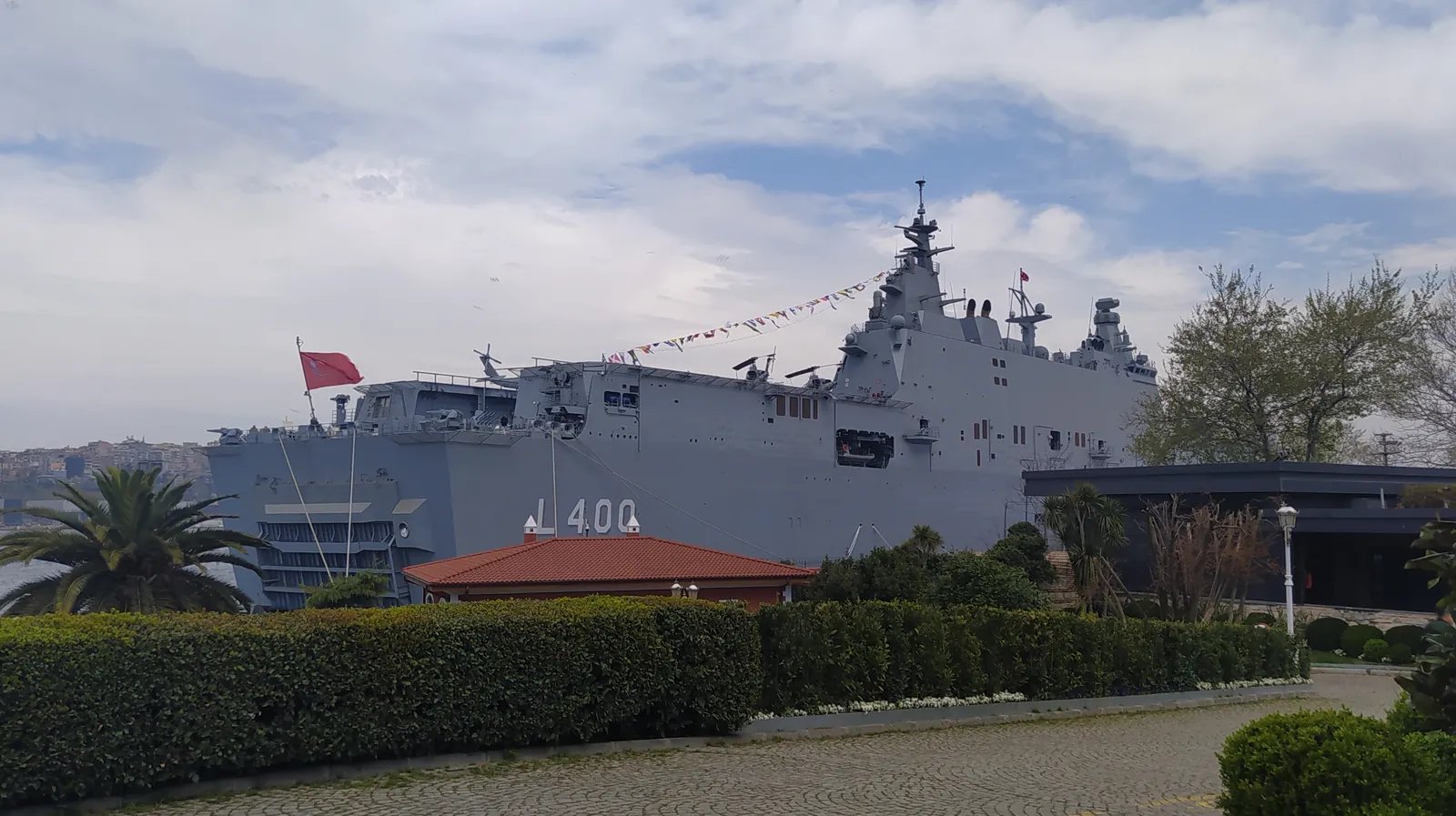
TCG Anadolu. Türkiye’s flagship amphibious assault ship was built at Sedef shipyard in Istanbul under a contract signed in 2015, to a Navantia design derived from the Spanish Navy’s Juan Carlos I. Navantia’s own account of the programme lists engineering support and technology transfer, five diesel generator sets from its engine factory and the platform’s integrated control system from Navantia Sistemas. The ship was commissioned in April 2023 and has since become the centrepiece of Turkish naval aviation experiments, as covered in our TCG Anadolu profile.
The Anadolu relationship did not end at commissioning, which is the part procurement readers should mark. A spare-parts supply contract has been in force since 2023, and on 8 April 2026 Navantia and Türkiye’s Naval Shipyards General Directorate (TGM) signed a framework maintenance agreement in Ankara — maintenance and repair, on-site and remote technical support, technical documentation updates and specialised training, for three years, renewable for three more. Alfonso Valea González signed for Navantia and Emre Dinçer for TGM.
That is the quiet lesson of the Spanish file. A platform can be assembled domestically, counted toward localisation and still carry a sustainment dependency on the original design authority a decade later. We look at the general problem in who supports Turkish weapons after the sale.
There is a longer history behind all of this. Turkish Aerospace built CN-235 light transports under licence from Spain’s CASA through the 1990s, with the first Turkish-assembled aircraft handed over in 1992. The company that is now selling Spain a jet trainer learned part of its aircraft-assembly trade on a Spanish design.
What Türkiye will sell Spain
The HÜRJET contract is the first Turkish export of a jet aircraft to a Western European NATO member, and it is the reason this relationship is now worth a page of its own.

Spain awarded the contract on 28 December 2025 for 30 aircraft, with a formal signing ceremony at Airbus facilities in Getafe, Madrid, in April 2026. Neither Airbus nor Spain’s Ministry of Defence published a contract value; press figures range from about €2.4 billion to about €2.6 billion, and the higher number is the one most Turkish and Spanish outlets carry. Separately, Spain’s Council of Ministers approved a programme with a €3.12 billion ceiling covering up to 45 aircraft under the ITS-C designation. Those are two different numbers measuring two different things — a firm order and a programme ceiling — and they should not be stacked. Reporting gives the Spanish aircraft the designation SAETA II; that name does not appear in the enabling Royal Decree, so treat it as a reported designation rather than an official one.
The financing is documented in Spanish law. Royal Decree 848/2025 of 23 September 2025 establishes interest-free direct loans from the Ministry of Industry and Tourism totalling €3,680 million across six air-domain modernisation programmes, disbursed between 2025 and 2030 without competitive tender. Article 3 allocates €1,040,000,000 to ITS-C and €520,000,000 to ITS-T, both to Airbus Defence and Space SAU. The preamble states that ITS-C is “basada en la plataforma Hurjet desarrollada por Turkish Aerospace”. Annex II routes the financing to the joint venture formed by Turkish Aerospace and Airbus DS España, provides for up to 45 aircraft produced at Turkish Aerospace facilities, and specifies that conversion to the Spanish configuration will be performed by Airbus DS España.
What the decree does not do is transfer ownership or intellectual property in the aircraft. What it writes down is an industrial right: the conversion work happens in Spain, performed by the Spanish company, together with the systems work that makes later national upgrades possible. That distinction matters for anyone reading the deal as a template — and it is the same distinction we draw in who owns the technology when you buy a Turkish weapon. For where the aircraft itself sits against the M-346 and the T-50, see our analysis of the advanced jet trainer market.
SSB head Haluk Görgün said in October 2026 that the programme is moving into a phase in which Spanish industry takes on a growing share of the aircraft’s content, and that the resulting Spanish-configured version is intended to be offered to other NATO allies and partner nations. No timeline or target country has been published.
The two-way ledger
| Direction | Item | Contract / date | Disclosed value | Status |
|---|---|---|---|---|
| Spain → Türkiye | CN-235 light transport, licence assembly by Turkish Aerospace | 1990s; first Turkish-built aircraft 1992 | Not disclosed | Delivered, in service |
| Spain → Türkiye | A400M Atlas, 10 aircraft, Seville final assembly | Final aircraft handed over 29 March 2022 | Not disclosed separately | Delivered, fleet complete |
| Spain → Türkiye | TCG Anadolu — Navantia design, engineering support, generators, IPMS | Contract 2015; commissioned April 2023 | Not disclosed | In service |
| Spain → Türkiye | TCG Anadolu spare-parts supply contract | In force since 2023 | Not disclosed | Active |
| Spain → Türkiye | Navantia–TGM framework maintenance agreement | Signed 8 April 2026, Ankara | Not disclosed | 3 years, renewable for 3 |
| Türkiye → Spain | HÜRJET advanced jet trainer, 30 firm aircraft | Awarded 28 Dec 2025; signed Getafe, April 2026 | No official figure; €2.4–2.6bn reported | Contracted; deliveries expected from 2028 |
| Türkiye → Spain | ITS-C programme envelope, up to 45 aircraft | Council of Ministers approval; RD 848/2025 loans | €3.12bn ceiling; €1.04bn + €520m state loans | Approved, not a firm order for 45 |
| Türkiye → Spain | ASELSAN payloads for the Spanish HÜRJET fleet | Contract reported 2026 | Not disclosed | Signed, scope undisclosed |
| Türkiye → Spain | ASELSAN sensors, EW pods, radios to replace cancelled Israeli kit | Talks reported October 2026 | n/a | Discussions only — nothing awarded |
Compiled by DefenceTürkiye from SIPRI, Spain’s Boletín Oficial del Estado, Navantia, OCCAR-reported delivery dates and published contract reporting. “Not disclosed” means no party has published a figure.
Spain’s third role: gatekeeper
Supplier and customer are the two obvious roles. The third is easy to miss. Spain is one of the four Eurofighter partner nations — with the United Kingdom, Germany and Italy — whose agreement the consortium requires before a Typhoon export proceeds. When Türkiye pursued the Typhoon, Germany was the holdout; reporting consistently places Italy and Spain on the supportive side, though the Turkish characterisation of other capitals’ positions is a Turkish-side account rather than an independent one.
That gives Madrid a standing position in Türkiye’s single largest combat-aircraft acquisition, on top of selling it transports and a flagship and buying its trainers. Few partners sit in three places at once.
WHY IT MATTERS
Spain is the proof that a Western European NATO member can buy a major Turkish combat aircraft without a political crisis, and it got there by being a supplier first. For procurement offices in Europe watching Turkish industry, the useful lesson is not that Spain bought a trainer — it is that the sale sat on three decades of industrial contact running the other way, and on an arrangement that gives Spanish industry conversion work and a route to a Spanish-configured variant it can market onward.
The Israeli-supplier opening
A second door opened in Madrid in 2025, and it had nothing to do with Türkiye. Spain’s parliament approved a Royal Decree-Law on 8 October 2025, by 178 votes to 169, banning defence exports to and imports from Israel, with provision for dual-use exceptions where the general national interest would be harmed. Before that, in September 2025, Spain cancelled a contract worth close to €700 million for SILAM rocket launchers derived from Elbit Systems’ PULS, and a €287.5 million order for 168 Rafael Spike anti-tank missiles through the Spanish subsidiary PAP Tecnos.
Those cancellations left capability gaps that Spain still intends to fill. In October 2026 an ASELSAN representative told the Spanish trade outlet Infodefensa that the company was in discussions with Spain about specific payloads, naming a catalogue that includes electronic warfare pods, AESA radars, electro-optical and thermal systems, laser guidance equipment and tactical radios. The same representative framed the approach as partnership-building and noted work with Spain’s Indra.
Nothing has been awarded. ASELSAN has no direct equivalent to the SILAM launcher or the Spike missile itself, and the reporting is explicit that talks are talks. Our report on the ASELSAN–Spain discussions sets out what was and was not said.
Why Spain, and not another European buyer
Three structural reasons, none of which is “the HÜRJET is the best trainer available”.
Spain needed a platform, not a product. Airbus Defence and Space España needed an aircraft programme to anchor Spanish aeronautical work after the F-5 replacement decision, and RD 848/2025 funds it as an industrial modernisation programme rather than an off-the-shelf purchase. Türkiye offered a design that could be built in Türkiye and converted in Spain. A European competitor selling a finished aircraft could not offer the same conversion work.
Spain is a middle-tier exporter itself. At 2.3 per cent of world exports it sits one rung above Türkiye, and its own import profile — 49 per cent from the United States, 25 per cent from Switzerland and 9.1 per cent from France — gives it the same incentive every middle-tier producer has to spread its dependencies. The manufacturer on the Turkish side of the deal is profiled in our Turkish Aerospace company file.
The relationship already existed. This is the point that generalises. Poland, Romania and Spain have all bought Turkish systems in the last three years, and the Spanish deal is by some distance the largest — but Spain is also the one of the three with a thirty-year industrial history with Turkish industry running in the opposite direction. Our wider survey of Turkish defence exports in Europe and our file on what Warsaw actually buys cover the comparison cases.
What the relationship is not
Four limits, stated plainly.
- It is not balanced. Spain’s deliveries are complete; Türkiye’s have not started. If HÜRJET slips, the balance stays where it is.
- It is not an alliance. There is no joint doctrine, no basing arrangement, no combined force structure. It is trade and industrial participation.
- Türkiye has not displaced Spain’s main supplier. Spain takes 49 per cent of its own imports from the United States, 25 per cent from Switzerland and 9.1 per cent from France. Türkiye is not in that list.
- The sustainment dependency runs one way. Navantia remains the design authority on Türkiye’s flagship, under an agreement renewed in 2026. There is no equivalent Turkish position inside a Spanish platform, and there will not be one until HÜRJET is in Spanish service.
BUYER VIEW
Delivery: No HÜRJET has been delivered to Spain. First deliveries are expected from 2028; a buyer evaluating the type now is buying a schedule, not a fleet in service.
Cost data: Unusually good by Turkish export standards. Spain’s Council of Ministers approval and RD 848/2025 put real euro figures in the public record — but they are a programme ceiling and state loans to the Spanish partner, not a unit price.
Industrial partnership: The strongest part of the package. Conversion work performed in Spain by a Spanish company, with a route to a nationally configured variant. No ownership or IP transfer is written into the decree.
Export limitations: A Spanish-configured HÜRJET offered to third countries would carry Spanish and European content, and therefore Spanish and European export-control exposure alongside Turkish. That cuts both ways for a prospective third-country buyer.
Support: Untested. Türkiye has no in-service support footprint in Western Europe yet, which is precisely the capability Spain’s own experience as a supplier to Türkiye demonstrates the value of.
Open-source editorial analysis. DefenceTürkiye does not advise governments.
What comes next
Three things to watch, in order of how much they would change the picture.
The first is the Spanish-configured HÜRJET. If Airbus DS España and Turkish Aerospace put a jointly marketed variant in front of a third NATO customer, the relationship stops being bilateral trade and becomes a joint export platform — a materially different proposition for Turkish industry than selling aircraft one air force at a time.
The second is whether any ASELSAN discussion converts into a Spanish contract. A single awarded sensor or EW programme would establish Turkish electronics inside Spanish force structure, which is a harder precedent to reverse than an aircraft order.
The third is the first HÜRJET delivery itself. Until an aircraft is handed over, every claim made about this relationship rests on paper.
FAQ
Is Spain really Türkiye’s second-largest arms supplier?
Yes, by SIPRI’s measure. Its March 2026 fact sheet puts Spain at 29 per cent of Türkiye’s major-arms imports in 2021–25, behind Germany at 31 per cent and ahead of Italy at 19 per cent. SIPRI measures delivered military capability rather than money, and excludes most components, so the figure describes major platforms rather than total defence trade.
Do the 29 per cent and 16 per cent figures mean the trade runs both ways?
No. Both describe Spanish equipment going to Türkiye — once from the importer’s side and once from the exporter’s side. SIPRI records no significant Turkish arms deliveries to Spain in 2021–25. The two-way element of the relationship rests entirely on contracts signed from December 2025 onward, none of which has been delivered.
How many HÜRJETs has Spain ordered?
Thirty firm aircraft, contracted in December 2025, with a signing ceremony in Madrid in April 2026. No official contract value has been published; reported figures run from about €2.4 billion to about €2.6 billion. Spain’s Council of Ministers separately approved a programme with a €3.12 billion ceiling covering up to 45 aircraft. The 45 figure is a ceiling, not an order.
Has Spain received any HÜRJETs?
No. Deliveries are expected to begin in 2028. The aircraft will be produced at Turkish Aerospace facilities and converted to Spanish configuration by Airbus Defence and Space España.
Did Spain build TCG Anadolu?
No — it was built at Sedef shipyard in Istanbul. The design is Navantia’s, derived from the Spanish Navy’s Juan Carlos I, and Navantia supplied engineering support, technology transfer, five diesel generator sets and the integrated platform management system. Navantia also holds the spare-parts contract and, since April 2026, a framework maintenance agreement with Türkiye’s Naval Shipyards General Directorate.
Is Türkiye replacing Israel as a supplier to Spain?
Not so far. Spain cancelled the SILAM and Spike contracts in September 2025 and its parliament passed an arms embargo on Israel in October 2025. ASELSAN said in October 2026 that it was in talks with Spain about payloads. No replacement contract has been announced, and ASELSAN does not offer a direct equivalent to either cancelled system.
Did Spain have to approve Türkiye’s Eurofighter purchase?
Spain is one of four Eurofighter partner nations whose agreement the consortium requires for an export. Reporting places Italy and Spain on the supportive side, with Germany the holdout that delayed the Turkish deal.
Which country gets more out of the relationship?
On delivered volume, Spain — everything it has sold has arrived, and nothing Türkiye has sold has. On trajectory, Türkiye, because the HÜRJET contract is larger than anything Spain has sold Türkiye in a single programme and opens a route into the European trainer market. Both statements are true at once, and which matters more depends on whether the 2028 delivery date holds.
Sources
- SIPRI, Trends in International Arms Transfers, 2025, fact sheet, March 2026 (Tables 1 and 2)
- Boletín Oficial del Estado, Real Decreto 848/2025, de 23 de septiembre
- Navantia, Navantia to provide life-cycle support for the Turkish Navy amphibious ship Anadolu, April 2026
- Infodefensa, interview with ASELSAN on expanding its presence in Spain, October 2026
- The Aviationist, Spain signs contract for 30 HÜRJETs, December 2025
- Turkish Minute, Spain signs €2.6bn deal for 30 Turkish-made HÜRJET jet trainers, December 2025
- FlightGlobal, Turkey completes its A400M fleet with 10th delivery
- Middle East Eye, Spain’s parliament approves arms embargo against Israel, October 2025
- Breaking Defense, London’s Eurofighter sale to Turkey