ASELSAN to Build Precision-Munitions Plant in Azerbaijan’s Nakhchivan Exclave

ASELSAN has agreed in principle to build a production facility in Nakhchivan, the Azerbaijani exclave wedged between Armenia, Iran and Türkiye, under a preliminary agreement signed with local partner NOVASIS on September 30 at the ADEX 2026 exhibition in Baku. Haluk Görgün, head of Türkiye’s Presidency of Defence Industries (SSB), announced the term sheet, saying it covered manufacturing technology tied to three ASELSAN product families: laser guidance kits (LGK), TOLUN precision-guided munitions, and the KORKUT air defence gun system.
The agreement is a term sheet rather than a firm construction contract. Neither ASELSAN nor the SSB has disclosed an investment figure, a production start date, planned output volumes, or how ownership and technology-transfer terms will be structured between ASELSAN, its Baku-registered subsidiary ASELSAN BAKÜ LLC, and NOVASIS.
Why Nakhchivan
Nakhchivan’s location is the story here as much as the factory itself. The exclave has no land border with the rest of Azerbaijan, sitting instead against Armenia, Iran and a short stretch of Türkiye along the Aras river. Since the 2020 Nagorno-Karabakh war and the subsequent opening of transit corridors under discussion between Baku, Ankara and Yerevan, Nakhchivan has drawn fresh attention as a potential land bridge connecting Türkiye to the wider Turkic world via Azerbaijan and onward to Central Asia. Locating a defence plant there gives Türkiye an industrial foothold in a strategically sensitive corridor rather than purely in Baku, and ties Ankara’s defence-industrial presence to a part of Azerbaijan that borders Türkiye directly.
What the Plant Would Build
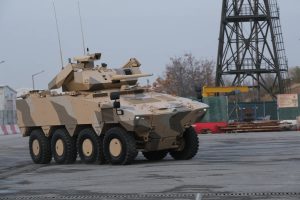
The three product lines named are all established ASELSAN munitions rather than new developments. Laser guidance kits convert unguided bombs and rockets into precision weapons by bolting on a seeker and control fins; ASELSAN has demonstrated several LGK variants at recent weapons trials. TOLUN is ASELSAN’s family of precision-guided glide munitions, built for release from fixed-wing aircraft and unmanned platforms including Baykar’s AKINCI; the company opened a dedicated $56 million guided-weapons production plant in Türkiye for the same product lines last year. KORKUT is ASELSAN’s twin-barrel 35mm self-propelled anti-aircraft gun, developed originally for the Turkish Army’s short-range air defence requirement and increasingly pitched abroad as a counter-drone system; DefenceTürkiye has covered KORKUT’s design and export pitch separately.
Manufacturing all three locally in Azerbaijan, rather than exporting finished rounds, would mark a step up from ASELSAN’s existing Azerbaijani sales, which to date have mostly involved complete systems such as the ASELFLIR-500 electro-optical pod and the TOLUN munitions it carries, sold at the 2024 edition of ADEX.
Part of a Broader Localisation Push
The Nakhchivan term sheet was the least detailed of the five agreements Turkish companies signed with Azerbaijan at ADEX’s opening day, a package SSB chief Görgün valued at more than $500 million and which DefenceTürkiye detailed when the deals were announced. But it may prove the most structurally significant, since it points toward co-production rather than a one-off sale. Roketsan has already taken a similar path in Azerbaijan through AZROKSAN, its joint venture with state firm STP that is preparing to assemble 122mm artillery rockets locally. If the ASELSAN-NOVASIS facility proceeds from term sheet to construction, it would give Türkiye two parallel local-manufacturing footholds in Azerbaijan within the same defence-industrial relationship — one in rockets, one in guided munitions and air defence.
Görgün has described Turkish-Azerbaijani defence cooperation as moving from “an arms-supplier relationship toward one built around co-production and technology transfer,” a framing Ankara applies elsewhere in its export strategy, including with Indonesia and Pakistan. Whether the Nakhchivan plant follows through depends on steps neither government has yet detailed: a binding investment agreement, Azerbaijani regulatory approval for a sensitive exclave location, and ASELSAN’s own capital allocation, which is already stretched across a $6.5 billion order book and expansion of Çelik Kubbe air defence production at home.