Turkish Pilots Now Log Hours in Simulators Before They Touch a Jet

A trainee pilot who makes a bad call in a simulator restarts the scenario. In a jet, the same mistake costs an airframe or a life. That asymmetry is the core reason air forces, armies and navies pour money into military simulation technology, and Türkiye has spent two decades building a domestic supply chain for it, led by the state-owned software house HAVELSAN.
This piece looks at what simulators actually replace, how the hardware works, and where Turkish programmes stand, using published company and trade-press material.
What Does a Military Simulator Actually Replace?
Three things: aircraft hours, ammunition and risk. Every flight hour on a fighter or jet trainer burns fuel, consumes engine life and ties up maintenance crews. A simulator hour does none of that, and it can rehearse scenarios nobody would fly for real, such as engine fires, loss of hydraulics, hostile air defences or formation emergencies.
Simulators do not replace flying. They reorder it. Basic procedures, instrument work and emergency drills move to the ground, so the scarce hours in the aircraft go to what only an aircraft can teach.
How Did Turkish Pilot Training Start Using Simulators at Scale?
The clearest early example is the TESIM and ARISIM pair of programmes, started in 2009 and operational by 2013, according to Turkish defence press coverage. TESIM covered the KT-1T turboprop trainer: two operational flight training simulators, two instrument flight training simulators, two aircraft training devices, an aircraft abandoning trainer and a simulator training centre building. ARISIM added two T-38 operational and two T-38 instrument simulators.
The reported training figures show the logic. In 2013 the system trained 280 pilot candidates and logged 9,000 simulator hours. The programme described a syllabus that mixed about 60 hours of real flying on the KT-1T and T-38 with 30 hours in the simulator. The simulators carried more than 150 programmed failure and emergency cases and could run virtual formation flights with up to eight aircraft at once. The visual system was reported as 270 degrees wide and 115 degrees tall.
What Is Inside a Full Mission Simulator?
A modern fighter simulator is several systems stacked together.
- Cockpit replica. Real or faithfully reproduced switches, displays and controls, so muscle memory transfers to the aircraft.
- Visual system. Projectors on a dome or collimated displays that present terrain, weather, targets and other aircraft.
- Flight and systems models. Software that reproduces how the aircraft handles and how its radar, weapons and avionics respond.
- Motion or sensation cues. Platforms or seats that move the pilot, a feature that matters more for rotary-wing and transport training than for some fighter tasks.
- Instructor station. Where failures are injected, scenarios are changed and the debrief data is recorded.
HAVELSAN’s F-16 work with Lockheed Martin shows the scale. The company has described full mission simulators with a 360-degree dome and 25 projectors, a roll-in, roll-out cockpit that lets the same visual system serve different cockpit configurations, and a network of six full mission simulators and 20 weapons and tactics trainers across six main jet bases. A separate F-16 troubleshooting trainer for maintainers simulates about 1,000 faults, per the company.
Why Does Motion Matter?
Motion systems range from a full six-degree-of-freedom platform to something as simple as the two-degree-of-freedom arrangement HAVELSAN describes for its submarine diving simulator, built to give trainees a sense of real vessel movement. The purpose is not realism for its own sake. It is giving the trainee body cues, such as sink rate, vibration and pitch, that help a correct reflex form under normal and emergency conditions.
HAVELSAN has also shown a flight training simulator combining extended reality with a 360-degree motion system at the IDEF 2023 defence fair, an indicator of where the market is moving, towards compact and cheaper devices for early training stages.
Are Simulators Only for Pilots?
No, and this is where the cost argument gets stronger. Armour, naval and maintenance training all carry high running costs.
For the ALTAY main battle tank, HAVELSAN is delivering a training package reported at 94 training products across 44 product types, split into 10 batches, with the first batch scheduled for the end of 2025 and deliveries continuing over the following three years. The package combines real mechanical structures with virtual and augmented reality, includes a virtual maintenance and fault simulation system, and features a live turret training model with a domestically developed motion system. Trainees can practise fire control, communications and command procedures and troubleshoot faults without using up a real tank. For the vehicle itself, see our ALTAY programme overview.
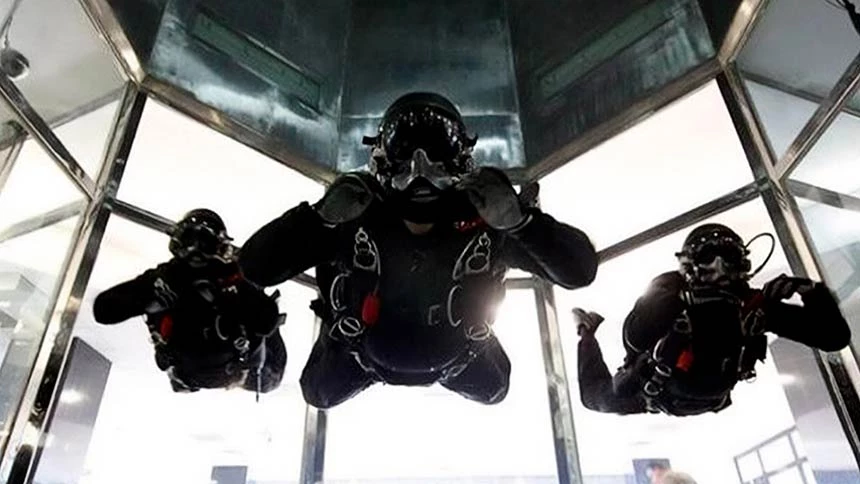
The company’s wider portfolio, as listed on its simulation pages, also includes sniper, parachute, forward air controller, firing and vertical wind tunnel trainers. A trade-press profile also lists helicopter simulators for platforms such as the T-129 ATAK, as well as naval systems, and cites 80 percent local content in the ATAKSIM project.
Which New Aircraft Come With Their Own Simulators?
HÜRJET is the best current case. HAVELSAN has said it started simulator work about three years before the April 2026 announcement and fed the effort into engineering tests, cockpit scenario development and validation during flight testing. A full mission and flight training simulator is expected to reach the Turkish Air Force in the fourth quarter of 2026, according to reports. Spain, which has been named as an export customer for the jet, is due to receive a simulator and the FSGP flight simulation and mission planning system, described as the first international export of that planning tool. Background on the aircraft is in our report on where HÜRJET fits in the advanced jet trainer market and the first production aircraft’s maiden flight.
Developing the trainer alongside the aircraft is the point. It means a pilot’s first sorties on a new type are rehearsed before the first student sits in the real cockpit.
Is Türkiye Building Capacity or Just Buying Simulators?
Building. HAVELSAN says it has more than 40 years in simulation and has delivered over 400 simulators for more than 60 military and civil platforms. In Ankara, a 17,000 square metre facility under construction, expected to finish in 2027, is planned to produce more than 30 full flight simulators a year and, with existing infrastructure, handle up to 40 civil and military simulators at once, according to the company. It will use the STARVIEW-B collimated visual system, part of the STARLINE full flight simulator family. The civil side is already visible in the A320 simulator orders from Turkish carriers.
The company’s broader role is covered in our HAVELSAN company profile, and smaller suppliers such as SDT also contribute trainers and recorders, as in our piece on SDT’s recorders and trainers.
What Are the Limits?
Simulators cannot reproduce everything. High-g stress, real weather turbulence and the judgement of flying close to other aircraft still need airborne experience, which is why the 2013 syllabus kept most hours in the air. Fidelity also depends on data from the aircraft maker, which is why early cooperation with programmes such as HÜRJET matters. Public figures on exact flight-hour savings per student are limited, and the numbers above come from programme reporting rather than an independent audit.
What can be said with confidence is the direction. New Turkish types now arrive with their trainers in parallel, and the domestic industry is expanding the capacity to build them.