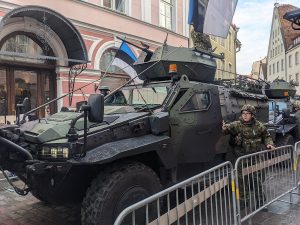
How FNSS Stretched PARS From a 4×4 Scout to an 8×8 Fighting Vehicle

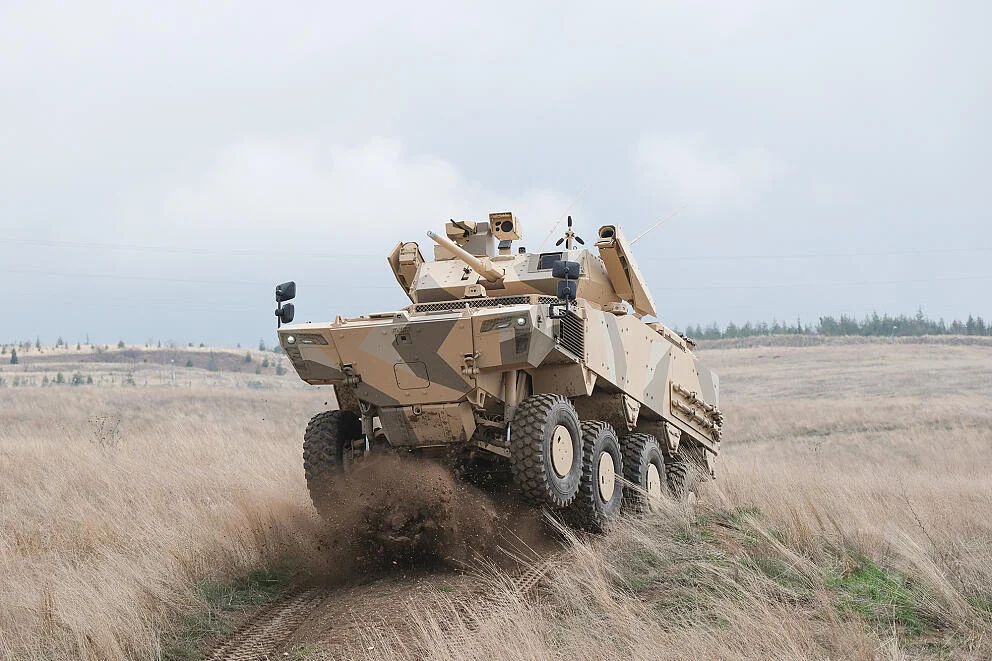
Most armoured vehicle makers pick a weight class and build around it. FNSS did something different with PARS. The Ankara-based company took one design philosophy, balanced axle loads, all-axle steering and a mine-resistant hull, and stretched it from a 4×4 scout to an 8×8 vehicle of roughly 30 tonnes. The result is a wheeled family that now spans reconnaissance, command posts, special operations and infantry carriers.
The name is Turkish for leopard. The programme began in the early 2000s with technical support from the US firm General Purpose Vehicles (GPV), according to open-source references, and the vehicles were first shown publicly at IDEX in Abu Dhabi in 2005. Two decades later the line is FNSS’s main wheeled export product and a growing part of Turkish Land Forces procurement.
| Item | Detail |
|---|---|
| Manufacturer | FNSS Savunma Sistemleri A.S., Ankara |
| Type | Wheeled armoured combat vehicle family |
| Configurations | 4×4, 6×6, 8×8 |
| Models listed by FNSS | PARS 4×4, PARS III 6×6 and 8×8, PARS Scout 6×6 and 8×8, PARS IV 6×6 S-Ops and 8×8, PARS ALPHA 8×8 |
| Road speed | Up to 100 km/h (PARS III, Scout); over 115 km/h (PARS ALPHA), per FNSS |
| Known export customer | Oman (PARS III) |
What Does the PARS Family Actually Include?
FNSS lists eight models on its website, and the naming can confuse. The simplest way to read it is by size and mission.
The PARS 4×4 is the smallest. FNSS describes it as a vehicle for advanced surveillance, anti-tank and command and control roles, with a crew of four, a power-to-weight ratio of 25 hp per tonne and amphibious capability using two rear propellers. It can climb 70 percent slopes and cross 0.4 metre vertical obstacles, according to the company.
The PARS III is the workhorse. The 6×6 has a stated combat weight of 25,000 kg and the 8×8 of 30,000 kg. Both run a diesel engine with a fully automatic transmission and reach up to 100 km/h on road. The 8×8 claims the tightest turning radius in its class at 8 metres, thanks to all-axle steering. Trench crossing is 1.75 metres for the 6×6 and 2 metres for the 8×8.
The PARS Scout, in 6×6 and 8×8 form, targets reconnaissance and internal security. FNSS quotes 20 hp per tonne including payload and the same 100 km/h road speed. The PARS IV pair, a 6×6 special operations vehicle and an 8×8 “new generation” carrier, sit higher in the line. The S-Ops version carries two remote-controlled turrets, front and rear, that take 7.62 mm or 12.7 mm machine guns or a 40 mm grenade launcher.
Why Does the 6×6 and 8×8 Split Matter?
Wheel count is a trade between size, payload and footprint. A 6×6 is shorter and lighter, easier to move by air and through narrow streets. An 8×8 carries more troops or a heavier turret and spreads weight over four axles.
FNSS designs both on a shared logic. Its product pages stress an engine layout that gives near-equal load on each axle, a central tyre inflation system, and axles that can be locked on soft ground. Sharing that approach across sizes lets the company offer a customer a mixed fleet with common training and, in principle, common parts. That is the pitch behind the “weight classes” idea, though specific parts commonality figures are not published by the company.
How Is the Family Configured for Different Missions?
The PARS IV 8×8 is the clearest example of modularity. FNSS says it can be built as an infantry fighting vehicle, reconnaissance, command and control, personnel carrier, mortar carrier, combat engineering, CBRN or recovery vehicle. The two-man driver compartment gives more than 180 degrees of visibility, and panoramic periscopes with thermal cameras front and rear feed the crew.
Open-source references also credit the family with a baseline of STANAG 4569 Level 4 ballistic protection and 25 mm turret options, but FNSS does not publish a single protection figure for the whole range. Armour levels depend on the variant and the add-on kits a customer orders, so any one number should be read with care.
Turrets are the other lever. The company pairs the vehicles with its own remote weapon stations and two-man turrets, and, as the Spanish teaming shows, with partner turrets when a customer asks.
What Is PARS ALPHA and How Does It Differ?
PARS ALPHA is the newest 8×8. FNSS unveiled it at the World Defense Show in Riyadh in February 2024 as a new generation armoured fighting vehicle for what it calls full-spectrum operations.
The company claims a road speed above 115 km/h, a range above 800 km, the ability to take 40 percent side slopes, 70 percent gradients, 2.4 metre trenches and 0.8 metre vertical steps, and a 5,000 km endurance interval without field maintenance. It uses hydro-pneumatic suspension with adjustable ride height, can lower itself for stability at speed, and keeps moving after tyre or wheel loss. Positive-pressure CBRN protection is standard. These are manufacturer figures, not independent test results.
Secondary reporting gives further numbers, including a 711 hp engine and a crew of nine, but those come from trade coverage rather than FNSS’s own product page, so treat them as reported.
Who Has Bought PARS Vehicles?
Oman is the clearest export success. Open-source accounts describe a 2015 contract for 172 PARS III vehicles, 145 of them 8×8 and 27 of them 6×6, in 13 variants, delivered between 2017 and 2020. The reported value is around 500 million dollars. In 2022 FNSS announced a depot-level maintenance facility for the Omani fleet, and the vehicles appeared in Omani exercises in 2024.
At home, the Turkish Land Forces already operate PARS 4×4 and PARS IV 6×6 vehicles, according to open-source listings. FNSS said ahead of SAHA 2026 that PARS İZCİ 6×6 command and control vehicles were nearing the end of their deliveries to the Land Forces, and that PARS ALPHA 8×8 would be delivered to the service. Trade press reported a first order of 25 PARS ALPHA vehicles in 6×6 and 8×8 configurations after field trials run by the Presidency of Defence Industries (SSB), with a much larger total requirement mentioned but not officially confirmed.
The family also left a mark in Malaysia. The 8×8 AV8 Gempita built by DefTech is widely described as based on PARS technology, the product of an earlier FNSS and Malaysian cooperation. For the wider export picture, see our look at how FNSS turned Turkish armoured vehicles into exports.
Is Europe the Next Market?
FNSS is pushing that way. In May 2025 FNSS, Belgium’s John Cockerill Defense and the Spanish firms TSD and Grupo Oesia signed a memorandum of understanding to offer a 6×6 cavalry vehicle to the Spanish Army, based on the PARS ALPHA 6×6 concept. The reported design pairs the vehicle with John Cockerill’s 3000 Series turret, which can take guns up to 50 mm or a 105 mm direct-fire weapon. The partners said they would handle design, assembly, production and turret integration together with local support.
An MoU is not a contract, and the Spanish outcome is still open. Our coverage of the European partnership and what it could mean for exports goes into the commercial logic.
How Does PARS Fit Beside Other Turkish Wheeled Vehicles?
FNSS competes at home with Otokar, BMC and Nurol, each strong in different segments. A side-by-side comparison is in our piece on how Turkish armoured vehicle makers divide the market, and the buyer view is covered in why countries buy Turkish armoured vehicles.
PARS is only one half of the FNSS catalogue. The company’s tracked line and its amphibious assault vehicle, covered in our ZAHA profile, serve different customers. Within wheeled vehicles, though, PARS gives FNSS something rarer than a single hit product. It gives a buyer a ladder, from a four-person scout to a 30-tonne carrier, on one engineering base.
Watch for three things next: the size of the PARS ALPHA order for Türkiye, whether the Spanish teaming turns into a competition entry, and whether a second Gulf or European customer follows Oman.