Türkiye and Nigeria: Why Abuja Buys Turkish Weapons


Nigeria buys Turkish weapons because Türkiye sells equipment Abuja can pay for in instalments it controls, delivers inside a political window no Western capital can guarantee, and attaches no parliamentary veto to the sale. Nigeria is the largest arms importer in sub-Saharan Africa — 16 per cent of the subregion’s major-arms imports in 2021–25, on SIPRI’s figures — and the single most important Turkish customer south of the Sahara. The relationship now spans armed drones, attack helicopters, offshore patrol vessels and armoured vehicles. What it still does not contain, after three years of forums and memoranda, is one signed production line on Nigerian soil.
DEFENCETÜRKIYE DATA BOX
| Relationship | Türkiye–Nigeria defence cooperation |
| Legal basis | 2021 Defence Industry Cooperation Agreement; Protocol on Military Cooperation signed Ankara, 27 January 2026 (ratification still in progress) |
| Nigeria’s import rank | Largest recipient in sub-Saharan Africa, 16% of subregional imports (SIPRI, 2021–25) |
| Türkiye’s supplier rank | 3rd to the subregion overall, 11% — behind China (22%) and Russia (12%) |
| Main Turkish categories | Armed UAVs, attack helicopters, offshore patrol vessels, 4×4 armour, loitering munitions |
| Known Turkish suppliers | Baykar, Turkish Aerospace, Dearsan, Otokar, ASISGUARD, DASAL; HAVELSAN and ASELSAN in talks |
| Local production | Discussed and memorialised, not contracted as of November 2026 |
| Nigeria’s 2026 defence budget | ₦3.154 trillion; 75.9% personnel; ₦464.47bn capital |
What Nigeria Actually Operates, and What It Only Expects
The gap between what Nigeria is reported to have bought and what can be documented as delivered is unusually wide, and any procurement analyst reading about this relationship should start there. Nigeria’s armed forces do not publish a platform-by-platform inventory, and Turkish suppliers rarely disclose delivery counts for African customers, a problem that runs across Türkiye’s wider sub-Saharan customer base. The table below separates the two.
| System / supplier | Reported quantity | Documented status, November 2026 |
|---|---|---|
| Bayraktar TB2 Baykar |
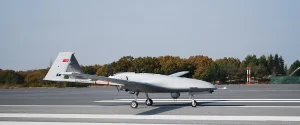
43 ordered | In service. Order figure from Shephard’s database; delivered total never officially published, and the Army/Air Force split is disputed between sources |
| T129 ATAK Turkish Aerospace |
6 ordered (July 2022) |
First two delivered October 2023; inductions ran into 2024 |
| T129 ATAK, second tranche Turkish Aerospace |
6 more | Expected, not confirmed contracted. Listed in a Nigerian Air Force fleet-development disclosure, October 2026 |
| AKSUNGUR Turkish Aerospace |
12 | Expected, not confirmed contracted. Same October 2026 disclosure |
| OPV-76 offshore patrol vessel Dearsan |
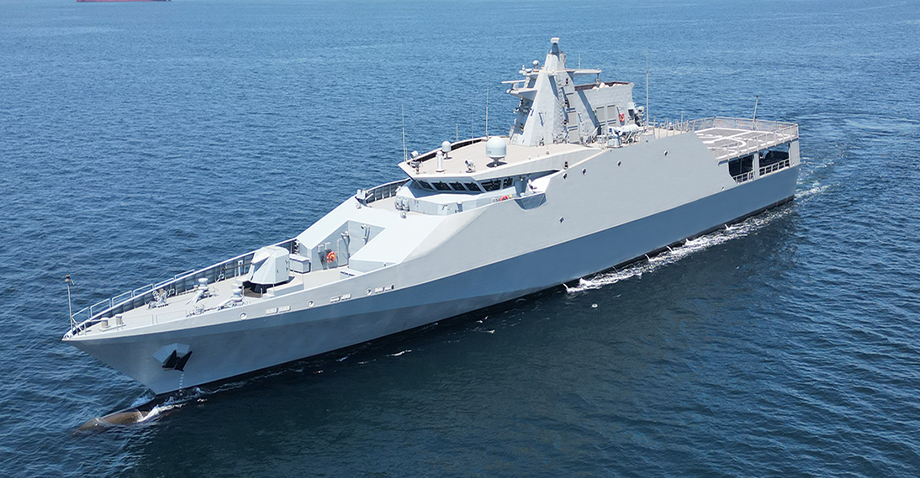
2 | Signed Abuja 3 Nov 2021; keel 16 Sep 2022; launched 26 Oct 2023 and 19 Apr 2024; sea trials reported 2025. Final handover not publicly confirmed |
| NNS Aradu refit; Tuzla-class boat Dearsan |
1 refit, 1 boat |
Agreed at a June 2023 Abuja ceremony; completion not announced |
| Cobra armoured vehicles Otokar |
Undisclosed | In service |
| Songar armed quadcopter ASISGUARD |
Undisclosed | In service |
| MIKON loitering munition, FALCON R556, PUHU DASAL, via NIGUS International |
Indicative: 100,000 / 200 / 100 |
Framework agreement only (SAHA 2026, Istanbul, May). No published delivery schedule; how much is firm versus a ceiling is undisclosed |
Compiled by DefenceTürkiye from contract announcements, Nigerian Air Force disclosures, Shephard Defence Insight and company statements. Quantities in italic-free “expected” rows are plans, not orders.
Two things stand out. First, every large Turkish item in Nigerian service was bought as a discrete tranche — six helicopters, two ships — rather than as a fleet programme. Second, the most eye-catching number in the whole relationship, the 100,000 MIKON loitering munitions, rests on a framework agreement that neither DASAL nor NIGUS has converted into a published order. Treating that figure as a sale would be the single easiest mistake to make about this market.
WHY IT MATTERS
Nigeria is the test case for whether Turkish industry can hold a major African market once richer competitors arrive. Ankara got in early, during years when Washington hesitated over human-rights conditions and Abuja needed counter-insurgency aircraft quickly. That window has now closed: American attack helicopters and Italian light-attack jets are in production for Nigeria, funded by far larger contracts than anything Türkiye has signed there. Whether Turkish firms stay relevant depends less on hardware than on whether they convert three years of localisation talk into a factory.
Why Abuja Bought Turkish in the First Place
Three reasons recur in Nigerian official statements, and none of them is a claim that Turkish equipment outperforms the alternatives.
Availability when it mattered. Nigeria’s requirement was urgent — armed drones for operations against Boko Haram, Islamic State West Africa Province and, latterly, mass-abduction gangs in the north-west. Turkish suppliers quoted delivery in months. The pattern is consistent across Turkish export markets and is covered in more detail in our analysis of how fast Turkish defence firms actually deliver.
No end-use veto. Turkish sales are licensed by Ankara’s own export-control machinery, which is executive-led and does not route through a legislature with an independent power to block. For a government that had previously seen American transfers delayed over Leahy-law vetting, that predictability has a price premium of its own. We set out the mechanics in who approves a Turkish arms export, and who can stop it.
Affordability at tranche scale. This is the under-reported one, and it is where most English-language coverage of the relationship goes wrong.
The Budget Ceiling Nobody Writes About
Nigeria’s 2026 defence allocation is ₦3.154 trillion — a nominal record, and roughly 8.5 per cent smaller in real terms than 2025 once inflation is applied. The composition matters more than the headline. Pay and allowances absorb about ₦2.4 trillion, or 75.9 per cent. Capital and equipment take ₦464.47 billion, close to 15 per cent, the lowest share since 2021. Army and Navy investment budgets fell roughly 37 per cent in real terms. For continental context, Envanter Medya maintains a Turkish-language ranking of Africa’s ten largest defence budgets for 2026.
WHERE NIGERIA’S 2026 DEFENCE NAIRA GOES
At prevailing exchange rates, that capital line is worth somewhere around 300 million dollars for all three services combined, in a year. Set it against the single American helicopter package now in production for Nigeria — notified to the US Congress in 2022 at a ceiling of 997 million dollars, with a 2024 Bell production contract of roughly 455 million — and the arithmetic becomes obvious. Nigeria does not fund major procurement out of its annual capital vote. It funds it through multi-year foreign military sales credit, supplier finance and occasional supplementary appropriations.
That is precisely the structure Turkish industry is good at and bad at in equal measure. Good, because a six-helicopter or two-ship tranche fits inside what Abuja can commit without a decade-long credit arrangement. Bad, because Türkiye cannot match the financing depth behind an American FMS package or a European export-credit line — a constraint we examine in how Turkish arms sales in Africa are financed and taught.
Nigeria Is Not a Turkish Client State
English-language commentary tends to file Nigeria under “Turkish drone customer” and stop. The procurement record says something more interesting: Nigeria is one of the most deliberately diversified buyers in Africa, and Turkish systems sit alongside direct competitors in the same roles.
| Supplier | Headline programme and value | Status |
|---|---|---|
| United States Bell |
12 AH-1Z Viper attack helicopters $997m notified ceiling (2022); ~$455m production contract (2024) |
Production began Amarillo, Texas, 16 Sep 2026; completion expected early 2029 |
| Italy Leonardo |
24 M-346FA light attack aircraft Reported €1.2bn |
Signed Nov 2023; first aircraft flew in delivery livery March 2026; deliveries under way |
| China | Wing Loong II UAVs; earlier armour and aircraft Value undisclosed |
In service. China was Nigeria’s largest supplier across 2009–23 on SIPRI’s long-run figures |
| Türkiye | TB2, 6 T129 ATAK, 2 OPV-76 Not disclosed by either government |
Delivered or launched; second helicopter tranche expected, not contracted |
The AH-1Z line is the one to watch. Nigeria will, by the end of this decade, operate Turkish and American attack helicopters in the same air arm — a rare direct comparison in a single customer’s hands. Türkiye won the first round on speed and political terms, not on capability, and the T129’s own foreign-content history gives Washington leverage it has used before. Readers tracking that constraint will find it in our piece on which countries fly the T129 ATAK.
Nigeria is also building its own base. The state-linked DICON-D7G joint venture has been producing at a Kaduna facility since early 2026, delivering an initial batch of about 1,000 DG-103 rifles — a local AK-103 variant — and working toward an annual target of 60 million rounds. Turkish firms are not announced participants in DICON-D7G, but it is the industrial floor any technology-transfer offer would have to stand on.
The Localisation Turn, and What Is Actually Signed
Since early 2026 the public language on both sides has shifted from sales to production, a turn we reported when Nigeria and Türkiye agreed to move beyond arms sales toward joint manufacturing. The record, stated precisely:
- 27 January 2026, Ankara. Nine agreements signed during President Bola Tinubu’s state visit, including a Protocol on Military Cooperation. Türkiye’s ambassador in Abuja said in November 2026 that both sides were still working through ratification — so these are signed, not yet fully in force.
- May 2026, Istanbul. DASAL Aviation Technologies and NIGUS International Investment agreed supply of MIKON, FALCON R556 and PUHU systems plus a separate local assembly, integration and overhaul arrangement at SAHA 2026. A framework, with no published schedule.
- 26 August 2026, Abuja. The 7th Nigeria–Türkiye Defence Industry Business Forum and the minutes of the 7th Defence Industry Cooperation Committee, led by Defence Minister Christopher Musa and SSB Vice President Gökhan Uçar. Nigeria asked explicitly to move beyond a buyer–seller relationship. No contract followed.
- October 2026, Lagos. STM led a Turkish pavilion at AFRIDEX.
- Early November 2026. HAVELSAN signed a memorandum with DICON covering C4ISR, simulation, unmanned systems and cyber security. A memorandum, not an order.
- September–November 2026. ASELSAN chief executive Ahmet Akyol said the company is seeking a local manufacturing partner in Nigeria, a line repeated around its KORKUT display at BAMEX 2026. An expression of intent.
Six entries, no production contract. Nigeria’s leverage for one is real — the DICON Act 2023 gives Abuja a statutory vehicle for local manufacture and private partnership — but leverage is not the same as a signature. Our survey of where Turkish firms have actually built plants abroad shows how rarely these announcements convert, and how long it takes when they do. Readers who want the Nigerian force structure in detail will find a fuller Turkish-language order-of-battle treatment in Envanter Medya’s ranking of sub-Saharan Africa’s ten strongest armies for 2026, which places Nigeria first.
BUYER VIEW
Delivery. Turkish tranches to Nigeria have moved at the pace advertised: T129s ordered July 2022, first pair delivered October 2023. The naval side is slower — two hulls launched, handover still unannounced four years after contract.
Cost data. Neither government has published a value for any Turkish contract with Nigeria. Buyers benchmarking Turkish pricing will not find a Nigerian reference point; the Italian and American deals are the only ones with public figures.
Industrial partnership. Offered repeatedly, contracted never. Any buyer told that Türkiye “has set up production in Nigeria” should ask for the contract reference.
Political risk. Low on the Turkish side — no legislative veto. Higher on the Nigerian side: funding depends on credit arrangements and supplementary votes rather than the capital budget, which is where schedule slippage originates.
Where This Can Go Wrong
Three honest limitations. The first is documentation: a relationship this large should not depend on an order figure from a commercial database for its single biggest line item, and the absence of any official Nigerian delivery statement for the TB2 fleet is a real gap, not a technicality. The second is money — Nigeria’s real-terms defence spending is falling, and a 37 per cent real cut to Army and Navy investment is not an environment in which new tranches get signed quickly. The third is competition: the M-346FA and AH-1Z contracts are each worth more than the entire documented Turkish portfolio in Nigeria, and they come with multi-year sustainment that locks in supplier relationships.
Against that, Türkiye has an advantage its competitors cannot easily copy: it is willing to discuss manufacturing in Nigeria at all. Washington and Rome are selling finished aircraft. Ankara is, at minimum, negotiating about a factory. If one of the six memoranda above becomes a contract, the balance shifts.
What to Watch Next
Four concrete triggers: formal handover of the two Dearsan OPVs to the Nigerian Navy; a contract — not a disclosure — for the second six T129s and the twelve AKSUNGURs; conversion of the HAVELSAN–DICON memorandum or the ASELSAN partnership search into a signed arrangement; and completed ratification of the January 2026 military protocol. Any one of them would be the first hard movement in this relationship since 2022.
FAQ
Does Nigeria buy weapons from Türkiye?
Yes. Nigeria operates Bayraktar TB2 armed drones, six T129 ATAK attack helicopters, Otokar Cobra armoured vehicles and ASISGUARD Songar armed quadcopters, and has two Dearsan OPV-76 offshore patrol vessels built and launched. Nigeria is the largest Turkish defence customer in sub-Saharan Africa.
How many Bayraktar TB2s does Nigeria have?
Forty-three units appear as an order figure in Shephard’s defence database. Neither the Nigerian government nor Baykar has published a delivered total, and sources disagree on whether the Army or the Air Force operates them. Any specific in-service number currently circulating is an estimate.
Is Türkiye building a weapons factory in Nigeria?
No. As of November 2026 there are memoranda and stated intentions — HAVELSAN with DICON, ASELSAN searching for a partner, DASAL with NIGUS — but no announced production contract on Nigerian soil.
Who is Nigeria’s largest arms supplier?
SIPRI’s long-run data makes China Nigeria’s largest supplier across 2009–23, at 36 per cent of imports. SIPRI’s 2021–25 fact sheet does not publish a Nigeria-specific supplier split; its 22/12/11 per cent figures for China, Russia and Türkiye cover sub-Saharan Africa as a whole.
Why does Nigeria buy Turkish rather than Western equipment?
Speed, political predictability and tranche-sized pricing — not performance claims. Nigeria continues to buy Western, including 24 Italian M-346FA jets and 12 American AH-1Z Vipers, so the relationship is a diversification strategy rather than a switch of alignment.
How big is Nigeria’s defence budget?
₦3.154 trillion for 2026, a nominal record but about 8.5 per cent lower in real terms than 2025. Personnel costs take 75.9 per cent; capital and equipment take ₦464.47 billion, the lowest share since 2021.
Sources
- SIPRI, Trends in International Arms Transfers, 2025, fact sheet published March 2026 — sub-Saharan recipient and supplier shares.
- International Institute for Strategic Studies, Nigeria’s 2026 defence budget: stretched between instability and inflation (2026) — budget composition and real-terms change.
- Military Africa, 11 November 2026 — service-by-service allocations and the capital share.
- Bell and US Defense Security Cooperation Agency notifications; Army Recognition, 2026 — AH-1Z Viper production start and contract values.
- Leonardo and Nigerian Air Force statements; The Aviationist, April 2026 — M-346FA status.
- Dearsan Shipyard contract and launch announcements, 2021–2024; Naval News.
- FlightGlobal, 26 October 2026 — Nigerian Air Force fleet development disclosure.
- Shephard Defence Insight — Bayraktar TB2 order data.
- Nigerian Ministry of Defence and Presidency of Defence Industries (SSB) statements from the 7th Nigeria–Türkiye Defence Industry Business Forum, Abuja, August 2026.