Turkish Weapons in Sub-Saharan Africa: Who Buys What

Türkiye is the third-largest arms supplier to sub-Saharan Africa, behind China and Russia. SIPRI’s 2021–25 data puts the Turkish share of the subregion’s major-arms imports at 11 per cent, against 22 per cent for China and 12 per cent for Russia. What Türkiye sells there is narrow and consistent: armed drones, wheeled armoured vehicles, patrol ships, ammunition and training. The buyers are concentrated in West Africa and the Horn — Nigeria, Senegal, Mali, Chad, Niger, Somalia. But the subregion is only 2.2 per cent of world arms imports, so Türkiye’s standing there buys influence more than revenue.
DEFENCETÜRKIYE DATA BOX
| Market | Sub-Saharan Africa major-arms imports |
| Türkiye’s rank | 3rd supplier, 11% of subregional imports (SIPRI, 2021–25) |
| Ahead of Türkiye | China 22%, Russia 12% |
| Subregion size | 2.2% of global major-arms imports; up 13% on 2016–20 |
| Largest buyers in subregion | Nigeria 16%, Senegal 8.8%, Mali 8.0% of subregional imports |
| Main Turkish categories | Armed UAVs, 4×4 and 8×8 armour, patrol vessels, ammunition, attack helicopters, training |
| Local production | Morocco (Baykar, announced); Nigeria plant discussed, not contracted |
| Türkiye globally | 11th-largest exporter, 1.8% of world exports, +122% on 2016–20 |
Africa is two markets, and Türkiye only wins one
The single most useful thing a procurement analyst can know about Turkish sales in Africa is that the continent does not behave as one market, and Türkiye’s position in the two halves is completely different.
Take Africa as a whole. SIPRI’s figures for 2021–25 give the main suppliers as the United States on 19 per cent, China on 17, Russia on 15 and France on 8.3. Türkiye does not appear in that group. Continental arms imports also fell 41 per cent against the previous five years, so Africa overall is a shrinking market in which Turkish industry is not a leading player.
Now split off North Africa. Morocco and Algeria are, in SIPRI’s words, “by far the largest recipients of major arms in Africa” — they rank 28th and 33rd in the world respectively, and their rivalry drives most of the continent’s volume. Morocco buys mainly American and Israeli; Algeria buys Russian and Chinese. Egypt buys French and German. Those three states absorb the bulk of African demand and almost none of it goes to Ankara.
What is left is sub-Saharan Africa, and there the picture inverts. Imports rose 13 per cent. China leads on 22 per cent, having supplied major arms to 23 states in the period. Russia follows on 12. Türkiye is third on 11 — a point behind Russia, and ahead of France and the United States in the subregion where neither is dominant. This is the only region in the world where Türkiye is a top-three supplier outright, a point we set out alongside its other regional shares in our analysis of which countries buy the most Turkish weapons.
Two markets, two supplier sets
Share of major-arms imports, 2021–25, from SIPRI’s fact sheet published in March 2026. Türkiye is third in the subregion and absent from the continental top four. Chart: DefenceTürkiye.
How big is sub-Saharan Africa for Türkiye, really?
Third place in a region sounds larger than it is, and this is where most coverage of Turkish arms sales in Africa stops thinking.
Sub-Saharan Africa accounted for 2.2 per cent of global major-arms imports in 2021–25. Türkiye took 11 per cent of that. Multiply the two and Turkish deliveries to the subregion come to roughly 0.24 per cent of world import volume. Türkiye’s total exports over the same period were 1.8 per cent of the world figure. On that arithmetic, sub-Saharan Africa represents something in the order of an eighth of Türkiye’s export volume — material, but not the centre of the business.
That estimate is ours, derived from SIPRI’s published percentage shares rather than from any SIPRI statement, and the rounding in those shares makes it indicative rather than exact. It is still enough to settle the question of proportion. SIPRI’s own recipient table for Türkiye names Pakistan (16 per cent), the UAE (12 per cent) and Ukraine (8.4 per cent) as its three largest customers in 2021–25. No African state appears in that top three.
Turkish industry figures point the same way. Türkiye’s defence and aerospace exports reached $10.05 billion in 2025 according to the Presidency of Defence Industries, and passed $11.3 billion in the twelve months to October 2026. Turkish industry data cited by Daily Sabah puts African sales at about $328 million for 2025. We could not find an official SSB breakdown by region to confirm it, and earlier figures in circulation — roughly $83 million for 2020 rising above $460 million in 2021, reported by Military Africa — appear to use a different basket. Treat all of them as indicative. The order of magnitude they agree on is low hundreds of millions of dollars a year, against a total in the tens of billions.
WHY IT MATTERS
For a foreign buyer, the useful read is not that Türkiye is “winning Africa”. It is that Türkiye has built a top-three position in a subregion that larger exporters have largely conceded, using a product set priced for defence budgets that cannot reach a Western fighter or a European frigate. For Western and Chinese competitors, the same data says Turkish share there was bought in a market worth a fraction of what the Gulf or South Asia is worth — which is why Ankara’s African footprint is better understood as access, basing and political reach than as a revenue engine.
Who buys what
No Turkish authority publishes a customer list, and manufacturers publish only what suits them. The table below includes a country only where a contract, an official acceptance or a government statement can be pointed to. It follows the same discipline as our register of countries that operate Turkish armoured vehicles, which excludes states that appear in reference lists without a traceable deal.
| Country | Turkish equipment | Status |
|---|---|---|
| Nigeria | Two Dearsan 76 m offshore patrol vessels; NNS Aradu refit and a 57 m Tuzla-class boat; six T129 ATAK helicopters; Bayraktar TB2 | OPV contract signed Nov 2021, both hulls launched, final handover not publicly confirmed; first two T129 delivered Oct 2023 |
| Somalia | T129 ATAK; BMC Kirpi; Bayraktar TB2 and AKINCI; training at Camp TURKSOM | In service; framework agreement signed Feb 2024 |
| Senegal | Nurol Makina Ejder Yalçın and Ejder Toma; Otokar Cobra II | In service from 2018; a further army equipment contract reported by Africa Intelligence at about €317m in March 2025, unconfirmed |
| Chad | Nurol Makina Ejder Yalçın | In service, 20 or more; some deployed with the Chadian contingent in Mali. Quantities unconfirmed |
| Mali | Bayraktar TB2; Turkish armoured vehicles | In service. Bamako has publicly sought technology transfer, most recently at BAMEX 2026 |
| Niger | Turkish armoured vehicles; Bayraktar TB2 | In service, figures not published |
| Kenya | Bayraktar TB2 | Six aircraft delivered late 2024; operator training completed Aug 2024 |
| Ethiopia | Bayraktar TB2 and AKINCI | In service; used in the Tigray conflict. Quantities and values undisclosed |
| Morocco (North Africa) | 13 Bayraktar TB2; AKINCI; Baykar assembly and maintenance project | TB2 ordered 2021, reported at about $70m; Atlas Defence registered Dec 2024, Benslimane plant expected 2026 |
| Libya, Tunisia (North Africa) | BMC Kirpi and other wheeled armour; Bayraktar TB2 | In service, holdings reported rather than declared |
Angola, Burkina Faso, Djibouti, Rwanda, Togo and others appear in published lists of Baykar customers without a contract or official statement we can cite, and are left out above on purpose. A fuller account of the drone fleet sits in our Bayraktar TB2 programme file, and the helicopter list in our survey of the four countries that fly the T129 ATAK. Envanter Medya maintains a Turkish-language ranking of the ten strongest armed forces in sub-Saharan Africa, which is a useful inventory-level view of the armies behind these purchases.

What is actually in the catalogue
Four categories account for almost all of it.
Armed drones. The Bayraktar TB2 is the entry point in nearly every case, and it is the reason Turkish industry has the subregional share it does. Reported unit costs of roughly $2–5 million put a squadron inside budgets that cannot reach a manned combat aircraft. AKINCI follows in the larger air forces. Below both sits a new tier of expendable systems: Skydagger, founded only in 2024, said at BAMEX this month that it has delivered about 75,000 loitering and FPV drones to more than 30 countries, figures reported by Anadolu Agency and not independently audited.
Wheeled armour. Nurol Makina’s Ejder Yalçın, BMC’s Kirpi and Otokar’s Cobra II are mine-resistant patrol vehicles built for exactly the roads and threats that West African and Horn of Africa forces face. They are the least glamorous part of the portfolio and probably the most consequential.
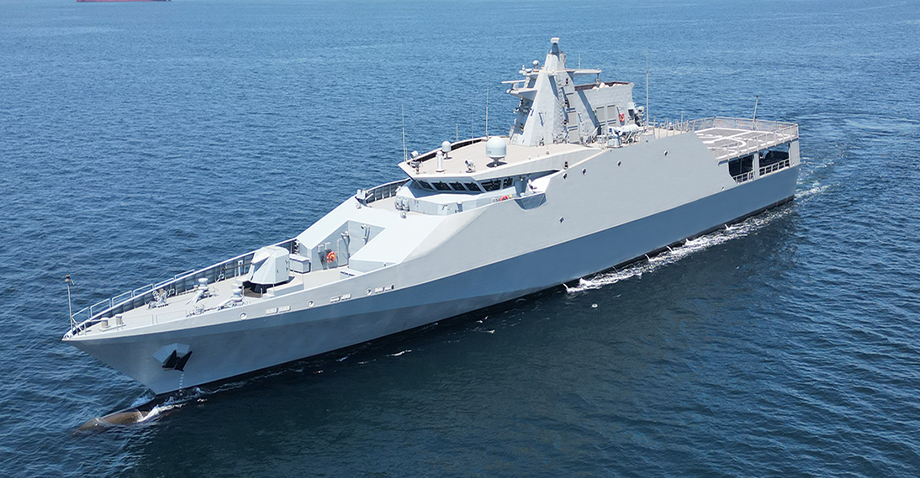
Naval. Nigeria is the reference case. Dearsan signed for two 76-metre offshore patrol vessels in Abuja on 3 November 2021 — the yard calls it its first naval export to Africa — laid the first keel in September 2022 and launched both hulls by April 2024, with sea trials running through 2025. The ships carry a 40 mm Leonardo gun, an ASELSAN 30 mm remote weapon station, ASELSAN sensors and HAVELSAN’s ADVENT combat management system, and are configured for anti-piracy and fisheries patrol in the Gulf of Guinea. The background to that deal is in our profile of Dearsan’s export record.
Ammunition, guns and training. The least visible and most durable layer. MKE sells conventional ammunition and has built assembly plants abroad; ASELSAN brought its KORKUT gun-based air defence system to Bamako this month. Training wraps around all of it, which is the subject of our earlier piece on how Turkish arms sales in Africa start in the classroom.
Why buyers pick Türkiye over China, Russia or France
Four reasons recur in procurement records and ministerial statements, and none of them is “the equipment is better”.
Price against capability. A TB2 squadron with ground stations and munitions costs less than the sustainment bill on a small fast-jet fleet. For an air force fighting an insurgency rather than another air force, that trade is straightforward.
Delivery speed. Turkish manufacturers have repeatedly moved from signature to handover faster than European competitors. Dearsan delivered its first Turkmen corvette inside a short schedule and launched the first Nigerian OPV about two years after contract.
Fewer political conditions at the point of sale. Turkish export approvals run through the Presidency of Defence Industries and the Ministry of National Defence, a process we set out in detail in who approves a Turkish arms export. In practice Ankara has sold to governments that faced restrictions from Washington, Paris or Berlin. That is an advantage to the buyer and a liability for Türkiye’s own reputation, and both halves are real.
Training and financing bundled in. The package usually includes operator and maintainer training, and sometimes Turkish personnel on the ground. Third-party financing has also appeared: Gulf capitals have funded Turkish drone purchases for African states, a pattern traced in our piece on how Gulf capitals moved from buying Turkish drones to building them.
BUYER VIEW
Delivery: generally faster than European equivalents; drone deliveries have run 12–24 months from contract, naval hulls 36–48.
Cost data: poor. Türkiye does not publish contract values and most African buyers do not either. Expect to negotiate without a public benchmark.
Industrial partnership: available but shallow so far. Morocco has the only announced Baykar facility on the continent; Nigeria has discussed a plant with ASELSAN without a contract. Assembly and maintenance, not design authority.
Support: the real variable. Turkish systems carry Turkish spares chains and, in several cases, Turkish technicians. Ask what happens to availability when they leave.
Export limitations: some Turkish platforms carry foreign subsystems that give third countries a veto. The T129’s American-built engine has blocked sales before; the dependency question is set out in which countries Türkiye cannot sell weapons to.
Interoperability: NATO-standard interfaces on most systems, which matters for states working alongside Western partners. This is open-source editorial analysis, not procurement advice.
The limits, and the cases that show them
Three problems sit underneath the sales figures, and a buyer should price all three.
Capability without institutions. The sharpest published critique comes from Military Africa, where Babatunde Fatai argued in July 2026 that the Turkish model is “bought, not built” — that it delivers platforms, training and basing but not the planning, budgeting and force-regeneration machinery a state needs to stand on its own. His case study is Somalia, where Turkish-trained Gorgor commando units suffered heavy desertions during offensive operations and the town of Adan Yabaal fell in April 2025. It is an opinion piece drawing partly on secondary reporting, and it does not establish that a different supplier would have done better. It does identify something the sales brochures do not address. Our own account of the arrangement is in what the Türkiye–Somalia defence deal actually contains.
Transfers into active civil wars. SIPRI names Türkiye as one of five known suppliers — alongside Belarus, Iran, Kyrgyzstan and the UAE — of armed UAVs, armoured vehicles and transport aircraft to the Sudanese armed forces during 2021–25. Sudan is a live civil war with documented atrocities on both sides. For European and North American buyers weighing a Turkish purchase, that record is part of the file whether or not it affects their own contract.
A small, contested base. China supplied major arms to 23 sub-Saharan states in 2021–25 and holds twice Türkiye’s share. Chinese drones compete directly on price. Meanwhile the subregion’s total demand is a fraction of the Gulf’s. Turkish share there is real, but it is share of a small and crowded market, and the structural argument for whether Ankara can convert this kind of position into something larger is the subject of our analysis of whether Türkiye can replace Russia in the global arms market.
What comes next
Two things are worth watching in the next twelve to eighteen months.
The first is whether local production moves past announcement. Baykar’s Benslimane facility in Morocco is the only Turkish aircraft plant announced on the continent, and reporting disagrees on whether it amounts to co-production or maintenance. ASELSAN’s chief executive raised the possibility of a Nigerian manufacturing partnership at BAMEX this month; nothing has been contracted. HAVELSAN signed a memorandum with Nigeria’s Defence Industries Corporation at AFRIDEX in Lagos in October. Memoranda are not orders. The pattern of what Türkiye has actually built abroad is set out in our file on Turkish defence factories overseas.
The second is the Sahel. Mali, Niger and Burkina Faso have pushed out French and American forces and are rebuilding supplier relationships from scratch. Mali hosted its first international defence exhibition in 2025 and the second edition, BAMEX 2026, ran at the Bamako Exhibitions Park from 9 to 13 November with more than 20 Turkish companies attending, live-fire demonstrations at Koulikoro and Turkish defence ministry and SSB officials present. Bamako has asked publicly for technology transfer rather than more aircraft. Whether Ankara offers it — and on what terms — will tell you more about the next five years of Turkish sales in the subregion than any single order. Envanter Medya covered Mali’s technology-transfer request at BAMEX 2026 in Turkish.
FAQ
Which African countries buy Turkish weapons?
Nigeria, Somalia, Senegal, Chad, Mali, Niger, Kenya and Ethiopia are the clearest sub-Saharan cases with traceable contracts or official acceptances. In North Africa, Morocco, Libya and Tunisia operate Turkish equipment. Several other states appear in manufacturer customer lists without a citable contract.
Is Türkiye the largest arms supplier to Africa?
No. For Africa as a whole the largest suppliers in 2021–25 were the United States, China, Russia and France. Türkiye is third in sub-Saharan Africa specifically, on 11 per cent, behind China on 22 and Russia on 12.
How much does Türkiye earn from African arms sales?
No official breakdown is published. Turkish industry data cited in the Turkish press puts 2025 African sales at about $328 million against total defence and aerospace exports of $10.05 billion. Derived from SIPRI volume shares, sub-Saharan Africa works out at roughly an eighth of Turkish export volume. Both figures are approximations.
Why do African states buy Turkish drones instead of Chinese or American ones?
Price against capability, delivery speed, bundled training and support, and fewer political conditions at the point of sale. Chinese systems compete closely on the first two; American and European systems often cannot be bought at all because of export restrictions.
Does Türkiye build weapons in Africa?
Barely. Baykar’s Morocco facility is the only announced aircraft plant, and its scope is disputed. Discussions about plants in Nigeria and elsewhere have not produced contracts. Most Turkish industrial presence on the continent is maintenance and training, not manufacturing.
Has Türkiye sold weapons into African conflicts?
Yes. SIPRI lists Türkiye among five known suppliers of major arms to the Sudanese armed forces during 2021–25, and Turkish drones were used in the Tigray conflict in Ethiopia and in Libya. Türkiye has not published export-licence decisions for these cases.
Sources
- SIPRI, Trends in International Arms Transfers, 2025, fact sheet published March 2026 — supplier and recipient shares for Africa, sub-Saharan Africa and Türkiye.
- Presidency of Defence Industries (SSB) export statements for 2025 and 2026, reported by Anadolu Agency and the Turkish press; the running 2026 total is tracked in our report on Turkish defence exports through October 2026.
- Babatunde Fatai, “Bought, Not Built: The Turkish Defence Model and the Capacity It Leaves Behind in Africa”, Military Africa, 28 July 2026.
- Africa Defense Forum, “As Drone Warfare Expands in Africa, Turkey Increases Share of the Market”, 11 February 2025 — Kenya and Morocco delivery detail.
- defenceWeb, “African arms imports dropped by nearly half over the last decade”, 17 March 2026.
- Dearsan Shipyard contract and launch dates for the Nigerian Navy offshore patrol vessels; Turkish Aerospace T129 delivery announcements.
- Anadolu Agency reporting from BAMEX 2026, Bamako, November 2026.