Who Builds Türkiye’s Laser Weapons? ASELSAN, Roketsan, MKE

Three Turkish companies build laser weapons, and a fourth programme uses microwaves instead of light. ROKETSAN’s ALKA is the only one its maker describes as being in serial production and in Turkish Armed Forces service, and its published effective laser destruction range is 750 metres. ASELSAN’s GÖKBERK, shown at 10 kW during 2026, and MKE’s 20 kW laser module for the TOLGA air defence system have each destroyed drones in tests but carry no disclosed order. ASELSAN’s EJDERHA fires high-power microwaves rather than a beam. None of the four has been exported.
That is a more interesting answer than the headlines suggest. Turkish directed-energy work generated a run of announcements through 2026 – a 10 kW laser at SAHA EXPO in May, a vehicle-mounted version at the same show, a 20 kW laser kill at an army firing range in October – and the gap between a demonstration and a weapon a government can order is where most of the useful information sits. This page maps who builds what, what each company actually claims on paper, and what a foreign procurement office could realistically sign for today.
DefenceTürkiye data box
Builders: ROKETSAN, ASELSAN, MKE · Systems: ALKA, GÖKBERK, TOLGA laser module, EJDERHA (microwave) · Category: very-short-range counter-UAS directed energy · Output class: 2.5–20 kW, against 100 kW abroad · In service: ALKA only, serial production from 2023 · First public laser drone kill by MKE: 13 October 2026, 760 m · Known export customers: none · Industrial partnership: ROKETSAN–Electro Optic Systems (Australia), signed 10 February 2026 · Current milestone: moving from demonstration to a disclosed production contract
The four programmes, and who builds them
ROKETSAN ALKA: the only one in service
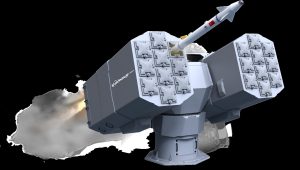
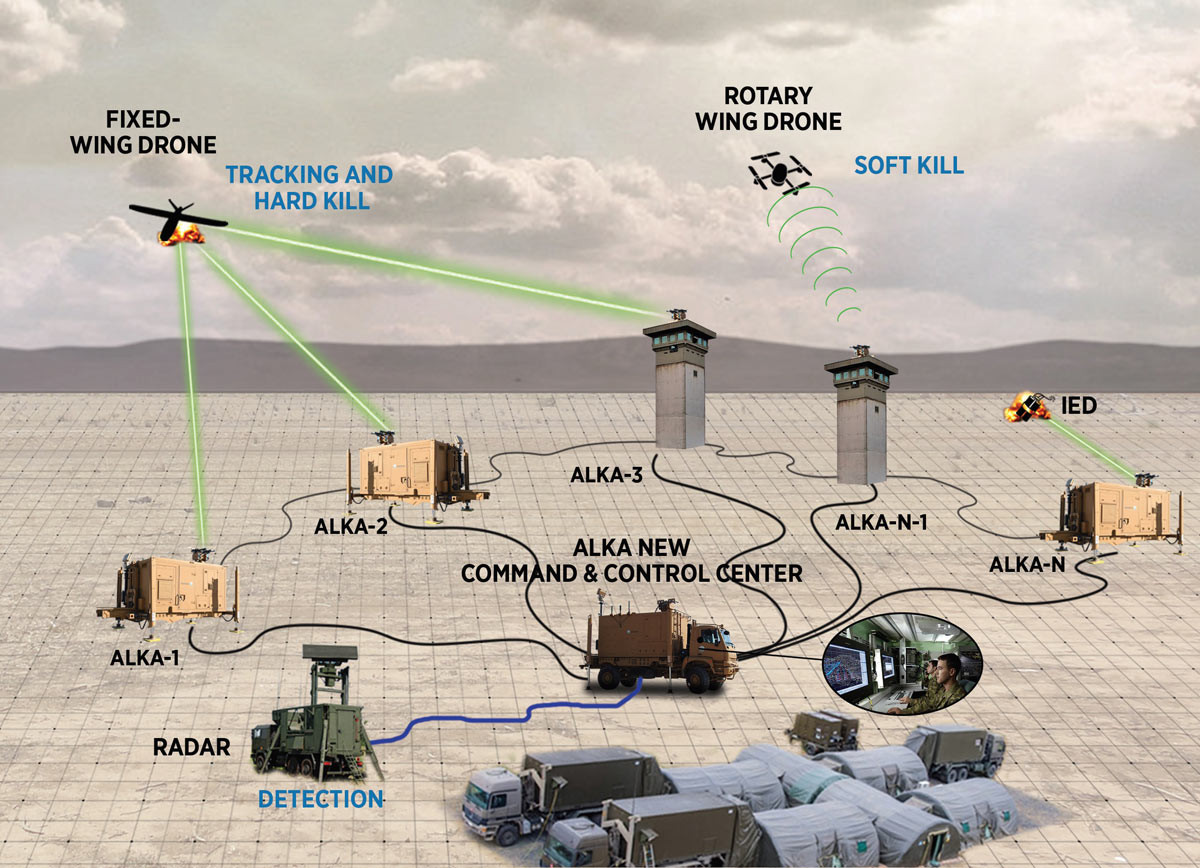
ALKA is the oldest of the four and the only one with a service claim behind it. ROKETSAN describes it on its ALKA NEW product page as a “very close hybrid air defense system” that works in two layers: an Electromagnetic Jamming System for soft kills and a Laser Destruction System for hard kills. The datasheet also lists a secondary role against roadside improvised explosive devices and booby traps, which is where the system started and a use case none of the others advertise.
The number that matters on that page is the one nobody quotes: effective laser destruction range, 750 metres. It is ROKETSAN’s own figure, on ROKETSAN’s own current catalogue entry, and it is shorter than every other range in this article. At IDEF 2025 the company described variants scaling from 1.1 km at 2.5 kW to 2.2 km at 10 kW, so the 750 m figure most likely describes the fielded configuration rather than the catalogue’s upper end – but ROKETSAN has not said which, and the distinction is exactly what a buyer needs.
In February 2026, at the World Defense Show in Riyadh, ROKETSAN signed a cooperation agreement with the Australian firm Electro Optic Systems covering joint laser weapon technology. The company’s announcement of that agreement contains the clearest status statement any Turkish firm has made about directed energy: ALKA entered serial production in 2023 and is, in ROKETSAN’s words, the only energy weapon in the Turkish Armed Forces inventory, used to protect critical military facilities and state institutions. General Manager Murat İkinci said the partnership was aimed at making the company “the world’s best in laser weapon systems”. Our profile of the ALKA system covers the hardware in more detail, and readers who want the Turkish-language engineering view will find a breakdown of ALKA’s two-layer architecture in Envanter Medya’s platform database.
At SAHA EXPO 2026 ROKETSAN showed ALKA mounted on FNSS’s KAPLAN Hybrid tracked vehicle. The interesting part of that pairing is not the turret but the generator: FNSS said at IDEF 2025 that the hybrid drive can export up to 220 kW, and that the vehicle can run the weapon for roughly an hour on stored battery energy before the generator has to start. Power, not optics, is the binding constraint on a mobile laser, and that is a Turkish answer to it.
ASELSAN GÖKBERK: the most developed single beam
GÖKBERK is ASELSAN’s laser, and it is the one being pushed hardest at export shows. ASELSAN said in March 2025 that the system had detected, automatically tracked and destroyed FPV threats across several test scenarios. At SAHA EXPO in May 2026 the company unveiled GÖKBERK 10, which EDR Magazine reported as a 10 kW system – double the original – on a trailer that also carries the power supply, with an engagement envelope of 150 to 2,000 metres and a tracking accuracy quoted as better than 10 microradians.
That tracking figure is worth pausing on, because it is the real engineering problem. A 10 kW beam only destroys something if it holds the same square centimetre of a moving airframe for several seconds. Beam power sells the system; pointing stability is what makes it work. ASELSAN is one of the few manufacturers to publish a tracking number at all, which is a point in its favour.
GÖKBERK does not stand alone. ASELSAN sells it inside a counter-drone package alongside the İHTAR detection and jamming system, the KORKUT gun family and the GÖKALP interceptor drone, and it took that whole package to MSPO 2026 in Poland. Envanter Medya’s Turkish-language technical profile of the GÖKBERK mobile laser goes further into the system’s configuration than any English-language page we have found.
MKE’s TOLGA laser: the newest and the strongest on paper
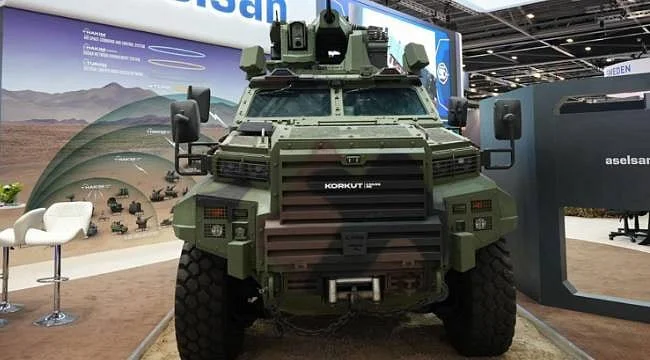
MKE is the state-owned ordnance manufacturer, and TOLGA is its close-in air defence system: a command-and-control unit, the GÖKBÖRÜ AESA search radar, electro-optical sensors and a family of 35 mm, 20 mm and 12.7 mm remote weapon stations firing airburst ammunition. In October 2026 MKE added a laser to it.
On 13 October the company released video of a 20 kW multi-aperture fibre laser destroying a quadrotor at a slant range of 760 metres during the Turkish Armed Forces’ Ateş Serbest-2026 exercise at Polatlı. The laser is built from four 5 kW modules on a stabilised electro-optical turret, and MKE lists three engagement bands: dazzle at 2,500 to 4,500 metres, permanent optical damage at 1,500 to 2,500 metres, and physical destruction between 100 and 1,500 metres. Our reports on the TOLGA laser kill and on the exercise itself cover the event; the point here is the architecture. A laser was bolted onto a gun system that already had the radar, the tracker and the battle-management software. That is a cheaper route to a fielded weapon than building a laser system from scratch, and it is the route MKE has taken.
It also matters commercially, because TOLGA already sells. The gun-based versions have an export sale to Qatar agreed at DIMDEX, a partnership with Hungary’s HT Division, and a memorandum of understanding with Poland’s PGZ signed at MSPO in September 2026 that explicitly covers non-kinetic countermeasures. The laser arrives on a platform with a customer base rather than a prototype looking for one.

ASELSAN EJDERHA: microwaves, not light
EJDERHA belongs in this article even though it is not a laser, because it answers the same question with different physics. Instead of burning a hole in an airframe, it floods a volume with directed, narrowband high-power electromagnetic energy and destroys the transistor junctions inside the drone’s electronics. ASELSAN showed the AD 200 version in 2025 and an AD 210 at SAHA EXPO 2026 with a much larger antenna, its own radar and electro-optical sensors so it can work without a separate detection system. Reported effect range is around a kilometre, with a 20-metre safety distance from the antenna.
The pitch is swarms. A laser kills one drone at a time and needs seconds per target; a microwave pulse can in principle disable several at once. Neither claim has been independently tested in public, but the division of labour is coherent, and it is why ASELSAN sells both.
What each system actually claims
| System | Builder | Effect | Stated output | Stated range | Status | Disclosed order |
|---|---|---|---|---|---|---|
| ALKA | ROKETSAN | Laser hard kill plus electromagnetic jamming | Not published on the datasheet; 2.5, 5 and 10 kW variants described at IDEF 2025 | 750 m effective laser destruction range (ROKETSAN datasheet) | Serial production since 2023; ROKETSAN calls it the only energy weapon in the Turkish inventory | Turkish domestic use stated; no export contract announced |
| GÖKBERK 10 | ASELSAN | Laser hard kill | 10 kW, twice the original GÖKBERK | 150–2,000 m engagement envelope (trade reporting from SAHA EXPO 2026) | Destroyed FPV drones in company tests from 2025; marketed as part of Çelik Kubbe | None itemising GÖKBERK |
| TOLGA laser module | MKE | Laser hard kill, optical damage and dazzle | 20 kW from four 5 kW fibre modules | Destroy 100–1,500 m; blind 1,500–2,500 m; dazzle 2,500–4,500 m | First public drone kill 13 October 2026 at 760 m | None for the laser; the gun-based TOLGA has a Qatari sale |
| EJDERHA / AD 210 | ASELSAN | High-power microwave; burns drone electronics | Not published | Effect reported at about 1 km; 20 m safety distance from the antenna | AD 200 shown 2025; AD 210 shown at SAHA EXPO 2026 | None published |
Why it matters
Every European and Gulf air force is now shopping for something that can shoot down a $500 drone without spending a $500,000 missile, and the shortlist of suppliers who have actually destroyed a drone with a beam is short. Türkiye is on it, with three companies rather than one, and with systems already integrated into radars and battle-management software that its customers are buying anyway. What Türkiye does not yet have is a laser in the 100 kW class, a published cost per shot, or a single export contract for a directed-energy weapon. The gap between those two statements is the whole commercial story.
The power problem, and Türkiye’s answer to it
Laser weapons scale brutally with power. Roughly speaking, more kilowatts on target means either a longer reach or a shorter dwell time, and both are what turn a demonstration into a weapon. The international benchmark is Israel’s Iron Beam at around 100 kW. Turkish systems sit between 2.5 and 20 kW. That is not a rounding error; it is a different class of weapon, limited to small drones at short range.
Sources: ROKETSAN product datasheet (ALKA, 750 m); EDR Magazine reporting from SAHA EXPO 2026 (GÖKBERK 10, 150–2,000 m; EJDERHA AD 210, about 1 km); MKE figures as reported by Times of Defence (TOLGA laser). Rafael states Iron Beam engages targets at up to 10 km, which is off the right-hand edge of this scale.
ROKETSAN’s published answer to this is the most original idea in the Turkish directed-energy portfolio, and almost nobody outside Turkish-language coverage has noticed it. The ALKA NEW datasheet describes a networked concept in which several ALKA units share command and control, each vehicle carries a redundant C2 capability, and – the key line – the network performs “autonomous targeting of multiple laser on the same point on target”. In other words, rather than building one very powerful emitter, ROKETSAN proposes converging the beams of several modest ones onto a single spot.
Whether that works at operationally useful ranges is unproven; atmospheric turbulence and the geometry of multi-site convergence are hard problems and ROKETSAN has published no test results. But it is a sensible engineering response to a national industrial position. Türkiye can build 5 and 10 kW fibre modules today; it cannot build a 100 kW beam director today. Networking is the cheaper path, and it fits the layered architecture that Çelik Kubbe is built around in the first place.
Where this sits against Iron Beam and DragonFire
Context helps, because the global state of directed energy is less advanced than the press releases imply.
Israel’s Iron Beam is the only system in the world that has been handed to an operational military in the 100 kW class. Rafael says it engages targets out to 10 kilometres, and a Rafael official told National Defense in July 2026 that the system was operational and in production for further units. Yet The Defense Post, reporting Israeli media in August 2026, said only one unit had been delivered and that it had not entered full operational use eight months after handover. The world leader in this field is itself somewhere between delivery and capability.
Britain’s DragonFire is further back still. The UK Ministry of Defence said in April 2024 that the weapon would be installed on Royal Navy warships from 2027, and put the cost of a shot at around £10. That cost-per-shot figure is the one piece of hard commercial data any government has published about laser weapons, and it is the argument for the entire technology.
So the honest comparison is not “Türkiye is behind”. It is that Türkiye is in the same unfinished race as everyone else, one power class lower, with a narrower target set, and – unlike the UK – without publishing the number that makes the business case. ROKETSAN’s datasheet says “low cost per shot compared to conventional methods” and leaves it there. MKE has described its approach as effective, simple and cheap, with cost bounded mainly by stored electrical power. Neither has given a figure.
Can a foreign government buy a Turkish laser?
Not yet, on the public record. No Turkish directed-energy system has a disclosed export contract. What exists is one tier down from that, and it is worth being precise about the difference, because the categories get blurred in a lot of coverage.
- Marketed abroad. GÖKBERK 10 has been shown at MSPO in Poland and at Gulf and African exhibitions as part of ASELSAN’s counter-drone package. ALKA was displayed at the World Defense Show in Riyadh.
- Industrial partnership signed. ROKETSAN and Electro Optic Systems agreed in February 2026 to develop laser technology jointly and address customer requirements together. EOS is an established Australian directed-energy and remote weapon station builder; this is the most substantive foreign tie any Turkish laser programme has.
- Adjacent system sold. MKE has sold gun-based TOLGA variants to Qatar and signed cooperation agreements with Hungarian and Polish industry covering, among other things, non-kinetic countermeasures. A laser added to an already-exported system is a far shorter commercial path than a new product.
- Nothing contracted. No government, Turkish or foreign, has published a contract that itemises a Turkish laser weapon. That includes Türkiye’s own large 2026 air-defence awards, which were announced as packages without a public line-item breakdown.
Buyer view
Delivery. Only ALKA has a production history, and ROKETSAN has not published lead times or quantities. Everything else would be a first-of-type order.
Cost data. None published, by any Turkish manufacturer, for unit price or cost per shot. A buyer would be negotiating without a public benchmark – though the same is true of most of this market.
Integration. This is the Turkish strength. All four systems are designed to plug into radars and battle-management software from the same industrial base, so a customer that already operates Turkish air defence buys an increment rather than an island.
Power and logistics. A mobile laser is a power plant with an optic attached. The FNSS KAPLAN Hybrid figures – 220 kW exportable, about an hour on batteries – are the kind of detail to press for, because they determine the operational profile more than beam power does.
Export restrictions. These are indigenous systems with no obvious third-country licence exposure of the kind that has blocked Turkish helicopter and engine exports before. That is a genuine advantage, but it has not yet been tested by an actual export case.
The combat record, graded honestly
ALKA is frequently described as combat-proven, on the basis of a reported engagement in Libya on or around 4 August 2019 in which a laser is said to have destroyed a Chinese-built Wing Loong II near Misrata. The claim circulates widely and is repeated in product write-ups around the world.
It should be treated as unproven. The account traces to a single trade-press article; ROKETSAN has never confirmed the engagement, nor has the Turkish Ministry of National Defence or the Libyan Government of National Accord. The National Interest examined the story at the time and found the sourcing thin, noting that Libyan forces had separately announced downing a Wing Loong over Misrata a day earlier by other means. No wreckage analysis was ever published. A buyer should assume no Turkish laser has a verified combat kill, and should ask ROKETSAN directly rather than relying on the secondary literature.
Limitations worth stating plainly
Power class. At 2.5 to 20 kW, these are weapons for Class I and small Class II drones. They do not engage cruise missiles, artillery rockets or manned aircraft, and no Turkish manufacturer claims they do.
Range. ROKETSAN’s own published destruction range for its only in-service laser is 750 metres. MKE’s demonstrated kill was at 760 metres against a cooperative target on a range. These are point-defence distances – useful for a base perimeter or a convoy, not for an air-defence belt.
Weather and dwell. No Turkish manufacturer has published performance in fog, dust or rain, or the dwell time needed per kill. Both numbers decide whether a laser is a weapon or a demonstration, and both are missing from every Turkish datasheet we have read.
No independent testing. Every figure in this article originates with a manufacturer or a trade-show briefing. There is no equivalent of a customer-nation evaluation report for any Turkish directed-energy system.
Naming confusion. ROKETSAN’s catalogue lists the directed-energy system under “ALKA NEW Network Enabled Weapon”, which reads like a separate product and is not. MKE’s TOLGA is a gun-based air defence system that now has a laser option, so “TOLGA laser” and “TOLGA” are different things. Procurement documents should name the configuration, not the family.
What comes next
Three things would change the picture, and all three are observable from outside.
The first is a contract that names a laser. Türkiye signed several very large air-defence packages during 2026, and if directed energy appears as an itemised line in one of them, that moves GÖKBERK or the TOLGA laser from demonstrator to programme overnight. The second is a power jump. Nobody in Türkiye has publicly demonstrated above 20 kW; the first 50 kW-class Turkish beam would be a genuine step, and the ROKETSAN–EOS partnership is the most likely route to it. The third is an export order, most plausibly from a customer that already operates Turkish counter-drone equipment – Qatar and Poland are the obvious candidates, given what has already been signed.
Until at least one of those happens, the accurate description of Türkiye’s laser weapons is that they are real, they work at short range, one of them is in service at home, and none of them is yet a product a foreign government has bought.
FAQ
Does Türkiye have laser weapons?
Yes. ROKETSAN’s ALKA has been in serial production since 2023 and the company describes it as the only energy weapon in the Turkish Armed Forces inventory. ASELSAN’s GÖKBERK and MKE’s TOLGA laser module have destroyed drones in tests but are not confirmed to be in service.
Who builds Türkiye’s laser weapons?
ROKETSAN builds ALKA, ASELSAN builds GÖKBERK and the EJDERHA high-power microwave system, and MKE builds the 20 kW laser module for its TOLGA air defence system. FNSS supplies the KAPLAN Hybrid vehicle used to make ALKA mobile.
How powerful are Turkish laser weapons?
Between 2.5 and 20 kW on current public figures. MKE’s 20 kW TOLGA module is the most powerful demonstrated; ASELSAN’s GÖKBERK 10 is a 10 kW system. For comparison, Israel’s Iron Beam is in the 100 kW class.
What is the range of a Turkish laser weapon?
ROKETSAN publishes 750 metres as ALKA’s effective laser destruction range. MKE claims destruction between 100 and 1,500 metres and demonstrated a kill at 760 metres. GÖKBERK 10 was reported at SAHA EXPO 2026 with an engagement envelope of 150 to 2,000 metres.
Has a Turkish laser weapon ever been used in combat?
No confirmed case exists. A widely repeated claim that ALKA destroyed a Wing Loong II drone in Libya in August 2019 traces to a single trade-press report and has never been confirmed by ROKETSAN or by any government.
Can other countries buy Turkish laser weapons?
No export contract for a Turkish directed-energy weapon has been announced. The systems are marketed at international exhibitions, and ROKETSAN signed a laser technology partnership with Australia’s Electro Optic Systems in February 2026, but nothing has been sold.
Is EJDERHA a laser?
No. EJDERHA is a high-power microwave system. It damages the electronics inside drones with directed electromagnetic energy rather than burning the airframe with a beam, and it is pitched primarily against swarms.
Sources
- ROKETSAN, ALKA NEW Network Enabled Weapon product page – system description, 750 m effective laser destruction range, networked targeting concept.
- ROKETSAN, agreement with Electro Optic Systems, 10 February 2026 – serial production from 2023 and the Turkish inventory statement.
- ASELSAN, new electronic warfare and counter-UAV solutions at SAHA 2026.
- EDR Magazine, SAHA EXPO 2026: ASELSAN adds new elements to its Steel Dome – GÖKBERK 10 and EJDERHA AD 210 figures.
- EDR Magazine, IDEF 2025: FNSS and ROKETSAN present a self-propelled armoured C-UAS system – KAPLAN Hybrid power figures.
- Breaking Defense, ASELSAN tests laser counter-drone system, March 2025.
- Army Recognition, ALKA on the KAPLAN Hybrid vehicle, 2026.
- Times of Defence, MKE demonstrates the 20 kW TOLGA laser at Ateş Serbest-2026, 16 October 2026.
- Defence Industry Europe, ASELSAN launches advanced electronic warfare and counter-drone systems.
- UK Ministry of Defence, DragonFire fitting to Royal Navy ships, 12 April 2024 – 2027 installation date and the £10 per shot figure.
- The Defense Post, Israel’s Iron Beam still not fully operational, 11 August 2026.
- National Defense Magazine, Iron Dome now operational with laser weapon, July 2026.