Katmerciler Went From Garbage Trucks to Armoured Vehicles in Three Decades

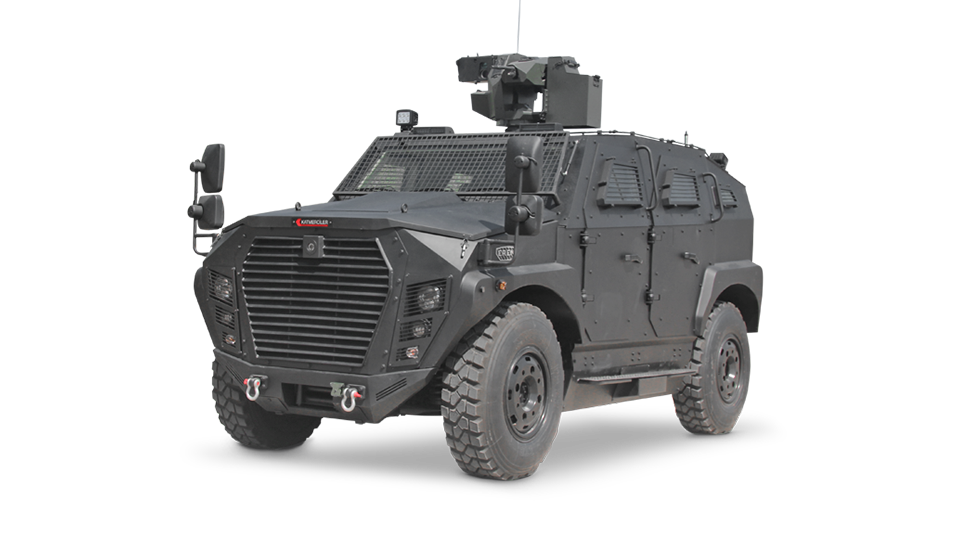
Katmerciler did not start out as a defence company. For its first three decades the İzmir firm made equipment that sits on top of other people’s trucks, such as garbage compactors, fire-fighting bodies and vacuum tankers. Today it builds mine-protected armoured vehicles for the Turkish security forces and for customers in Africa, and it has just signed a technology-transfer deal with a Malaysian state-linked manufacturer. This profile traces how that happened and what the company actually sells.
| Item | Detail |
|---|---|
| Company | Katmerciler Araç Üstü Ekipman Sanayi ve Ticaret A.Ş. |
| Founded | 1985 |
| Headquarters | Çiğli Atatürk Organised Industrial Zone, İzmir |
| Other facility | Ankara defence plant, opened 2016 |
| Listing | Borsa Istanbul, since November 2010 |
| Workforce | Around 500 employees, about 50 of them engineers (company statement, July 2025) |
| Key defence products | HIZIR and HIZIR II 4×4, EREN 4×4, Khan and Ateş, O-IKA 2 unmanned ground vehicle |
| Other lines | Riot control vehicles, fire trucks, municipal vehicles, armoured construction equipment |
| Website | katmerciler.com.tr |
How Did a Truck-Equipment Maker End Up in the Defence Industry?
The company was founded in 1985 as Katmerciler Araç Üstü Ekipman, and the name says what it did: equipment mounted on vehicle chassis. Its own milestones page records a first export to Japan in 1998, which it says was garbage trucks, and steady export awards through the 2000s. The firm also supplies subsystems to manufacturers that include Ford, BMC, Iveco, Mercedes-Benz, Scania and Volvo, according to Wikipedia’s company entry.
The turn toward security work came through riot control. Katmerciler began producing riot control vehicles in 2010, the same year it listed on Borsa Istanbul. Its TOMA water-cannon trucks became familiar on Turkish streets during the 2013 protests, as Defense News noted in a 2016 profile. In October 2014 the company signed two contracts with the General Directorate of Security, for 65 TOMA units worth €13.68 million and 50 units worth €11.78 million, according to CNN Türk’s coverage of its results.
That business was profitable enough to fund a change of direction. Katmerciler reported 2015 revenue up 83 percent to 310 million liras, and its leadership said plainly that the goal was to take part in the defence industry. The same year it set up a certified R&D centre and launched its first armoured personnel carrier, the Khan 4×4.
What Changed in 2016?
Two things. First, the company opened a dedicated plant in Ankara. Local reporting put the investment at about $2 million in the Başkent Organised Industrial Zone, financed from the firm’s own equity. Second, it unveiled the HIZIR, a 4×4 mine-protected tactical vehicle, together with an armouring package it calls NEFER.
Defense News observed at the time that Katmerciler’s entry made the Turkish wheeled-armour market a four-player field alongside BMC, FNSS and Otokar. The same article noted that Katmerciler and BMC were seen as close to the government, which raised questions about how contracts would be split. That is an industry source’s view, not an established fact, but it explains why the newcomer drew attention. For the established players, see our profiles of FNSS and Otokar.
The early product line was broader than the HIZIR alone. Defense News described two NATO-standard designs from that period, the Khan.D, reported to carry eight personnel at up to 130 km/h, and the Kangal, reported to carry ten and to ford water up to 1.5 metres deep. Khan survived into the current catalogue, while Kangal does not feature in the sources reviewed for this profile. The company also reported that its first government order for the new vehicles was small, at 10.5 million liras, a modest start for a company with no track record in armour.
Formal permission to produce wheeled armoured vehicles followed in 2017 and 2018, per the company timeline. Two special-purpose vehicles came out of that period, the KIRAÇ criminal investigation vehicle and the ATEŞ border security vehicle.
What Is the HIZIR and How Is It Built?
The HIZIR is the vehicle that put Katmerciler on defence buyers’ lists. Figures published by Army Recognition and Wikipedia describe a vehicle of roughly 16 tonnes, about 5.6 metres long, with a crew of two and room for seven more. Power comes from a 400 PS Cummins ISL 8.9-litre diesel coupled to an Allison six-speed automatic. Top speed is given as 120 km/h and road range as about 700 km.
Protection is listed as STANAG 4569 Level 2 for ballistics, with a V-shaped hull and energy-absorbing seats intended to resist mines and improvised explosive devices. Level 2 is a modest ballistic rating, so the selling point is the blast design and price rather than heavy armour. The standard weapon fit is a remote-controlled station, commonly an Aselsan SARP, carrying a 7.62 mm or 12.7 mm machine gun or a 40 mm grenade launcher.
Variants built on the same platform include the Ateş border patrol version, which carries Aselsan surveillance sensors. The newer HIZIR II, shown at IDEF 2021, reworked the crew compartment. Reported changes include face-to-face seating with more legroom, a larger fuel tank, a rear ramp for faster dismounting and a spare wheel moved under the body to lower the centre of gravity. Our dedicated article on the HIZIR II covers the design in more detail.
Why Was the EREN Designed for Cities?
The EREN, also launched at IDEF 2021, goes the other way on size. Katmerciler describes it as a 4×4 tactical urban warfare vehicle with an armoured monocoque hull designed in-house, intended for internal security forces working in residential areas and confined spaces. Army Recognition lists a 250 hp diesel, an automatic gearbox with a two-speed transfer case, independent coil-spring suspension and differential locks. It seats five, or seven in the larger layout, and offers options such as a stabilised remote weapon station, a rescue winch, a fog cannon and an automatic fire extinguishing system.
The urban focus follows naturally from the firm’s history with police customers. Our separate piece on the EREN 4×4 looks at how it fits that role. Weight and protection level were not given in the sources I could confirm, so they are left out here.
Who Has Bought Katmerciler Vehicles?
Exports drove the company’s defence reputation, and Africa was the first big market.
- Kenya. Katmerciler announced in July 2021 a contract for 118 HIZIR vehicles and variants for the Kenya Defence Forces. The reported value was $91.4 million, including spare parts and maintenance, with deliveries planned for 2022 and 2023. Kenyan officials had said in January 2021 that the vehicles were meant for operations against Al-Shabaab in Somalia.
- Gambia. At least 20 HIZIR vehicles were ordered in August 2021, reported Military Africa. Uganda is reported to have ordered 30.
- An unnamed ally. In October 2022 the company announced a package of about €39.45 million covering HIZIR, Ateş and Khan vehicles for an unnamed friendly country, with deliveries through 2024. Its acting board chair described it as the firm’s largest single export contract. Khan was being exported for the first time. Because the Kenya figure above is larger in dollar terms, that “largest” claim is best read as the company’s framing of one specific deal structure, and I have not been able to reconcile the two.
- United Nations. The company timeline says Khan and HIZIR vehicles were delivered to the UN between 2022 and 2025. It does not name the mission or the quantities.
Katmerciler says it exports to more than 75 countries, but that figure covers its whole product range, including municipal and commercial vehicles, so it should not be read as 75 armed-forces customers. For the broader buying pattern, see why countries buy Turkish armoured vehicles.
What Did the Malaysia Agreement Change?
At IDEF 2025 in July, Katmerciler and DRB-HICOM Defence Technologies, known as DEFTECH, signed a collaboration agreement on the EREN 4×4 High Mobility Light Tactical Vehicle. It was signed by Katmerciler CEO Mehmet Katmerci and DEFTECH chief executive Mohammad Shanaz bin Mohammad Shees. According to the announcement, the deal covers joint development, assembly and supply of the EREN, with potential transfer of design and manufacturing know-how for Malaysian production.
It is a framework, not a production order. No quantity or value has been published. Still, local production is the route by which several Turkish land-vehicle firms have reached Southeast Asia, and it shows Katmerciler moving from selling finished vehicles to licensing them.
What Else Is in the Defence Catalogue?
Katmerciler’s website groups its defence products into tactical wheeled armoured vehicles (seven listed), security vehicles (three), armoured construction equipment (five), logistics support vehicles (eight), special products (three) and one unmanned ground vehicle. Recent additions, according to the company, include a tank recovery vehicle and a military aircraft refuelling vehicle.
At IDEF 2025 the company also showed the O-IKA 2, an unmanned ground vehicle with a remote-controlled weapon and satellite communication. The firm describes roles from reconnaissance to casualty rescue. No production or customer details have been announced.
What Should Readers Keep in Mind?
Katmerciler is a small player next to Otokar, FNSS or BMC, and most of its defence export volume so far rests on one vehicle family. Its production sites are an İzmir plant with 17,000 square metres under cover, per the company, and the Ankara unit. Delivery numbers to the Turkish armed forces are not disclosed in the sources reviewed here, and some third-party operator lists for HIZIR, including countries such as Senegal, Uruguay and Rwanda on Wikipedia, could not be confirmed against an official source.
The company is publicly traded, and its filings on the Public Disclosure Platform are the primary record for contracts and financial results. This article is informational and is not investment advice. The next milestones to watch are whether the DEFTECH framework becomes a funded order and whether a second EREN customer appears.