Roketsan Built One Cruise Missile for Jets and Another for Trucks

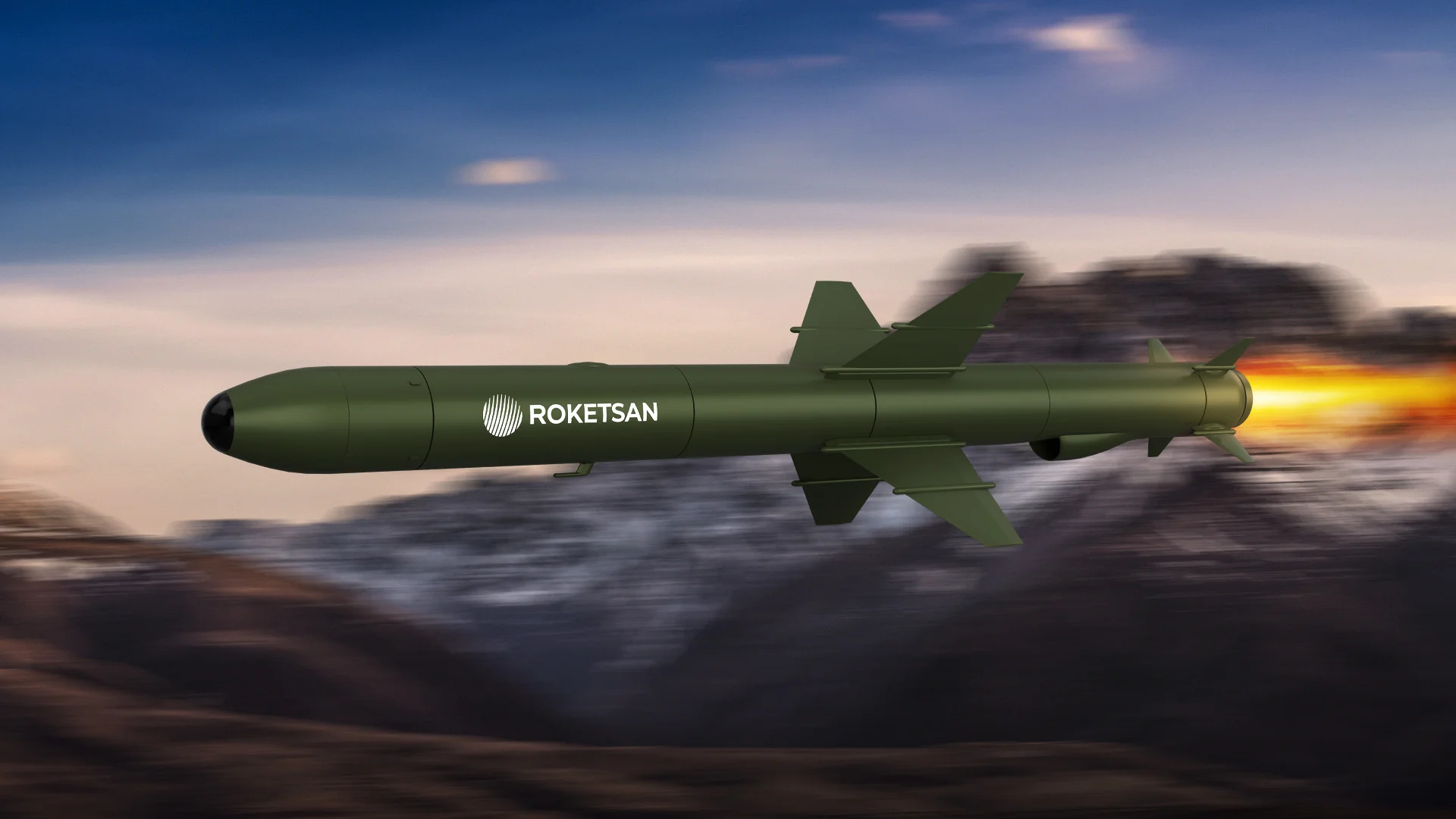
Türkiye now fields two cruise missiles that look similar on a spec sheet and do very different jobs. One hangs under a fighter and flies out to hit a target from beyond air defence range. The other rides on a wheeled truck and never leaves the ground until launch. Comparing SOM and KARA ATMACA is mostly a question of who launches them, what they can reach and which industrial lineage each one comes from.
Both are Roketsan products, and both sit in the same 250 to 280 km bracket. That overlap is the reason the comparison keeps coming up, and also the reason it can mislead.
How Do SOM and KARA ATMACA Compare on Paper?
Figures below come from Roketsan’s own product pages. Where a number is not on those pages, it is left out rather than guessed.
| Item | SOM | KARA ATMACA |
|---|---|---|
| Manufacturer | Roketsan (designed by TÜBİTAK SAGE) | Roketsan |
| Launch mode | Air-launched | Truck-mounted wheeled launcher |
| Role | Stand-off strike on defended land and naval targets | Strike on strategic land targets |
| Range | 250 km | 280 km |
| Weight | About 600 kg | 890 kg |
| Length | Not stated on the product page; commonly cited as roughly 3.7 m | 6 m |
| Warhead | Variant dependent (SOM-B1 is reported at about 230 kg) | 250 kg, with high-explosive, blast-fragmentation and penetration options |
| Terminal guidance | Imaging infrared | Imaging infrared |
| Navigation | INS, satellite, terrain-referenced navigation | INS, GPS, barometric and radar altimeters, terrain-referenced navigation |
The guidance packages are close cousins. Both combine inertial navigation with terrain matching and finish with an imaging infrared seeker that compares what it sees to a stored picture of the target. That is why both can be sold as jamming-resistant: little in the flight depends on a signal an enemy can easily disrupt.
Where Does Each Missile Come From?
SOM is the older design, and its roots are in the public research sector. TÜBİTAK SAGE started the work in the mid-2000s, flew the first guided test in 2011 according to open sources, and Roketsan took over series production. The story of how it lost its imported powerplant is covered in our piece on the SOM and its stealthier sibling.
KARA ATMACA has a different parent. It grew out of the ship-launched ATMACA anti-ship missile, itself a Roketsan programme. Roketsan engineers kept the family concept, lengthened the airframe, and swapped the target set from ships to fixed land installations. Janes reported at the August 2024 test announcement that the land version is longer and about 100 kg heavier than the naval original, with the warhead growing from 220 kg to 250 kg and an imaging infrared seeker replacing the active radar seeker.
So SOM is a SAGE design industrialised by Roketsan, while KARA ATMACA is a Roketsan derivative of its own naval missile. The product page for the longer-range variant is on our KARA ATMACA guide.
Who Fires Them, and From Where?
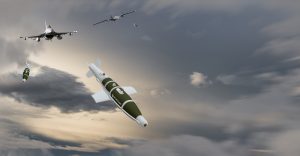
SOM needs an aircraft. Open sources list the F-16 and F-4E among carriers, and the Turkish Air Force is the lead operator. Its reach depends on how far the aircraft can fly before release, so the real striking distance is the missile’s 250 km plus whatever the pilot covers first. The aircraft, meanwhile, has to survive getting to the launch point.
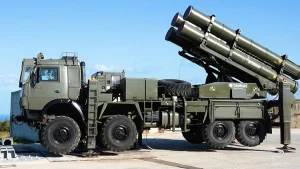
KARA ATMACA flips that. A wheeled launcher can sit in a hide site, fire a salvo and relocate. Roketsan lists several firing modes, including time-on-target and simultaneous time-on-target, which let launchers in different places arrange for several missiles to arrive together. The product page also cites target update by data link and a re-attack option, although public detail on how those features are used in service is thin.
The trade is straightforward. A ground launcher is cheaper to keep on alert, does not risk a pilot and can be hidden. An aircraft-launched missile can be pointed at almost any bearing and carries the threat of surprise from an unexpected direction.
Is There a Gap Between 250 and 280 km?
Thirty kilometres is not a strategic difference, and the two missiles are not rivals for the same mission slot. They are complementary arms for the air force and the land forces. What matters more is the launch geography. A truck on the Black Sea coast and a jet over the Aegean cover very different arcs of the map, and both cover them without requiring the other service.
There is a third piece that gets less attention. In July 2026, Quwa reported that the Turkish Air Force inducted the SOM-B1T, a version using the Kale KTJ-3200 turbojet rather than the French Microturbo TR-40. The reported range stayed at 250 km. Whether or not the engine is a headline, it removes a foreign licensing dependency, and Janes noted that NATO’s July 2026 summit statement referred to Türkiye procuring a significant number of land-based Atmaca long-range cruise missiles. Roketsan’s own role as a defence industry contractor in that context shows how the company is positioned.
The ground-launched ÇAKIR is the third Roketsan cruise missile in the picture, a smaller and cheaper design aimed at a different price point. Together with SOM and KARA ATMACA it gives Roketsan three layers of cruise missile, from a low-cost option to heavier strike weapons.
Which Variants Are Still Moving?
SOM is the family with more branches. Open sources describe a B2 version with a tandem penetrating warhead for hardened targets, and SOM-J, an anti-ship derivative reported to be offered for the internal weapon bays of the F-35 together with Lockheed Martin. A first sea-target firing of SOM-J was reported in March 2025, with a range of about 275 km. The stealth-shaped airframe is the main difference from the older body.
KARA ATMACA is at an earlier stage of its public record. Roketsan announced the test firing from Sinop in August 2024, and Janes cites the Turkish defence minister saying in April 2026 that deliveries of Atmaca missiles to the armed forces were under way. The report does not say how many land-attack rounds are included, so the delivery quantity remains unknown.
That asymmetry is worth keeping in mind. SOM is a mature service weapon getting incremental upgrades, while KARA ATMACA is a newer system still building its operational history.
What Do They Mean for Roketsan’s Export Pitch?
For a buyer, the choice is partly about platform. A country with fighters and a modern air arm can use SOM. A land force that wants stand-off strike without relying on an air force may find KARA ATMACA more attractive, since a truck launcher fits existing logistics. Roketsan markets both through its catalogue, and the Roketsan company profile covers its wider product line and export limits.
No public contract for either missile with a foreign customer is confirmed in the sources reviewed for this article, so claims of export orders should be treated cautiously until the buyer or Roketsan publishes them. What the open record supports is simpler. Türkiye has built two cruise missiles with a similar guidance chain, one for the air and one for the ground, and it is gradually replacing foreign parts in the older of the two.