How Turkish Sonar Systems Hunt Submarines and Mines

A submarine that stays quiet is hard to find, and the tool most navies rely on to find it is acoustic. Radar sees nothing below the waterline, and optical sensors are useless a few metres down. For Türkiye, which operates in the Black Sea, the Aegean and the Eastern Mediterranean at once, sonar is the sensor that decides whether a frigate can protect itself and the ships around it. Over roughly two decades the country has moved from buying sonars abroad to fielding several of its own.
Turkish sonar systems now come from a small group of builders. ASELSAN and Meteksan lead, with ARMELSAN, a smaller firm established in 2012, and the state research body TÜBİTAK MAM also involved in underwater acoustics. The picture below is drawn mostly from company announcements and trade-press reporting, and performance figures are the manufacturers’ own unless stated.
How Did Türkiye Start Building Its Own Sonars?
The work began in the mid-2000s with the MİLGEM corvette programme. According to Defence Turkey magazine, the Turkish Naval Research Center Command started conceptual design of a hull-mounted sonar in 2005, a formal contract followed in July 2006, and at-sea trials took place in 2007. The sonar was later industrialised by Meteksan as YAKAMOS and first went aboard TCG Heybeliada, the lead ship of the Ada-class corvette line within the wider MİLGEM family.
ASELSAN began its own underwater acoustics work around 2006, and Meteksan Defence was designated a centre of excellence in underwater acoustics in 2009, per the same source. Defence Turkey also reports that between 2009 and 2019 these firms made 33 deliveries of 11 domestic underwater acoustic systems across 36 platforms, 16 submarines and 20 surface ships. That figure comes from the magazine’s survey, not an official tally.
What Is YAKAMOS and Where Does It Serve?
YAKAMOS is a medium-frequency hull-mounted sonar for anti-submarine warfare and obstacle avoidance. It is meant to detect and track submarines, small submersibles, torpedoes and mine-like objects, and it feeds a ship’s combat management system and torpedo countermeasures.
Defence Turkey lists active frequencies of 5 to 9 kHz and passive listening from 3 to 5 kHz. Naval News reports that the original version entered service on Ada-class corvettes in 2012, and that the second generation, YAKAMOS 2020, is modular and scalable with a revised transducer layout intended to extend detection range. Meteksan describes it as Türkiye’s first exported hull-mounted sonar.
The export record is concrete. Naval News reports that sonars for Pakistan Navy MİLGEM corvettes began outfitting in 2022, and Defence Turkey names the Pakistani Babur class and a planned Ukrainian ship as users. Naval News also quotes a former Turkish Navy officer who said the sonar outperformed the US-made SQS-56 on range and bearing sensitivity. Treat that as one person’s assessment, not a test result.
| System | Maker | Role | Reported detail |
|---|---|---|---|
| YAKAMOS 2020 | Meteksan | Hull-mounted ASW sonar | Medium frequency; Ada-class and Pakistani MİLGEM corvettes |
| YAKAMOS-RT | Meteksan | Retractable ASW sonar | 20 to 30 kHz, 450 mm array, 288 channels |
| FERSAH | ASELSAN with ARMELSAN | Hull-mounted ASW sonar | Active 6.7, 7.5 and 8.4 kHz; passive 3 to 12 kHz |
| DÜFAS | ASELSAN with ARMELSAN | Towed low-frequency active sonar | Long-range detection, optional torpedo countermeasures |
| MATES | ASELSAN | Mine detection sonar | On TCG Edincik mine hunter |
| HIZIR | ASELSAN | Torpedo defence | Towed array and decoys, Ada class |
What Does YAKAMOS-RT Add for Small Boats and Drones?
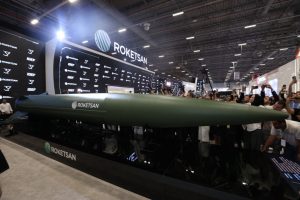
Meteksan unveiled YAKAMOS-RT at IDEF 2023. It is described as Türkiye’s first retractable sonar for anti-submarine work, built for patrol boats, corvettes and unmanned surface vessels that cannot carry a conventional hull array.
Naval News gives the published figures: a 20 to 30 kHz band, a 450 mm array, 288 channels, a dipping depth of about 2 metres and angular resolution under 10 degrees. Tests started in 2023, with initial operational capability expected in 2024, according to that report. The high frequency trades range for a compact array, which suits harbour approaches and naval base protection more than open-ocean search.
The USV link matters. Small unmanned craft are increasingly discussed as cheap pickets for coastal waters, and a sonar that does not hurt manoeuvrability is a prerequisite.
What Has ASELSAN Built Under the Waterline?
ASELSAN covers the widest range. FERSAH, launched at IDEF 2019 and developed with ARMELSAN, is a mid-frequency hull sonar with active, passive, mine-avoidance and intercept modes. Defence Turkey reports it is fitted to the İstif-class frigates and the Barbaros mid-life upgrade, with factory acceptance tests for TCG İstanbul completed in July 2021. For context on the hulls themselves, see the İstif-class production story.
For deeper detection ASELSAN offers DÜFAS, a towed low-frequency active and passive sonar. EDR Magazine, reporting from UDT 2025, said ASELSAN expected its first DÜFAS 100/LR contract that year for İstanbul-class frigates, and that a compact DÜFAS 100-CU for unmanned surface vessels was expected to finish qualification in 2026. Those are expectations as reported, and the article does not confirm either milestone has been met.
The company has also moved to submarines. In March 2024, Marine Insight reported the first domestically designed and produced low-frequency towed active sonar, developed for the Naval Forces Command under the Presidency of Defense Industries. EDR adds that a next-generation submarine suite, with a towed array, is in risk-reduction work, building on a package developed for the Type 209-1400 Preveze-class upgrade. Anyone following the underwater fleet should read this alongside the overview of Turkish submarines.
Why does the split between hull, towed and retractable sonars matter? A hull array is fixed to the ship and works at mid frequencies, which gives a balance of range and resolution. A towed array can be lowered below the thermal layer that bends and traps sound near the surface, so it can hear targets a hull sonar misses. A retractable unit is the budget option for boats too small for either. A modern frigate is likely to want more than one of these working together.
Mines, Echo Sounders and Torpedo Defence
Not every sonar hunts submarines. MATES, ASELSAN’s mine detection sonar, was developed from 2013, prototyped in 2014 and entered Turkish Naval Forces service in late 2018 on the mine hunter TCG Edincik, detecting bottom mines, moored mines and divers, per Defence Turkey. The KULAÇ echo sounder is a navigation aid for submarines and surface ships, and the same source says its first export went to Indonesia in 2015.
HIZIR is the defensive side: a towed detection array of roughly 800 metres and a towed decoy, with expendable decoys fired from launchers. Defence Turkey says it detected and classified a DM2A4 exercise torpedo at about 10 to 12 km during 2018 trials. ASELSAN also lists Deringöz autonomous underwater vehicles, contracted per EDR for Turkish Navy mine countermeasure vessels, and the aselBUOY 100P passive sonobuoy for aircraft. Sonobuoys connect to recent anti-submarine experiments, including Bayraktar TB3 sonobuoy drops from TCG Anadolu.
What Comes Next for Turkish Naval Sonar?
The most ambitious package is for the TF-2000 destroyers. Defence Turkey reported in August 2021 that ASELSAN, with ARMELSAN as subcontractor, would develop a multi-static suite combining a hull sonar, towed arrays, a helicopter dipping sonar and a small-object detector on a 36-month schedule. First entry into service for the ships was given as 2030. See the TF-2000 programme page for the ship side.
Company context is on the profiles of Meteksan and ASELSAN. What remains unclear from public sources is how many sonars are in service today and which export deals beyond Pakistan, Indonesia and Ukraine are signed. Neither company publishes a full delivery list.