The Foundation-Owned Battery Maker Powering Turkish Military Kit

Every radio, night-vision goggle and handheld terminal a soldier carries needs a power source, and for decades Türkiye bought much of that power abroad. ASPİLSAN Enerji, a Kayseri company owned by the Turkish Armed Forces Foundation (TSKGV), is the main domestic effort to change that. Since 2022 it has made lithium-ion cells at home rather than assembling imported ones into packs.
The company rarely makes headlines in the way a missile or a fighter jet does. Its products sit inside other firms’ systems. That is exactly what makes it a link in the supply chain behind Türkiye’s defence industry.
Who Is ASPİLSAN and Who Owns It?
ASPİLSAN was founded in Kayseri in 1981, according to the company and sector databases. It is a subsidiary of the Turkish Armed Forces Foundation, the TSKGV, which also holds stakes in other defence firms. Turkish-language reference sources put the foundation’s share at about 98 percent, a figure that should be treated as approximate because the exact split changes with capital increases.
Its core business is rechargeable batteries and cells for military and civilian customers. The company says it handles research, design, production and after-sales service, and it offers engineering work such as PCB design and battery management electronics, plus chemical, environmental, electrical and EMI/EMC testing.
| Field | Detail |
|---|---|
| Company | ASPİLSAN Enerji Sanayi ve Ticaret A.Ş. |
| Headquarters | Kayseri, Türkiye |
| Founded | 1981 |
| Owner | Turkish Armed Forces Foundation (TSKGV), majority shareholder |
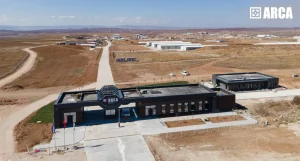
| Cell factory | Mimarsinan Organized Industrial Zone, Kayseri; 25,000 m² enclosed area |
| Cell format in series production | Cylindrical 18650 lithium-ion |
| Stated annual target | About 21 million cells (about 220 MWh, per Invest in Türkiye) |
| Markets served | Defence, aviation, rail and marine, energy storage, e-mobility, telecoms, medical, robotics |
What Did the Kayseri Cell Plant Change?
Before the plant, ASPİLSAN made battery packs, including nickel-cadmium and lithium-ion types, but the cells inside lithium-ion packs came from elsewhere. In December 2020 the company signed a technology transfer agreement with South Korea’s Top Battery Co. Ltd. to build cell production in Kayseri. The foundation stone for the plant was laid in October 2020, and the company’s general manager at the time said the project targeted a localization rate of at least 51 percent through a local supplier ecosystem.
Mass production of lithium-ion cells began in September 2022, according to Invest in Türkiye, the government investment agency. The same source says the project received support under the state’s Project-Based Incentive Support System, announced in the Official Gazette on 6 August 2021.
The first series cell was a 2,800 mAh, 3.65 V cylindrical cell in the 18650 format. The company describes the line as able to handle other chemistries too, including NCA, LFP, LTO and LMO. ASPİLSAN calls the facility the first cylindrical lithium-ion cell plant in Europe; that is the company’s own framing and has not been independently checked here.
Why Does a Military Need Its Own Cell Supply?
Cells are a classic dependency. A pack designer can be fully domestic and still rely on a handful of Asian cell makers for the part that determines energy density, temperature behaviour and safety. For defence customers that creates three risks: export-licence or sanctions exposure, quality traceability, and long-term availability when civilian demand spikes.
Domestic cells let a defence prime specify and qualify a battery once and keep that qualification. They also let the supplier tune a design for cold-weather performance or high discharge rates rather than accepting a catalogue product. The wider push is the same one behind Türkiye’s drive for defence production independence, applied one level down the supply chain.
Which Defence Programmes Does ASPİLSAN Supply?
The company’s own materials list defence system batteries as a main product line, with radios, weapon systems and night-vision equipment among the uses for its cells. A Turkish-language reference source says it has supplied batteries to ASELSAN, ROKETSAN and TUSAŞ. ASPİLSAN reportedly made its first batteries for ASELSAN systems in the mid-1980s.
On the aviation side, a sector database reports that ASPİLSAN batteries are used on the KAAN fighter and the TÜRAN trainer. Treat that as reported rather than confirmed by TUSAŞ or the Presidency of Defence Industries (SSB). The same reference lists EASA certification for civil aviation applications in 2018 and NATO-standard quality certification in 1997, both from a Turkish encyclopedia entry rather than the company’s current site.
The ties with TUSAŞ have deepened. Reports from the SAHA 2026 fair say two agreements were signed: a contract for developing and producing aviation battery cells under the SSB’s industrial participation offset support, and a framework protocol on space-qualified batteries meant to reduce reliance on foreign suppliers. No contract values were disclosed in the coverage reviewed.
Space is a separate test. Satellite batteries face vacuum, radiation and thermal cycling, and qualification takes years. The framework protocol is an agreement to cooperate, not proof of a flight-qualified cell, and the sources reviewed give no timeline for one.
What Is the New Silicon-Anode Cell?
At SAHA 2026, ASPİLSAN showed what it described as Türkiye’s first lithium-ion cell with a silicon-based anode. Reported as the A35, it is an 18650 cell rated at 3,500 mAh with a silicon/graphite composite anode, against 2,800 mAh for the first series cell in the same format. That is a gain of roughly a quarter in capacity without changing the cell’s size, which matters for equipment with fixed battery compartments such as radios and handheld devices.
The company positions the cell for defence and demanding field conditions, including low temperatures. Cycle life, discharge performance and qualification status were not detailed in the sources reviewed, so no performance claims beyond rated capacity are made here.
How Big Is the Business Beyond Defence?
ASPİLSAN sells well outside the military. It has long supplied rail operators; trade coverage names TCDD and TÜRASAŞ among partners and links the company to the Istanbul Airport metro line. It also makes packs for e-mobility, energy storage, telecommunications, medical devices and robotics, and offers fuel-cell-related products according to a sector database.
For 2025, the company reported 25 percent revenue growth in Turkish lira terms, 490 new customers, four patent applications and one design registration. It also said it ranked 13th in a list of organized industrial zone companies by R&D spending, and that it received the largest amount of external funding of any defence industry company that year. Those are company-reported figures. Lira revenue growth in a high-inflation economy says little about real growth, and the company did not publish absolute revenue in the source reviewed.
What Limits ASPİLSAN’s Growth?
The plant’s nameplate target of about 21 million cells per year is small next to the largest cell producers, which make billions annually. ASPİLSAN is not competing on price in mass consumer markets. Its case rests on qualification, traceability and domestic supply for programmes where an imported cell can be refused or delayed.
The localization of raw materials is the harder part. Cathode and anode materials, separators and electrolyte still largely come from abroad across the industry, and the company’s 51 percent localization goal was framed as an ecosystem-building target rather than something the plant achieved on day one. The 2025 results suggest series production is maturing; the next measure will be how much of the cell’s material content is sourced in Türkiye, and whether the silicon-anode cell moves from a fair showpiece into qualified military products.