HAVELSAN’s ADVENT Now Runs Turkish Warships and Has Its First NATO Customer

A modern warship is a floating collection of sensors, guns, missiles and radios, and none of them is useful until something ties them together. That something is the combat management system, or CMS. In the Turkish Navy it is, increasingly, a single software family from HAVELSAN called ADVENT.
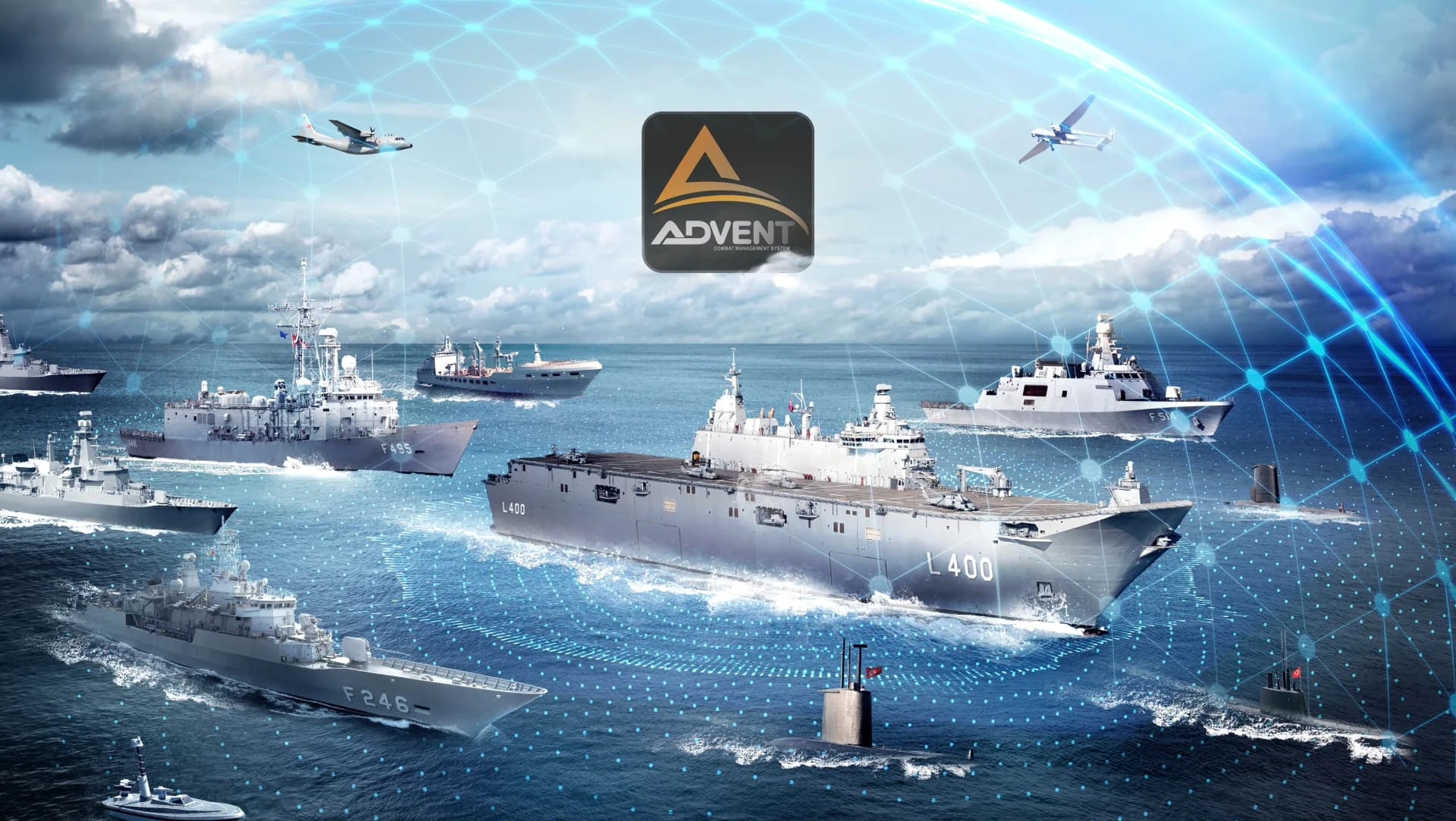
The name stands for Ağ Destekli Veri Entegre Savaş Yönetim Sistemi, roughly “network-supported, data-integrated combat management system”. The word that matters is network. HAVELSAN describes ADVENT as built around a force-oriented approach rather than a single-ship one, so that a frigate, a patrol aircraft and an unmanned boat can work from the same operational picture.
What does a naval combat management system actually do?
A CMS takes tracks from radar, sonar, electronic-support sensors and data links, correlates them into one picture, helps the command team decide what to do about each contact, and then tasks the weapons. It also handles navigation, training and, in peacetime, tasks such as search and rescue.
According to the Defence Turkey magazine description of ADVENT, the system is meant to raise situational awareness, support the use of weapons and sensors, provide decision support and allow rule-based automated responses to detected tracks. It covers surface, anti-air, anti-submarine, electronic, mine and amphibious warfare, and non-combat missions such as evacuation and humanitarian assistance.
| Field | Detail |
|---|---|
| Developer | HAVELSAN, with the Turkish Naval Research Center Command |
| Development start | 2010 |
| Type | Network-enabled naval combat management system |
| Tactical data links | Link 11, Link 16, Link 22, SIMPLE, JREAP, VMF |
| Variants | ADVENT ROTA (unmanned systems), ADVENT UFUK (maritime security), ADVENT MARTI (special mission aircraft and helicopters) |
| Predecessor | GENESIS |
Where did ADVENT come from?
Turkish naval software did not start with HAVELSAN. Defence Turkey traces the lineage through foreign-supplied systems on older ships, then the national K-5 in the mid-1990s on Tepe-class frigates. The Turkish Naval Research Center Command began work on a first national CMS in 1998, and that effort produced GENESIS, short for Gemi Entegre Savaş İdare Sistemi.
GENESIS entered use in 2005 with the modernization of Gabya-class frigates. According to HAVELSAN it was later installed on eight modernized frigates, the Ada-class corvettes and the LST amphibious ships, and Defence Turkey counts 12 platforms in total. The contract for GENESIS on the first two Ada-class corvettes was signed on 23 May 2007.
ADVENT was the next step. Development began in 2010 with the same naval research organisation, and HAVELSAN’s own product page dates its introduction to that year. Defence Turkey describes about two years of system engineering followed by roughly six years of development and testing, with a product-line design in which navigation, warfare and search-and-rescue functions are separate building blocks. The same account puts the code base at around 500 applications and about 10 million lines.
Which ships carry ADVENT?
The first operational host was TCG Kınalıada, the last of the Ada-class corvettes in the MİLGEM family, which received ADVENT in place of GENESIS and went through live-firing tests. Naval News, reporting from DIMDEX 2024, lists sea acceptance tests completed on TCG Kınalıada, TCG Ufuk and TCG Beykoz.
HAVELSAN’s product page lists MİLGEM, the Pakistan corvette, the Ukrainian Ada-class corvette, the landing helicopter dock, the DİMDEG supply and combat support ship, an offshore patrol vessel and the MELTEM 2 CN-235 maritime patrol aircraft. The landing helicopter dock is TCG Anadolu. Defence Turkey and Naval News also cite modernization of the Barbaros-class frigates and the I-class frigate TCG İstanbul as planned deployments, so check the current status of those before treating them as fielded.
Why does the data link list matter?
ADVENT consoles can reach Link 11, Link 16 and Link 22 functions, plus SIMPLE, JREAP and VMF, and can run several link types simultaneously, according to HAVELSAN and Defence Turkey. For a NATO navy this is the difference between a ship that sees only its own sensors and one that shares a picture with allies. HAVELSAN markets the system as NATO-standard compliant.
Integration with the ship itself is the harder part. Defence Turkey says the platform interface is compatible with around 50 systems, using a plug-and-play approach for sensors and weapons. That is where a domestic CMS pays off for the owner: new local weapons or radars can be connected without waiting for a foreign vendor to open its interfaces.
How is the system put together?
Defence Turkey describes a hierarchical structure with centralized control and distributed execution. In practice that means functions sit in separate modules rather than one monolith: situational awareness, status display and CMS support, combat management and navigation, non-war operations, platform integration, and a training and simulation system.
The training module is easy to overlook. HAVELSAN says the system supports training without disrupting operations, so crews can rehearse on the same software they fight with. The open architecture also lets the same core be scaled from small boats to large surface combatants and shore command centers, which is how one product can serve both a patrol craft for Qatar and a landing helicopter dock.
The platform-independent design is also what allowed HAVELSAN to carry ADVENT beyond ships, into aircraft and unmanned systems, without starting a new product each time.
What are ROTA, UFUK and MARTI?
ADVENT is no longer only a ship system. ADVENT ROTA is the mission management layer for unmanned platforms, and HAVELSAN’s catalogue says it is used on more than 30 surface, underwater and air platforms. The company’s site also pairs it with its autonomous SANCAR unmanned surface vessel, developed with Yonca Onuk, and describes it as integrable with other NATO-standard naval platforms.
ADVENT UFUK targets maritime security and situational awareness for coastal operations. ADVENT MARTI is the airborne version for special mission aircraft and helicopters, handling tasks such as intelligence gathering, anti-submarine and special warfare, electronic warfare and search and rescue.
HAVELSAN also said in August 2025, as reported by military.africa, that it was integrating its corporate AI platform MAIN into ADVENT. The first phase of laboratory testing was reported complete, with integration work continuing. The stated uses are threat identification, anomaly detection and maintenance support through natural-language queries. Naval News reported in July 2026 that an AI-supported ADVENT version is still in development.
Who has bought ADVENT abroad?
Exports are the clearest sign that the system has moved beyond a single navy. In 2021 HAVELSAN described itself as the sole-source naval CMS provider for the Turkish Navy for over 15 years and said it was marketing in Indonesia, Malaysia, Bangladesh and the Philippines, with a Malaysian office opened that year. It also reported that the Pakistan Navy had selected ADVENT for the Pakistan corvette programme.
Naval News in 2024 added fast attack craft for Qatar built by Dearsan, and vessels for Pakistan, Ukraine, Malaysia and Indonesia. Romania Insider, citing reports, lists Pakistan, Indonesia, Ukraine, Qatar, Oman, Nigeria, Malaysia and Chile as earlier customers. For how MİLGEM-type corvettes compete for such orders, see this export comparison.
The newest step came in mid-2026. Naval News and EDR Magazine reported that ADVENT entered service with the Romanian Navy, the first NATO member to use it, through the corvette CAm.ROMAN (Contraamiral Roman 261), handed over in June 2026. Before that, the sources say, the system served 10 countries across five continents, Türkiye included. The version supplied to Romania is described as an adaptation of the Turkish Navy system tailored to Romanian requirements.
What is HAVELSAN’s role in the bigger picture?
HAVELSAN is a software and systems house rather than a shipbuilder, and ADVENT is among its flagship naval products. Its company profile covers the wider portfolio, from simulation to command and control. ADVENT shows a pattern: a national navy funds a research programme, a state-linked company turns it into a product family, and the product then follows hulls and aircraft into export contracts.
The open questions are practical. Which of the planned Turkish installations are complete, how large the AI layer becomes, and whether Romania leads other NATO navies to ask for the same system. Those are the details to watch in HAVELSAN and SSB announcements.