Korean Diesel Powers the ALTAY Tank While the Turkish BATU Waits

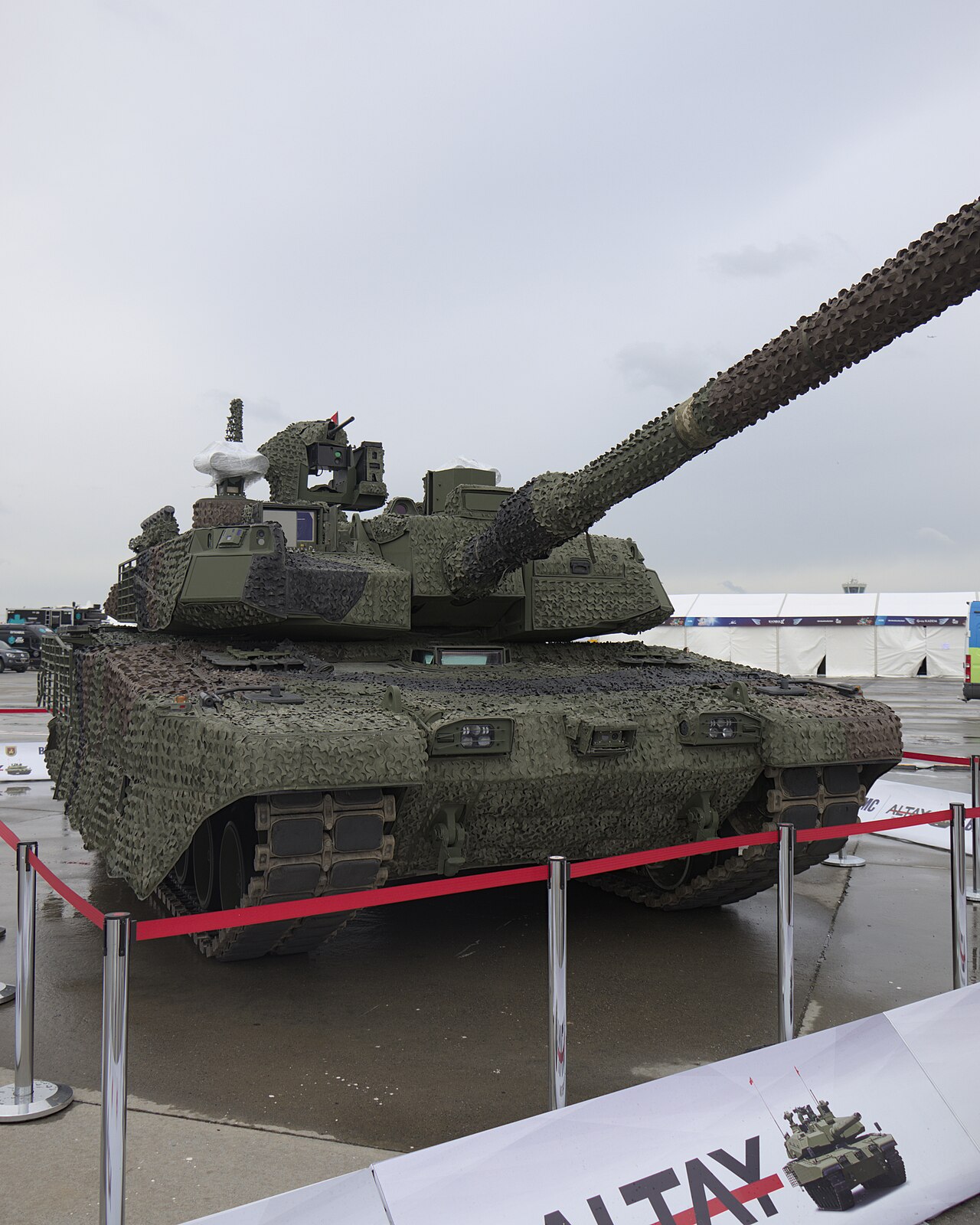
The short answer is a South Korean one. The first ALTAY main battle tanks rolling out of Türkiye’s production line run on a Korean powerpack, an HD Hyundai Infracore DV27K diesel paired with an S&T Dynamics EST15K automatic transmission. The Turkish-built BATU engine from BMC Power has cleared factory tests, but it is not the one in service tanks yet.
Which engine powers the ALTAY tank in service today?
The early-production tanks, known as the T1 batch, use the DV27K. It is a 27.2-litre, twin-turbocharged V12 diesel rated at about 1,500 horsepower, with torque reported at roughly 4,560 Nm. The EST15K gearbox offers six forward and three reverse gears and is integrated with the engine as a single powerpack.
That arrangement was not the original plan. The ALTAY was designed around a German powerpack, an MTU engine with a RENK transmission. German restrictions on arms exports to Türkiye, tied to the Syria operations, left the programme without that supply line. Ankara turned to South Korea, where the DV27K is already used in the K2 tank.
| Item | T1 batch (current) | T2 batch (planned) |
|---|---|---|
| Engine | HD Hyundai Infracore DV27K, V12 diesel | BMC Power BATU, V12 diesel |
| Rated power | About 1,500 hp | At least 1,500 hp |
| Transmission | S&T Dynamics EST15K, 6 forward / 3 reverse | BMC Power cross-drive, 6 forward / 2 reverse |
| Origin | South Korea | Türkiye |
How did the Korean powerpack get onto the tank?
A letter of intent between Türkiye and South Korea’s defence procurement agency DAPA was signed in October 2021. In May 2022 the Presidency of Defense Industries (SSB) announced that Korean powerpacks had been integrated into ALTAY prototypes and tested. Durability trials followed through 2022, according to published accounts.
The choice was a pragmatic one. The DV27K is a proven engine, and it let production start while the Turkish alternative was still on the test bench. The Korean unit is slightly heavier and larger than the German package it replaced, and reported torque is a little lower. For a tank of around 65 tonnes, that leaves the ALTAY with a power-to-weight ratio in the low 20s of horsepower per tonne.
What is the BATU engine?
BATU is the indigenous powerpack developed by BMC Power, the BMC-linked company set up to build Turkish tank engines and transmissions. It pairs a V12 water-cooled, turbocharged diesel of at least 1,500 horsepower with an automatic cross-drive transmission that also handles steering and braking. Reports put minimum torque at 4,600 Nm.
The engine first ran in 2021. BMC Power reported that BATU completed factory acceptance tests at the end of 2025, describing it as the first Turkish-designed 12-cylinder engine of this class. The transmission side has lagged: qualification of the gearbox was still continuing when the engine milestone was announced. The two halves of the powerpack are running on different clocks.
When will the Turkish engine reach production tanks?
The published plan points to 2028. The indigenous powerpack is meant for the T2 variant, which makes up the larger part of the reported order. Press reports describe a contract for 250 tanks, reported as 85 T1 and 165 T2 machines, with options for up to 750 more. These numbers come from secondary reporting and could shift as the schedule does.
Serial production of the T1 batch was reported to have begun in autumn 2025, with first deliveries to the Turkish Land Forces following. That timing matters for the engine story. Every tank delivered before 2028 will carry Korean propulsion, so the army will operate a mixed fleet with two powerpacks and two supply chains.
Does the Korean engine leave the ALTAY exposed to export limits?
It could, and this is the open question. The German episode showed how a single foreign component can stall a national programme. Swapping MTU for Hyundai moves the dependency rather than removing it. A Korean engine brings Korean export approval into any future ALTAY sale, which is one reason BATU matters to the export ambitions around the tank. Nothing in the public record says Seoul has blocked anything; the point is about exposure, not a dispute.
The same logic plays out in aviation, where Türkiye is working to replace foreign engines across its platforms and progress is slow. Our coverage of the KAAN engine timeline and its ALTAY parallel and the wider push for defence production independence puts the tank powerpack in that context.
Why does the powerpack matter so much for a tank?
A tank’s engine and transmission are not interchangeable parts. They dictate hull layout, cooling, maintenance routines and spare-parts logistics. The ALTAY’s rear compartment was shaped around a specific powerpack envelope, which is why the Korean unit, being a little larger than the German one, needed integration work rather than a simple swap.
The same applies in reverse. BATU has to fit the same hull and meet the same mobility requirements, so its qualification is as much about packaging and durability as about raw horsepower. Only after the gearbox clears qualification can the army treat the Turkish powerpack as a production item rather than a test article.
For crews and depots, the mixed-fleet period will be the practical test. Two engine types mean two training tracks, two parts pipelines and, for a while, two sets of maintenance manuals on the same tank model.
Where to read more on the ALTAY
For deliveries, status and export talk, see the full ALTAY tank programme guide. For how the platform stacks up against its main European rival, read the ALTAY and Leopard 2A7 comparison. Export licensing questions that shape component choices are covered in our piece on ITAR and Turkish defence exports.