Who Trains the Armies That Buy Turkish Weapons, and Where

Four different organisations train the armies that buy Turkish weapons, and only one of them is the manufacturer. Baykar, ASELSAN and Turkish Aerospace teach crews to fly and maintain the hardware. The Turkish Armed Forces train partner militaries as institutions, at home and at overseas bases. HAVELSAN sells the simulators and training centres that let a customer eventually train itself. And the Presidency of Defence Industries (SSB) has begun exporting engineering education through its Defence Industry Academy. For a procurement officer the practical question is not whether training is offered, but which of those four layers a particular contract actually buys.
That distinction decides how long it takes a new fleet to become useful, who owns the instructor base in five years, and whether the buyer is still dependent on Turkish courses when the second batch arrives. The published record is uneven — most of what is known comes from graduation ceremonies and contract summaries rather than from syllabuses — but it is thick enough to map.
DEFENCETÜRKİYE DATA BOX
Subject: Training delivered to foreign customers of Turkish defence equipment
Main company providers: Baykar, ASELSAN, Turkish Aerospace, HAVELSAN, ROKETSAN
Main state providers: Turkish Armed Forces; SSB Defence Industry Academy; Turkish Partnership for Peace Training Centre, Ankara
Principal named facility: Baykar Çorlu Flight Training and Test Centre, Tekirdağ
Most recent documented cohort: 15 pilots and 15 technicians of the Royal Saudi Naval Forces, AKINCI, graduated 25 September 2026
Usually inside the contract: operator and maintainer courses, simulators, spares, logistic support
Rarely published: course length, syllabus, instructor-to-student ratios, training cost as a share of contract value
State grant funding: none equivalent to US IMET; training is normally a priced contract line
What does a Turkish arms contract actually include by way of training?
In the contracts whose scope has been published, training is a named deliverable rather than an afterthought. Poland’s May 2021 purchase of 24 Bayraktar TB2 aircraft is the clearest example in Europe, because a NATO member had to document what it was buying. The package covered four systems, each with six aircraft and three ground control stations, together with synthetic aperture radar, simulators, a spares stock, ROKETSAN MAM-L and MAM-C munitions, and training and logistic services. Deliveries began in October 2022 and the final batch arrived in May 2024.
What followed matters more to other European buyers. In October 2024 Baykar signed a three-year logistical and service support agreement for the Polish fleet with the NATO Support and Procurement Agency, with an option for two further years. NSPA general manager Stacy Cummings described the arrangement as designed to accommodate other TB2 user nations as required. Sustainment of a Turkish platform now sits inside an alliance procurement body, which changes the administrative picture for any NATO customer weighing the same aircraft. Our guide to how countries buy and pay for Turkish weapons sets out the contracting routes in more detail.
Outside Europe the scope is usually summarised rather than itemised. The 2023 export and cooperation agreement between Baykar and the Saudi Ministry of Defense commits the company to provide training, technical support and logistics services alongside the aircraft themselves. Neither party has published a contract value.
Layer one: the manufacturer trains the crews
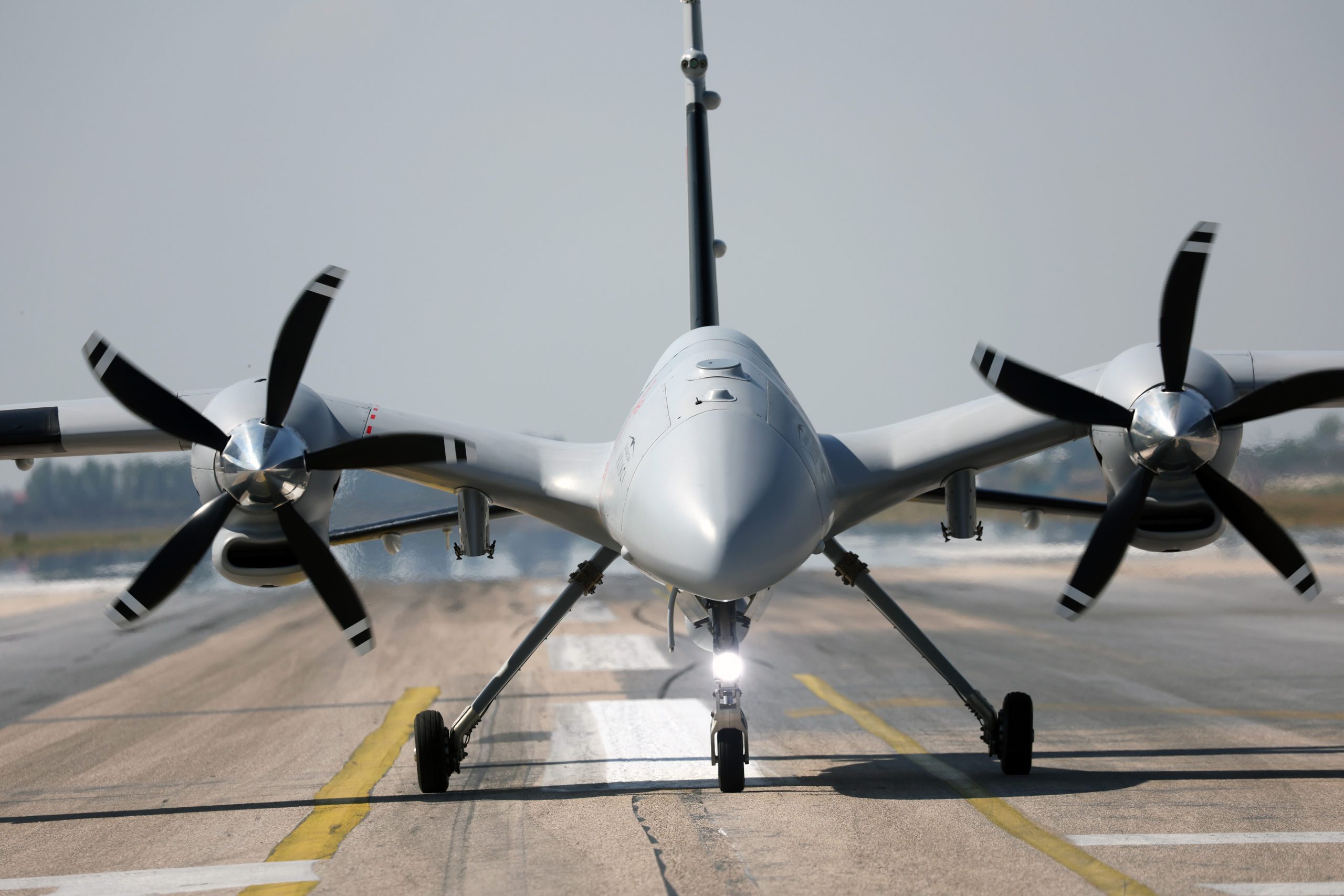
This is the visible layer, and Baykar runs the most publicised version of it. On 25 September 2026 the company announced that 30 personnel of the Royal Saudi Naval Forces — 15 pilots and 15 mechanical and electronic technicians — had completed AKINCI courses at its Çorlu Flight Training and Test Centre in Tekirdağ. Envanter Medya’s Turkish-language account of the Saudi AKINCI graduation at Çorlu puts the 2023 agreement behind it at around $3 billion, a figure neither government has confirmed.
The split is the informative part. Fifteen aircrew and fifteen maintainers is a roughly even weighting of flying and fixing, which is unusual in a drone sale and tells a buyer that the supplier expects the customer to hold the aircraft on its own flight line rather than return it for depot work. The same balance appears in Nigeria’s case. Forty-six Nigerian Army personnel trained in Türkiye from 2022 — 14 pilots, seven mission operators and the remainder engineers and technicians — and 22 of them were formally certified at a ceremony in Abuja in December 2024, the rest being on operational duty. The Chief of Army Staff, Lieutenant-General Olufemi Oluyede, said their winging confirmed their certification to fly and maintain the TB2s in the inventory. By that date the fleet had flown 254 sorties and 1,664 flight hours since October 2022.
Baykar publishes an outline of one of its courses. Its payload operator training programme runs through gimbal camera hardware, a technical course in mission terminology, simulator application, drill videos, map use and image evaluation, fault prevention, and finally training flights, with operators completing the programme on real test flights. That is a conventional civil-aviation course structure applied to an unmanned system, and it is one of the few places where a buyer can see the shape of the syllabus before signing.
ASELSAN’s approach to its own domestic customer shows the next step. When the HİSAR-A+ air defence system was handed to the Turkish Land Forces Command, the company ran Instructor Operator and Maintenance Instructor courses lasting about six months, using simulators and training missiles so that scenarios could be built without firing live rounds. Those are train-the-trainer courses, not operator courses. A buyer that negotiates for the instructor version rather than the operator version is buying the ability to run its own school afterwards. More on the company that builds most of these systems is in our ASELSAN company profile.
Layer two: the Turkish state trains the institution
Company courses produce crews. They do not produce a staff system, a logistics branch or a doctrine, and this is where the Turkish Armed Forces operate separately from industry. Camp TURKSOM in Mogadishu, opened in 2017, is Türkiye’s largest overseas military facility and has put thousands of Somali soldiers through basic and specialist training; the published totals vary widely by source and year, and should be treated as estimates rather than audited figures. In 2026 soldiers of Somalia’s 21st Gorgor Brigade also trained at Türkiye’s 8th Commando Training Brigade. Soldiers from Mali and Niger completed special forces courses in Isparta in June 2026.
Writing in September 2026, the analyst Nebahat Tanrıverdi Yaşar told defenceWeb that the scope of these agreements “extends far beyond tactical training to encompass organizational structure, logistics, military intelligence, defense industry cooperation, and professional capacity building.” The commercial consequence is obvious enough, though it should not be overstated: training relationships and equipment sales often run in parallel, and each makes the other easier, but neither automatically produces the other. Our separate study of how Turkish arms sales in Africa start in the classroom traces that pairing country by country, including the financing side.
There is a quieter alliance channel as well. The Turkish Partnership for Peace Training Centre in Ankara describes itself as the first NATO-recognised partnership training centre, opened in 1999, and lists thirteen course lines covering civil-military interaction, munitions management, joint terminal attack control, law of armed conflict, border security and — notably — Military Instructor Training. Recent intakes it publishes are small and broad: 32 participants from 16 countries on a Law of Armed Conflict course in March 2026, 20 from nine countries on a UN Military Observer course the same spring. NATO announced the centre’s opening as the alliance’s first Partnership for Peace Training Centre in June 1999. None of this sells equipment directly. All of it puts foreign officers in Turkish classrooms.
Layer three: the buyer gets the training equipment
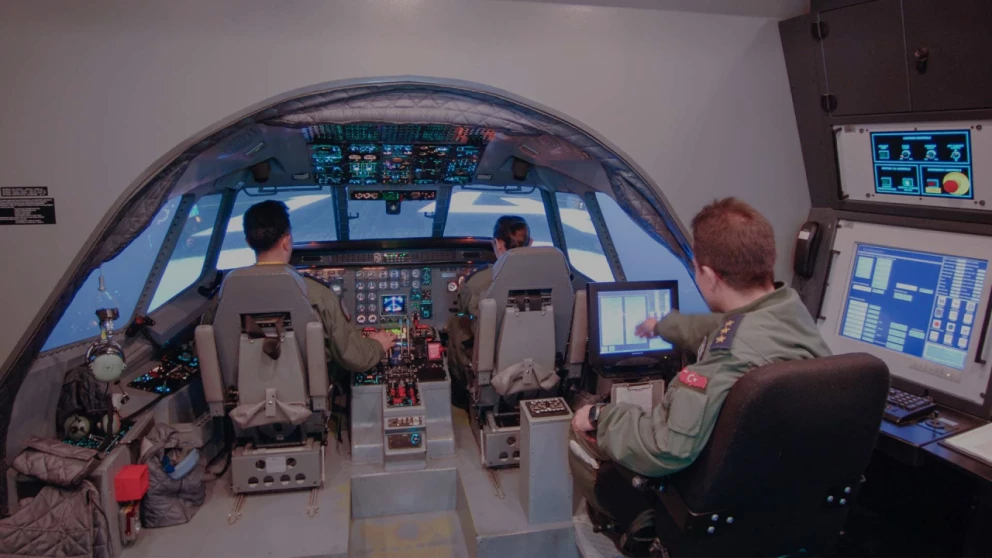
The third layer is the one most likely to appear in a tender evaluation, because it is the one that ends the dependency. HAVELSAN lists Simulation and Training Technologies as one of its five business areas, alongside command and control, ICT, unmanned systems and cyber security, and describes its role as developing “training solutions, simulation systems, and platforms tailored to their needs.” The company has exported the physical article as well as the service: it built an AW139 helicopter simulator integrated training centre for the Qatar Air Force, with the full mission simulator shipped to Doha in December 2016 and three years of operational services following integration. Envanter Medya’s Turkish-language survey of HAVELSAN’s flight training centres and their move from building simulators to running schools is a useful companion for readers who want the domestic picture; our own HAVELSAN company profile covers the business in English.
Poland’s contract included simulators from the start, and reporting at the time of the sale indicated that depot-level maintenance capability for the TB2 would be transferred to the Polish military. Where that happens, the training question shifts from “who teaches our crews” to “who certifies our instructors”, which is a different and considerably more valuable thing to buy.
Layer four: training the buyer’s engineers, not only its soldiers
The newest layer is industrial. The Defence Industry Academy (SSA) was established in 2017 under the SSB and works from the METU Technopolis campus in Ankara. It states that it runs more than nine active training programmes — specialist schools in radio frequency, airworthiness, electronic warfare, systems engineering, project management, artificial intelligence, cyber security, guidance navigation and control, advanced materials, avionics, electro-optics and aircraft structures — and reports more than 10,000 graduates. Until recently that was an entirely domestic workforce programme.
At ADEX 2026 in Baku it became an export. On 30 September 2026, as part of a package of agreements the two sides valued at more than $500 million, Azerbaijan’s Ministry of Defence Industry and Ministry of Science and Education signed a memorandum with the SSB and Türkiye’s Council of Higher Education (YÖK) covering higher education, scientific research, technology and human-resources development for the defence sector. A separate cooperation agreement linked the Defence Industry Academy to Azerbaijan’s Defence Industry Research and Innovation Center. The memorandum as reported by APA envisages training qualified engineering and technical personnel, exchanges of students and academic staff, and joint research projects. The same week Azerbaijan contracted for 14 HÜRKUŞ-II trainer aircraft, making it the first export customer for that version, according to Daily Sabah.
A memorandum is not a programme, and no intake figures have been published. But the direction is clear: Türkiye is beginning to offer buyers a route into building their own defence engineering base, not only their own crews. That is the same promise that drives the offset obligations attached to Turkish export contracts.
The four layers side by side
| Layer | Who delivers it | Where | Documented example | What the buyer ends up owning |
|---|---|---|---|---|
| 1. Crew training | Manufacturer (Baykar, ASELSAN, Turkish Aerospace, ROKETSAN) | Company facilities in Türkiye | 30 Royal Saudi Naval Forces personnel, AKINCI, Çorlu, September 2026 | Qualified crews. No instructor base. |
| 2. Institutional training | Turkish Armed Forces; Turkish PfP Training Centre | Türkiye and overseas bases such as Camp TURKSOM | Somali, Malian and Nigerien courses, 2026; multinational PfP courses | Staff procedures and doctrine. Also a political relationship. |
| 3. Training equipment | HAVELSAN and platform primes | Installed in the customer’s country | AW139 training centre, Qatar, 2016; simulators in Poland’s TB2 package | The means to train itself, if instructors come with it. |
| 4. Industrial education | SSB Defence Industry Academy; YÖK universities | Ankara, and partner institutions abroad | SSA–Azerbaijan agreement, ADEX 2026, 30 September 2026 | Engineers. Announced, not yet measurable. |
Original DefenceTürkiye table, compiled from the company, government and alliance sources listed at the end of this article. Figures are those published by the parties; none has been independently audited.
WHY IT MATTERS
Turkish suppliers compete on the time it takes a customer to field a capability, not only on unit price. A package that brings crews, maintainers, simulators and a support contract arrives as a working squadron rather than a crate of aircraft. The weakness of the model is its ceiling: cohorts are small, instructor capacity in Türkiye is finite, and a buyer that does not negotiate for instructor-level courses will be sending people back to Tekirdağ for years.
What the documented cases show
| Customer | System | Personnel trained | Where and when | Status of the evidence |
|---|---|---|---|---|
| Saudi Arabia (Navy) | Bayraktar AKINCI | 15 pilots, 15 technicians | Çorlu, graduated 25 September 2026 | Announced by the manufacturer |
| Nigeria (Army) | Bayraktar TB2 | 46 total; 14 pilots, 7 mission operators | Türkiye, from 2022; certified Abuja, December 2024 | Stated by the Chief of Army Staff |
| Poland | Bayraktar TB2 | Not published | Contract May 2021; NSPA support deal October 2024 | Training named in contract scope |
| Qatar (Air Force) | AW139 training centre | Not published | Doha, simulator shipped December 2016 | Reported contemporaneously |
| Azerbaijan | Engineering and research cooperation | No intake figure | Baku, memorandum signed 30 September 2026 | Memorandum only; no programme announced |
Original DefenceTürkiye compilation. “Not published” means neither the supplier nor the customer government has released the figure, not that no training took place.
Where the limits are
Three constraints deserve to be stated plainly, because a buyer will meet all of them.
Throughput. Thirty personnel is a creditable cohort for a first delivery and a small number against a fleet that is meant to fly continuously. Nigeria’s 46 trained personnel supported 254 sorties over roughly two years, which is sustainable for a single-theatre deployment and thin for anything larger. Published Turkish training capacity is nowhere near the scale of the long-established Western schoolhouses, and the companies have not released annual intake numbers.
Funding. Türkiye has no equivalent of the US International Military Education and Training grant programme. Training is normally priced into a commercial contract and paid for by the buyer, sometimes through export credit. That keeps Turkish offers free of some of the political conditions attached elsewhere, and it also means a budget-constrained customer can be tempted to trim the training line to save money — the single most common way a good package turns into a disappointing capability.
Transparency. Course length, instructor qualification standards, the language of instruction and the ratio of simulator hours to live hours are almost never published for export cohorts. A buyer must extract them in negotiation. The same opacity affects contract reporting generally, as our piece on why Turkish defence contracts say “customer undisclosed” explains.
A fourth point is political rather than technical. The institutional layer — basing, commando training, long-term military cooperation — arrives with a relationship, and not every buyer wants one. A government shopping purely for equipment can buy layers one and three and decline layer two. Several have.
BUYER VIEW
Questions worth putting in writing before signature, based on what the published contracts do and do not cover:
- Does the package buy operator courses or instructor courses? Only the second lets you run your own school.
- How many personnel, in which trades, and over what period — and what does an additional cohort cost?
- Where does training take place after the first batch: in Türkiye, or on equipment installed in your country?
- Is depot-level maintenance authority transferred, as reported in the Polish case, or retained by the supplier?
- Who certifies your instructors once Turkish instructors leave, and against whose standard?
- Can sustainment be routed through a third party such as NSPA, and on what terms?
- What share of the contract value is the training and support line, and is it separable?
This is open-source editorial analysis by DefenceTürkiye. It is not procurement advice, and DefenceTürkiye does not advise governments.
What comes next
Three things are worth watching. The first is whether the Azerbaijani academy agreement produces named intakes; until it does, layer four remains an announcement. The second is whether the NSPA route for TB2 sustainment is used by a second European operator, which would turn a bilateral arrangement into something closer to a standard. The third is capacity: Baykar, Turkish Aerospace and ASELSAN are all exporting faster than they are publishing training figures, and the gap between delivered systems and trained crews is the number that would actually settle how durable this model is. None of the three companies currently releases it.
For readers tracking the demand side, our analysis of why countries buy Turkish drones and our survey of who supports Turkish weapons after the sale cover the two halves of the package that training sits between.
FAQ
Does Türkiye provide training with its weapons exports?
Yes, and it is normally written into the contract. Published scopes such as Poland’s 2021 TB2 package list training and logistic services alongside aircraft, ground stations, simulators and munitions. Turkish suppliers also run courses at their own facilities, most visibly Baykar’s Çorlu Flight Training and Test Centre.
Where do foreign crews train on Turkish drones?
Mostly in Türkiye, at manufacturer facilities. Baykar’s Çorlu centre in Tekirdağ is the one named most often in official announcements, including the September 2026 graduation of 30 Royal Saudi Naval Forces personnel on AKINCI. Some customers later receive simulators and training equipment installed in their own countries.
Is Turkish military training free, like US IMET?
No. Türkiye has no standing grant-aid programme comparable to US International Military Education and Training. Company-delivered training is a priced element of a commercial contract. State-to-state military training is arranged under bilateral defence cooperation agreements, whose financial terms are generally not published.
How long does training on a Turkish system take?
Export course lengths are rarely published. The clearest indication comes from the domestic side: ASELSAN’s Instructor Operator and Maintenance Instructor courses for the HİSAR-A+ air defence system ran about six months. Operator courses are shorter than instructor courses, and maintainer courses vary by trade.
Does a buyer have to keep sending people to Türkiye?
That depends on what was bought. A contract that includes simulators, a local training centre and instructor-level courses lets the customer take over. Poland’s package included simulators and, according to reporting at the time of the sale, a transfer of depot-level maintenance capability. A contract limited to operator courses leaves the customer returning for each new cohort.
Who trains the Turkish defence industry’s own engineers?
The SSB’s Defence Industry Academy, founded in 2017 at METU Technopolis in Ankara, which reports more than 10,000 graduates across specialist schools in fields from electronic warfare to airworthiness. Since the ADEX 2026 agreements in Baku it has a cooperation framework with Azerbaijan’s defence research institutions as well.
Sources
- Baykar, payload and UAV operator user training programme (company page)
- A News / TRT World, “30 Saudi naval personnel complete training at Turkish defence firm Baykar”, 25 September 2026
- Defence Industry Academy (SSA), official site, ssa.gov.tr
- Turkish Partnership for Peace Training Centre, official site, turkishpfp.tsk.tr; NATO, “The first Partnership for Peace Training Centre opens in Ankara”, June 1999
- APA, memorandum on defence industry cooperation signed at ADEX 2026; Daily Sabah, Türkiye–Azerbaijan defence contracts, 30 September 2026
- HAVELSAN, business areas (company site); Defense News, “Turkey’s Havelsan builds AW139 simulator for Qatar”, 4 January 2017
- Shephard Media, Poland–NSPA Bayraktar TB2 support contract, 18 October 2024
- The Eagle Online, Nigerian Army winging ceremony, 18 December 2024
- defenceWeb, “Türkiye builds ties through training”, 7 September 2026
- DefenceTurkey, “HİSAR-A+ Operator Training Completed”, 23 May 2021
- Envanter Medya (Turkish), Saudi AKINCI training graduation and HAVELSAN flight training centres