
FNSS, PT Pindad Complete Pre-Delivery Tests on First Kaplan APC


Türkiye’s FNSS and Indonesia’s state-owned PT Pindad have completed pre-delivery acceptance tests on the first Kaplan APC, the tracked armoured personnel carrier the two companies are developing jointly for the Indonesian Army, Defence Turkey magazine reported on September 16. The vehicle, built at FNSS’s plant in Türkiye, is the first of two prototypes due under the programme and moves the co-production effort a step closer to delivery.
Pre-delivery acceptance testing is the checkpoint at which a manufacturer demonstrates to the customer’s representatives that a vehicle meets its contracted specification before it is released for shipment. According to the report, PT Pindad representatives took part in the tests in Türkiye alongside FNSS. The vehicle will still need to pass final acceptance testing with the Indonesian Army end user once it reaches Indonesia; no delivery date has been disclosed.
A 30-Tonne APC Built on a Proven Platform
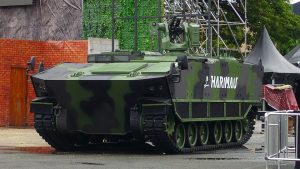
Kaplan APC — known as Harimau APC in Indonesia — is a 30-tonne class tracked personnel carrier that shares its automotive base with the Kaplan MT/Harimau medium tank, the FNSS-Pindad platform Indonesia has already fielded with its army’s cavalry battalions. FNSS first showed the APC’s conceptual design at SAHA EXPO in Istanbul in October 2024, before the companies signed a Kaplan Armoured Personnel Carrier Development and Production Agreement tied to PT Pindad’s contract with Indonesia’s Ministry of Defence.
Under the programme’s division of labour, the first vehicle was manufactured at FNSS’s facility in Türkiye, while a second is being built at PT Pindad’s plant in Bandung, Indonesia — mirroring how the two companies split production of the Kaplan MT tank. FNSS said in February that assembly of the first APC had reached its final stage; vehicle testing was expected to begin in the first half of 2026, and the pre-delivery tests reported this week appear to be the next scheduled step in that plan.
The vehicle carries a crew of three — driver, gunner and commander — plus around ten troops, and is designed around a modular protection package rated against ballistic, mine and IED threats. FNSS has said the design will accept manned or unmanned turret stations, with weapon options reported to include 30mm and 35mm cannon, 120mm mortars or anti-tank guided missiles depending on customer configuration. The hull uses an open-architecture electronics backbone intended to support a battlefield management system and 360-degree day/night situational-awareness cameras for the crew.
Deepening an Established Partnership
Kaplan APC extends a co-production relationship that dates to 2015, when Türkiye and Indonesia agreed to jointly develop what became the Kaplan MT/Harimau medium tank. FNSS delivered the first batch of ten tanks from its Turkish plant in 2022, with a second batch assembled by PT Pindad in Bandung — the same production split now being repeated for the APC variant. That track record is one reason Jakarta turned back to FNSS for its next tracked vehicle requirement rather than opening a fresh competition.
The APC programme also sits inside a broader deepening of Turkish-Indonesian defence industrial ties. Indonesia signed a commercial contract for 48 KAAN fighters from Turkish Aerospace in 2026, one of the largest export orders yet secured for Türkiye’s fifth-generation fighter programme, and Turkish firms have pursued a wider push into the Indonesian market across land, air and naval systems. For Jakarta, co-production deals like Kaplan APC bring technology transfer and local manufacturing work at PT Pindad rather than an off-the-shelf import, a model Indonesia has consistently favoured in its defence procurement.
Why It Matters
For FNSS, a Nurol Holding-owned manufacturer better known internationally for its PARS wheeled vehicle family and its ZAHA amphibious assault vehicle, Kaplan APC is a chance to convert a single, hard-won reference customer into a second tracked-vehicle export line. The company has also been expanding into unmanned platforms, unveiling the İ-ZAHA unmanned amphibious vehicle earlier this month. Successful delivery of Kaplan APC would give FNSS a combat-vehicle family — tank and APC on a shared chassis — that it can offer to other prospective customers evaluating medium-weight tracked fleets, at a time when several armies are looking to modernise ageing APC inventories without the cost of a full main battle tank purchase.
No contract value or unit quantity beyond the two prototypes has been disclosed. The programme’s next milestones will be completion of the second vehicle at PT Pindad’s Bandung facility, shipment of the Turkish-built prototype to Indonesia, and final acceptance testing with the Indonesian Army before any decision on serial production quantities.
Sources: Defence Turkey magazine; FNSS; PT Pindad; Indonesian Ministry of Defence public statements.


[…] contract becomes effective.” Indonesia has run this playbook before with Turkish industry — FNSS and PT Pindad’s Kaplan armoured vehicle programme is the land-systems equivalent — but a buyer counting on the offset should price in the gap […]