AKSUNGUR Drone Drops Turkey’s First Air-Launched Sonobuoy

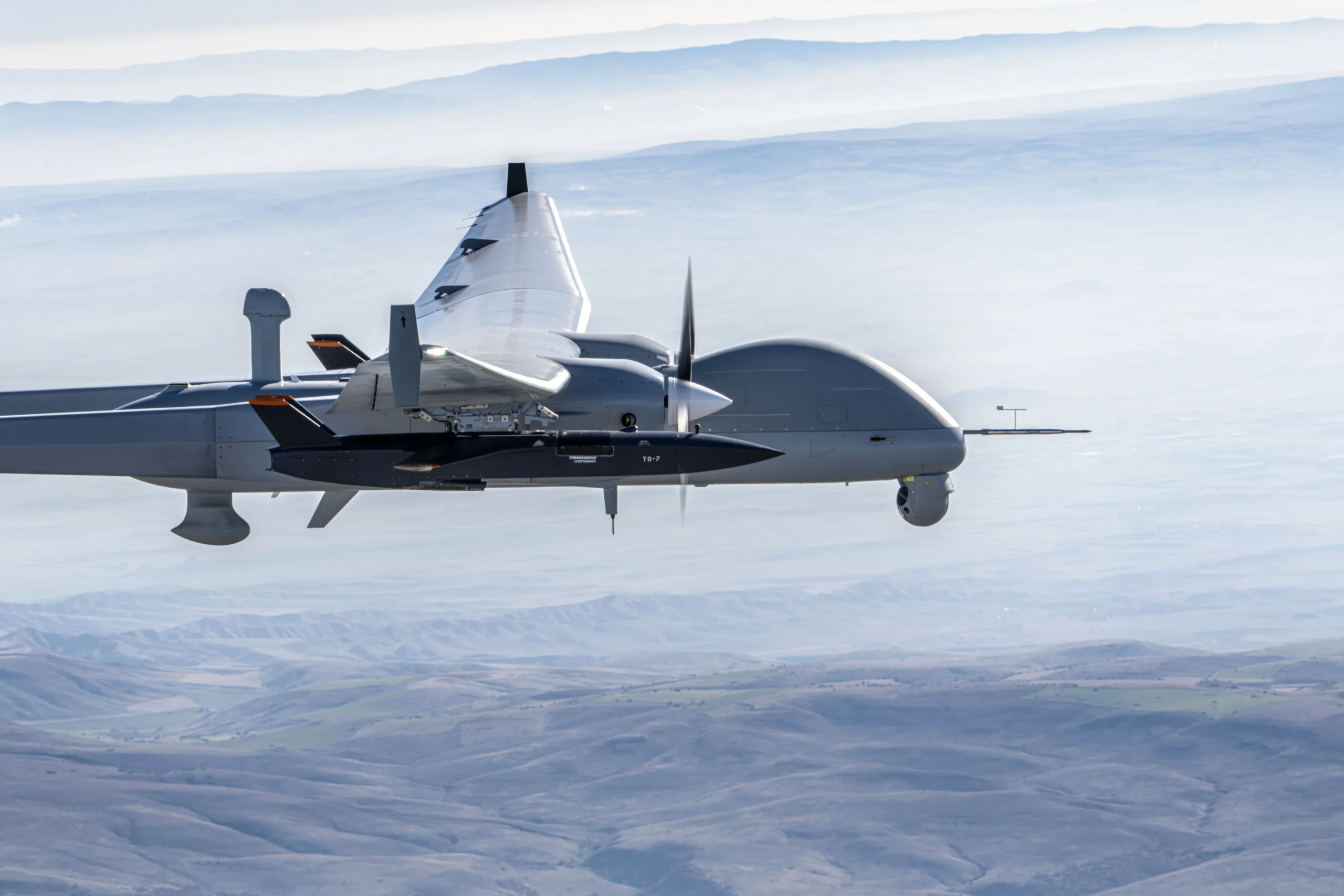
An AKSUNGUR unmanned combat aerial vehicle released sonobuoys over the eastern Mediterranean on October 24, the first time Türkiye has air-dropped the acoustic sensors from a drone, according to a Turkish Aerospace statement relayed by the Turkish defence outlet SavunmaSanayiST. The flight was part of TURNAs-2026, a Turkish Naval Forces Command exercise focused on unmanned maritime systems that began off Antalya on October 21.
The milestone links three previously separate Turkish programmes — Turkish Aerospace’s twin-engine AKSUNGUR, ASELSAN’s aselBUOY sonar sensor, and TUSAŞ Engine Industries’ (TEI) domestically designed PD170 turboprop — into a single anti-submarine warfare chain that no longer depends on an imported sonobuoy launch system.
What happened over Antalya
According to the company’s account, the AKSUNGUR took off from Ankara and flew to the exercise area under satellite control, powered by the TEI-PD170 engine. Over the Mediterranean it descended to roughly 1,000 feet and released three ASELBUOY 100P passive sonobuoys along with a fourth buoy from an underwing pod, then climbed back to around 6,000 feet to monitor the returns.
The aircraft spent close to four hours in the mission area. Acoustic data picked up by the buoys was passed through an airborne relay to an acoustic data transfer centre and on to the Ground Control Station in Ankara, where it was processed to help identify underwater contacts — the basic function of a sonobuoy field used to detect and track submarines.
Turkish Aerospace has not published its own release confirming the mission in English, and the figures above come from the company’s Turkish-language statement as reported by SavunmaSanayiST. Independent confirmation from the Naval Forces Command or the Presidency of Defence Industries (SSB) was not available at the time of writing.
Why an air-dropped sonobuoy matters
Sonobuoys are expendable listening devices that an aircraft scatters across a patch of ocean to triangulate a submarine’s position from underwater noise. Fielding them from a crewed maritime patrol aircraft is long-established practice among NATO navies; doing it from an unmanned platform is rarer, and until now Türkiye’s own anti-submarine aircraft fleet — P-72A turboprops converted from retired CN-235s — has carried the job alone.
Handing part of that mission to AKSUNGUR matters for three reasons. It extends persistence: a drone can loiter for far longer than a crewed patrol aircraft without risking a flight crew. It frees crewed assets for other tasks in a maritime environment where Greek, Russian and other navies operate increasingly capable submarines in the Aegean, Black Sea and eastern Mediterranean. And it closes a gap in Türkiye’s indigenous sensor-to-shooter chain: ASELSAN’s aselBUOY entered serial production earlier in 2026 after the company signed its first production contract with the Naval Forces Command, and Naval News reported in February that air-launch trials were expected within weeks — a timeline this flight would appear to fulfil, though neither company has confirmed the link publicly.
A programme that has taken years to mature
AKSUNGUR’s anti-submarine role has been a known objective since at least 2020, when Turkish Aerospace first displayed a sonobuoy pod and magnetic-anomaly-detector boom on the airframe. Industry officials at the time described a three-phase plan: first relaying raw sonobuoy data without processing it onboard, then launching buoys, and finally processing and distributing the acoustic picture to other naval units in real time. Earlier public targets for a first launch slipped by several years, a pattern common to maritime sensor integration programmes and one this site has tracked rather than glossed over in earlier coverage comparing AKSUNGUR with its smaller ANKA stablemate.
The October mission suggests the programme has reached, or is close to, the launch-and-monitor stage. What is not yet clear is whether AKSUNGUR can process sonobuoy data onboard or still depends on the Ankara-based ground station — a distinction that affects how useful the capability is in a contested environment where satellite links can be degraded.
Part of a larger unmanned naval push
TURNAs-2026 is itself a sign of how far Türkiye has pushed unmanned systems into routine naval exercising. Anadolu Agency reported that the drill, running in the Gulf of Antalya and the eastern Mediterranean, involves 18 crewed ships, 11 manned aircraft, 41 systems and 17 companies, alongside 9 UAVs, 7 unmanned underwater vehicles and 9 unmanned surface vessels. It follows a run of similar demonstrations this year, including the HAVELSAN-led exercise linking a sea drone and a kamikaze UAV under one command system and the Ateş Serbest-2026 drill that put a Turkish laser weapon through its first live drone kill.
The pattern mirrors how ASELSAN introduced other munitions this year, including the first firing of its MGK guidance kit from an AKINCI drone in October — incremental, company-announced milestones rather than a single dramatic unveiling. For export customers, the appeal is less the single sonobuoy drop than the demonstration that Türkiye can integrate an entire maritime patrol chain — airframe, engine and sensor — without a foreign supplier in any link, a capability that also underpins Turkish-built platforms already in service abroad, from the MILGEM corvette family sold to Pakistan and Ukraine onward.
Sources: SavunmaSanayiST.com, relaying a Turkish Aerospace statement; Anadolu Agency, on the scale of TURNAs-2026; Naval News, on aselBUOY’s path to serial production; Jamestown Foundation, on AKSUNGUR’s anti-submarine development history.