
GÖKTÜRK Satellites Have Taken 411,000 Images and Their Replacements Are Years Away

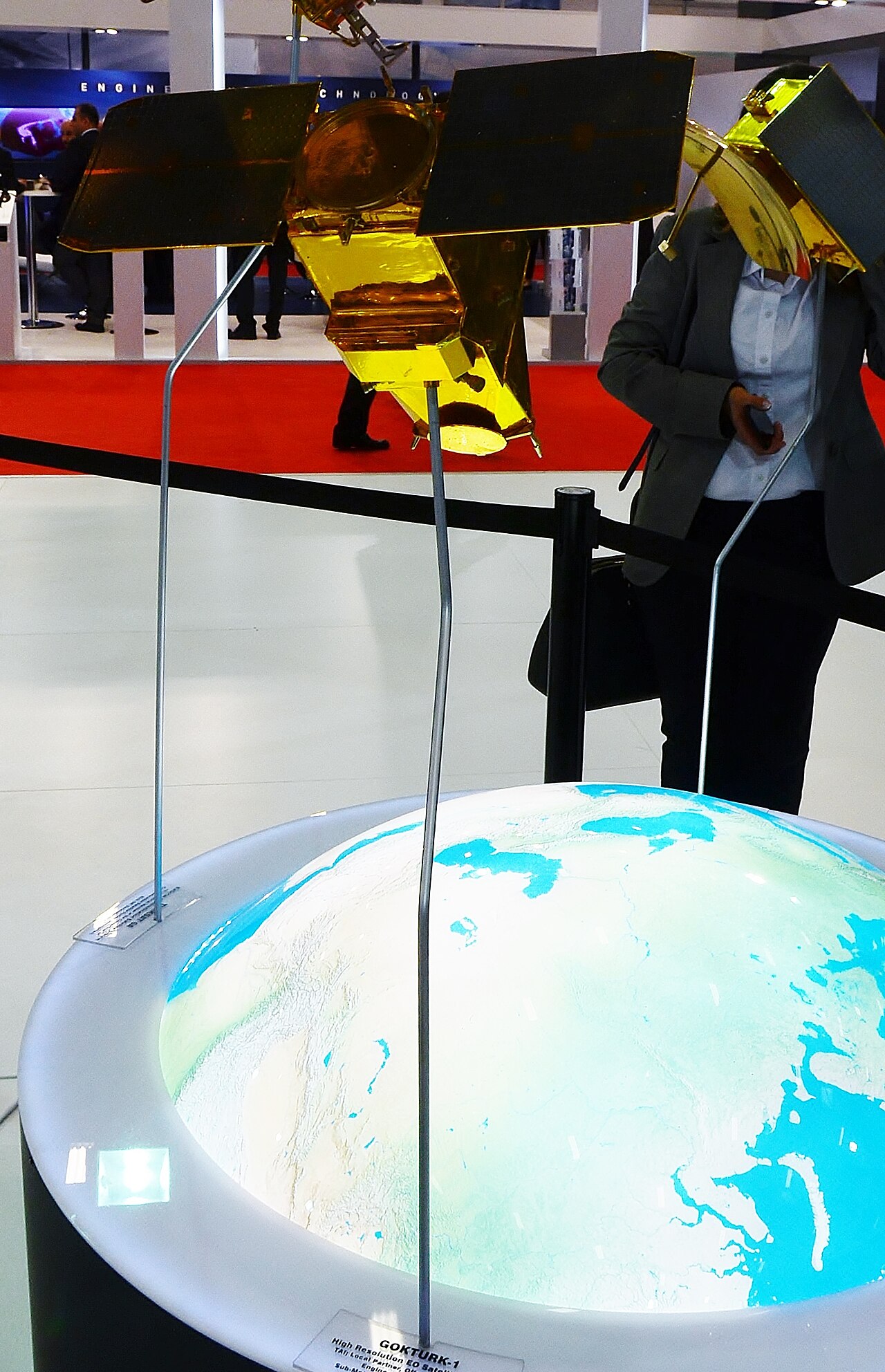
Türkiye’s military has been looking down on the world from its own reconnaissance satellites for more than a decade, and the two GÖKTÜRK spacecraft now in orbit have long outlived the expectations attached to them. According to figures released by the Turkish Armed Forces in December 2024, the pair had together captured 411,085 images. The harder question is what replaces them, and when.
Two successors are in the works. GÖKTÜRK-Y is a like-for-like optical replacement, and GÖKTÜRK-3 is Türkiye’s first radar imaging satellite. Both are led by Turkish Aerospace (TUSAŞ), and both are still several years from launch.
What Are the GÖKTÜRK Satellites and Who Flies Them?
GÖKTÜRK is the name used by the Defence Industry Agency (SSB) and the Ministry of National Defence for the country’s military Earth observation line. The satellites are operated for the Turkish Air Force, which tasks them through the Reconnaissance Satellite Battalion Command in Ahlatlıbel, Ankara. Civil users, from mapping to disaster response, are a secondary customer.
| Satellite | Type | Launch | Key facts |
|---|---|---|---|
| GÖKTÜRK-2 | Electro-optical | 18 December 2012, Long March 2D, Jiuquan (China) | About 400 kg, 686 km sun-synchronous orbit, 2.5 m panchromatic resolution. Built by TÜBİTAK UZAY and TUSAŞ |
| GÖKTÜRK-1 | Electro-optical | 5 December 2016, Vega, Kourou (French Guiana) | About 680 km orbit, reported 0.5 m resolution, 7-year design life. Prime contractor Telespazio, satellite built by Thales Alenia Space |
| GÖKTÜRK-Y (renewal) | Electro-optical | Targeted for 2029 (reported) | Ground sample distance under 1 m, about 1,000 kg, about 700 km orbit, 7-year design life. TUSAŞ is prime contractor |
| GÖKTÜRK-3 | Synthetic aperture radar (SAR) | Targeted for 2030 (reported) | Sub-metre imaging, day and night, all weather. TUSAŞ prime, with ASELSAN and TÜBİTAK UZAY |
Why Are the Two Orbiting Satellites So Different?
The numbering is misleading. GÖKTÜRK-2 came first and GÖKTÜRK-1 second, and they come from two different approaches.
GÖKTÜRK-2 is the domestic one. It was designed by TÜBİTAK and built by TÜBİTAK UZAY together with TUSAŞ, with a flight computer and software developed in Türkiye. It weighs roughly 400 kg and images at 2.5 m in panchromatic mode, which is enough to count buildings and follow large vehicles but not to identify them. It followed RASAT as Türkiye’s second national satellite and was the first step toward building a high-resolution satellite at home.
GÖKTÜRK-1 was the turnkey purchase. The Turkish side signed with Italy’s Telespazio on 13 July 2009. Telespazio acted as prime contractor and system integrator, and Thales Alenia Space built the spacecraft. The package included the ground segment and an assembly, integration and test centre in Ankara, which Leonardo described as having more than 3,000 square metres of Class 100,000 clean rooms, plus thermal-vacuum and acoustic chambers and vibration benches. Turkish industry, including TUSAŞ and ASELSAN, contributed to the programme. Image quality is well above GÖKTÜRK-2’s, with sub-metre resolution reported at 0.5 m, and the launch on a Vega rocket came in December 2016.
The Ankara test centre outlasts the satellite in one sense. It is where Türkiye learned to integrate and test a spacecraft of this class, and TUSAŞ now presents it as a facility for national and international space programmes.
How Much Imagery Have They Delivered?
The Turkish Armed Forces released a round-up in December 2024. GÖKTÜRK-1 had taken 322,607 images over roughly eight years and about 42,700 orbits. GÖKTÜRK-2 had taken 88,478 images over 12 years and about 64,000 orbits. Combined, that is the 411,085 figure.
Other published counts are lower, and tallies depend on how a scene is defined, so the numbers are best read as a sense of scale rather than an audit. What is not in doubt is the age. GÖKTÜRK-2 was designed for five years of service and was still working at full capacity after 12. GÖKTÜRK-1’s seven-year design life ran out around the end of 2023.
Both satellites sit in sun-synchronous orbits, passing over a given point at about the same local time each day. A single satellite in such an orbit revisits a location only occasionally, and an optical camera sees nothing through cloud or at night. Those two limits explain much of what the next generation is meant to fix.
What Does a Radar Satellite Add That an Optical One Cannot?
Synthetic aperture radar, or SAR, builds an image from reflected microwave pulses rather than sunlight. It works through cloud, rain and darkness. For a military customer, that means a border region, a port or an airfield can be imaged on a schedule that weather does not dictate.
The SSB describes the GÖKTÜRK-3 goal as imaging any region on Earth at better than one metre, day and night, for military needs and for civil uses such as disaster monitoring, agriculture, maritime activity, mapping and geology. The preliminary design contract also named terrain elevation modelling. Optical and radar data complement each other: radar shows that something has changed, and an optical frame helps say what it is.
Who Builds GÖKTÜRK-3 and Why Is It So Late?
The preliminary design contract between the SSB and TUSAŞ was signed on 8 May 2013 at the IDEF fair. The original plan, as cited in earlier reporting, called for a launch by the end of 2019. The schedule has slipped repeatedly. A 2021 industry report put the launch at 2028, and in May 2025 TUSAŞ General Manager Mehmet Demiroğlu named 2030.
A new contract was signed in 2024. Defence Turk reported its value as 250 million dollars, a figure that should be read as reported rather than confirmed by the agency.
The work split is clear. TUSAŞ is prime contractor and handles structure, thermal control, the on-board processing computer, integration, testing and launch operations. ASELSAN develops the SAR payload and the X-band communication subsystem, and is reported to work on ground station subsystems as well. The payload has been reported under the name FULMAR 1000-S. TÜBİTAK UZAY handles propulsion, power electronics, attitude and orbit control and the S-band link. The project scope also includes fixed and portable ground stations.
The radar payload is the hard part of the job. ASELSAN’s design work dates back to the original contract, with payload design reported complete in 2016, which makes the long gap before the 2024 restart all the more notable. The published sources do not explain the delay.
What Is GÖKTÜRK-Y and When Will It Fly?
GÖKTÜRK-Y, sometimes written GÖKTÜRK-1Y and called the renewal satellite, exists so that Türkiye does not lose its optical capability when GÖKTÜRK-1 dies. The contract between the SSB and TUSAŞ was signed in June 2021. It covers one satellite, a fixed and a mobile ground station, launch and early orbit operations, and logistics support.
TUSAŞ’s own project page lists sub-metre ground sample distance, an orbit of about 700 km, a mass of about 1,000 kg, a revisit of about 2.5 days, a seven-year life and spot, strip, wide-area and stereo imaging modes. Launch was first reported for 2024, then pushed to 2026, and TUSAŞ now points to 2029.
The company described a two-prototype approach in 2025. A structural and thermal qualification model had been assembled, environmental testing was due to finish by the end of that year, and the flight model build would begin in 2027. A micro satellite funded by TUSAŞ itself, meant to prove serial production, sits ahead of both in the queue with a 2027 launch.
The gap this creates is uncomfortable. GÖKTÜRK-1 is already past its nominal life, and its replacement is not expected for years.
Where Does İMECE Fit In?
İMECE is the TÜBİTAK UZAY-developed observation satellite that SpaceX launched on a Falcon 9 from Vandenberg on 15 April 2023, as part of the Transporter-7 rideshare. Tracking data placed it in a sun-synchronous orbit of roughly 680 km, and launch mass was reported near 800 kg. The SSB lists it on the same project page as GÖKTÜRK-3, noting that the İMECE effort preserved earlier technological achievements and built heritage for future systems.
Its imagery serves both defence and civil users. We followed how its data flow continues in an earlier report.
What Does the Wider Space Programme Look Like?
GÖKTÜRK is one thread in a larger push. Türksat 6A, Türkiye’s first indigenous communications satellite, took the country’s active satellite count to nine, as we reported when Türksat 6A entered service. The Turkish Space Agency’s roadmap, which covers launch systems, satellite production and positioning, is covered in our look at the agency’s new team. TUSAŞ says the satellites will also support network-centric warfare for aircraft such as the KAAN fighter.
The practical reading is simple. By the end of the decade, Türkiye wants its own optical and radar satellites, tasked by its own air force and downlinked to its own ground stations. Until then, two ageing optical satellites are carrying the load.


