Who Builds Türkiye’s Ammunition? The Full Supply Chain


Türkiye’s ammunition is built by one state company, one large private one, and a small group of specialists around them. MKE, the state ordnance corporation, lists twelve production units, and six of them form a single chain that runs from melting steel ingots to nitrating cellulose to filling and fuzing a finished round. ARCA Defense is the largest private producer and, by reported revenue, the bigger exporter. TÜBİTAK SAGE supplies fuzes, explosives and guidance kits. Repkon sells ammunition factories rather than ammunition. For a foreign buyer the useful question is not the list of names but which tiers of that chain are genuinely Turkish — and which are still bought in.
DEFENCETÜRKIYE DATA BOX
Sector: Ammunition, propellants and energetic materials
State producer: MKE A.Ş. (Makine ve Kimya Endüstrisi), 12 listed production units across Ankara and Kırıkkale
Largest private producer: ARCA Defense, integrated campus at Sungurlu, Çorum
Plant and machinery: Repkon (metal forming lines, explosive filling plants)
Fuzes, explosives, guidance kits: TÜBİTAK SAGE
2025 defence revenue: ARCA $3bn (53rd), MKE $1.42bn (81st), Defense News Top 100, 2026 edition
Largest declared investment: $818m, cylindrical propellant and ammunition, Kırıkkale (MKE, April 2025)
Known weak link: Imported precursor chemicals for energetic materials, stated by MKE itself
Published output figures: None. MKE publishes site areas, not tonnes or rounds
The chain, tier by tier
Ammunition is not one industry. It is at least five, stacked on top of each other, and a country can be strong in the visible ones while depending on imports for the invisible ones. The sequence runs: metal, energetic materials, initiation, loading and assembly, and finally the machinery that makes all of the above possible. Türkiye covers every tier on paper. The quality of that coverage varies sharply, and the gaps are not where most coverage looks for them.
| Tier | What it covers | Who does it |
|---|---|---|
| Raw metal | Steel ingots and forgings, aircraft bomb bodies, brass | MKE Çelik ve Pirinç Fabrikası Kırıkkale |
| Propellant | Nitrocellulose, gun and small-arms powders, combustible cartridge cases | MKE Barut Fabrikası Kırıkkale |
| Explosives and acids | TNT, nitroglycerine, black powder, rocket propellant, oleum and sulphuric acid | MKE Roket ve Patlayıcı Fabrikası Elmadağ, Ankara |
| Initiation | Detonators, boosters, blasting caps, decoy and countermeasure rounds | MKE Piroteknik Fabrikası Kayaş, Ankara |
| Fuzes | Artillery, mortar, anti-aircraft, electronic time and UAV-munition fuzes | MKE Mühimmat Fabrikası also TÜBİTAK SAGE |
| Large calibre | 25 mm to 175 mm, mortar, tank, howitzer rounds and aircraft bombs | MKE Mühimmat Fabrikası also ARCA Defense |
| Small calibre | Pistol, .50 cal and 20 mm cannon ammunition | MKE Gazi Fişek Fabrikası also ARCA, Sungurlu |
| Guided and terminal | Guidance kits, penetrating bombs, thermobaric bombs, UAV munitions | TÜBİTAK SAGE Ankara |
| Rocket motors | 2.75-inch, 107 mm and 122 mm motors and warheads | MKE Roket ve Patlayıcı also ROKETSAN |
| The factory itself | Flowforming and shell-body lines, explosive filling plants | Repkon Şile, İstanbul |
Compiled by DefenceTürkiye from the producers’ own published product and facility descriptions, November 2026.
MKE: six factories, one chain
MKE publishes a factory list, and reading it in order is the quickest way to understand the Turkish ammunition industry. The corporation lists twelve units. Three make weapons, two are support and recycling operations, one is a machine shop. The remaining six are the ammunition chain, and they are arranged so that the output of each is the input of the next.
| Factory | Principal output | Site area |
|---|---|---|
| Çelik ve Pirinç Kırıkkale |
Steel ingots from 1.1 to 24.4 tonnes; forged bar, square and flat stock; MK82–MK84 aircraft bomb bodies; NEB penetrator forging blanks; mortar, tank and howitzer blanks | 444,523 m² 82,044 m² enclosed |
| Barut Kırıkkale |
Nitrocellulose; spherical powders in 5.56, 7.62, 9, 12.7 and 20 mm; single-, double- and triple-base gun powders; 120 mm and 155 mm combustible cartridge cases and adapters | 1,940,990 m² 29,178 m² enclosed |
| Roket ve Patlayıcı Elmadağ, Ankara |
Nitroglycerine, TNT, black powder, rocket propellants, mortar propelling charges; oleum and sulphuric acid; 2.75-inch rocket motors, 107 and 122 mm rocket ammunition, 66 mm HAR launcher | 7,530,000 m² 215,000 m² enclosed |
| Piroteknik Kayaş, Ankara |
Initiating explosives; detonators and boosters that fire fuzes; electric, delay and demolition caps; infrared and radar decoy rounds; copper, aluminium and zinc cold rolling | 554,519 m² 43,659 m² enclosed |
| Mühimmat Kırıkkale |
25 and 35 mm anti-aircraft; 40 mm grenade; 60, 81 and 120 mm mortar; 105 and 120 mm tank; 155 and 175 mm gun; 105 and 155 mm and 8-inch howitzer; 4.5 lb to 2,000 lb aircraft bombs; seven fuze families | 8,526,107 m² 1,555,712 m² enclosed |
| Gazi Fişek Etimesgut, Ankara |
Small-arms ammunition: 7.65×17 pistol, 12.7×99 M8, M17, M33 and solid, 20×102 and 20×110 HEI-HEIT; also cartridge line installation and indigenisation work | 415,000 m² 40,000 m² enclosed |
Source: MKE A.Ş. factory pages, mke.gov.tr, read 17 November 2026. Areas are as published by the company.
Two things in that table deserve more attention than they usually get. The first is the Çelik ve Pirinç plant, whose stated mission is to reduce Türkiye’s dependence on imported steel raw material — it is an ordnance company that melts its own ingots. The second is the Barut factory’s line of combustible cartridge cases for 120 mm and 155 mm. That is a consumable, not a one-off purchase, and it is the kind of item an army discovers it cannot buy during a war.
The vertical integration is not a claim MKE leaves implicit. Describing its work on the ALTAY main battle tank, the company says the production process runs “from the machining of raw steel to its transformation into a weapon system” inside its own factories. It supplies ALTAY’s 120 mm/55-calibre main gun — 7,118 mm long, 3,103 kg, six rounds a minute — the 7.62 mm PMT 76/57T coaxial machine gun, and the 120 mm tank ammunition the tank fires. A reader who wants the technical vocabulary behind these categories in Turkish will find Envanter Medya’s explainer on what mühimmat covers and how it differs from cephane a useful companion.
Energetic materials: the tier that decides everything
Forging a shell body is metalwork. Plenty of countries can do it. The constraint in any ammunition expansion is energetic materials — the propellant that launches the projectile and the explosive that fills it — and above all nitrocellulose, which is made by nitrating purified cellulose, usually from cotton linters.

That is where Europe’s problem sits. Rheinmetall chief executive Armin Papperger said in 2024 that European nitrocellulose producers sourced more than 70 per cent of their cotton linters from China, and The Wall Street Journal has estimated that European nitrocellulose capacity would have to more than double, to roughly 20,000 tonnes a year, to meet projected demand. Those figures were reported in Türkiye by Hürriyet Daily News in August 2026 in the context of what Turkish industry could offer.
Türkiye grows cotton at scale, processes it domestically and nitrates it. MKE’s Barut factory at Kırıkkale already produces several types of nitrocellulose and supplies the propellant and nitrocellulose needs of the corporation’s other plants. Next door, the Roket ve Patlayıcı factory at Elmadağ makes TNT, nitroglycerine and black powder — and, unusually for an ordnance plant, its own oleum and sulphuric acid, the reagents nitration consumes.
MKE is building on top of that. In April 2025 the company announced that its $818 million Kırıkkale investment in cylindrical propellant and ammunition production had ranked first among defence firms and third across all sectors on the Ministry of Industry and Technology’s project-based incentive list for large-scale investments. MKE described the purpose in its own words: to indigenise critical chemicals on which it depends on foreign suppliers, and to raise the capacity of existing capabilities. The flagship of that programme is the Hüseyin Kâhya Energetic Materials Factory at Kırıkkale, which is to make nitrocellulose, gunpowder, rocket fuel, concentrated nitric acid and solid TNT. The Ministry of National Defence has said the investment will roughly triple national capacity in those categories.
Status language matters here. In May 2026, hosting SSB President Haluk Görgün, MKE described the plant as aiming to end Türkiye’s foreign dependence in explosives and as planned to be commissioned this year. As of today, MKE’s own newsroom carries no commissioning announcement. The correct description is under construction, scheduled for 2026, not yet publicly in service.
Fuzes and initiators: the parts nobody photographs
A shell without a working fuze is a paperweight, and fuzing is one of the quieter tests of a real ammunition industry. Türkiye runs it through two institutions. MKE’s Mühimmat factory lists seven fuze families of its own — anti-aircraft, grenade launcher, artillery, mortar, electronic time, UAV munition and hand grenade. The Piroteknik plant at Kayaş supplies the layer underneath: initiating explosives, and the detonators and boosters that actually set those fuzes off. The same plant makes Türkiye’s infrared and radar decoy rounds, which is why an aircraft countermeasure and an artillery fuze come out of the same gate.
TÜBİTAK SAGE, the defence research institute, runs a parallel line. Alongside its guidance kits and its bomb families, SAGE lists fuzes, explosives, pyrotechnic devices and thermal batteries among its subsystem products. The division of labour is visible if you read both catalogues: MKE’s steel plant lists the forging blank for the NEB penetrator body among its products, while SAGE lists the NEB-84 penetrating bomb among its systems. One institution forges it; the other designs what it becomes.
The private tier: ARCA, and the business of selling factories
The private side of Turkish ammunition is concentrated rather than broad. ARCA Defense, built around an integrated campus at Sungurlu in Çorum province, is the one producer operating at a scale comparable to the state arsenal, and on the 2026 Defense News Top 100 it ranked 53rd on $3 billion of 2025 defence revenue against $653.2 million the year before — ahead of MKE, which placed 81st on $1.42 billion. Those are company-supplied figures for a privately held firm, and a buyer doing due diligence should ask for an order book rather than a ranking. Our profile of ARCA Defense sets out what is documented and what is not.
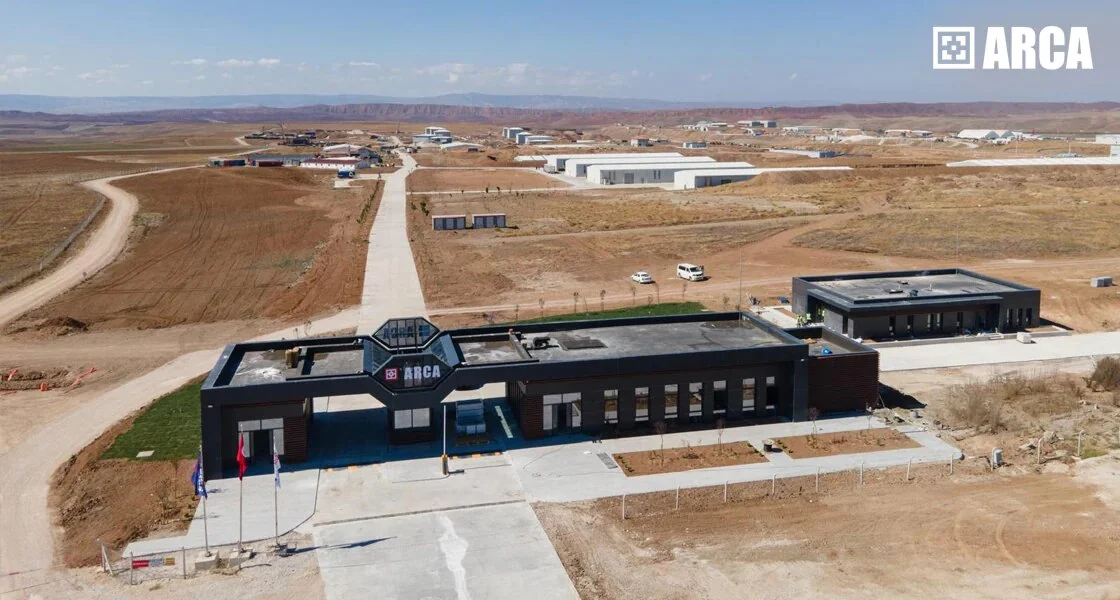
ARCA’s most consequential move is outside Türkiye. On 21 April 2026 the Estonian Centre for Defence Investment announced that ARCA Baltics Operations would build an ammunition plant on a 141-hectare site in the Põhja-Kiviõli defence industry park, a roughly €300 million private investment against up to €10 million of Estonian state spending on access roads, fencing and utilities, with production from 2028 and up to 1,000 jobs. Defence Minister Hanno Pevkur noted that the agreement gives the Estonian state the option to buy from the plant if it wishes. The company received its operating permit on 20 October, under a commission led by the Consumer Protection and Technical Regulatory Authority.
The Estonian debate around it is worth reading before anyone treats the plant as settled. Public broadcaster ERR reported that output will initially be for export, that the M107 shell ARCA would start with reaches about 18 km while the Estonian Defence Forces prefer 30 to 40 km, and that the award drew domestic scrutiny — to which the defence ministry replied that both companies met every tender condition, including the absence of valid criminal convictions, and that no disqualifying factors were found. What this plant cannot settle on its own is whether output from an EU-registered, Turkish-controlled factory counts as European for EU-funded procurement; we work through that separately in our analysis of what EU rules actually allow Europe to buy from Türkiye.
Repkon occupies a different position again, and it is routinely misdescribed. On its own website the company presents itself as a metal-forming specialist — flowforming, hot spinning, shear forming and hydraulic presses — serving aviation, automotive, oil and gas and mining, with turnkey lines for everything from LPG cylinders to truck wheel rims. It sells the means of production, not the munition. That is a far better business than it sounds, because very few firms anywhere sell both halves of an ammunition factory, and it sits outside the content rules that govern finished rounds. It also carries its own risks, which we document in our account of Repkon’s machinery and its US plants.
MKE has begun exporting the same thing. Its Gazi Fişek factory lists cartridge production line installation and indigenisation among its activities, and the corporation confirmed in October 2025 that after its plant in Jordan became operational it had completed the installation of a cartridge production facility in Mongolia. The pattern is consistent across Turkish industry: the plant travels, as our survey of where Turkish defence companies actually own factories abroad shows.
WHY IT MATTERS
Most assessments of Turkish defence industry start at the top of the chain, with drones and missiles. Ammunition sits at the bottom, and it is the tier that decides whether any of the rest can be sustained in a long war — or sold to someone else fighting one.
Türkiye is one of a small number of NATO members that grows cotton, nitrates it domestically and makes its own nitration acids. That combination, not the shell body, is what a European procurement office short of propellant is actually looking at.
Where the chain is still thin
Four limitations belong on the record, and three of them come from Turkish sources rather than foreign critics.
Precursor chemicals are still imported. The $818 million investment exists because they are. MKE’s own description of the project is that it will indigenise critical chemicals on which the company depends on foreign suppliers. Until the Hüseyin Kâhya plant is commissioned and running, the upstream end of Turkish energetics is not self-sufficient, whatever the downstream catalogue shows.
No output figures are published. MKE publishes site areas in square metres and product lists by calibre. It does not publish annual tonnages, rounds per year or line capacity, and neither does ARCA. Anyone quoting a Turkish 155 mm annual production number is quoting an estimate; the primary sources contain no such figure. This is the same disclosure gap we found across the sector in our assessment of how much Turkish industry can actually build.
A schedule is not a commissioning. The energetic materials plant was scheduled for 2026 and has not been announced as operational. Programme dates in this sector move.
Selling the plant is not the same as selling the round. Repkon’s European and American business is real and growing, but a filling line delivered to Denmark or Germany is a Danish or German munition at the end of it. Turkish-origin finished artillery ammunition has not been the subject of a large publicly announced EU-state contract.
BUYER VIEW
Ask which tier you are buying. A contract for finished rounds, a technology transfer plant and a propellant supply agreement are three different risk profiles with three different export-control exposures.
Ask about the propellant source separately. Projectile bodies are the easy part. Request the origin of the nitrocellulose and the propelling charge in writing; this is where a supply chain fails under volume.
Expect no capacity figures. Neither producer publishes output. Treat any quoted annual number as an estimate and ask for a delivery schedule with penalties instead.
Check the fuze separately from the round. Fuzes and their initiators come from different plants, sometimes different institutions, and qualification is per-combination.
Open-source editorial analysis. DefenceTürkiye does not advise governments or companies on procurement.
How this sits internationally
Türkiye is not the largest ammunition producer in NATO and does not claim to be. What distinguishes it is coverage: a single state company that owns the metal, the chemistry, the initiation and the assembly, plus a private producer large enough to build a plant inside the European Union and a machinery house selling production lines to Western armies. Very few middle powers hold all four positions.
The limits are structural rather than industrial. Finished Turkish rounds face EU content rules; Turkish plant and machinery do not. That asymmetry explains why the visible trade is in factories and filling lines rather than pallets of shells — a pattern Envanter Medya examines from the Turkish side in its Turkish-language analysis of why European buyers are interested in Turkish ammunition. The wider artillery picture, including the guns these rounds are fired from, is in our survey of the Turkish artillery programme, and the solid-propellant side of the same chemistry in our piece on solid rocket motors.
FAQ
Who makes Türkiye’s artillery shells?
MKE’s Mühimmat Fabrikası at Kırıkkale is the state producer, covering 105 mm, 155 mm and 175 mm gun and howitzer ammunition among much else. ARCA Defense is the main private producer of large-calibre rounds, including the NATO-pattern M107 155 mm shell.
Does Türkiye make its own propellant and nitrocellulose?
Yes. MKE’s Barut Fabrikası at Kırıkkale produces several types of nitrocellulose, spherical small-arms powders and single-, double- and triple-base gun propellants, and supplies the rest of the corporation. Some precursor chemicals are still imported, which is the stated reason for the $818 million Kırıkkale investment.
Is MKE state-owned?
Yes. MKE A.Ş. is the Turkish state ordnance corporation, traced by the company to the Ottoman imperial arsenal. It ranked 81st on the 2026 Defense News Top 100 with $1.42 billion in 2025 defence revenue and entered the SIPRI Top 100 for the first time at 93rd.
Does Repkon manufacture ammunition?
Not as its core business. Repkon describes itself as a metal-forming company that builds production lines — flowforming and shell-body equipment, and explosive filling plant. Its customers are the manufacturers.
What is ARCA Defense building in Estonia?
ARCA Baltics Operations is building an ammunition plant on a 141-hectare site at Põhja-Kiviõli, a roughly €300 million investment announced on 21 April 2026, producing 155 mm artillery ammunition including long-range types, mortar rounds and 122 mm rockets from 2028. It received its operating permit on 20 October 2026.
How much ammunition does Türkiye produce per year?
No producer publishes the figure. MKE discloses site areas and product ranges, not tonnages or rounds, and ARCA is privately held. Any annual output number in circulation is an estimate, and whose estimate it is should be stated.
Can EU countries buy Turkish ammunition?
Member states can buy Turkish equipment with national money, and several have. EU-financed procurement is a different matter, because content rules apply to the finished product. Turkish-supplied production machinery falls outside those rules, which is why that route has moved faster.
Sources
- MKE A.Ş. — factory list and individual factory pages (product ranges, locations, site areas), read 17 November 2026
- MKE A.Ş. — announcement of the $818 million Kırıkkale cylindrical propellant and ammunition investment, April 2025; statement on the Hüseyin Kâhya Energetic Materials Factory during the SSB President’s visit, May 2026; Mongolia cartridge plant completion, October 2025; SIPRI Top 100 entry, December 2025
- TÜBİTAK SAGE — systems and subsystem product families
- Estonian Centre for Defence Investment — ARCA Baltics Operations announcement, 21 April 2026
- ERR — Turkish defence company ARCA to produce ammunition for export in Estonia, and ERR’s follow-up on the October operating permit
- Hürriyet Daily News — Europe’s ammunition drive hits cotton supply bottleneck, 19 August 2026, reporting the Rheinmetall and Wall Street Journal figures
- Repkon — company technologies and turnkey production lines
- Defense News Top 100, 2026 edition, for the ARCA and MKE revenue rankings