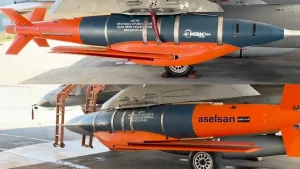
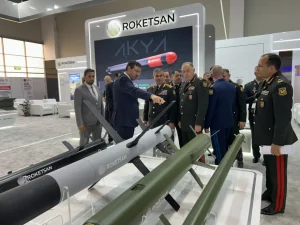
ASELSAN’s EJDERHA Disables 51 Drones in a Single Test

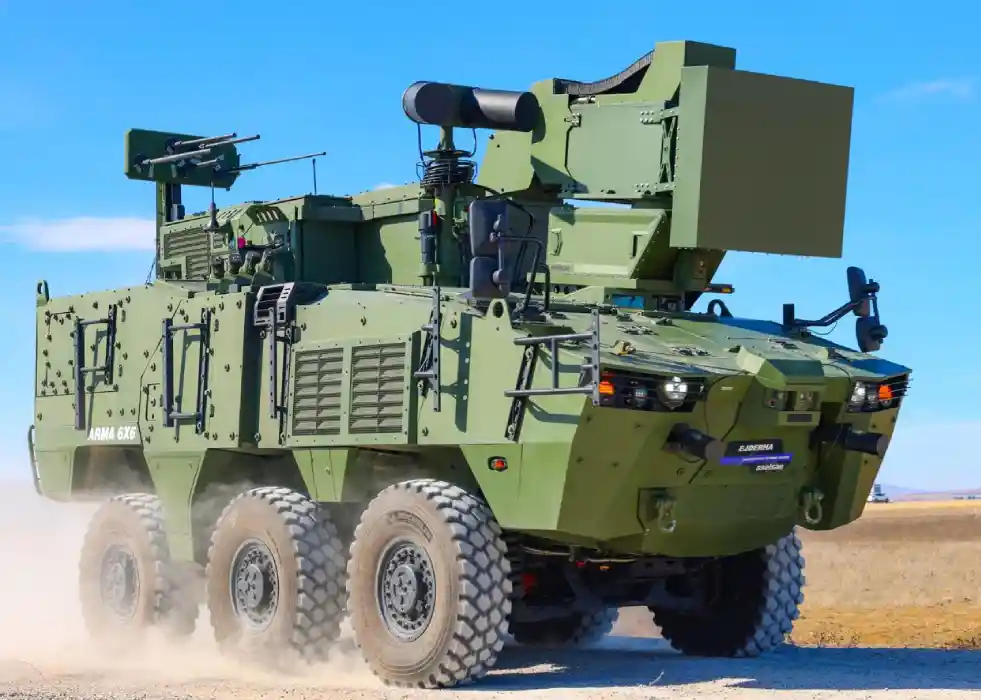
ASELSAN says its EJDERHA high-power electromagnetic weapon disabled 51 drones launched at it simultaneously during a company test, a figure the Ankara-based defense electronics giant is calling a world first for a directed-energy counter-drone system. The test was staged, ASELSAN says, to mark the company’s 51st year in business, which explains the oddly specific number: one drone for every year since its founding in 1975.
ASELSAN General Director Ahmet Akyol announced the result on November 15, saying EJDERHA “became the first system in the world to neutralize 51 drones at the push of a button,” without firing a missile or round of ammunition. He said the system has moved from testing into serial production and is already being delivered. The claim has not been independently verified, and ASELSAN has not disclosed where the test took place, how the drones were configured, or what counts as “neutralized” for record-keeping purposes. What is clear from the footage the company released is that EJDERHA disrupts electronics rather than physically destroying its targets — the more accurate description is disabled, not shot down.
What EJDERHA actually does
EJDERHA — Turkish for “dragon” — is a high-power electromagnetic (HPEM) weapon built around vacuum-electronics technology. Instead of a kinetic interceptor, it radiates focused electromagnetic energy at a target’s onboard electronics, corrupting navigation, communications and flight-control circuits. Depending on the power setting and dwell time, ASELSAN says the effect ranges from a temporary reboot to permanent component damage. The system can work in a narrow, high-intensity beam against a single target or widen its emission to blanket a sector against a swarm, which is the mode shown in the 51-drone test.
In ASELSAN’s demonstration video, the system ran two scenarios. In the first, EJDERHA disabled two wire-guided FPV drones at roughly 1,000 meters — a profile that matters because fiber-optic-controlled drones, immune to radio jamming, have become one of the harder problems in counter-UAV defense over the past two years of drone warfare in Ukraine and the Middle East. In the second scenario, 51 drones were launched together and the system’s radar and electro-optical sensors cued EJDERHA to sweep the volume, disabling the group within seconds, according to the company.
EJDERHA does not operate alone. It is the “hard kill without munitions” layer in a counter-drone family that also includes İHTAR, a detection and jamming system built around an AURA radar that typically cues the engagement, and GÖKBERK, which handles tracking. ASELSAN has shown all three working together at its Gölbek test center in past demonstrations, alongside gun-based options such as KORKUT, which uses 25mm and 35mm cannon fire against drones too hardened or too fast for jamming alone. İHTAR’s detection chain and KORKUT’s live-fire record against Shahed-style drones give some sense of how the layers are meant to fit together: EJDERHA is built for the moment when there are too many targets, or the wrong kind of targets, for an interceptor missile or a gun to handle economically.
Why a microwave weapon matters here
The appeal of a system like EJDERHA is cost per engagement. A single swarm attack of even modest size can exhaust a defender’s stock of interceptor missiles long before it exhausts the attacker’s stock of cheap drones — a math problem that has shaped air-defense thinking since Shahed-136 swarms became a feature of the war in Ukraine and Houthi drone and missile salvos a recurring threat in the Red Sea. A directed-energy weapon that disables dozens of targets in one engagement, with no munitions cost beyond electricity, is the kind of asymmetry defense planners have been chasing for years. The United States, Britain and Israel are all developing comparable high-power microwave or laser systems — the US Army’s Epirus-built Leonidas is probably the best known — and ASELSAN’s announcement puts Türkiye in that same small group of states fielding the technology rather than just testing it.
That said, HPEM weapons have real limits that ASELSAN’s statement does not address. Range, beam dispersion with distance, performance against shielded or hardened electronics, and effects on friendly systems and civilian infrastructure in the engagement area are all open questions for any system in this class, and the company has not published technical specifications on EJDERHA’s effective range or power output. The 51-drone figure also describes a controlled demonstration against drones ASELSAN itself configured, not a combat engagement against an adversary actively trying to defeat the system’s electronic attack — a distinction that matters for judging real-world performance.
Part of the Çelik Kubbe push
EJDERHA’s broader significance is its place inside Çelik Kubbe, or “Steel Dome,” Türkiye’s umbrella program to stitch together layered air and missile defense — from short-range guns and HPEM systems up through SİPER’s long-range interceptors — into a single, largely domestic architecture. ASELSAN has been the prime beneficiary of Steel Dome contracting this year, including a $1.1 billion air-defense export contract disclosed on November 3 and the company’s decision this month to build a second major technology campus in Malatya to expand production capacity. ASELSAN’s order backlog has been reported at roughly $30.7 billion as of late October, and counter-drone systems are one of the faster-growing segments inside that total as militaries worldwide scramble to answer the proliferation of cheap attack drones.
EJDERHA’s immediate customer is Türkiye’s own armed forces — earlier reporting has placed a mobile, vehicle-mounted version in Turkish Land Forces Command inventory — and ASELSAN has not announced an export customer for the system. But the company has been explicit about wanting counter-drone and electronic-warfare products to carry more of its export growth, and a demonstration timed for maximum publicity, on the anniversary of the company’s founding, reads as much as a sales pitch to NATO allies and Gulf buyers already shopping for counter-swarm capability as it does a domestic milestone announcement.
What is still unconfirmed
ASELSAN’s statement leaves several things unverified: the test’s exact location and date, the type and altitude of the 51 drones used, independent confirmation that all 51 were in fact disabled rather than a subset, and any cost or unit-price figures. No foreign government or independent testing body has commented on the claim. Readers should treat the “world record” framing as ASELSAN’s own characterization rather than an audited result, even as the underlying technology — and Türkiye’s push to field it at scale — is real and consistent with the company’s other recent Steel Dome announcements.
Sources: ASELSAN company statement via Militarnyi and Defense Arabia; Daily Sabah.