Who Builds Türkiye’s Warship Engines? GE, MTU and TEI

Türkiye designs, builds and arms its own warships, but it does not build their engines. The gas turbine in a Turkish frigate is a General Electric LM2500, bought from the United States. The two main diesels are MTU units from Germany, now part of the Rolls-Royce group. The reduction gear, the generators and the azimuthing pods on the navy’s largest ship are also foreign. What is Turkish is everything above the engine room: the hull, the combat management system, the radar, the launcher and the missiles. Propulsion is the single layer of a Turkish warship that still arrives from somewhere else, and it is the layer a foreign buyer should ask about first.
DEFENCETÜRKİYE DATA BOX
Subject: Main propulsion of Turkish Navy surface combatants and submarines
Gas turbine: General Electric LM2500, supplied from the United States
Main diesels: MTU (Rolls-Royce Power Systems), Friedrichshafen, Germany
Turkish installed base: 31 LM2500 gas turbines on 18 Turkish ships, per GE, 2023-2024
Turkish industrial role: TEI (TUSAŞ Engine Industries) is GE’s in-country maintenance, repair and overhaul provider for marine LM2500s, announced April 2023
Turkish-built marine engines in naval service: TÜMOSAN diesels in the hundreds-of-horsepower class, fitted to unmanned surface vessels
Indigenous warship-scale engine: none announced as entering service as of 13 October 2026
Status checked: 13 October 2026
What actually turns the propellers
The standard Turkish surface combatant uses a CODAG plant: combined diesel and gas. One gas turbine provides sprint power, two diesels provide cruise power, and the two drive the same pair of shafts through a reduction gearbox to controllable-pitch propellers. The arrangement is conventional, it is the same one the Franco-Italian FREMM and the German F124 use in their own variants, and it is not where Turkish engineering distinguishes itself.
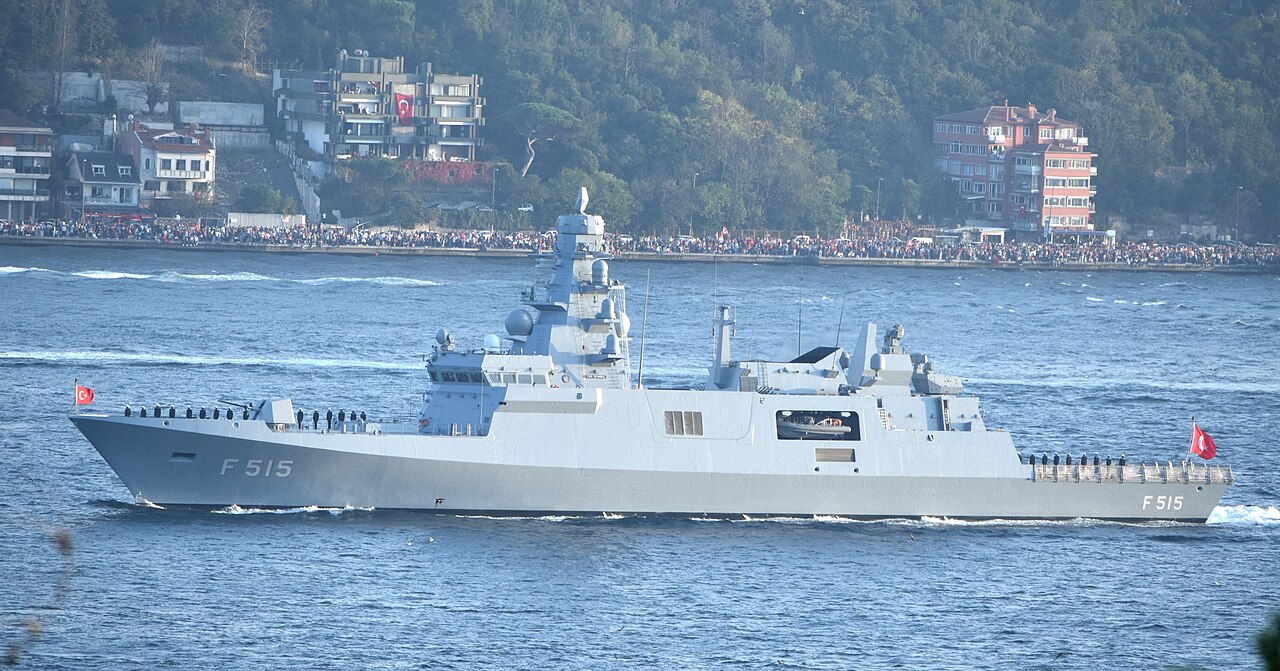
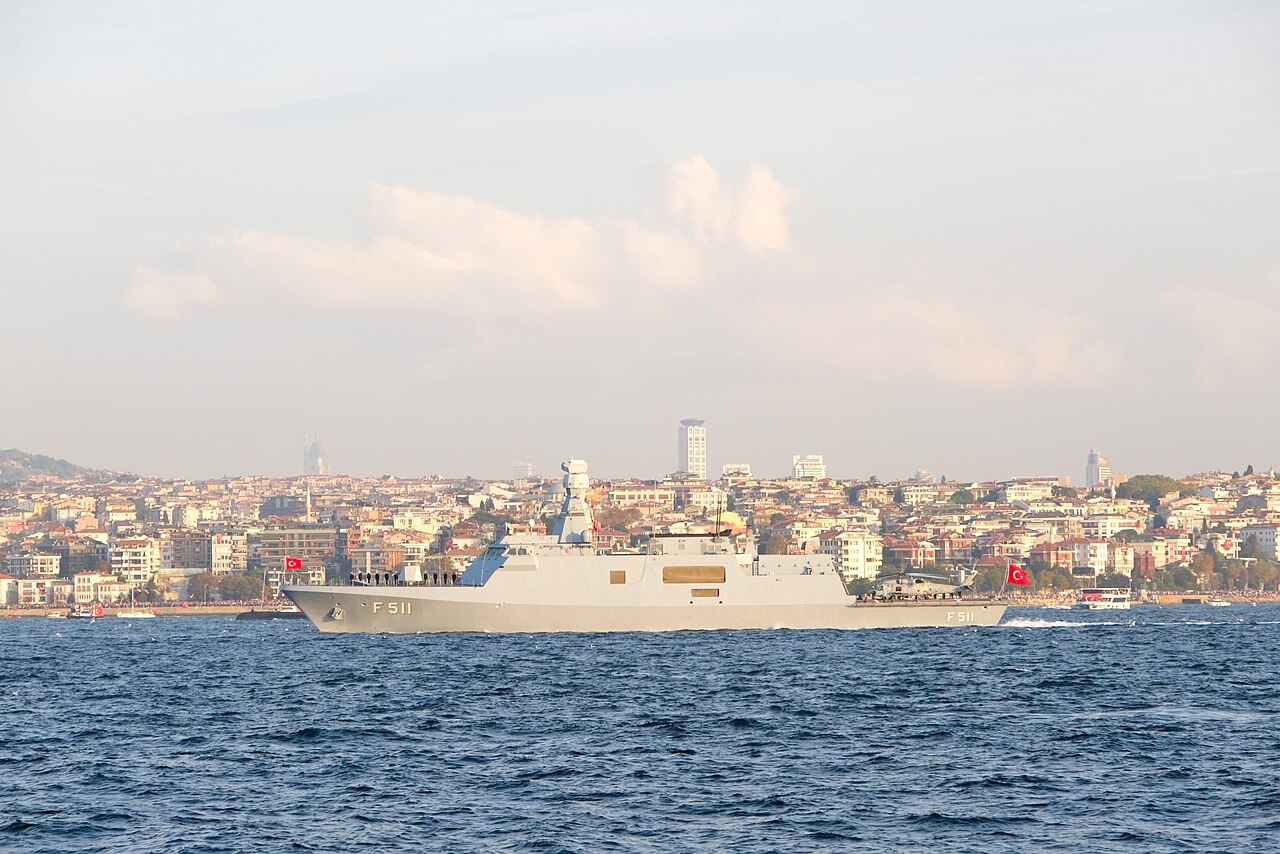
It is where Turkish procurement is still exposed. On the İstif-class frigate the gas turbine is a GE LM2500 rated at 22 to 23 MW depending on the configuration quoted, and the diesels are two MTU 20V 4000 M93L units, as set out in the specification table Defense News published when TCG İstanbul was launched in January 2021. On the earlier Ada-class corvette the same LM2500 is paired with the older MTU 16V 595 TE90. The pattern holds across the fleet, and it holds on the ships Türkiye exports.
| Ship class | Main propulsion and where it comes from |
|---|---|
| Ada-class corvette MİLGEM baseline, Turkish Navy and export |
CODAG. One GE LM2500 gas turbine (US) and two MTU 16V 595 TE90 diesels (Germany), two shafts, controllable-pitch propellers. |
| İstif-class frigate Turkish Navy and Indonesia |
CODAG. One GE LM2500 of 22-23 MW (US) and two MTU 20V 4000 M93L diesels (Germany). Maximum speed reported above 29 knots. |
| Babur-class corvette Pakistan Navy, built in Istanbul and Karachi |
CODAG on the Ada pattern. One GE LM2500 and two MTU 16V 595 TE90 diesels, as reported in trade coverage of the class. The export customer inherits both supply chains. |
| Barbaros and Gabya classes legacy frigates, in service |
Also LM2500-powered. GE counts 31 of its marine gas turbines across 18 Turkish ships, a relationship it dates to 1997. |
| TCG Anadolu (L-400) amphibious assault ship, largest unit in the fleet |
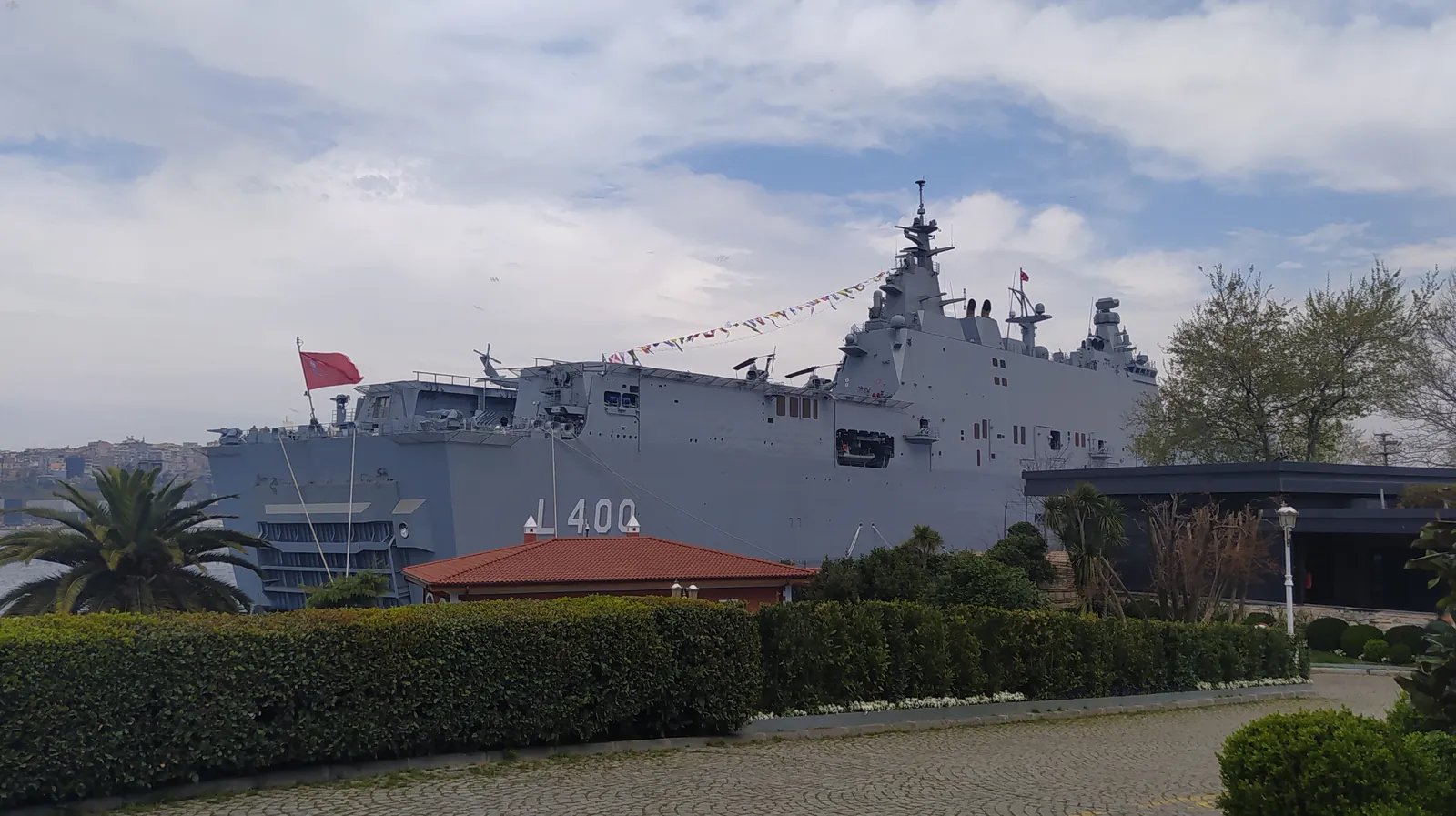
Diesel-electric. Five MAN diesel generators of about 8 MW each (Germany) driving two Siemens azimuthing pods of 11 MW each (Germany). Secondary sources disagree on whether a gas turbine is also fitted; no Turkish official document settles it. |
| Reis-class submarine Type 214TN, six boats |
MTU diesels, a Siemens permanent-magnet motor and German fuel-cell air-independent propulsion, under the thyssenkrupp Marine Systems design licence. |
| TF-2000 destroyer lead ship under construction |
CODOG, per the published design. GE has publicly positioned the LM2500 family for the programme, so the exposure carries into the 2030s fleet. |
| ULAQ armed USV unmanned surface vessel, in Turkish Navy use |
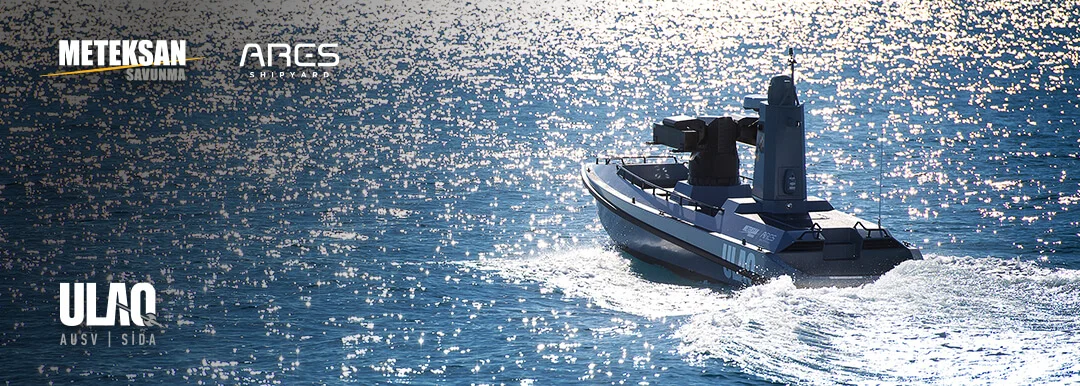
Turkish. A TÜMOSAN marine diesel, the clearest example of a domestically designed engine actually propelling a Turkish naval craft. |
Compiled by DefenceTürkiye from manufacturer announcements and specification sets published by Naval News, Defense News and Baird Maritime. Engine model designations for Turkish Navy ships are reported by trade press rather than disclosed by SSB or the shipyards.
General Electric has been in the Turkish fleet since 1997
The American side of the arrangement is the better documented of the two, because GE announces it. At IDEF 2023 the company signed with the TAIS OG-STM joint venture to supply LM2500 gas turbines for İstif-class frigates six to eight, Naval News reported from the show, with one 22 MW turbine per ship and the hulls to be built at the Anadolu, Sedef and Sefine yards. In August 2024 the company confirmed three more engines and said an order covering frigates nine to twelve had been initiated, putting the figure at 23 MW per ship and noting that the LM2500 family is positioned for the TF-2000 destroyer as well.
Two things in those announcements matter more than the engine count. The first is the contracting structure: GE sells to a Turkish shipbuilding consortium, not to the ministry, which is why the gas turbine rarely appears in Turkish programme communications even though it is the single most expensive imported item on the ship. The second is sustainment. GE named TEI, the Eskişehir engine house better known for its work on Türkiye’s aircraft engines, as its in-country service provider for marine LM2500 maintenance, repair and overhaul in April 2023. That is a real transfer of capability. A Turkish frigate no longer has to send its gas turbine abroad to be overhauled, and TEI’s industrial profile now includes a marine line it did not have five years ago.
It is also the distinction a buyer has to keep straight. Being able to maintain an engine is not the same as being able to supply one. The depot work is Turkish; the licence to deliver a new turbine is American.
The German half of the plant, and the parts nobody publishes
The diesels are the quieter dependency. MTU Friedrichshafen has been inside Turkish naval propulsion for decades, and since 2014 it has sat within Rolls-Royce Power Systems, which means the cruise engines of a Turkish frigate are German-built under British ownership. The same supplier appears in the ALTAY tank powerpack story, where German export approval did not follow and Türkiye turned to South Korea instead. On ships, no such substitution has happened: the MTU units are still there.
Below that, the public record thins out fast. The reduction gearbox, the shaft line and the diesel generators are not identified by SSB, by the shipyards or by the Turkish Naval Forces in any document this publication could verify. Secondary descriptions of the Ada-class attribute the cross-connect gearbox to the German firm RENK, but that attribution does not come from a Turkish official source and is not treated here as established. Envanter Medya’s Turkish-language audit of the move from the Ada class to the İstif class, system by system reaches the same conclusion from the other direction: the gearbox and generator brands are marked unconfirmed because no official source names them.
That silence is itself information. Every Turkish programme announcement quantifies local content. None of them publishes the bill of materials for the engine room.
What Türkiye has localised, and how big the remaining gap is
Turkish industry does build marine engines. TÜMOSAN, the Konya-based engine and tractor maker, has developed a marine family and supplies the diesel in the ULAQ armed unmanned surface vessel built by Ares Shipyard with Meteksan; Envanter Medya’s profile of TÜMOSAN’s marine engine line sets out the range in Turkish. The company’s declared military diesel range runs to roughly 530 hp, and the first marine member of the family was a 105 hp unit shown at a boat show.
Set that against what a frigate needs. The LM2500 in an İstif-class hull produces around 23 MW, which is about 31,000 hp. Each of the two MTU diesels alongside it is in the 4,300 kW class, roughly 5,800 hp. The gap between the largest engine Turkish industry has put into naval service and the smallest engine a frigate requires is not a matter of refinement; it is an order of magnitude and then some.
The gap has been recognised for a long time. In April 2018 five private shipyards — Sedef, Anadolu, Sefine, Selah and Istanbul — formed the TAIS consortium explicitly to design and produce Türkiye’s first domestically made naval ship engine, telling Defense News they aimed at a prototype within two and a half years and serial production within four and a half, against an estimated domestic market of about 100 engines over a decade. Those dates have passed. No Turkish-built main propulsion engine has been announced as entering service on a Turkish Navy surface combatant, and no public status update on that initiative has surfaced since.
The institutional work continues in a narrower form. SSB funds a Marine Engine Family project whose stated purpose includes meeting the engine requirements of national naval platforms while resolving the export licence problems arising from the engines — the procurement authority naming licence exposure as the reason for the programme, in its own words. That is the same logic driving Türkiye’s wider push for production independence, and it is running roughly a decade behind the aviation equivalent.
There is one place where the trajectory is clearly different. The national fast attack craft under development at STM is designed around four diesels and four waterjets with no gas turbine at all, which keeps the propulsion demand in a class Turkish industry has a realistic path towards. Choosing an architecture that domestic suppliers can eventually fill is a slower answer than importing a turbine, and a more durable one.
What this means if you are buying a Turkish warship
Türkiye is now a warship exporter, and the question stops being academic the moment a navy signs. Pakistan’s Babur-class corvettes are built on the Ada pattern and carry the same American turbine and German diesels. Ukraine’s Ada-class ship was built at a Turkish yard to the same propulsion layout. Indonesia has contracted for the İstif-class frigate. In each case the buyer is purchasing a Turkish ship whose engine room depends on export approvals issued in Washington and Berlin, not in Ankara.
BUYER VIEW
Ask who holds the end-user certificate for the gas turbine. A Turkish prime contractor can sign for the hull, the sensors and the weapons on its own authority. It cannot sign for the LM2500 without an American re-transfer approval, and that approval names the final operator, not the shipyard.
Separate supply risk from sustainment risk. These are different exposures with different answers. Delivery of a new turbine runs through a US licence. Overhaul of an installed turbine can now be done by TEI in Türkiye, which materially shortens the logistics chain for an operator in the region.
Price the spares, not just the ship. Thirty years of diesel and turbine spares are quoted in euros and dollars and are subject to the originating state’s rules for the life of the hull. A localisation percentage in the contract does not cover them.
Read any propulsion offer as of a date. Turkish naval programmes are moving quickly at the sensor and weapons layer and slowly at the propulsion layer. An engine-room specification from a 2023 brochure is likely still accurate; a combat-system specification from the same brochure probably is not.
WHY IT MATTERS
Turkish warships are often described in international coverage as either fully indigenous or as assembled kits, and neither description survives contact with the engine room. The honest version is more useful to a procurement office: Türkiye has closed the design, sensor, weapons and combat-system layers of naval shipbuilding and has not closed propulsion. That means a Turkish hull is cheaper and faster to field than most Western equivalents and carries a residual third-country approval risk that a buyer can identify precisely, quantify, and write into a contract — which is more than can be said for most political-risk assessments of Turkish defence exports.
Where the public record runs out
Three limits should be stated plainly rather than papered over. First, engine model designations for Turkish Navy ships come from trade press specification tables, not from SSB or the shipyards, and they are not always consistent between sources — the İstif-class diesels appear as MTU 20V 4000 M93L in the fullest published specification, while other descriptions of the MİLGEM family cite different MTU series. Second, the makers of the reduction gearboxes, shaft lines and ship service generators are not publicly identified, which means any claim about total foreign content in a Turkish engine room is an estimate. Third, the propulsion arrangement of TCG Anadolu is reported inconsistently: the five MAN generators and two Siemens pods are well attested, including in Baird Maritime’s vessel review of the ship, but whether a gas turbine sits alongside them is asserted by some reference works and denied by others. Where sources conflict, this page reports the conflict.
What comes next
Three things are worth watching, and none of them is a secret programme. The first is whether the SSB Marine Engine Family work produces an engine in the megawatt class or stays in the auxiliary and small-craft segment where it currently sits. The second is the national fast attack craft, where an all-diesel, waterjet-driven design gives Turkish engine makers a target they can plausibly hit; STM has pointed to 2028 for first sea trials. The third is the TF-2000 air-defence destroyer, whose CODOG plant will decide whether the next generation of Turkish surface combatants is still built around an American gas turbine in the 2030s.
Until one of those changes, the sentence that describes Turkish naval shipbuilding most accurately is the one the shipyards themselves do not use: Türkiye builds the whole ship except the part that moves it.
FAQ
Who makes the engines in Turkish warships?
General Electric supplies the LM2500 gas turbine and MTU of Germany, part of Rolls-Royce Power Systems, supplies the main diesels. Turkish industry supplies the hull, the combat system, the sensors and the weapons. TEI performs LM2500 maintenance, repair and overhaul inside Türkiye.
Does Türkiye build its own ship engines?
Not at warship scale. TÜMOSAN builds marine diesels used on unmanned surface vessels, and SSB funds a Marine Engine Family project, but no Turkish-designed main propulsion engine has been announced as entering service on a Turkish Navy frigate or corvette as of October 2026.
What engine does the İstif-class frigate use?
A CODAG plant with one GE LM2500 gas turbine of 22 to 23 MW and two MTU 20V 4000 M93L diesel engines driving two shafts, giving a reported maximum speed above 29 knots.
How many GE gas turbines does the Turkish Navy operate?
GE stated in 2023 and again in 2024 that 31 LM2500 marine gas turbines power 18 Turkish ships, across the Ada, İstif, Barbaros and Gabya classes and the DIMDEG replenishment vessel, in a relationship dating to 1997.
Do countries that buy Turkish warships also depend on American and German engines?
Yes. Pakistan’s Babur-class corvettes and Ukraine’s Turkish-built Ada-class ship use the same CODAG arrangement, and Indonesia has contracted for the İstif-class. The export customer inherits the Turkish hull and the foreign propulsion supply chain together.
Could an embargo stop a Turkish warship being delivered?
It has not happened to a warship. The documented restrictions affecting Turkish programmes have hit components in other domains, most visibly the ALTAY tank powerpack. The structural point stands regardless: a new gas turbine requires a United States re-transfer approval naming the end user, which is a decision taken outside Türkiye.
Sources
- Naval News, GE to Supply LM2500 for Turkish I-Class Frigate, 27 July 2023, including the April 2023 designation of TEI as in-country MRO provider.
- Naval News, Turkish I-Class MILGEM Project Gets a Power Boost with Additional LM2500 Engines, 6 August 2024.
- Defense News, Here’s what we know about Turkey’s newly launched homemade frigate, 25 January 2021, for the İstif-class propulsion specification.
- Defense News, Turkish shipyards join forces to develop first locally made ship engine, 16 April 2018.
- Baird Maritime, Vessel Review: Anadolu, for the MAN and Siemens diesel-electric arrangement.
- Presidency of Defence Industries (SSB), Marine Engine Family project entry, for the programme’s stated purpose. The SSB website was unreachable from this publication’s network on 13 October 2026; the project description is quoted as recorded in our own earlier reporting on Turkish defence production independence.
- Envanter Medya (Turkish), MİLGEM’den İSTİF’e: Türk Savaş Gemilerinde Yerlileşme Nasıl Derinleşti?, 8 October 2026, and TÜMOSAN marin motorlar.