
FNSS ZAHA: Türkiye’s Marine Assault Vehicle for the TCG Anadolu Era

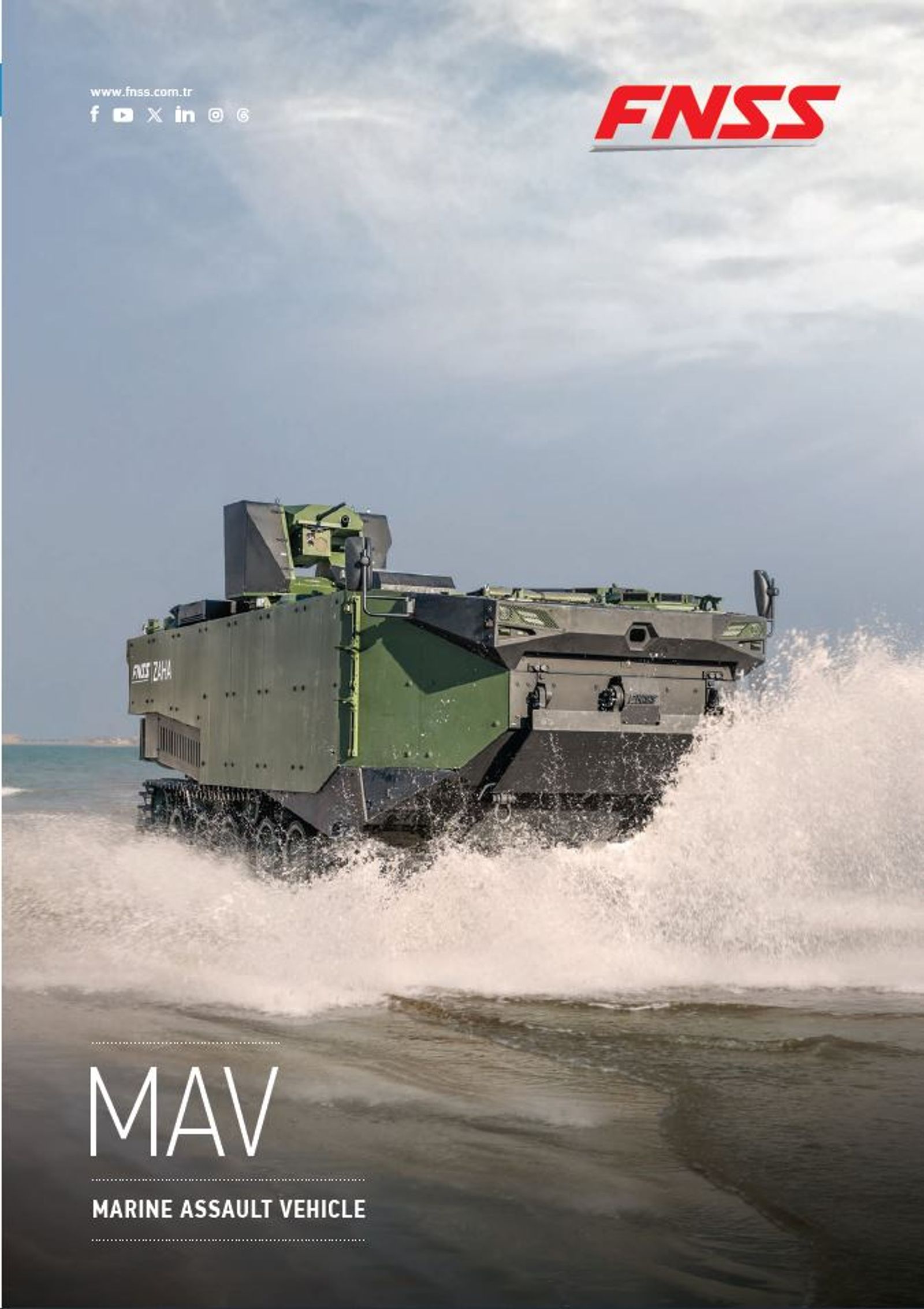
The FNSS ZAHA, known in export markets as the Marine Assault Vehicle or MAV, is the armoured amphibious assault vehicle developed by FNSS Savunma Sistemleri A.S. for the Amphibious Marine Brigade of the Turkish Naval Forces. Designed to swim from an amphibious ship over the horizon, cross the surf zone under its own power and then fight ashore as a tracked armoured personnel carrier, the ZAHA Marine Assault Vehicle is the first amphibious vehicle in the Turkish Armed Forces inventory with self-righting capability and open-ocean operating capability. Deliveries against the first 27-vehicle contract began on 25 March 2023, and on 7 May 2026 the Presidency of Defence Industries and FNSS signed a second-phase contract for a further 27 vehicles.
What the FNSS ZAHA Marine Assault Vehicle Is and Why It Matters
ZAHA is the Turkish acronym for Zirhli Amfibi Hucum Araci, the armoured amphibious assault vehicle. The designation describes the mission precisely. The vehicle is not a wheeled personnel carrier with a swim capability bolted on, and it is not a landing craft. It is a tracked armoured vehicle whose hull is designed first as a seaworthy hull and second as an armoured fighting compartment, and whose operational purpose is to move a marine rifle section from the well deck of an amphibious ship, across open water, through the surf line and onto a defended beach without the marines leaving armoured protection at any point in that sequence.
That combination is rare. Very few countries design and produce vehicles in this class, and the Presidency of Defence Industries has framed the programme in exactly those terms: the objective was to develop a fully original platform in the armoured amphibious assault vehicle class that only a handful of nations worldwide can design and manufacture. Professor Haluk Gorgun, president of the Presidency of Defence Industries, has publicly described the goal of the programme in those words. FNSS, for its part, states that it is the only supplier inside NATO with an operating production line for this vehicle type.
A capability with a narrow supplier base
The reason the supplier base is so narrow is engineering rather than politics. An amphibious assault vehicle has to satisfy two sets of requirements that pull against each other. At sea it needs buoyancy, a hydrodynamically efficient hull form, watertight integrity across every hatch, hull penetration and driveline seal, corrosion resistance, and enough reserve stability to survive a broaching sea. On land it needs armour, mine protection, a suspension capable of cross-country speed, a powerpack with the torque to move a heavy tracked hull up a beach gradient, and a fighting compartment arranged for rapid dismount under fire. Every kilogram of armour added for the land phase reduces freeboard and degrades sea behaviour. Every litre of internal volume added for buoyancy increases the surface area that must be armoured.
Resolving that trade is why the class has historically been dominated by a small number of long-running programmes, most of them derived from designs laid down decades ago. A clean-sheet entrant with a new hull, a new propulsion arrangement and a new turret represents a substantial national engineering investment, which is the context in which the FNSS ZAHA should be assessed.
Where ZAHA sits in Turkish naval infantry structure
The customer is the Amphibious Marine Brigade, the Turkish Naval Forces formation responsible for amphibious operations. The brigade previously operated the American AAV-7A1, a design whose lineage runs back to the 1970s and which has been progressively upgraded rather than replaced across most of its user base. ZAHA is the replacement generation for that capability, and it enters service alongside the amphibious assault ship TCG Anadolu (L-400), which entered the Turkish fleet as the largest vessel ever operated by the navy and as the platform around which Turkish expeditionary amphibious capability is being rebuilt.
The pairing matters. An amphibious assault ship without a fast, protected ship-to-shore connector can put marines ashore only by helicopter or by landing craft, both of which impose their own constraints on timing, weather and threat exposure. An armoured amphibious assault vehicle that can launch from the well deck and swim ashore gives the landing force a third option: an armoured wave that arrives with organic firepower and does not need to make a second transfer at the beach.
Programme History and the 27-Vehicle First Batch
From launch at IDEF 2019 to qualification
The programme was contracted between the Presidency of Defence Industries and FNSS for 27 vehicles in three configurations: 23 armoured personnel carriers, two command and control vehicles and two recovery vehicles. The vehicle was shown publicly for the first time in May 2019 at the IDEF defence exhibition in Istanbul.
Five prototypes were built, and the programme completed a full qualification test campaign. That campaign included mine and blast testing, which for an amphibious vehicle is a particularly demanding sequence because the hull must retain watertight integrity as well as structural integrity after a detonation. A land vehicle that survives a mine strike with a deformed floor pan is repairable; an amphibious vehicle with a compromised hull seal has lost its primary mission capability as well.
Deliveries from 25 March 2023
Deliveries to the Turkish Navy began on 25 March 2023. As of 2026 the type has been in operational service for more than two years, which is a significant milestone for any new platform because it is the point at which fleet availability data, maintenance burden and real corrosion behaviour in a salt-water operating cycle begin to be understood rather than predicted.
The three-configuration structure of the first batch is worth noting in itself. Rather than ordering a homogeneous fleet of personnel carriers and adding support variants later, the programme included the command and control and recovery configurations in the initial contract. That approach front-loads development cost but delivers a usable, self-supporting sub-unit rather than a collection of vehicles that cannot be recovered or coordinated without external assets.
The May 2026 Second-Phase Contract for the FNSS ZAHA
On 7 May 2026, the Presidency of Defence Industries and FNSS signed a procurement contract at the Istanbul Fair Center for a further 27 armoured amphibious assault vehicles. The second phase therefore doubles the programme of record to 54 vehicles.
What a repeat order signals
A second batch ordered after more than two years of operational service is the strongest form of endorsement available in defence procurement. Unlike an initial contract, which is placed on the basis of design documentation, test results and industrial policy, a repeat order is placed by a customer who has operated the vehicle, maintained it, exercised it from ships and knows what it costs to keep running. In a class of vehicle where corrosion, seal degradation and the cumulative effects of salt-water immersion are the principal long-term risks, that operational experience is not a formality.
The industrial consequences are equally important. A production line that runs continuously from a first batch into a second batch retains its trained workforce, its qualified supply chain and its tooling. A line that stops and restarts loses all three and pays to rebuild them. For a vehicle type that FNSS describes as having the only operating production line of its kind inside NATO, continuity of production is itself a strategic asset, both for domestic sustainment and for any export campaign that requires a credible delivery schedule.
Hull Design, Sealed Hydrodynamic Structure and Self-Righting Capability
An aluminium hull shaped for the water
The ZAHA uses a sealed, water-resistant aluminium hull with a hydrodynamic form. Aluminium is the conventional choice for amphibious armoured vehicles for two reasons that reinforce each other. It has a substantially better strength-to-weight ratio than rolled steel armour at equivalent structural stiffness, which preserves buoyancy margin, and it is far more tolerant of a marine environment than ferrous structure. The trade is that aluminium requires a different approach to ballistic protection, which is addressed on ZAHA through appliqué armour plates rather than by thickening the primary structure.
The word sealed carries more engineering weight than it appears to. Watertight integrity in a vehicle of this type is not a single feature but a discipline applied across every interface in the design: driver and commander hatches, the rear ramp, engine air intake and exhaust, cooling air paths, final drive and track seals, weapon station penetrations, cable and hydraulic runs, and periscope and sight apertures. Each is a potential leak path, and each must survive both the pressure of immersion and the mechanical shock of surf-zone operation and land driving.
Self-righting and open-ocean capability
The most distinctive characteristic of the design is its self-righting capability. If the vehicle capsizes, it can return itself to an upright attitude. FNSS and the Turkish Naval Forces identify ZAHA as the first amphibious vehicle in the Turkish Armed Forces inventory with this capability, and it is directly linked to the second characteristic that distinguishes the platform, its ability to operate in rough open sea rather than only in sheltered water.
These two properties are what allow a landing force to be launched from an amphibious ship standing off at a distance rather than from a vessel that must close the beach. Over-the-horizon launch reduces the exposure of the ship to shore-based anti-ship weapons, which is the central tactical problem of modern amphibious operations. It also means the vehicles spend far longer in the water, in a less forgiving sea state, before reaching the surf zone. A vehicle certified only for calm-water transit cannot be used that way. Self-righting is the safety case that makes the longer, rougher transit acceptable, because the failure mode that would otherwise be catastrophic for an embarked section becomes survivable.
Protection: Ballistic, Mine, NBC, Fire Suppression and Corrosion
Ballistic and mine-blast protection
Protection is built on the aluminium hull, which provides both ballistic and mine-blast protection, supplemented by appliqué armour plates. The modular approach is standard practice in the class and is particularly important for an amphibious vehicle, because the protection package is one of the few variables that can be adjusted to preserve buoyancy and sea-keeping margin as the vehicle grows in service. Mine and blast testing formed part of the completed qualification programme.
NBC protection, fire suppression and smoke
The vehicle carries an NBC protection system, referred to in Turkish service as KBRN, allowing the crew and embarked marines to operate in a contaminated environment. It is also fitted with an explosion detection and suppression system, which monitors the crew and engine compartments and releases suppressant within milliseconds of detecting the pressure and optical signature of an ignition event. In a vehicle carrying up to 21 embarked personnel behind a single ramp, fire and explosion suppression is one of the highest-value survivability investments available, because the time required to evacuate a full troop compartment is long relative to the propagation speed of a fuel or ammunition fire.
Smoke grenade launchers provide the standard obscuration capability, used to break an engagement, mask a movement or cover a dismount. In the amphibious assault role the launchers have an additional application, because the most vulnerable moment in the entire mission profile is the transition from water to land, when the vehicle is slow, predictable in its heading and silhouetted against the sea.
Cathodic protection and the corrosion problem
The inclusion of cathodic protection for the sea environment is a detail that distinguishes a purpose-designed amphibious vehicle from an adapted land vehicle. Cathodic protection counteracts galvanic corrosion, which occurs wherever dissimilar metals are in electrical contact in the presence of an electrolyte such as seawater. An armoured vehicle contains a large number of such junctions: aluminium structure against steel fasteners, running gear, track components, fittings and weapon mounts.
Without active corrosion management, the operating cycle of an amphibious vehicle, repeated immersion in salt water followed by land operation and storage, progressively degrades exactly the structure that the watertight integrity of the hull depends on. Corrosion control is therefore not a maintenance convenience but a direct contributor to the availability and service life of the fleet, and it is one of the areas where the value of a design conceived from the outset for the marine environment is clearest.
Powerpack, Transmission and Land Mobility
Diesel powerpack at 20 hp per tonne
ZAHA is driven by a diesel power pack coupled to a fully automatic transmission, delivering a power-to-weight ratio of 20 hp per tonne. Steering is through the transmission, the conventional arrangement for a tracked vehicle, and suspension is by torsion bar.
Twenty horsepower per tonne is a strong figure for a tracked amphibious vehicle. In the water it provides the margin needed to drive the waterjets against a sea state and a current while simultaneously running the bilge, cooling and electrical loads. At the surf line it supplies the reserve to climb a wet, soft gradient at the moment when the vehicle transitions from buoyant support to track support and momentarily carries its full weight on a poor surface. On land it supports cross-country manoeuvre alongside the rest of the landing force.
Land speed and obstacle performance
Road speed reaches up to 70 km/h. The vehicle can negotiate a 60 per cent gradient and a 40 per cent side slope, climb a vertical obstacle of 0.9 m and cross a 2.0 m trench. Torsion-bar suspension is a deliberate and conservative choice here: it is compact, sits within the hull envelope, contains no external hydraulic runs that could be damaged in the surf zone or corrode in salt water, and is well understood in maintenance terms. For a vehicle whose principal engineering challenge lies elsewhere, a robust and proven suspension arrangement is the right kind of conservatism.
Waterjet Propulsion and Sea Performance of the ZAHA Marine Assault Vehicle
In the water, ZAHA is driven by two rear-mounted waterjets and reaches a speed of up to 7 knots. Waterjets have become the standard propulsion solution for high-performance amphibious armoured vehicles, displacing the older approach of relying on track propulsion alone.
The advantages are practical. Waterjets deliver considerably more thrust than a moving track, so water speed and, more importantly, the ability to hold a heading against wind and current both improve. They contain no exposed propeller or shaft to be damaged in the surf zone or fouled in shallow water. Thrust vectoring through the jet outlets provides responsive steering at low speed, which is what a driver needs when manoeuvring alongside a ship in a well deck or holding station in a forming-up circle before a run to the beach. Reverse thrust gives the vehicle the ability to back off an obstacle without turning, a capability that matters when a wave of vehicles is manoeuvring in close proximity.
Seven knots is a competitive figure for a displacement-hull amphibious vehicle and is broadly in line with the established platforms in the class. It is the combination of that speed with self-righting and open-ocean certification, rather than the speed figure alone, that defines the operational envelope.
Key Characteristics of the FNSS ZAHA
| Characteristic | Detail |
|---|---|
| Designation | ZAHA (Zirhli Amfibi Hucum Araci); export designation MAV, Marine Assault Vehicle |
| Manufacturer | FNSS Savunma Sistemleri A.S., Türkiye |
| Customer | Turkish Naval Forces, Amphibious Marine Brigade |
| Crew and capacity | 3 crew (commander, driver, gunner) plus up to 21 embarked marines |
| Length | 8.3 m |
| Width | 3.3 m |
| Height | 3.8 m |
| Power-to-weight ratio | 20 hp per tonne |
| Powerpack | Diesel power pack with fully automatic transmission; steering through the transmission |
| Suspension | Torsion bar |
| Land speed | Up to 70 km/h |
| Water speed | Up to 7 knots, two rear-mounted waterjets |
| Gradient and side slope | 60 per cent gradient, 40 per cent side slope |
| Vertical obstacle and trench | 0.9 m vertical obstacle, 2.0 m trench crossing |
| Hull | Sealed hydrodynamic aluminium hull, water resistant, self-righting, open-ocean capable |
| Protection | Ballistic and mine-blast protection, appliqué armour plates, NBC (KBRN) system, explosion detection and suppression, cathodic protection, smoke grenade launchers |
| Armament | FNSS CAKA remote controlled turret with 12.7 mm M2 HB heavy machine gun and 40 mm automatic grenade launcher; elevation minus 7 to plus 45 degrees |
| Electronics | Day and night vision, 360-degree situational awareness, battle management system, navigation suite, VHF/UHF communications |
| First public showing | May 2019, IDEF |
| First deliveries | 25 March 2023 |
| Programme of record | 27 vehicles in the first batch (23 APC, 2 command and control, 2 recovery); further 27 contracted 7 May 2026 |
The CAKA Remote Controlled Turret and Armament
The armoured personnel carrier configuration is armed with CAKA, a remote controlled turret developed by FNSS. It mounts a 12.7 mm heavy machine gun, the M2 HB in .50 calibre, together with a 40 mm automatic grenade launcher. Elevation runs from minus 7 to plus 45 degrees.
The dual-weapon fit is well matched to the amphibious assault mission. The 12.7 mm machine gun provides accurate suppressive fire at extended range against personnel and light vehicles and is effective against light structures. The 40 mm automatic grenade launcher provides area effect against dug-in infantry, defilade positions and beach obstacles where a flat-trajectory weapon cannot reach. During a beach assault, both are needed, and the ability to switch between them without exposing the gunner is a meaningful advantage.
CAKA incorporates stabilisation, a thermal sight and automatic target tracking, and is described by FNSS as a lightweight design. Every one of those attributes has a specific value in this application. Stabilisation permits engagement while the vehicle is moving, including while it is under way in the water, where hull motion is continuous and largely uncontrollable. Automatic target tracking reduces the gunner’s workload during the phase of the mission in which he is also managing situational awareness for a vehicle carrying 21 embarked marines. Thermal imaging supports night landings, which is when amphibious assaults are most likely to be conducted. Low turret weight preserves buoyancy margin and, because the mass sits high on the hull, directly benefits stability at sea.
The plus 45 degree elevation limit is also relevant to the assault role, allowing engagement of positions on high ground overlooking a beach and of targets in upper storeys during subsequent operations in built-up terrain. The gunner remains under armour throughout, which removes the exposure that an open pintle mount would impose during the most dangerous phase of the mission.
Sensors, Battle Management System and Communications
ZAHA carries day and night vision systems, 360-degree situational awareness, a battle management system, a navigation suite and VHF/UHF communications.
The 360-degree situational awareness capability answers a problem specific to this vehicle class. An armoured amphibious vehicle in the water has very poor natural visibility. Freeboard is low by design, the crew stations sit close to the waterline, spray obscures optics, and the driver may be operating closed down. A distributed camera system that provides a continuous view around the vehicle is therefore not a convenience feature but a basic navigation and collision-avoidance requirement during a ship-to-shore movement in which many vehicles manoeuvre in proximity, often at night.
The navigation suite performs a comparable function. A vehicle launched over the horizon has no visual reference to the landing beach for much of its transit and must hold a heading against set and drift. Accurate navigation is what allows a wave of vehicles to arrive at the intended point on the correct beach rather than dispersed along the coastline.
The battle management system links the vehicle into the wider landing force picture, sharing position and tactical data with other vehicles, with the command and control variant coordinating the wave, and with the amphibious task force. Combined with VHF/UHF communications, this is what allows the landing to be controlled as a single coordinated operation rather than as a set of independent vehicle movements.
Variants: APC, Command and Control, Recovery and Mine Clearance
The first batch of 27 vehicles comprised three configurations, with a fourth foreseen for the family:
- Armoured personnel carrier with the CAKA remote controlled turret, 23 vehicles in the first batch. This is the assault configuration, carrying the marine section from ship to shore and then fighting as a tracked APC.
- Command and control vehicle, two in the first batch. It coordinates the wave of vehicles during the ship-to-shore movement and maintains communications with TCG Anadolu, functioning as the tactical link between the landing force in the water and the amphibious task force commander afloat.
- Recovery vehicle, two in the first batch, fitted with a lifting winch in place of the turret. Recovery capability is critical in this role because a disabled vehicle in the surf zone is both an obstacle and a hazard, and because a landing force ashore in the early hours of an assault has no external recovery support.
- Mine clearance variant, foreseen for the family. Beach and near-shore obstacle and mine clearance is one of the oldest and least tractable problems in amphibious warfare, and a vehicle-mounted capability that can operate in the same wave as the assault vehicles rather than arriving separately addresses a real gap.
The logic of building all four on a single hull is the same logic that drives common-chassis policy in land formations. Training, spares, maintenance procedures, driver qualification and battlefield recovery are all simplified when every vehicle in a sub-unit shares a powerpack, a running gear and a hull. For an amphibious unit operating from a ship with finite storage volume and finite workshop capacity, commonality is worth more than it is ashore.
TCG Anadolu and the Blue Homeland Doctrine
ZAHA operates from the landing helicopter dock TCG Anadolu (L-400) and from landing craft. The vehicle is the armoured connector in a system whose other elements are the ship, its well deck, its aviation facilities and the landing craft that carry heavier loads ashore once a beachhead is secure.
The strategic framing is the Turkish maritime doctrine known as Mavi Vatan, or Blue Homeland, which emphasises the defence of maritime interests across the Aegean, the eastern Mediterranean and the Black Sea, and the ability to project force beyond national waters. An amphibious capability supports that doctrine in several distinct ways: securing and, if required, retaking islands and coastal features; conducting non-combatant evacuation operations; delivering humanitarian assistance and disaster relief in coastal regions; and providing the deterrent value that a visible, exercised expeditionary capability generates.
None of those missions is possible without a protected ship-to-shore connector. Helicopters carry personnel but not armour and are highly weather-dependent. Landing craft carry heavy loads but must beach, which requires a suitable and preferably uncontested landing site. An armoured amphibious assault vehicle is the only element of the system that can deliver protected mobile firepower directly onto a defended shoreline. Doubling the ZAHA fleet through the May 2026 contract is therefore a direct increase in the amount of combat power the amphibious task force can put ashore in a single wave.
How the FNSS ZAHA Compares With the AAV-7A1, ACV 1.1, KAAV and ZBD-05
The international field in this class is small. The AAV-7A1 is the reference design, in service with the United States Marine Corps and a number of allied forces, including previously with Türkiye. Its longevity is a testament to the original concept, but the design dates from the 1970s and has been sustained through successive upgrade programmes rather than replaced. The BAE Systems and Iveco ACV 1.1 is the wheeled 8×8 amphibious combat vehicle selected by the United States Marine Corps to succeed the AAV-7A1, representing a deliberate architectural shift from tracks to wheels. The South Korean KAAV is a licensed and developed derivative of the AAV lineage. The Chinese ZBD-05 family takes a different approach again, using a planing hull and retractable running gear to achieve high water speed.
Against that field, FNSS positions ZAHA as a modern replacement generation, and the design choices are internally consistent with that positioning. The tracked configuration retains the beach and soft-ground performance that is the traditional argument for tracks in the surf zone, where a wheeled vehicle must contend with soft sand and a broken gradient at the moment of transition. Waterjet propulsion, self-righting capability and open-ocean certification address the over-the-horizon launch requirement that has driven every recent programme in the category. The remote controlled turret with a dual 12.7 mm and 40 mm fit reflects current practice, and the sensor and battle management fit is a clean-sheet integration rather than a retrofit into a hull designed before networked operations existed.
The advantage a new design holds over an upgraded one is that electrical capacity, internal volume, cooling and structural growth margin were sized for contemporary requirements from the start. The advantage the established designs hold is service history measured in decades, mature support networks and, in the case of the AAV family, extensive operational experience. ZAHA is at the beginning of that curve, with more than two years of Turkish Naval Forces service accumulated and a second production batch now contracted.
FNSS Industrial Position and Export Potential
FNSS Savunma Sistemleri is one of the most established armoured vehicle manufacturers in the Turkish defence industry, with a portfolio that spans the tracked ACV-15 and ACV-19 families, the PARS wheeled family in 4×4, 6×6 and 8×8 configurations, the KAPLAN tracked family and the KUNDUZ armoured amphibious combat earthmover. The KUNDUZ is particularly relevant to ZAHA, because it demonstrates that amphibious engineering competence within the company extends beyond a single programme.
The company’s export record is substantial by any measure. FNSS supplied the AV-8 Gempita 8×8 to Malaysia, developed the Kaplan MT, known in Indonesian service as Harimau, in partnership with Indonesian industry, and has delivered vehicles to Oman, the United Arab Emirates, the Philippines and Saudi Arabia. Several of those programmes involved technology transfer and local production, which is the transaction structure most large export competitions now require.
That record is directly relevant to the export prospects of the ZAHA Marine Assault Vehicle. The addressable market for an armoured amphibious assault vehicle is narrower than for a wheeled personnel carrier, since it consists only of navies and marine corps that maintain an amphibious assault capability and possess or are acquiring the amphibious shipping to employ it. But within that market, the supplier options are correspondingly few, and FNSS states that it operates the only production line of its kind inside NATO. A customer seeking a modern vehicle in this class, rather than an upgraded legacy design, has very few places to look.
The additional factor is the reference customer. Export campaigns for a vehicle of this complexity are won on demonstrated operational service, not on brochures. Two years of Turkish Naval Forces operation, a completed qualification programme including mine and blast testing, and a repeat order placed by the same customer after that service experience together constitute the reference package that any serious export campaign requires.
Outlook
The immediate outlook for the programme is defined by the second-phase contract. Delivery of a further 27 vehicles doubles the fleet and consolidates the production line, and the addition of the foreseen mine clearance variant would complete the family’s coverage of the amphibious assault mission set.
The broader technological environment the platform will operate in is changing quickly. Uncrewed aerial systems have transformed the threat picture for armoured vehicles, and a vehicle in the water during a ship-to-shore movement is a slow, predictable and highly visible target. Counter-UAS measures, whether through electronic attack, hard-kill effectors or the turret’s own capability against low, slow targets, are the most probable direction of future capability growth across this class. Anti-ship and coastal defence weapons have also proliferated, which reinforces rather than undermines the over-the-horizon launch concept that self-righting and open-ocean capability exist to support.
Against that background, the durable advantages of the design are the ones built into its architecture: growth margin in an aluminium hull designed for the marine environment from the outset, electrical and cooling capacity sized for a modern sensor and battle management fit, and a modular appliqué armour approach that allows protection to be adjusted without redesigning the hull. Whether the FNSS ZAHA converts its technical position into export orders will depend on procurement timing in a small number of navies rather than on the platform itself. What the programme has already established is that Türkiye can design, qualify, produce and sustain a vehicle in a class that very few countries attempt.
Frequently Asked Questions
What is the FNSS ZAHA Marine Assault Vehicle?
The FNSS ZAHA, or Zirhli Amfibi Hucum Araci, exported as the MAV or Marine Assault Vehicle, is a tracked armoured amphibious assault vehicle developed by FNSS Savunma Sistemleri for the Amphibious Marine Brigade of the Turkish Naval Forces. It carries three crew and up to 21 embarked marines, swims at up to 7 knots on two rear-mounted waterjets, travels at up to 70 km/h on land, and is the first amphibious vehicle in the Turkish Armed Forces inventory with self-righting capability and open-ocean operating capability.
How many ZAHA vehicles has Türkiye ordered?
The first contract with the Presidency of Defence Industries covered 27 vehicles, comprising 23 armoured personnel carriers, two command and control vehicles and two recovery vehicles. Deliveries began on 25 March 2023. On 7 May 2026 the Presidency of Defence Industries and FNSS signed a second-phase contract at the Istanbul Fair Center for a further 27 vehicles, bringing the programme of record to 54.
What weapons does the ZAHA carry?
The armoured personnel carrier configuration is fitted with the FNSS CAKA remote controlled turret, mounting a 12.7 mm M2 HB heavy machine gun and a 40 mm automatic grenade launcher with elevation from minus 7 to plus 45 degrees. The turret is stabilised, has a thermal sight and automatic target tracking, and allows the gunner to remain under armour. Smoke grenade launchers are also fitted.
How does the ZAHA work with TCG Anadolu?
ZAHA operates from the landing helicopter dock TCG Anadolu (L-400) and from landing craft, carrying marines from ship to shore at speed and then fighting on land as an armoured personnel carrier. The command and control variant coordinates the wave of vehicles during the ship-to-shore movement and maintains communications with TCG Anadolu, linking the landing force in the water to the amphibious task force.
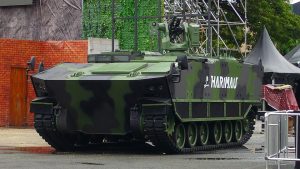
[…] in Kocaeli from 20 to 23 August. It is designed to run in front of FNSS’s existing crewed ZAHA Marine Assault Vehicle, taking on the highest-risk minutes of a landing so that a human crew does not have […]