
ASFAT: The Turkish Defence Ministry’s Own Contractor

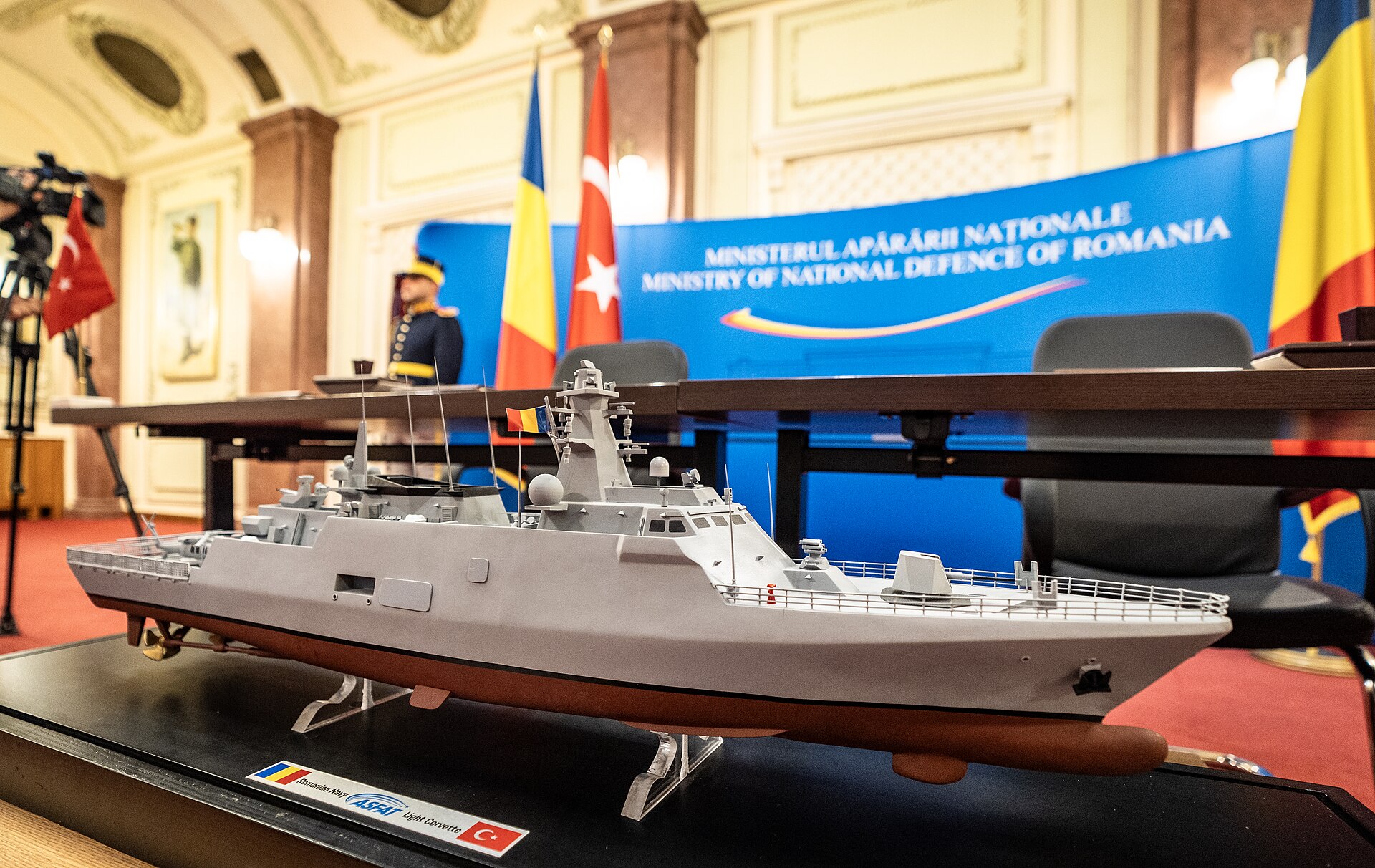
ASFAT is the Turkish Ministry of National Defence’s own commercial company. Founded in January 2018 as Askeri Fabrika ve Tersane İşletme A.Ş. — Military Factory and Shipyard Management Inc. — it exists to sell the output of the armed forces’ own factories and shipyards, at home and abroad. It is wholly state-owned, its chairman is a serving deputy defence minister, and a foreign navy that buys a warship through ASFAT is signing with the Turkish government rather than with a private manufacturer. Romania’s December 2025 corvette contract, Pakistan’s four Babur-class corvettes and Jordan’s five patrol boats all ran through it.
That structure is the reason ASFAT matters to anyone outside Türkiye, and it is the part most often missed. ASELSAN, Roketsan, Baykar and Turkish Aerospace are companies that happen to be Turkish. ASFAT is the Turkish state acting as a contractor. The difference changes who the counterparty is, what recourse a buyer has, how the deal is negotiated and what can be offered — including, as Romania found, a warship that had already been built for the Turkish Navy.
DEFENCETÜRKIYE DATA BOX
| Company | ASFAT A.Ş. (Askeri Fabrika ve Tersane İşletme A.Ş.) |
| Owner | Turkish Ministry of National Defence — wholly state-owned |
| Established | 12 January 2018, Ankara |
| Chairman / General Manager | Musa Heybet, Deputy Minister of National Defence / Prof. Dr. Mustafa İlbaş |
| Industrial base | 27 military factories and 10 naval shipyards, 30,000+ personnel (ASFAT figures) |
| Business areas | Warship construction; military aircraft MRO; land systems and munitions; modernisation |
| Exports 2026 | Above US$550 million by late August; more than 20 countries |
| Export customers (signed) | Pakistan, Romania, Jordan, Senegal |
| Largest domestic programme | TF-2000 Tepe-class air defence destroyer; lead ship TCG Kocatepe |
| Published accounts | None. Not listed; not in the Defense News Top 100 |
What ASFAT actually is
Until 2017 Türkiye’s military factories and naval shipyards sat inside the armed forces. They repaired tanks, overhauled aircraft, made ammunition and built ships for the Turkish Navy, and they were not commercial entities. A restructuring moved them under the Ministry of National Defence, and ASFAT was incorporated on 12 January 2018 under Additional Article 12 of Law No. 1325 to run their capacity as a business.
The company’s own description of its industrial base is 27 military factories and 10 naval shipyards employing more than 30,000 people. Those figures describe the facilities ASFAT draws on rather than a payroll it owns outright, and they should be read that way. For warship construction the ones that matter are the Ministry’s three naval shipyards — İstanbul, Gölcük and İzmir — with İstanbul Naval Shipyard carrying almost all of the export work. For aircraft it is three Air Maintenance Factory Directorates: the 1st at Eskişehir for fighters, the 2nd at Kayseri for transports, and the 5th at Ankara for helicopters.
Governance follows the ownership. The chairman of the board is Musa Heybet, a serving Deputy Minister of National Defence. The general manager since March 2025 is Prof. Dr. Mustafa İlbaş, previously of Gazi University. There is no free float, no share price and no annual report in the sense an equity analyst would recognise.
WHY IT MATTERS
For a foreign ministry of defence, ASFAT converts a commercial purchase into a government-to-government one. That removes the intermediary, puts a sovereign counterparty on the other side of the contract and brings political weight — and, in practice, access to production slots and hulls inside the Turkish Navy’s own build programme. It also means the buyer cannot read the supplier’s accounts, because there are none to read.
Romania: what a government-to-government warship deal looks like
The clearest illustration is Romania, and the Romanian Ministry of National Defence titled its own record of the event precisely: the signing of the contract to acquire a HISAR-class light corvette from the Government of the Republic of Türkiye. Not from a shipyard. From a government.
The contract was signed on 3 December 2025 and is worth €223 million excluding VAT. What Romania bought was not a ship on order but a ship already in the water: the vessel had been laid down at İstanbul Naval Shipyard on 15 August 2021 and launched on 23 September 2023 as the Turkish Navy’s TCG Akhisar. It was handed over and commissioned into the Romanian Navy on 20 June 2026 as ROS Contraamiral August Roman, pennant Cvt 261, and reached Constanța on 10 July 2026 — the first Turkish-built warship delivered to an EU and NATO member state.
That transaction is only possible because of what ASFAT is. A private yard cannot sell a customer a hull that belongs to the Turkish Navy’s own order book; the Ministry that owns both the navy and the shipyard operator can. For Bucharest the payoff was time. Romania had not taken delivery of a new-build warship in more than three decades, and buying a completed hull compressed a build programme into a transfer.
The limitation is equally instructive, and buyers should note it. The ship arrived armed with a 76 mm main gun, two 12.7 mm remote weapon stations, a three-dimensional surveillance radar, fire-control radar with electro-optical sensors, electronic warfare equipment and a hull-mounted sonar. The air-defence and anti-ship layers were not in the delivered configuration. Defense News reported in June 2026 that Romania planned a follow-on package of roughly €42 million later in 2026 for full operational capability — vertical launch cells for air-defence missiles, a 35 mm close-in weapon system, depth charges and additional sensors — with Naval Strike Missiles to be added through the European Union’s SAFE instrument. A fast delivery and a fully armed delivery are different things, and the Romanian contract bought the first.
Where ASFAT has signed abroad
Four export relationships are documented by contract rather than by intention. They are worth separating from the much longer list of discussions, because the gap between the two is where most reporting on Turkish defence exports goes wrong.
| Customer | What | Signed | Built where | Status, September 2026 |
|---|---|---|---|---|
| Pakistan | 4 × Babur-class (MİLGEM) corvettes | July 2018 | 2 İstanbul, 2 Karachi | Two delivered; PNS Khaibar inducted at Karachi 4 April 2026; two Karachi hulls outstanding |
| Romania | 1 × Hisar-class light corvette | 3 December 2025 · €223m excl. VAT | İstanbul Naval Shipyard | Delivered and commissioned 20 June 2026; follow-on weapons package planned |
| Jordan | 5 × mid-sized patrol boats | 12 February 2026 · value not published | İstanbul Naval Shipyard | Contracted; coast guard, border protection and search-and-rescue roles |
| Senegal | CN-235 heavy maintenance | 2026 · value not published | 2nd Air Maintenance Factory, Kayseri | Aircraft in Türkiye; ASFAT’s first foreign military aircraft MRO contract |
| Kazakhstan, Iraq, Qatar, Saudi Arabia, Niger, Nigeria | A400M and C-130 maintenance lines, joint ventures, naval platforms | — | — | Negotiations and stated plans only. No signed contract published |
Original DefenceTürkiye compilation from contract announcements and official customer statements, September 2026. Where a value is not listed, none has been published.
The fastest-growing business is not ships
ASFAT is generally written about as a shipbuilder. Its own growth story in 2026 was aircraft maintenance, and that is the part of the company most likely to matter to foreign air forces over the next five years.
The capability base is inherited: the Air Maintenance Factory Directorates have sustained the Turkish Air Force’s transport, fighter and helicopter fleets for decades. What changed is that ASFAT began selling that capacity. The Kayseri factory performs depot-level maintenance on C-130, CN-235 and KC-135 aircraft and holds Airbus-certified retrofit capability for the A400M; Eskişehir handles fighters and F-16 and F-4 engine work; Ankara covers Black Hawk, Chinook, Cougar, AW119 and T129 ATAK helicopters.
Two developments turned that into an export line. Airbus Defence and Space and ASFAT signed a memorandum establishing a joint task force to identify cooperation models for in-country military aircraft MRO in Türkiye. And in 2026 ASFAT took its first foreign military aircraft: a Senegalese Air Force CN-235 arrived at Kayseri for heavy maintenance. In August 2026 Musa Heybet said A400M maintenance requests from European Union countries and Turkic states were being handled in Türkiye and that ASFAT’s exports had passed US$550 million for the year across more than 20 countries.
The strategic logic is straightforward, and it is not primarily about revenue. MRO creates a dependency that runs in the opposite direction to an arms sale: the customer keeps coming back, the relationship is measured in decades, and it does not require the customer to buy a Turkish platform at all. It is also a market where Türkiye’s labour costs and its position between Europe, the Gulf and Africa are genuine advantages rather than talking points. Speaking to Breaking Defense in June 2025, İlbaş set out an ambition to become a regional MRO hub for the Middle East and Africa, naming Kazakhstan for A400M work and Niger and Nigeria for C-130 fleets, alongside a joint venture in Iraq and a planned company in Qatar. Those remain negotiations, not contracts.
How the contract chain works
The ASFAT contracting chain. Original DefenceTürkiye diagram, September 2026.
Two things follow from that chain. First, ASFAT holds the customer relationship but does not build everything in it. The combat system, radars, sonar and weapons on an ASFAT-delivered warship come from ASELSAN, Roketsan, HAVELSAN and Meteksan, and the split of work across prime contractors, yards and suppliers is set out in our guide to who builds Türkiye’s warships. Second, ASFAT is not the only route into the Turkish naval market. STM is the other state-linked prime, and the private consortium yards run their own export programmes; Envanter Medya maintains a Turkish-language file on the TAİS consortium’s export programmes in Indonesia, Qatar and India that shows how different that channel looks.
What ASFAT builds for Türkiye
The domestic order book is what gives the export offer its credibility, and it is currently the largest in the company’s short history. In July 2025 ASFAT was contracted to build the TF-2000 air defence destroyer, the first Turkish warship designed around area air defence and the naval layer of the Çelik Kubbe (“Steel Dome”) architecture. ASFAT’s figures for the Tepe-class ship are 149 metres, 21.3 metres of beam and about 8,300 tonnes, with a speed above 26 knots and a hull assembled from 68 blocks. The prime contract was signed on 20 December 2024, Phase-2 construction and procurement began on 7 November 2025, and the lead ship TCG Kocatepe was laid down at İstanbul Naval Shipyard on 3 April 2026, with launch planned for the fourth quarter of 2027 and commissioning in the first quarter of 2031. The programme has its own detail in our TF-2000 file.
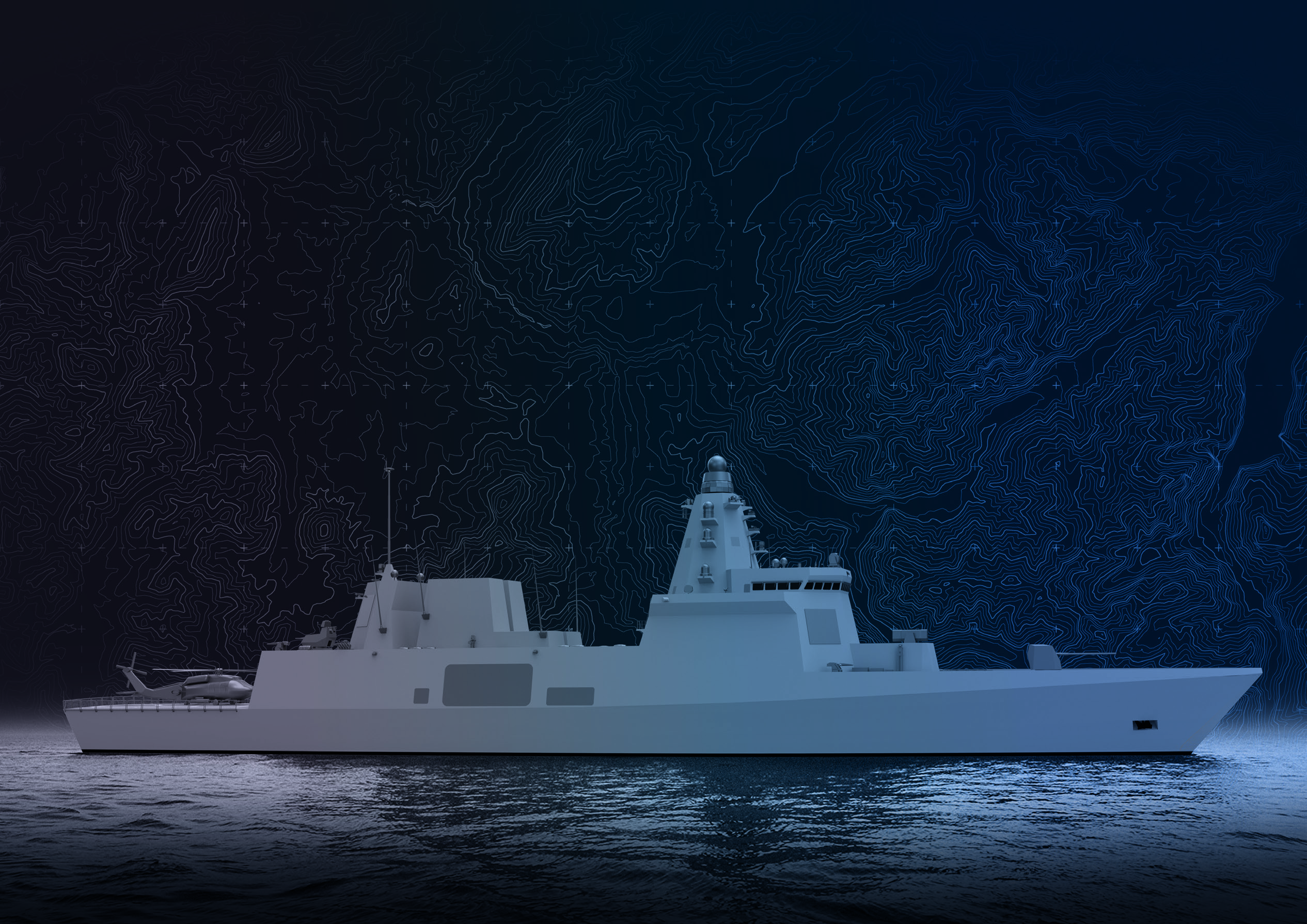
Alongside it, ASFAT holds a July 2025 order for four offshore patrol vessels derived from the Ada-class corvette, to be built inside 36 months. That matters commercially as well as militarily: the Hisar-class OPVs are exactly the product Romania bought, and a warm production line is what allows a completed hull to be offered to a foreign navy at short notice.
The land and munitions side is smaller and less visible. ASFAT markets the MEMATT mechanical mine-clearing system, HGK precision guidance kits, tactical wheeled armoured vehicles and munitions sub-systems drawn from the military factories. None of it has produced an export contract on the scale of the naval or MRO work.
BUYER VIEW
Counterparty. A contract with ASFAT is a contract with the Turkish Ministry of National Defence. That brings political durability and it also means disputes run through a state channel rather than a commercial one.
Delivery. ASFAT’s distinctive offer is speed, because it can transfer hulls from the Turkish Navy’s own programme. Romania went from signature to commissioning in roughly six months. A new-build order does not move at that pace — Pakistan’s programme has run since 2018.
Cost visibility. Thin. The Romanian corvette at €223 million excluding VAT is the only recent ASFAT ship price in the public record; the Jordanian and Pakistani values have not been published by either side.
Configuration. Check what is inside the price. The Romanian ship was delivered without its air-defence and anti-ship layers, with a separate follow-on package planned.
Technology transfer. Demonstrated, and at depth — but on long timelines. See our assessment of what was actually transferred in the Türkiye–Pakistan case.
Export control. ASFAT’s state ownership does not make its products licence-free. Propulsion and some subsystems on Turkish warships remain of Western origin, which keeps third-country approvals in the chain. Our explainer on whether Turkish weapons are ITAR-free sets out where those constraints bite.
This is open-source editorial analysis for readers following the Turkish defence market. DefenceTürkiye does not advise governments or companies on procurement.
The limitations, stated plainly
No accounts. ASFAT publishes no audited financial statements. Its revenue, margin, order backlog and debt are not in the public record, and it does not appear in the Defense News Top 100 — where five Turkish companies did rank in September 2026, led by ASELSAN at 40th on US$4.46 billion of 2025 defence revenue, with Turkish Aerospace 48th, ARCA Defense 53rd, Roketsan 64th and MKE 81st. Every figure quoted for ASFAT in this article originates with ASFAT or with the Ministry of National Defence. A procurement office that normally assesses supplier financial health cannot do so here.
Capacity is shared with the Turkish Navy. The yards building for export are the same yards building the TF-2000, the four OPVs and the MİLGEM programme. When domestic demand rises, export slots compete with it — and priority in a state-owned system is not decided commercially.
Foreign content has not gone away. İlbaş put ASFAT’s foreign material dependency at around 20 per cent in 2025. That is low for a shipbuilder, and it is not zero: propulsion in particular remains an import, which is why a Turkish warship export is not automatically free of third-country licensing.
The record is short and thin. ASFAT is eight years old. Four signed export customers is a real record, but it is not a deep one, and the MRO business — the part growing fastest — rests on one foreign aircraft in a hangar at Kayseri and a memorandum with Airbus. Memoranda are not contracts, and this piece has kept them in a separate column for that reason.
What comes next
Three things will show whether ASFAT is a durable export channel or a beneficiary of one good year.
The first is whether a second European customer follows Romania. Romania’s purchase was made easier by a specific combination — a Black Sea security problem, an urgent capability gap and an available hull — and no other European navy has yet repeated it. The second is whether the Airbus relationship converts into a signed MRO line rather than a task force; if EU A400M operators begin sending airframes to Kayseri under contract, Türkiye acquires a position in European fleet sustainment that no drone sale would give it. The third is the Pakistani hulls at Karachi, where the real test of ASFAT’s technology-transfer model is whether the locally built ships eventually deliver on the same timeline as the Istanbul-built ones.
For readers tracking the wider picture, the mechanics of Turkish defence contracting are set out in our guides to how countries buy Turkish weapons and what a Turkish offset actually delivers, and Envanter Medya’s Turkish-language analysis of why the MİLGEM family has sold as well as it has covers the design lineage behind most of ASFAT’s export ships.
FAQ
What does ASFAT stand for?
Askeri Fabrika ve Tersane İşletme Anonim Şirketi — Military Factory and Shipyard Management Inc. It is a joint-stock company wholly owned by the Turkish Ministry of National Defence, incorporated on 12 January 2018.
Is ASFAT a government agency or a company?
Legally it is a company. In practice it is the Ministry of National Defence acting commercially: the ministry owns it outright, a serving deputy minister chairs the board, and it operates the armed forces’ own factories and shipyards. That is why its export contracts are structured government-to-government.
Which countries have bought from ASFAT?
Four have signed: Pakistan (four Babur-class corvettes, 2018), Romania (one Hisar-class light corvette, December 2025), Jordan (five patrol boats, February 2026) and Senegal (CN-235 heavy maintenance, 2026). Turkish officials say ASFAT exports to more than 20 countries in total, a figure that includes smaller spares, munitions and service work that has not been itemised publicly.
How much did Romania pay for its Turkish corvette?
€223 million excluding VAT, under a contract signed on 3 December 2025. A follow-on weapons and sensors package of roughly €42 million was planned for later in 2026 to bring the ship to full operational capability.
Does ASFAT build the TF-2000 destroyer?
Yes. ASFAT is the prime contractor for the TF-2000 Tepe-class air defence destroyer. The lead ship, TCG Kocatepe, was laid down at İstanbul Naval Shipyard on 3 April 2026, with launch planned for late 2027 and commissioning in early 2031.
What is the difference between ASFAT and STM?
Both act as prime contractors on Turkish naval programmes, but ASFAT is owned outright by the Ministry of National Defence and operates the military’s own factories and shipyards, while STM is a state-linked technology and engineering company that contracts private yards. ASFAT’s route suits buyers who want a state counterparty; STM’s suits buyers who want a systems house.
How big is ASFAT?
Unknown in revenue terms, because it publishes no accounts. ASFAT cites an industrial base of 27 military factories and 10 naval shipyards with more than 30,000 personnel, around 150 completed and ongoing projects and a total project portfolio of roughly US$5 billion, with exports above US$550 million in 2026.
Sources
- Romanian Ministry of National Defence, signing of the contract to acquire a HISAR-class light corvette from the Government of the Republic of Türkiye, 3 December 2025
- Jordan News Agency (Petra), Jordan signs deal with Türkiye’s ASFAT for five mid-sized patrol boats, 12 February 2026
- ASFAT corporate site
- Defence Turkey, ASFAT’s 2026 exports exceed USD 550 million, 26 August 2026
- Defence Turkey, ASFAT to debut strategic capabilities at SAHA 2026
- Breaking Defense, Inside Turkey’s ASFAT and its push to become a regional hub for military aircraft MRO, June 2025
- Breaking Defense, ASFAT to construct first Turkish air defense destroyer TF-2000, inks deal for 4 OPVs, July 2025
- Defense News, Romania bolsters Black Sea fleet with Turkish-built corvette, 26 June 2026
- Naval News, ASFAT delivers TCG Koçhisar to the Turkish Navy and CAm. Roman to Romania, June 2026


