Türkiye’s Army Takes Delivery of New Fırtına-2 Howitzers and More TAYFUN Missiles

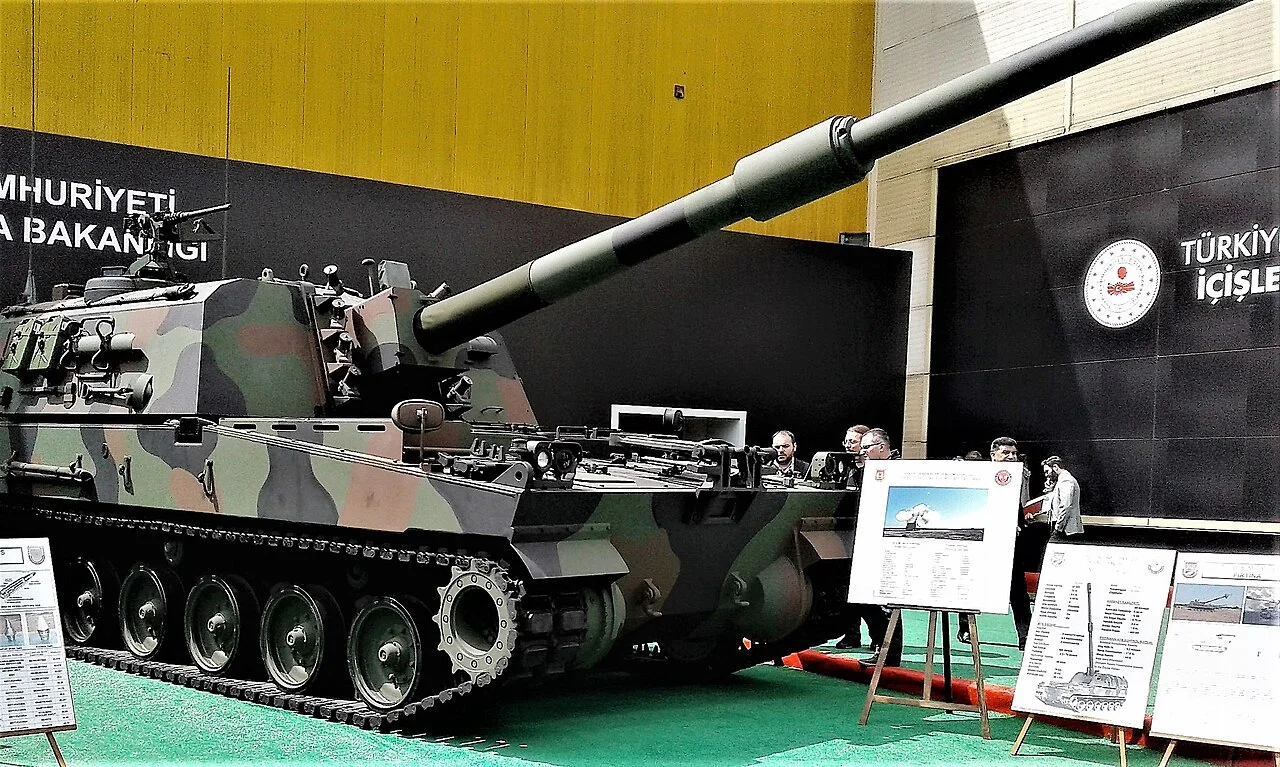
Türkiye’s Ministry of National Defence (MSB) said on October 22 that a new batch of Fırtına-2 self-propelled howitzers and TAYFUN Blok-2 ballistic missiles has completed inspection and acceptance and entered the Land Forces Command’s inventory. Ministry spokesman Rear Adm. Zeki Aktürk disclosed the deliveries at MSB’s weekly press briefing without stating exact quantities, continuing a pattern of incremental induction announcements the ministry has made through 2026 rather than describing a single large handover.
The briefing also flagged two HÜRKUŞ-II trainer aircraft nearing completion of their own inspection and acceptance process for the Air Force Command — a step beyond the first pair of HÜRKUŞ-II trainers handed over in September.
What makes Fırtına-2 different
Fırtına-2 is a modernized successor to the T-155 Fırtına, the 155mm self-propelled howitzer that has formed the backbone of Turkish Army artillery for two decades. Rather than a new vehicle, it is a re-engineered version of the same chassis and gun system, with the most significant change sitting inside the turret: ASELSAN’s hydraulic turret and barrel-traverse drive has been replaced with an electric-driven, servo-controlled system, paired with a new fire-control unit the company designates the K/M Howitzer Fire Control System. The upgrade package also adds a propellant-conditioning unit to keep charges at a stable temperature, a fully automatic ammunition-loading system intended to raise sustained rate of fire, and a SARP remote weapon station for close-in self-defence against infantry and drones — a feature increasingly standard across Turkish armoured platforms since drone-delivered munitions became a battlefield threat.
Reported figures put the upgraded vehicle at roughly 47 tonnes combat weight, around 12 metres long and 3.4 metres high, with a road speed near 65 km/h and the ability to ford 1.5-metre water obstacles and cross 2.8-metre trenches. A maximum range above 40 km has been cited in Turkish defence press, though neither ASELSAN nor the Land Forces Command has published an official figure. Turkish outlets have reported a total order of around 140 Fırtına-2 units, with deliveries proceeding in batches rather than as a single contract handover — consistent with how the ministry has announced them at successive weekly briefings rather than in one event.
A second TAYFUN Blok-2 delivery, not the first
Tuesday’s mention of TAYFUN Blok-2 missiles is not a new programme milestone on its own. The Land Forces Command took delivery of what Turkish reporting described as a third batch of the short-range ballistic missile in late September, and this week’s induction appears to be a further, incremental batch rather than a distinct event. TAYFUN, developed by ROKETSAN, is Türkiye’s first indigenous ballistic missile and has been presented domestically as a deterrent system; a more capable Blok-4 variant, whose “hypersonic” billing Turkish officials have not substantiated with released flight data, has drawn separate scrutiny in recent coverage.
Why steady induction matters more than a single headline
None of Tuesday’s announcements individually breaks new ground — Fırtına-2 howitzers and TAYFUN Blok-2 missiles have both entered service before. What the pattern shows is a defence ministry treating serial production and fleet induction as routine enough to report weekly, rather than saving each handover for a ceremony. That matters for how foreign buyers and partners read Turkish industrial capacity: a programme that delivers in regular, disclosed batches is a stronger reference for an export customer than one that produces a single showcase unit and goes quiet. It also underscores how much of Türkiye’s artillery modernization now runs through upgrades to existing platforms — replacing hydraulics with electric drives, adding automated loading and layering on counter-drone self-defence — rather than through clean-sheet new vehicles.
The Fırtına-2 upgrade path in particular reflects a wider shift in how Turkish Land Forces are adapting legacy artillery to a battlefield shaped by loitering munitions and first-person-view drones, where a SARP remote weapon station and a faster automatic loader can matter as much as raw range. For a howitzer design that first entered service in the early 2000s, continuing to re-engineer its turret and fire-control systems two decades later — and inducting the results in regular, publicly disclosed batches — says as much about the durability of the underlying platform as about any single new capability.
Source: Turkish Ministry of National Defence weekly press briefing, October 22, 2026, as reported by Turkish defence media.