ASELSAN’s GÖKALP Interceptor Drone Destroys a Target in First Integrated Hit-to-Kill Test

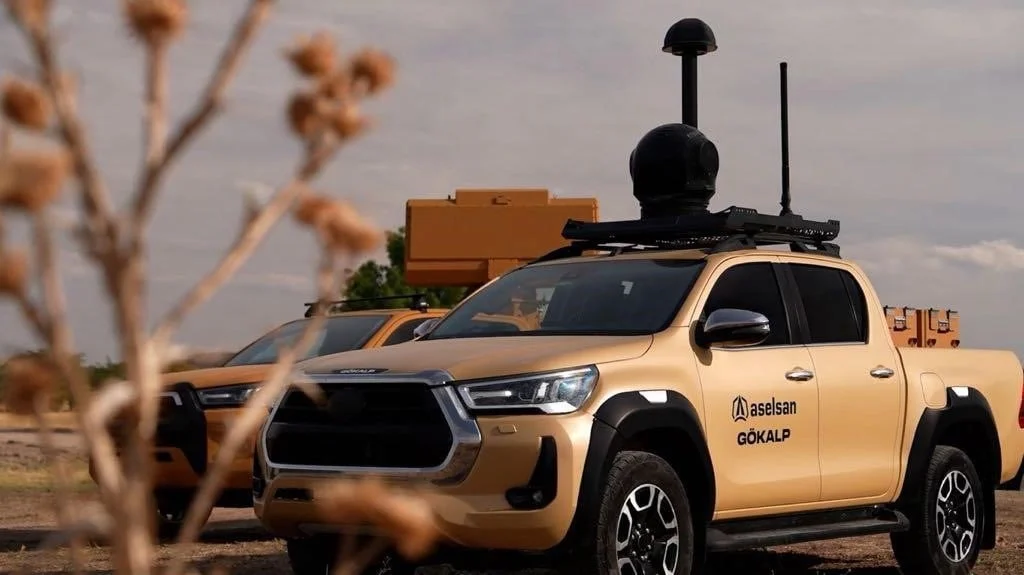
ASELSAN has demonstrated a live, end-to-end kill chain against a hostile drone using its own interceptor aircraft rather than a gun or missile, destroying a target by ramming it in mid-air at the company’s Oğulbey Technology Base outside Ankara. The test, which ASELSAN disclosed in a social media post around October 10-11, linked three previously separate pieces of hardware — a search radar, a command-and-control layer and a kamikaze interceptor drone — into a single automated engagement.
In the sequence ASELSAN described, its AURA radar picked up a target drone and passed the track in real time to DRONEDEF, the company’s counter-drone command-and-control software. DRONEDEF then cued a GÖKALP E1 interceptor, a small expendable drone built specifically to destroy other drones by flying into them, which struck and destroyed the target. ASELSAN said the trial showed the components operating together under field conditions, and described the wider GÖKALP system as vehicle-mounted and built to be moved between locations rather than fixed in place.
The company has not published range, speed, cost-per-unit or production status for GÖKALP, and there is no independent verification of the test beyond ASELSAN’s own account and the video it released. Hürriyet Daily News and several specialist outlets, including EDR Magazine, carried the same details, all sourced to ASELSAN’s statement.
A cheap answer to a cheap problem
Hit-to-kill interceptor drones belong to a category of counter-drone technology that has grown quickly since 2022, as militaries search for ways to down small, low-cost attack and reconnaissance drones without spending a surface-to-air missile worth hundreds of thousands of dollars on a target that might cost a few thousand. Ramming interceptors, sometimes called “kamikaze anti-drone drones,” are cheaper to build than guided missiles and avoid the fragment-damage and collateral-risk issues that come with shooting things out of the sky over populated areas.
That economics argument is central to how Türkiye has positioned its counter-drone industry for export: Turkish firms, led by ASELSAN, now offer a layered menu of hard-kill options spanning jamming, gun systems such as KORKUT, directed-energy weapons and now interceptor drones, aimed at militaries and border-security agencies facing the same low-cost drone threat that has become a fixture of the Russia-Ukraine war and of Houthi operations in the Red Sea.
Part of a bigger air defence push
GÖKALP sits inside ASELSAN’s broader counter-unmanned-aircraft-systems (C-UAS) line, alongside DRONEDEF and the AURA radar family, which the company has also shown integrated with its KORKUT gun systems. ASELSAN first showed GÖKALP publicly earlier in 2026 and has steadily added demonstrations of its components since, including at MSPO 2026 in Poland, where the company displayed its counter-drone and electronic-warfare portfolio to a NATO audience.
The timing is notable. ASELSAN has been in the middle of a run of large domestic contracts this month, including a €2.46 billion deal with Türkiye’s Secretariat of Defence Industries (SSB) for hybrid air defence systems signed on October 5. Counter-drone capability is one of the stated pillars of Çelik Kubbe (“Steel Dome”), Türkiye’s layered air defence architecture, and a working hit-to-kill interceptor would give that architecture a lower-cost option against drone swarms that sits below its surface-to-air missile layers.
What is not yet confirmed
Nothing in ASELSAN’s disclosure or in the press coverage indicates GÖKALP has been ordered, funded under a specific SSB contract, or scheduled for delivery to the Turkish armed forces. The October demonstration was a single engagement against a cooperative target in a controlled test environment, not an operational trial against a swarm, a jamming-degraded target or adverse weather — conditions that matter a great deal for a system whose entire premise is physically catching another flying object. ASELSAN has not disclosed an export customer for GÖKALP, and Defense Türkiye found no indication that one exists yet.
Still, the demonstration is a concrete technical milestone: it is the first time ASELSAN has shown the radar, the C2 software and the interceptor working together rather than describing them as separate product lines. For militaries watching the drone war in Ukraine and the Red Sea with an eye on their own air defence budgets, a credible low-cost interceptor is exactly the kind of system generating interest, and Türkiye’s defence industry has built its export record over the past decade on turning demonstrations like this one into contracts within a year or two.