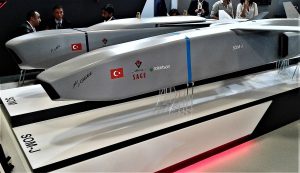
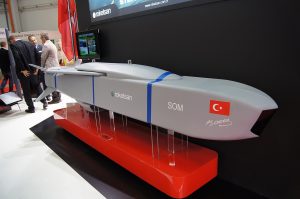
TAYFUN BLOK-3 Enters Serial Production as Türkiye’s First Anti-Ship Ballistic Missile


ROKETSAN’s anti-ship ballistic missile, TAYFUN BLOK-3, is entering serial production this year, with deliveries to the Turkish Armed Forces following soon after, company General Manager Murat İkinci said on October 3. The announcement, made to Anadolu Agency at the TEKNOFEST Southeast festival in Şanlıurfa, is the first confirmation that the newest member of Türkiye’s TAYFUN ballistic missile family has moved from testing into production.
“We are about to complete the activities necessary for the serial production of TAYFUN BLOK-3, and our serial production will also begin this year, with deliveries beginning,” İkinci said. He described BLOK-2, the variant already in the inventory, as being delivered on “an intensive schedule,” while BLOK-3 preparations are in their final stage.
A Ballistic Missile Built to Hit Ships
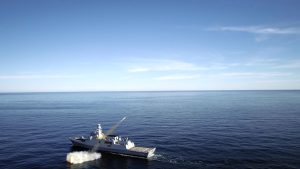
What sets BLOK-3 apart from the rest of the TAYFUN family is its target set. Where earlier variants were built against fixed land targets, İkinci said BLOK-3 carries a warhead that adds a penetration effect on top of blast and fragmentation, aimed primarily at ships and hardened targets such as bunkers. ROKETSAN demonstrated that capability in July, when a BLOK-3 round struck a moving unmanned surface vessel in the Black Sea — the first time a Turkish ballistic missile has engaged a manoeuvring target at sea, and, according to the company, only the handful of such tests have been attempted anywhere.
The test also marked the first integration of a terminal seeker head onto a Turkish ballistic missile, a technical step that matters beyond this one programme: inertial-plus-satellite guidance, the baseline for earlier TAYFUN variants, is accurate enough against a fixed point on land but not against a ship that can manoeuvre during the missile’s flight time. A seeker that reacquires and tracks the target in the final phase is what makes the anti-ship role workable at all.
Where BLOK-3 Fits in the TAYFUN Family
ROKETSAN has not published an official range figure for BLOK-3, and — as this site’s earlier guide to the TAYFUN family noted — reliable public detail on the variant has so far been thin. What is established: BLOK-1, first flown in October 2022, demonstrated roughly 561 km on its debut test and entered serial production within months, unusually fast for a first-generation ballistic missile. BLOK-2 entered Turkish Armed Forces service around the EFES 2026 exercise with a reported range above 600 km. BLOK-4, the largest variant shown publicly at IDEF 2025, remains in a different category — ROKETSAN and Turkish officials have described it using hypersonic terminology, though its range has not been disclosed either. BLOK-3 sits inside that family as the specialised anti-ship and hardened-target variant, built on the same common launch vehicle as the rest of the line, according to İkinci.
Why the Anti-Ship Role Matters
A ballistic missile that can credibly threaten ships at sea is a different proposition for Turkish industry than another land-attack variant. It gives the Turkish Navy and potential export customers a weapon class that currently has very few members worldwide — most anti-ship missiles are cruise missiles like ROKETSAN’s own ATMACA, which fly low and relatively slowly compared with a ballistic trajectory. No export customer has been named for any TAYFUN variant, and İkinci’s remarks concerned the Turkish Armed Forces only. But ROKETSAN used the same Şanlıurfa appearance to point to momentum elsewhere in its export book — including the Black Sea-adjacent BARBAROS coastal defence system‘s first export sale, to Azerbaijan — and said the company’s 2026 exports are already running ahead of target.
What’s Still Unconfirmed
ROKETSAN has not disclosed quantities, a contract value, or a firm delivery date for BLOK-3 beyond “this year.” Neither the July test’s exact date nor the seeker’s technical details — frequency band, lock-on range, or manufacturer — have been made public. Readers should treat BLOK-3’s range, like the rest of the TAYFUN family, as undisclosed rather than inferred from BLOK-1 or BLOK-2 figures, since Roketsan has deliberately not published one.