Türkiye and France Sign Defence Cooperation Roadmap, Reopening SAMP/T Talks

Türkiye and France signed a defence cooperation roadmap in Paris on October 3, putting a formal, institutional structure around a military relationship that spent much of the past decade in open rivalry. Turkish Ministry of National Defence spokesperson Rear Admiral Zeki Aktürk confirmed the agreement again at a weekly press briefing on October 8, listing air defence interoperability, intelligence sharing, countering hybrid threats and joint defence-industry projects among the areas the two sides intend to develop.
The signing brought together Lieutenant General İlkay Altındağ, Türkiye’s Director General of Defence and Security, and Guillaume Ollagnier, France’s Director General for International Relations and Strategy. Altındağ also met French Minister Delegate to the Armed Forces Alice Rufo and General Vincent Giraud, chief of staff to the French president, according to the Turkish defence ministry’s announcement and Anadolu Agency’s coverage of the visit.
What the roadmap actually covers
The document itself is not a procurement contract. It is a framework for “regular and results-oriented” consultations, meant to replace ad hoc contacts with a standing schedule of meetings alternating between Ankara and Paris, the first expected in the final quarter of 2026. The areas named by the ministry include air defence, hybrid-threat response, intelligence sharing, joint training and officer exchanges, port calls and combined exercises across land, sea and air forces, and — the line that matters most for Turkish industry — “joint defence industry projects and business opportunities,” along with more direct contact between the two countries’ defence companies.
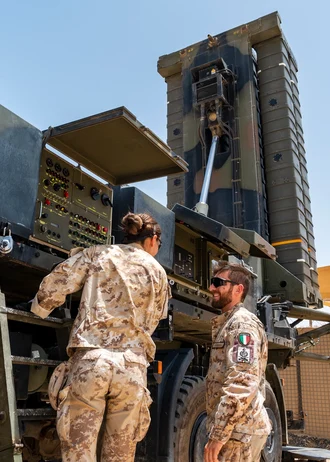
No contract, no named system and no Turkish company was attached to the signing itself. But Turkish outlets reporting on the roadmap linked it to a more concrete and longer-running discussion: a possible Turkish purchase of the Franco-Italian SAMP/T air defence system and MBDA’s Meteor air-to-air missile, after Paris reportedly eased its long-standing reluctance to sell the system to Ankara. Neither the French nor Turkish government has confirmed a SAMP/T deal, and no figures or timelines have been disclosed, so this should be read as a negotiating track opened by the roadmap rather than a signed order.
From “brain dead” to a standing dialogue
The reset is notable mainly because of where the relationship has been. Franco-Turkish military ties collapsed in 2020 over Libya, where Ankara backed the UN-recognised Government of National Accord in Tripoli while Paris leaned toward eastern commander Khalifa Haftar. A June 2020 incident in which a French frigate operating under NATO command said Turkish warships interfered with its attempt to inspect a cargo vessel suspected of running arms to Libya pushed the dispute into NATO itself; France suspended participation in the alliance’s Sea Guardian mission in response. Eastern Mediterranean drilling rights disputes and a blunt public exchange between Presidents Erdoğan and Macron over Syria policy kept relations cold through 2021.
A roadmap built around regular senior-level contact, rather than another one-off ministerial visit, is a different kind of commitment, even if it carries no financial figure. It also lands as Greece — a frequent subject of Turkish-French friction in the Aegean — continues to expand its own French arms relationship, having taken delivery of Rafale fighters and the first of four French-built FDI frigates for the Hellenic Navy this year. Ankara’s outreach to Paris does not reverse that dynamic, but it does give Türkiye a seat at the same table.
Why it matters for Turkish industry
For a defence-industrial base that has spent the past five years racing to cut dependence on foreign suppliers — most visibly by swapping French Microturbo engines out of the SOM cruise missile for an indigenous turbojet — renewed French interest might look counterintuitive. In practice, the two tracks are compatible. Türkiye has continued building out its own layered air defence architecture, Çelik Kubbe, and in October alone ASELSAN disclosed a record €2.46 billion contract to expand it. A SAMP/T or Meteor purchase would not replace that programme; it would most likely plug specific gaps — extended-range interception or air-to-air missile stocks — the same way Türkiye has used imported systems like Russia’s S-400 or, going back further, the French-Italian Eurosam consortium’s own earlier LORAMIDS-era talks with ASELSAN and ROKETSAN, as a bridge while domestic programmes such as SİPER and TAYFUN mature.
There is also a NATO dimension that both governments have an interest in emphasising. Türkiye remains outside France’s Future Combat Air System and has no path back into the F-35 programme it was removed from in 2019. A working defence-industrial channel with Paris — the only EU state with a nuclear-armed military and a serious combat-aircraft export business — gives Ankara a second European door at a moment when Washington’s defence relationship with Türkiye remains tangled in S-400-related sanctions questions.
What to watch
The roadmap commits both sides to little beyond talking on a schedule. The real test is whether the first formal meeting, expected before the end of the year, produces anything with a number attached — a SAMP/T letter of intent, a Meteor integration study, or a joint venture structure comparable to the ones Türkiye has built with Gulf and Central Asian partners. Until then, the agreement is best read as what Turkish officials have called it: an institutional framework, not a contract.