Kale Paid for Two of Its Three Missile Turbojets Itself

Most Turkish defence stories about engines are stories about waiting. The KAAN fighter waits for a domestic powerplant, the ALTAY tank waited for a Turkish diesel, and the programmes that did get engines usually got them through a state contract. Kale Group’s engine arm tells a slightly different story. According to the company, two of the three turbojets it now builds for Turkish cruise missiles were paid for out of its own pocket.
That claim needs careful handling, because the first of the three, the KTJ-3200, was not a private gamble at all. It started life under a Presidency of Defence Industries (SSB) contract. The later engines are where Kale’s own money enters the picture, and that is what makes this corner of Kale defence aviation worth a closer look.
Who Is Behind Kale’s Jet Engines?
Kale Group is a diversified Istanbul industrial conglomerate that began in building materials and moved into robotics, energy, and defence and aerospace. Its aviation side is better known abroad for something else: since 2010 it has run a joint venture with Pratt & Whitney, Kale Pratt & Whitney, in which Kale holds 51 percent. The venture started with hardware for the F135 engine of the F-35 and was expected to widen to parts for the F100, F117 and F119.
The engine design business is a separate operation. Kale Arge, set up in 2013 as a Kale Group subsidiary according to Turkish trade press, develops gas turbines and now trades publicly as Kale Jet Engines (Kale Jet Motorları). Its development and test centre sits in Tuzla, Istanbul, with an office in the Istanbul Technopark and a branch in Ankara. In an earlier interview its general manager, Cüneyt Kenger, put the staff at about 110, mostly young engineers. A 2024 interview put the headcount at 240, double the figure from the year before.
The two businesses share a name and a boardroom, not a product line. The Pratt & Whitney venture makes metal parts for engines designed elsewhere, and Kale is also described in trade reporting as a supplier to Boeing, Northrop Grumman and Spirit AeroSystems. The jet engine arm designs complete engines. That difference is why the missile turbojets are the more interesting story for Türkiye’s goal of reducing foreign dependence, a theme we examine in our piece on how independent Türkiye’s defence production really is.
| Item | Detail |
|---|---|
| Parent | Kale Group, Istanbul |
| Engine arm | Kale Arge, branded Kale Jet Engines (Kale Jet Motorları) |
| Established | 2013, reported |
| Test and development centre | Tuzla, Istanbul |
| Engines in production | KTJ-1750, KTJ-3200, KTJ-3700 turbojets |
| Main customer | Roketsan |
| Related aerospace business | Kale Pratt & Whitney (Kale 51 percent, founded 2010) |
Why Did Türkiye Need a Missile Turbojet of Its Own?
A cruise missile is a short-lived aircraft. It needs a small, light, cheap engine that runs for tens of minutes, not thousands of hours. Türkiye’s first long-range cruise missiles, SOM and ATMACA, flew on foreign powerplants. Reporting on the KTJ-3200 describes it as a replacement for the French Microturbo TRI-40 after French sales to Türkiye were restricted. The engine is described as produced domestically and without ITAR restrictions, which matters for any later export.
The SSB signed the KTJ-3200 development contract on 22 February 2012, according to Turkish defence press. The plan called for four years. The engine took about nine, and was accepted in mid-2021, by that reporting. A cost of roughly $50 million has been reported in the press for design and development, with SSB support. The first KTJ-3200 batch reached Roketsan in November 2020, based on public reporting, and serial production followed.
Those long years were not wasted effort. Kale says it developed the critical subsystems at home, including bearings, electronic control units, fuel control, pyrotechnic igniters and the built-in alternator, parts that had been hard to buy abroad. Whatever the delay cost the programme, it left Kale with a team and a test infrastructure that the later engines could build on. For the wider picture of who makes what, see our guide to Türkiye’s aircraft engine makers.
What Does the KTJ-3200 Actually Do?
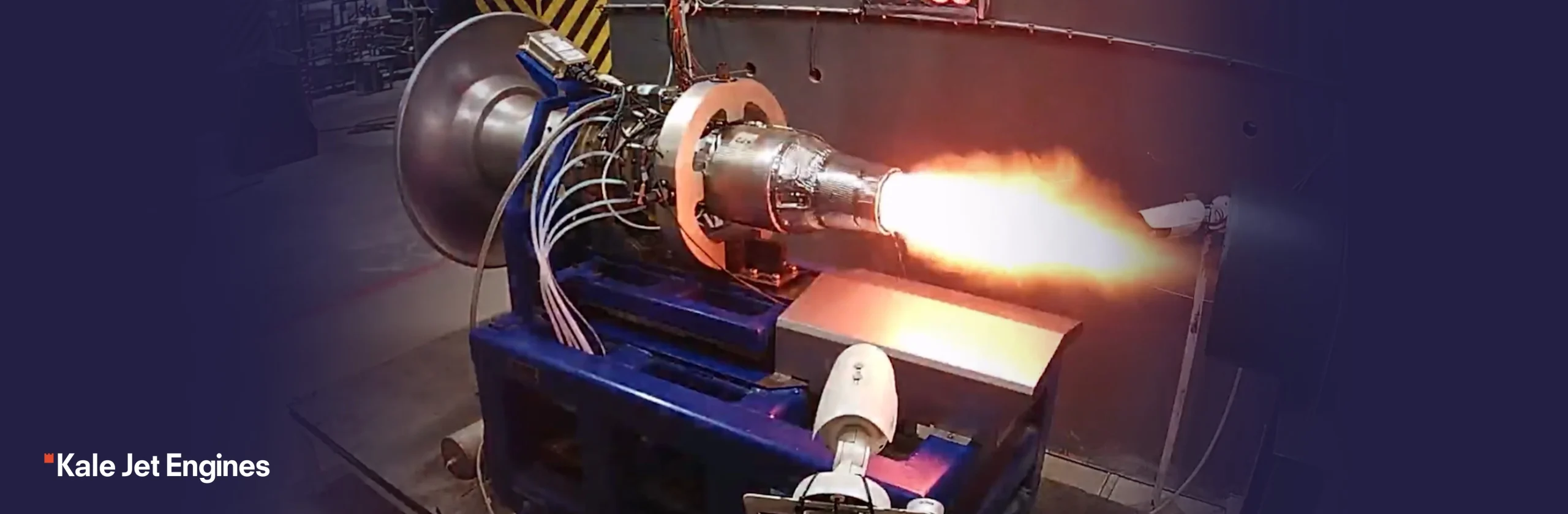
The KTJ-3200 is a single-spool turbojet. Kale’s own published figures give a thrust of up to 3,200 newtons, a length of 630 mm, a diameter of 330 mm and a weight of about 50 kg. It uses a four-stage axial compressor with a pressure ratio close to six, an annular combustor and a single-stage turbine, according to Turkish defence press. It can air-start by windmilling, and it was qualified for altitudes up to 5 km and speeds to Mach 0.95, per the same reports.
Two versions have gone into service. The KTJ-3200S powers the air-launched SOM missile, the story of which is covered in our SOM cruise missile article, and the KTJ-3200A powers the ATMACA anti-ship missile. A first ATMACA test launch with the engine installed took place on 10 March 2024, according to reporting.
Which Engines Did Kale Fund Itself?
This is where the company’s story departs from the usual state-funded model. Kale says the KTJ-1750 and KTJ-3700 were developed fully with its own resources. The KTJ-1750 effort began in March 2021 and, by Kale’s account, went from design to captive test in 15 months. Both claims come from the company and from trade-press coverage of its statements, and no figure for the money involved has been published.
| Engine | Thrust | Missile | Funding, as reported |
|---|---|---|---|
| KTJ-1750 | 1,750 N | Çakır | Kale’s own resources |
| KTJ-3200 | 3,200 N | SOM (S version), ATMACA (A version) | SSB contract, 2012 |
| KTJ-3700 | 3,700 N | Kara Atmaca | Kale’s own resources |
The small KTJ-1750 flies in Roketsan’s Çakır family. It was tested on a missile in May 2023, and Kenger described it as an engine with unusual thrust for its size, letting designers shrink the missile and its drag. Roketsan has since test-fired Çakır from a ground launcher.
The KTJ-3700 sits at the top of the family. Its first engine was delivered in January 2024, according to a Turkish defence magazine interview, and it powers the KARA ATMACA land-attack cruise missile. Kale describes it as the highest-thrust engine in its class.
How Fast Can Kale Build Them?
Output has climbed quickly. In the 2024 interview Kenger said the company had gone from two engines a week the previous year to seven. Production is run as an integration job: Kale Arge manages the supply chain, assembly and testing, while Kale’s aviation affiliate makes roughly 70 percent of components, with other Turkish suppliers covering the rest, according to the same interview. The earlier interview cited a target of 150 engines a year, with spare capacity beyond it.
Testing capacity is growing too. Kale operates what it describes as Türkiye’s only altitude test facility for turbojets, able to simulate 5,000 metres. A renovation planned for late 2024 was meant to raise that to 10,000 metres and add a second test chamber. We could not confirm from public sources whether that work finished on schedule.
Is Kale Selling Engines Abroad?
Yes, on a small scale so far. On 4 April 2025, at the LAAD defence fair in Brazil, Kale signed a KTJ-3200 supply deal with Brazil’s SIATT, for the MANSUP anti-ship missile, as reported by Turkish media. Local outlets called it Türkiye’s first jet engine export. No contract value has been published.
At home, the commercial relationship with Roketsan was formalised on 1 August 2025 at IDEF in Istanbul. Roketsan and Kale signed an agreement to power Atmaca, SOM, Kara Atmaca and Çakır with the KTJ-3200A, KTJ-3200S, KTJ-3700 and KTJ-1750 respectively. The value was not disclosed.
Is a Turbofan Next?
Kale has said it began turbofan development in 2024, aimed at drones and at missiles that need more range and endurance than a turbojet gives. Kenger has described a planned engine stronger than the KTJ-3200 with a longer service life. No thrust figure, first-run date or customer has been confirmed publicly, so treat the timeline as open.
The gap between a missile turbojet and a fighter-class engine is wide. Türkiye’s larger programmes are covered elsewhere, including the question of whether three new turbofans can free its combat aircraft from foreign engines. What Kale has shown is narrower but real: a private group can carry a small engine from design to captive test in about 15 months on its own money, and a state customer will then buy it in volume. Whether that approach scales to larger engines is the question the turbofan project will answer.