How a Turkish Medium Tank Became the Indonesian Army’s Harimau

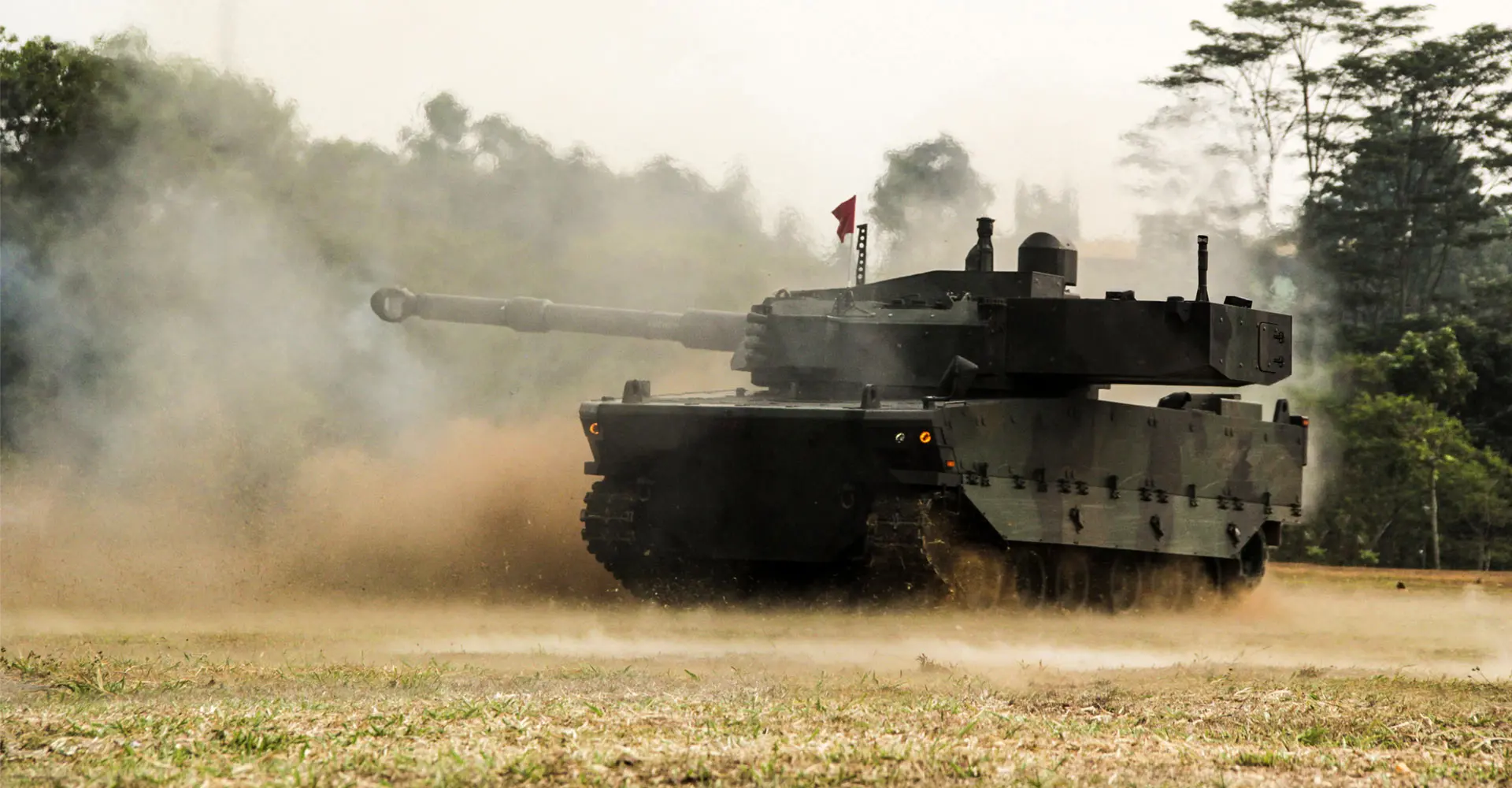
The Indonesian Army calls it Harimau, the Indonesian word for tiger. FNSS, the Ankara-based tracked vehicle maker, calls it KAPLAN MT, and kaplan means tiger in Turkish. The name changes at the border, but the vehicle is the same medium-weight tank, and it is the first tank-class platform Türkiye has sold abroad.
The quantities are small. The significance is not. Harimau is a clear example of how Turkish firms now pair an export sale with local assembly, and it set the template for the tracked armoured personnel carrier that FNSS and PT Pindad are building next.
| Item | Detail |
|---|---|
| Designation | KAPLAN MT (Türkiye), Harimau (Indonesia) |
| Developers | FNSS (Türkiye) and PT Pindad (Indonesia) |
| Class | Medium-weight tank, tracked |
| Crew | 3 |
| Main gun | 105 mm high-pressure gun in a Cockerill 3105 two-man turret |
| Secondary armament | 7.62 mm coaxial machine gun |
| Protection | STANAG 4569 Level 4 (reported), upgradeable with add-on armour |
| Maximum speed | Around 70 km/h (reported) |
| Range | Around 450 km (reported) |
| Power-to-weight | At least 20 hp per tonne (reported) |
| Initial order | 18 tanks (10 built in Türkiye, 8 completed by Pindad) |
Where Did the KAPLAN MT Come From?
The project began as a government-to-government cooperation agreement between Indonesia and Türkiye in May 2015. The goal was a medium tank, in the 30 to 35 tonne bracket according to published accounts, that could carry a 105 mm gun and keep its mobility in tropical terrain.
Pindad, the state-owned manufacturer in Bandung, already built the Anoa 6×6 armoured vehicle and a range of small arms, and it wanted tracked-vehicle experience. FNSS brought design experience from the PARS 8×8 and ACV-15 families.
A first model was shown at Indo Defence in November 2016, and a prototype followed at IDEF in Istanbul in May 2017. According to published accounts, the tank passed qualification testing in September 2018. FNSS has publicly described the effort as the first project under the Türkiye-Indonesia defence industry cooperation agreements.
What Did Indonesia Actually Order?
A production agreement for 18 vehicles was signed in 2019. Accounts differ on the exact month it took effect, so the safest summary is that it was signed at IDEF in May 2019 and entered into force later that year. Army Technology also reports an earlier letter of intent for up to 20 tanks valued at about $135 million. Treat that as a reported estimate, not a confirmed contract value.
The split is the interesting part. Ten tanks were built at FNSS in Türkiye. The other eight hulls were shipped to Indonesia without turrets and completed by Pindad. FNSS delivered production support and tool kits to Pindad in 2021 so the Bandung line could take over.
At the 2022 completion ceremony, Türkiye’s Presidency of Defence Industries (SSB) said both governments backed developing a local turret, with the aim of producing Harimau in Indonesia with its own intellectual property and components. A locally designed turret has not yet appeared in service.
How Is the Harimau Built and Armed?
The tank carries a Belgian Cockerill 3105 turret from CMI Defence with a 105 mm rifled high-pressure gun. The gun fires NATO-standard 105 mm ammunition and, per Army Technology, can engage targets out to about 10 km with suitable rounds. A 7.62 mm machine gun sits alongside it.
Gunner and commander have third-generation thermal sights. Army Technology lists the ASELSAN PULAT active protection system, laser warning and smoke grenade dischargers among the protection options, but public sources do not confirm which of these Indonesia’s tanks actually carry.
Mobility is the selling point. The published figures are a top speed of 70 km/h, a range of 450 km and a power-to-weight ratio of at least 20 hp per tonne. Army Technology adds an operating temperature band of -32 to 55 degrees Celsius, 60 percent gradients and 2 m trench crossing. Wikipedia lists a Caterpillar C13 diesel of about 711 hp; that engine detail comes from a secondary source and should be read with caution.
The imported turret is the obvious limit. A share of the tank’s firepower is Belgian, which is why the local-turret goal was stated openly in 2022.
When Did the Tanks Reach the Indonesian Army?
The timeline runs in three steps.
- 15 March 2022. FNSS marked completion of the first batch of 10 chassis at its facility in Türkiye, with eight turretless hulls to follow to Indonesia.
- March 2024. The Indonesian Army inducted Harimau tanks into its 13th Cavalry Battalion on 19 March. One report puts the number at nine in that ceremony, while other outlets describe 10 handed over that month. The discrepancy is not resolved in the sources checked.
- 2 October 2024. A batch of eight Pindad-assembled tanks was handed over during a large army vehicle ceremony, completing the initial 18, according to Army Recognition.
Janes states that deliveries under the programme were completed in October 2024. The same month, FNSS and Pindad signed the next agreement in the same family.
What Does Pindad Actually Do on the Programme?
Pindad is not a bystander. Its Bandung facility took the eight turretless hulls from Türkiye, fitted the turrets, then ran testing and adjustments to suit Indonesian Army requirements. Firing trials at the army’s infantry training centre in February 2022 were part of the same acceptance chain, according to Wikipedia’s account of the programme.
The work is closer to final integration than to full local manufacture. Hulls, tooling and technical support came from FNSS, and the turret came from Belgium. What Pindad gained is a trained workforce, a tooled line and, importantly, the right to say the tank was built at home. That is the logic behind the October 2024 APC agreement, which asks Pindad to build a vehicle from the start rather than finish someone else’s hull.
Why Would Indonesia Want a Medium Tank at All?
This part is analysis, not a published army statement. Indonesia is an archipelago of thousands of islands, and heavy main battle tanks are hard to move between them and hard to support on soft ground. A 30 to 35 tonne vehicle with a 105 mm gun is easier to ship, lighter on infrastructure and cheaper to run. It gives cavalry units direct-fire support for infantry without the logistics tail of a 60-tonne tank.
FNSS makes the same argument in its own marketing, pointing to tropical operating areas and forested terrain. The trade-off is protection and firepower. A Level 4 ballistic rating and a 105 mm gun will not match a modern heavy tank, and the design is not meant to.
Is There More Coming Under the Harimau Name?
Not another tank order, at least none that has been announced. On 22 October 2024, FNSS and Pindad signed a development agreement for a tracked armoured personnel carrier, KAPLAN APC, also called Harimau APC in Indonesia. It shares the tank’s chassis family and is described as a roughly 30-tonne vehicle.
Indonesia procured two evaluation vehicles. One is being built by FNSS in Türkiye, the other goes to Bandung for local assembly. A mock-up appeared at Indo Defence in June 2025, and Janes reports the army plans to evaluate the first unit in 2026 before any formal procurement. Our report on the pre-delivery tests of the first Kaplan APC covers where that stands.
FNSS also lists a fire support and reconnaissance vehicle, KAPLAN-10 and KAPLAN Hybrid on its product pages. Those are catalogue entries, not confirmed orders.
Why Does Harimau Matter for Turkish Exports?
Türkiye’s own main battle tank, the ALTAY, has spent years working through engine and series-production questions. Harimau shows a different route: a lighter, simpler tank sold to a partner that wanted local content rather than an off-the-shelf import.
That approach fits a wider pattern in Turkish defence sales across Southeast Asia and in the way Turkish firms build or assemble equipment abroad. Buyers often cite delivery speed and price when they look at Turkish armoured vehicles. Harimau adds technology transfer to that list.
For FNSS, the programme sits alongside a longer export record covered in the company’s profile and export history.
The honest caveat is scale. Eighteen tanks do not change the balance of a large army. Whether Harimau grows into a bigger fleet, or mainly proves a co-production model that the APC will carry forward, is not answered by any published Indonesian procurement plan.