A Small Ankara Firm Is Teaching Helicopters to Fly Without Pilots

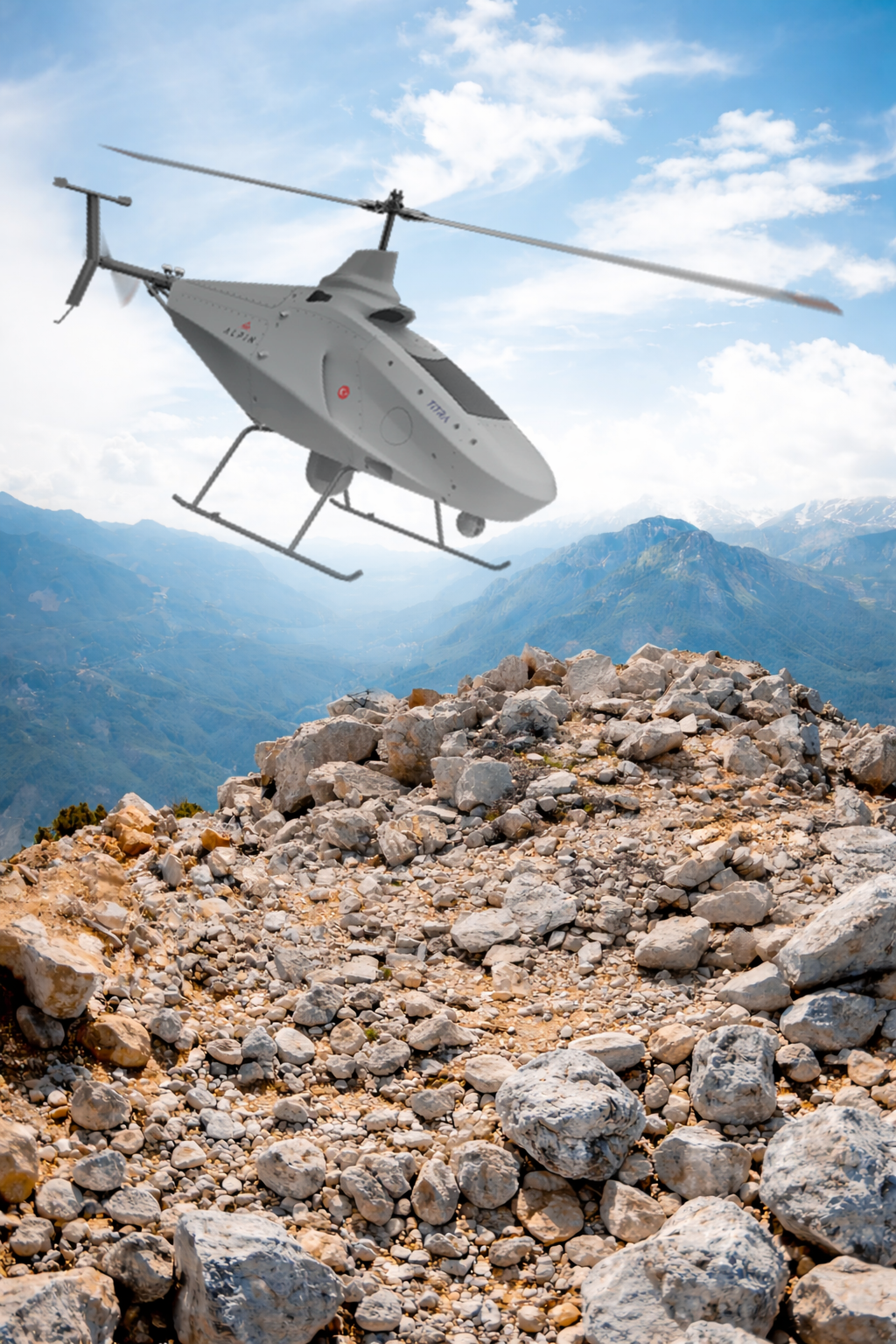
Most Turkish drone stories start with a fixed-wing airframe and a catapult or a runway. Titra Technology started somewhere else. The Ankara company took a helicopter built for people, removed the people, and made the aircraft fly itself. That choice shaped everything it sells today, from a 200 kilogram cargo helicopter to an electric mini helicopter that can carry a guided munition.
The firm is small by defence-industry standards, but it has been busy. It showed four products at SAHA EXPO 2024, took its unmanned helicopter to Dallas in 2025, and has reportedly told the trade press that 2026 is its serial production year. In September 2026 its mini helicopter was flying mission scenarios at a NATO-linked exercise off Portugal.
What Is Titra Technology?
Titra is the defence and unmanned aviation arm of Ankara-based Pasifik Teknoloji. According to Defence Turkey, the company was merged with Pasifik Teknoloji in 2024 and works from a 6,500 square metre facility in the Ankara Aerospace and Aviation Organized Industrial Zone. The same report cites a workforce of 250, about 75 percent of them engineers, plus an R&D unit at Kayseri Technokent and two hangars in the Kalecik special flight zone. Other profiles say the company was founded in 2020; the company’s own site does not spell out the date, so treat that figure as reported.
| Item | Detail |
|---|---|
| Headquarters | Ankara, Türkiye (Ankara Aerospace and Aviation OSB) |
| Parent | Pasifik Teknoloji |
| Staff (reported) | About 250, roughly 75% engineers |
| Core business | Rotary-wing and other unmanned aircraft, loitering munitions, FPV drones, navigation systems |
| Main products | ALPİN, DUMRUL, DELİ, DELİ-2, MERKÜT, SEYYAH |
| Overseas presence (reported) | US and Dubai offices, TİTRA Europa in Romania |
| Website | titra.com.tr |
How Do You Turn a Manned Helicopter Into a Drone?
ALPİN is the answer Titra gave first. As described in trade coverage, the company replaced the control linkages and interfaces of a two-seat helicopter with servo actuators driven by its own autopilot. The cockpit work that a pilot does by hand becomes software. Press a button and the aircraft lifts off vertically; press another and it lands.
The appeal is practical. A proven airframe already has a certified flight envelope, known maintenance routines and a spare-parts chain. Titra did not have to invent a new rotorcraft and then prove it could fly. It had to prove that its autopilot could fly an existing one safely.
Reported figures for the ALPİN family, drawn from Army Recognition’s Verticon 2025 report and Defence Turkey’s later interview coverage, include:
- Payload above 200 kg
- Endurance of up to nine hours with an extended fuel tank
- Service ceiling of about 21,000 feet
- Control radius of 200 km
- Maximum speed of about 203 km/h, with a navigation speed of about 107 km/h
- A 130-horsepower powerplant and a 175-litre gasoline tank
- An optional parachute system
Defence Turkey also reports a localisation rate of 80 to 85 percent for the Alpin-2 version, along with anti-jam GNSS, visual navigation, real-time mission planning, IFF, SATCOM and VHF links. Two units were reportedly delivered in 2023, with four more targeted by the end of 2025. Those numbers come from the company’s statements to the press, not from a procurement announcement, so the end customer is not identified here.
Sensor options reported for the aircraft include electro-optical and infrared payloads, synthetic aperture radar and communication relays. That makes it useful for intelligence and surveillance, logistics, search and rescue, agricultural monitoring and artillery targeting support. Cargo is the part that matters most for a helicopter. A drone that carries 200 kg, lands in a small clearing and needs no pilot is a different tool from a surveillance quadcopter.
Why Does the SEYYAH Navigation System Matter?
An unmanned helicopter that depends on GPS is an unmanned helicopter that goes home, or falls, when someone jams GPS. Titra’s answer is SEYYAH, a visual navigation system described by Defence Turkey as providing high-accuracy positioning in GPS-denied environments. The company says it runs on different platforms without software changes.
The idea is not unique to Titra. Several Turkish firms now sell some form of jam-resistant navigation, and the broader electronic warfare picture is covered in our piece on Türkiye’s homegrown jammers. What stands out here is that the same navigation module is pitched across ALPİN, the DELİ loitering munitions and other airframes. If that holds up in service, it spreads the development cost across the whole product line.
What Is DUMRUL and Why Did It Go to REPMUS?
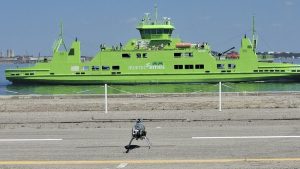
DUMRUL is the small end of the catalogue. It is an electrically powered helicopter with a takeoff weight of 17 to 18 kg. At SAHA EXPO 2024 Titra listed a payload of 8 kg and a control range of 60 km, with endurance of more than 30 minutes. Weapon options shown at the fair were dual 81 mm mortar munitions, a 40 mm grenade launcher or ROKETSAN’s METE guided munition. Later reporting mentions endurance above 90 minutes with a 2 kg payload; that figure is a company claim and depends on the load, so the two numbers should not be read as contradictory.
Electric propulsion makes DUMRUL quiet. For a small armed helicopter that matters more than speed: a unit can hover over a position and be heard by few people. It also means short sorties and a lot of battery logistics.
In September 2026 Titra sent DUMRUL to REPMUS, the multinational maritime exercise held off Portugal. The company said the helicopter began flying mission scenarios on 21 September. We covered the deployment in detail in our report on DUMRUL’s REPMUS debut. For a company of this size, an exercise with multiple allied participants is one of the few places where foreign procurement staff can see a system work alongside others and share sensor data.
What Else Does Titra Build?
The rotary-wing line gets the attention, but the company shows three other product families.
DELİ and DELİ-2 loitering munitions
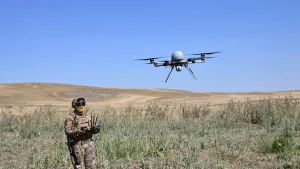
The hand-launched DELİ Mini weighs 8 kg at takeoff, carries a 2 kg warhead and has a stated operating range of 35 km with 30 minutes of endurance. The larger DELİ-2 reaches 15 kg at takeoff, with a 3.8 kg warhead, a 50 km range and 45 minutes in the air. It comes in an inertial-guidance version and an electro-optical version with a nose-mounted gimbal camera. Titra says the DELİ-2 can operate without GNSS using visual navigation and laser sensors. For wider context on this class of weapon see our profile of KARGU, the system that put Turkish loitering munitions on the export map.
MERKÜT FPV
MERKÜT is a first-person-view attack drone flown by a pilot who watches the target directly. It has low-light imaging and is described as effective under electronic warfare. This is where the production ambitions are loudest. Defence Turkey reports a plan to build 500 units a month, with capacity that could expand to 5,000 a month, and calls 2025 the inventory year and 2026 the serial production year. Those are intentions, not delivered numbers.
Retrofit programmes
The same coverage mentions a conversion effort for UH-1 and AB-206 helicopters, with a 36-month timeline and a payload above 1,000 kg. That would take the ALPİN idea, converting an existing helicopter, to a much heavier class. It is a long-range plan and no customer has been named.
Where Does Titra Fit Among Turkish Drone Makers?
Baykar and Turkish Aerospace dominate the export conversation, and our overview of who else builds Türkiye’s drones shows how crowded the second tier is. Titra differs in a few ways. It leans on rotorcraft while most rivals build fixed-wing aircraft. It sells small and mid-sized helicopters, not just one platform. And it is building an international footprint early, with offices in the US and Dubai and a Romanian entity aimed at Europe, according to Defence Turkey.
The company’s US push was visible at Verticon 2025 in Dallas, held from 10 to 13 March, which drew more than 600 companies. Army Recognition quotes co-founder and board member Muhammed Selman Dönmez in its coverage. The stated goal is to establish Titra as a UAV maker in international markets.
For comparison, Türkiye’s manned helicopter work is at a very different scale. The T625 GÖKBEY is a state-backed programme with a type certificate. Titra’s approach is the opposite: modify what exists, move quickly and sell the result as an unmanned system.
What Is Still Unproven?
Most of what is publicly known about Titra comes from the company itself, through exhibition material and interviews with trade magazines. No armed forces customer for ALPİN has been publicly named in the sources used for this report. The REPMUS appearance shows DUMRUL can fly within an exercise, but exercise participation is not a contract.
Questions worth watching in 2026: whether the MERKÜT production lines reach their stated rate, whether SEYYAH holds up against real jamming in operational conditions, and whether a Turkish or foreign customer announces an ALPİN order. Until then, Titra is a company with a distinctive approach, a small fleet and a lot of plans.