Fırtına Howitzer Keeps Turkish Artillery in the First League

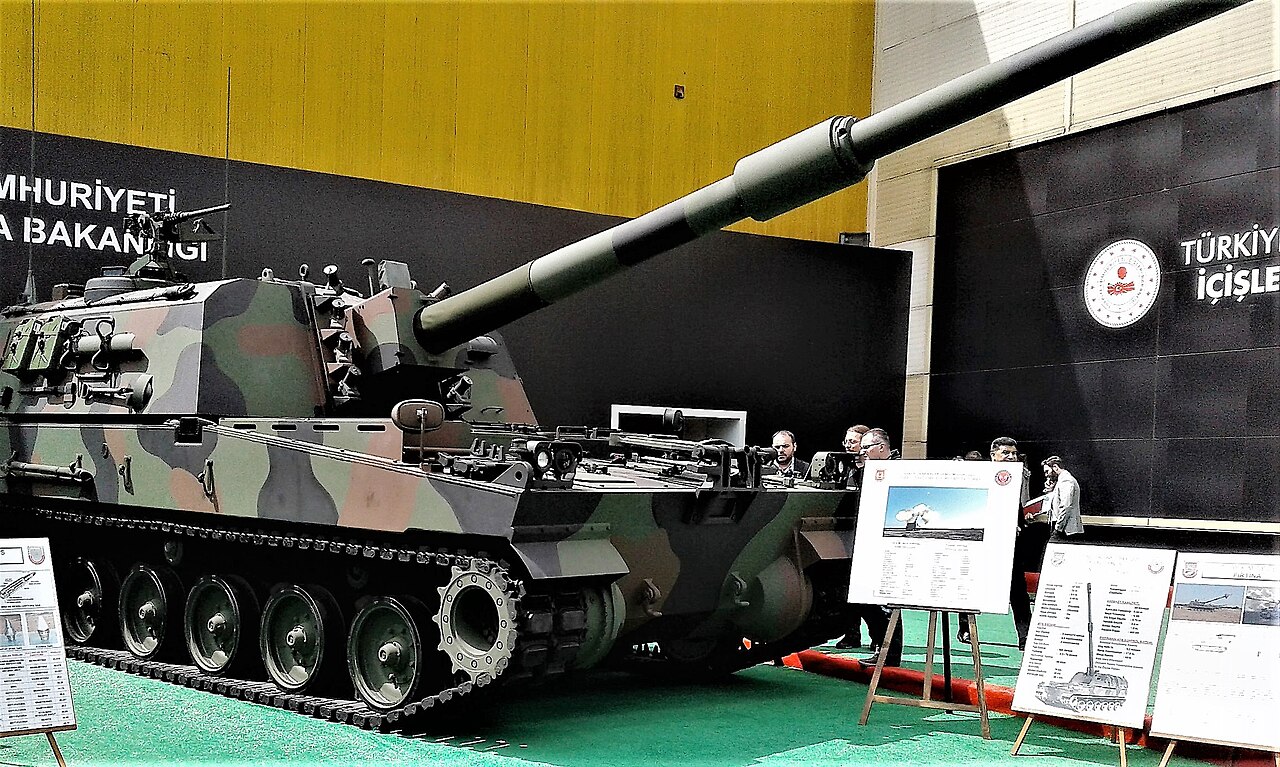
When Turkish 155 mm shells landed on targets in northern Syria in recent years, the gun behind them was a South Korean design wearing a Turkish turret. The T-155 Fırtına is the backbone of Türkiye’s tracked artillery, and it is about to change in a way that matters beyond the Turkish Army: the engine.
| Item | Detail |
|---|---|
| Designation | T-155 Fırtına (“Storm”) |
| Type | 155 mm / 52-calibre tracked self-propelled howitzer |
| Basis | Licensed from the South Korean K9 Thunder (Samsung Techwin) |
| Crew | 5 |
| Weight | About 47 tonnes (F1) |
| Engine (F1) | MTU MT881Ka-500 diesel, 735 kW (about 1,000 hp) |
| Top speed | 65 km/h |
| Operational range | About 360 km |
| Firing range | Roughly 18 km to 41 km depending on ammunition |
| Operators | Türkiye; Azerbaijan (reported order); Libya (reported transfers) |
Is the Fırtına really a Turkish howitzer or a Korean one?
Both, and the honest answer is in the proportions. The platform descends from the K9 Thunder, developed for the South Korean Army by Samsung Techwin. Türkiye licensed it in the early 2000s, and the first few vehicles were reportedly built in South Korea while the bulk of the fleet was assembled at home.
The Turkish share is not cosmetic. The turret is widely described as an original Turkish design that raises the ready-round magazine from 24 to 30 shells and trims hull stowage from 24 to 18. The inertial navigation system, parts of the chassis, radios and the fire-control system were developed in Türkiye, with ASELSAN supplying much of the electronics.
What stayed foreign was the powertrain: a German-designed MTU engine, built under licence in South Korea. That detail decided the Fırtına’s export story for two decades.
How many Fırtınas does the Turkish Army have?
Deliveries of the first-generation F1 ran from 2005 to around 2010, and open sources put the count at about 280 vehicles. The original plan reportedly envisioned 350, with roughly 70 set aside for export. Production of the follow-on configuration, the Fırtına II, began around 2019.
The Mechanical and Chemical Industry Corporation (MKE), the state arsenal that also makes the ammunition, is the programme’s core Turkish stakeholder. Our profile of MKE covers how it is stretching from shell production to whole artillery systems and plants abroad.
What changes in the Fırtına II?
The F1 was designed in the 1990s and showed it in places: a largely manual ammunition routine and an imported engine. The Fırtına II is the update. Reports indicate 140 vehicles on order with a domestic powerpack, after an earlier batch of about 40 built with an imported American engine.
The domestic option is BMC Power’s 1,000 hp diesel and transmission group, presented under the UTKU name. BMC delivered a batch of six new-generation Fırtınas to the Turkish Armed Forces at its Arifiye facility in January, according to company and Turkish press reports.
Other improvements attributed to the new standard include a modernised fire-control and ammunition-handling chain. Public detail is thin, and exact performance figures for the F2 have not been officially published in full, so treat claims about firing cadence with caution.
A hybrid-electric experimental variant, the E-Fırtına, has also been reported, using a large lithium battery pack. It sits closer to a technology demonstrator than a fielded product.
Where has the Fırtına been used in combat?
Turkish forces have used it in northern Iraq during Operation Sun in 2007 and 2008, and along the Syrian border from 2012. It supported the Jarabulus operation in 2016 and the Afrin operation in 2018, and, according to reports, operations around Aleppo in 2024.
A howitzer proves itself less in single shots than in tempo. The K9 family’s selling point is the ability to come into action within roughly half a minute and move on quickly, which is why counter-battery survivability is part of its pitch. The Poyraz ammunition resupply vehicle, carrying 96 shells, is meant to keep the guns fed.
Why did the Fırtına struggle to find export customers?
Because of the engine and the licence. A vehicle built on a licensed design with a third-country powerpack needs the approval of more than one government before it can be sold abroad. Azerbaijan was the most visible prospect, and reports mention an order of 36 vehicles, but the engine question has been cited as the obstacle to delivery.
Türkiye has also been reported to have considered supplying the howitzer to Ukraine, although no transfer has been confirmed. Libya reportedly received a handful of vehicles during its civil war, a transfer that came with its own controversy.
A fully domestic powerpack removes the biggest licensing tangle. It is the same logic behind other Turkish localisation pushes, from the ALTAY tank engine to the wider question of how independent Türkiye really is in defence production. Buyers also care about how deals are financed and supported, a topic we explain in how countries buy Turkish weapons.
Where does the Fırtına fit next to MKE’s other guns?
Türkiye is now building an artillery family rather than one big gun. Fırtına covers the heavy tracked role. Lighter, more deployable options sit below it. MKE’s 105 mm BORAN and the URAN mobile howitzer are aimed at customers that need mobility and a smaller logistics footprint, as covered in our report on the URAN mobile howitzer and BORAN exports.
Next to rocket systems and loitering munitions, tube artillery is cheaper per round, and the Ukraine war revived demand for 155 mm capacity across NATO. A Fırtına that can be exported without a licence veto would put Türkiye in a market where supply of NATO-standard shells and guns is currently tight. Whether customers line up will depend on price, delivery slots and a proven F2 production rhythm.
For now, the practical milestone to watch is simple: steady deliveries of the domestic-engine Fırtına II to the Army, and the first export contract signed under the new configuration.