
MUGEM: Türkiye’s Aircraft Carrier and Its Drone Air Wing

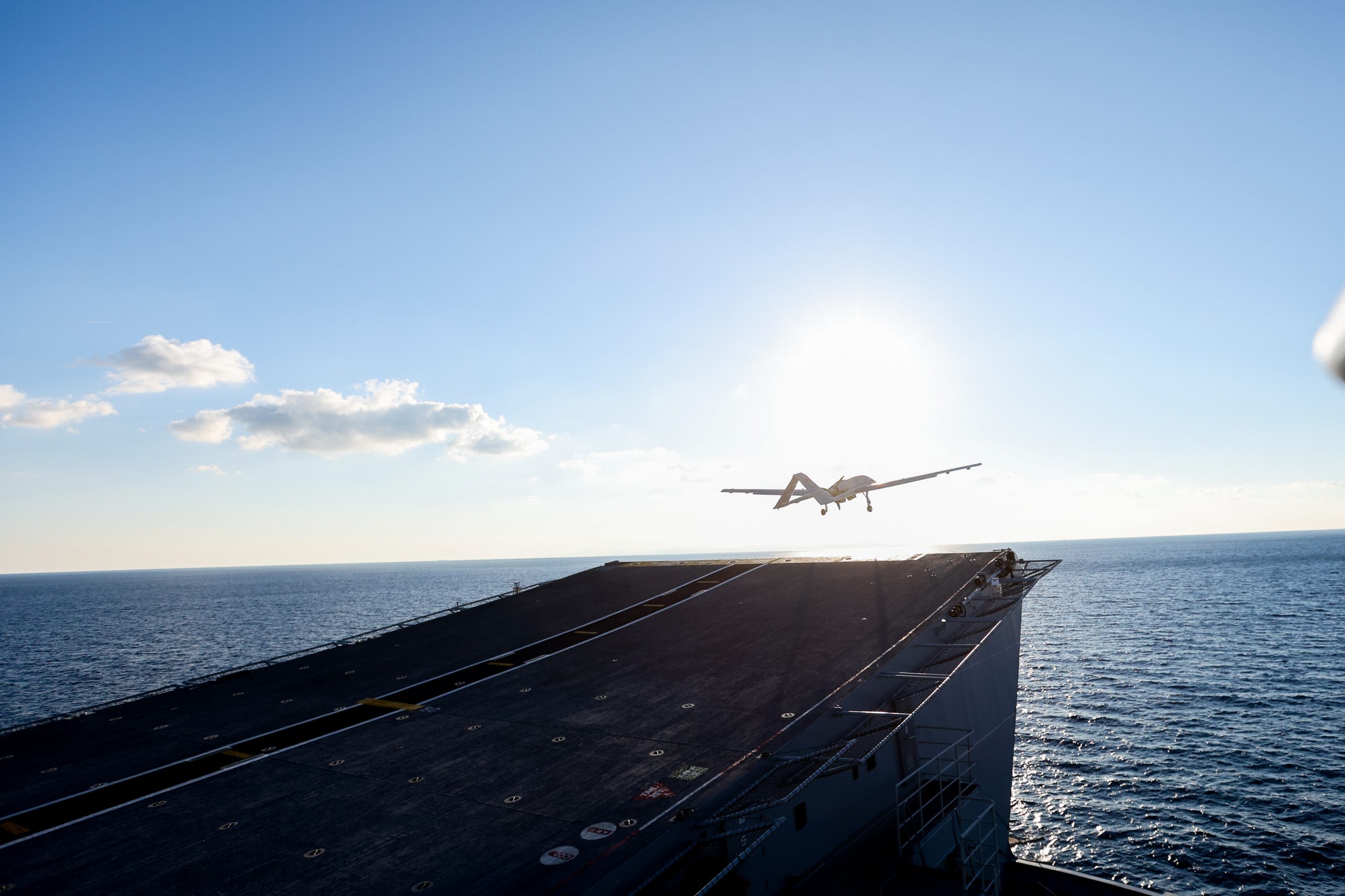
Türkiye does not have an aircraft carrier today. It is building one. The ship is called MUGEM, short for Milli Uçak Gemisi — National Aircraft Carrier — and steel was first cut for it at the Istanbul Naval Shipyard on 2 January 2025. The Turkish Naval Forces Commander, Admiral Ercüment Tatlıoğlu, said at the Teknofest Blue Homeland event on 23 August 2026 that the hull will be launched on 27 September 2027, with delivery to the fleet targeted for 2032. At roughly 285 metres and 60,000 tonnes it would be one of the largest warships built outside the United States and China this decade. The part that makes it genuinely unusual is not the tonnage. It is the air wing: of the four aircraft types the Navy has named for the deck, three are unmanned.
DEFENCETÜRKIYE DATA BOX
| Programme | MUGEM (Milli Uçak Gemisi), Turkish Naval Forces |
| Design authority | Design Project Office, Istanbul Naval Shipyard (Turkish design, not a licensed foreign hull) |
| Builder | Istanbul Naval Shipyard, with blocks from several Turkish yards |
| Category | STOBAR aircraft carrier, 12-degree ski jump, no catapult |
| Principal dimensions | 285 m length, 72 m maximum beam, 10.1 m draft, 60,000 tonnes |
| Propulsion | COGAG, four General Electric LM2500 gas turbines; 26+ knots, 10,000 nm at 14 knots |
| Air wing | 52 aircraft stated: naval HÜRJET (manned), Bayraktar KIZILELMA, ANKA-3, Bayraktar TB3 |
| Programme status | Under construction; preliminary design moving to detailed design during 2026 |
| Launch / delivery | Launch stated as 27 September 2027; delivery stated as 2032 |
| Cost | Not disclosed. No budget figure has been published by the Ministry of National Defence or the SSB |
| Export status | Not for export. No second hull has been contracted |
The deck came after the aircraft, not before it
Most carrier programmes start with an aeroplane. A navy decides it needs to fly a particular aircraft from the sea, and then commissions a ship big enough to do it. Türkiye’s sequence ran the other way round, and the reason is worth following, because it explains almost every design choice in MUGEM.
Türkiye’s first flat-deck ship, TCG Anadolu, was built at the Sedef Shipyard in Tuzla as a derivative of Navantia’s Juan Carlos I design and commissioned on 10 April 2023. It was drawn with a ski jump and with aircraft lifts sized for the short take-off and vertical landing F-35B. Türkiye’s removal from the F-35 programme in July 2019, after it took delivery of the Russian S-400 air-defence system, closed that door. The ship arrived with a ramp and no jet to launch off it.
What filled the gap was not a replacement fighter but a drone. On 19 November 2024 a Bayraktar TB3 took off from TCG Anadolu’s 12-degree ramp, flew for 46 minutes and landed back on the deck autonomously, without arresting gear. That made Türkiye the first operator to recover a fixed-wing aircraft onto a short deck without an arresting system, and it turned an amphibious assault ship into a working drone carrier. The pace has not slowed: in September 2026, during the Denizkurdu-I/2026 exercise, a TB3 dropped sonobuoys from the same deck in an anti-submarine trial and the new Bayraktar KALKAN flew from the ship for the first time.
Then the concept hit its ceiling. The heavier jet-powered Bayraktar KIZILELMA, at around 8.5 tonnes, had been promised for TCG Anadolu since the commissioning ceremony. In September 2025 Baykar chairman Selçuk Bayraktar stated publicly, in remarks reported by Cumhuriyet, that KIZILELMA can take off from TCG Anadolu but cannot land on it, because the ship has no arresting cables — and that the Navy was building a larger vessel for the aircraft. As of September 2026 no KIZILELMA take-off or landing from TCG Anadolu has been confirmed by any source.

That is the short version of why MUGEM exists. Türkiye has combat aircraft that need a deck before it has a deck that can take them. The ship is being built to catch up with an air wing that is already flying.
What is actually being built
MUGEM is a Turkish design. That distinction matters more than it sounds. TCG Anadolu was a licensed Spanish hull; the İstif-class frigates and the Reis-class submarines sit at different points on the same spectrum between building someone else’s drawings and drawing your own. MUGEM is being designed by the Design Project Office at the Istanbul Naval Shipyard, the yard President Erdoğan visited in February 2024 when the programme was first shown publicly. It is the most ambitious thing the Turkish naval shipbuilding base has attempted.
The published particulars, set out by Rear Admiral Hakan Uçar of the Naval Technical Command at the Combined Naval Event in Farnborough in May 2026 and reported by Naval News, are 285 metres length, 72 metres maximum beam, 10.1 metres draft and 60,000 tonnes displacement. Maximum speed is given as more than 26 knots, cruising speed 14 knots, and range 10,000 nautical miles at cruise. Complement is up to 2,500 including the air wing and embarked forces. Propulsion is a combined gas-turbine arrangement built around four General Electric LM2500 turbines, which the Navy intends to install before the hull is launched.
The ship is configured STOBAR — short take-off but arrested recovery — with a 12-degree ski jump, the same ramp angle TB3 has already used on TCG Anadolu. There is no catapult. Self-defence and area weapons are stated as a 32-cell MİDLAS vertical launching system, GÖKDENİZ close-in weapon systems and ASELSAN remote weapon stations, with the indigenous ADVENT combat management system tying the ship together. Construction is proceeding by mega-block, with sections fabricated at more than one Turkish yard and assembled at Istanbul.
The air wing: 52 aircraft, one of them manned
The Navy’s stated air wing is 52 aircraft of four types. Three are unmanned — KIZILELMA, the ANKA-3 flying wing and TB3 — and one is manned: a naval variant of the HÜRJET, work on which Turkish state broadcaster TRT Haber reported as having started in mid-May 2026. Naval News, reporting the same development, listed the changes under way as strengthened landing gear and structure, an arresting hook, and marinisation against salt and moisture. No carrier-trial date, arresting-hook test schedule or contract value has been announced.
Treat the 52-aircraft figure carefully when comparing it with other navies. China’s Fujian, commissioned on 5 November 2025 at 80,000–85,000 tonnes, is also credited with roughly 50 aircraft — but those are J-15T and J-35 fighters in the 25-tonne class. MUGEM’s stated complement is built from a 1.5-tonne class TB3, an 8.5-tonne KIZILELMA and a light trainer-derived jet. The same headline number describes a very different quantity of steel, fuel and ordnance in the air. This is not a criticism of the design; it is the design. But an outside analyst who reads “52 aircraft” as equivalent to a Western or Chinese air wing will draw the wrong conclusion.
WHY IT MATTERS
If MUGEM is delivered on the stated schedule, Türkiye becomes the first navy to commission a purpose-built carrier whose primary strike aircraft are unmanned. Every other carrier in service was designed around a crewed fighter and has had drones added later.
For governments watching Turkish industry, the signal is about the shipyards rather than the ship. Nobody is going to buy a 60,000-tonne carrier from Türkiye. But a state yard that can design and integrate one is a different commercial proposition from one that assembles licensed hulls — and that is the capability Turkish yards sell abroad.
Where MUGEM sits in the global carrier picture
Six navies operate fixed-wing carriers of 30,000 tonnes or more. MUGEM would slot into the upper-middle of that group by tonnage while sitting outside all of it by air wing. The table below compares published figures; the differences in launch method are the ones that shape what each ship can fly.
| Ship / programme | Navy | Displacement | Launch / recovery | Primary fixed-wing type | Status |
|---|---|---|---|---|---|
| MUGEM | Türkiye | 60,000 t | STOBAR, 12° ski jump | KIZILELMA / ANKA-3 / TB3 (unmanned) + naval HÜRJET | In build; delivery stated 2032 |
| Fujian | China | 80,000–85,000 t | CATOBAR, electromagnetic catapults | J-15T, J-35 | Commissioned 5 Nov 2025 |
| Queen Elizabeth class | United Kingdom | ~65,000 t | STOVL, ski jump | F-35B | In service |
| INS Vikrant | India | ~45,000 t | STOBAR, ski jump | MiG-29K | In service since 2022 |
| Charles de Gaulle | France | ~42,500 t | CATOBAR, steam catapults, nuclear | Rafale M | In service |
| Cavour | Italy | ~30,000 t | STOVL, ski jump | F-35B | In service |
| TCG Anadolu | Türkiye | ~27,000 t | Ski jump, no arresting gear | Bayraktar TB3 (unmanned) | In service since Apr 2023 |
Published displacement figures, full load where stated. DefenceTürkiye compilation.
Read across that table and the gap becomes obvious. STOVL ships buy flexibility from a vertical-landing aircraft that only two countries build. CATOBAR ships buy payload from catapults that only two countries build. STOBAR is the middle path, and it has historically meant accepting a fighter that launches light. Türkiye has chosen STOBAR and then filled the deck mostly with aircraft that weigh a fraction of a MiG-29K — which sidesteps the classic STOBAR payload penalty, at the cost of depending on unmanned types that have not yet made a single arrested landing at sea.
The dependency that has not gone away
MUGEM exists in part because an American export decision emptied TCG Anadolu’s deck. It is worth stating plainly that the replacement is not free of the same exposure.
The ship’s four LM2500 gas turbines are General Electric products. The naval HÜRJET, the only crewed aircraft named for the air wing, is powered by a single General Electric F404 — TUSAŞ gives the F404-GE-104 at 17,700 lb thrust for the land-based aircraft. KIZILELMA and ANKA-3 have flown on Ukrainian Ivchenko-Progress turbofans, the AI-25TLT and the afterburning AI-322F. Of the four named air-wing types, only TB3 — on TEI’s PD170 turbodiesel — is Turkish end to end. Envanter Medya keeps a Turkish-language technical file on the HÜRJET’s F404 engine and the indigenous replacement plan that sets out the thrust and supplier detail behind that dependency.
The mitigation is real and publicly documented rather than aspirational. TEI’s TF6000 turbofan first ran in March 2024 with pre-integration testing planned for 2027, and the larger TF10000 is in development on the same core; both are intended for exactly these unmanned types. But neither has flown, and the large-engine gap in Turkish aerospace remains the single most quoted limitation on the whole national programme. For the manned aircraft the exposure is a US export licence, which is the same mechanism covered in detail in our explainer on US export rules and Turkish defence products.
Eight years of decisions in one line
The programme is easier to judge as a sequence than as a specification sheet. Solid markers below have happened; hollow markers are stated plans.
What the programme still has to solve
Four gaps are visible in the public record, and none of them is hidden by the Navy.
No arrested landing has been demonstrated. STOBAR means arrested recovery. Neither KIZILELMA nor ANKA-3 nor a naval HÜRJET has made an arrested landing on a ship. The arresting hook on the naval HÜRJET is still a design change under way, and arresting-gear qualification is normally a multi-year test campaign in its own right. This is the single largest technical risk in the programme and it sits with the aircraft, not the hull.
No airborne early warning aircraft. Carriers depend on an organic radar picture from the air. Türkiye operates land-based Boeing 737 AEW&C aircraft, but there is no announced carrier-capable airborne early warning platform for MUGEM. Published sensor detail for the ship covers ÇAFRAD-family radar elements and the ADVENT combat system — shipborne sensors, not an airborne picket. Until something fills that role, MUGEM’s situational awareness is a ship’s horizon plus whatever its drones carry.
The escort is not in service either. A carrier is the centre of a task group, and the area air-defence ship for that group is the TF-2000 destroyer, whose steel was cut on the same January 2025 morning as MUGEM’s. State shipbuilder ASFAT expects to launch the lead TF-2000 by the end of 2027, with delivery after fitting-out and trials; earlier reporting around the July 2025 construction contract pointed to 2030, and no revised in-service date has been published. Türkiye is therefore building its first carrier and its first area-air-defence destroyer in parallel, with no margin between them.
Schedule. Turkish naval programmes have a mixed delivery record: İstif-class frigates have run broadly to plan, while the submarine and destroyer lines have slipped. A 2032 date for a first-of-class 60,000-tonne ship designed in-house, from a yard that has never built anything of the sort, should be read as an objective rather than a commitment. Envanter Medya maintains a Turkish-language tracker of every active SSB naval programme that is useful for seeing how MUGEM’s dates sit against the rest of the shipbuilding queue.
BUYER VIEW
MUGEM is not a product. No navy will be offered this ship and no export version has been proposed. What matters commercially is the second-order effect: a yard that completes a 60,000-tonne carrier design has demonstrated systems-integration depth that it can sell in frigate, corvette and support-ship competitions, where Turkish yards already compete on price and schedule.
The transferable technologies are the ones worth tracking — ADVENT as an exportable combat management system, MİDLAS as an exportable launcher, and above all shipborne unmanned aviation. If Türkiye qualifies arrested recovery of a jet UCAV at sea, that package, not the carrier, is what will be marketed.
For anyone assessing delivery risk on a Turkish naval bid between now and 2032: MUGEM and TF-2000 will be consuming design engineers, gas turbines and dock space at the same yards over the same years. That is a capacity question worth asking in a tender.
What comes next
Three things would move this programme from stated plan to demonstrated capability, and all three are checkable from open sources.
The first is the launch on 27 September 2027, with four LM2500 turbines installed beforehand. A slip there tells you more about the 2032 date than any statement will. The second is the first arrested landing of a Turkish jet UCAV on any deck — shore-based arresting gear would count, and would be the real proof that the air wing concept works. The third is a naval HÜRJET contract, because at present the aircraft is a design activity reported by a state broadcaster rather than a funded programme with a public order.
There is also a question the Navy has not answered: whether MUGEM is one ship or a class. The designation “MUGEM-class” appears in circulation, but no second hull has been contracted, and the earlier plan for a second amphibious ship, TCG Trakya, was announced in 2019 and never placed under contract. One carrier cannot be continuously available; two is a fleet decision that has not been taken in public.
FAQ
Does Türkiye have an aircraft carrier?
Not yet. Türkiye operates TCG Anadolu, an amphibious assault ship with a ski jump that has been used as a drone carrier since 2024. Its first purpose-built aircraft carrier, MUGEM, is under construction at the Istanbul Naval Shipyard with delivery stated for 2032.
What does MUGEM stand for?
MUGEM is the Turkish acronym for Milli Uçak Gemisi, meaning National Aircraft Carrier. It is a programme name, not a ship name; the vessel’s name has not been announced.
When will MUGEM be launched and delivered?
Admiral Ercüment Tatlıoğlu, the Turkish Naval Forces Commander, stated on 23 August 2026 that the launch is planned for 27 September 2027. Delivery to the fleet is stated as 2032. Both are targets, not contractual milestones that have been made public.
What aircraft will fly from MUGEM?
The Navy has named four types for a 52-aircraft air wing: the Bayraktar KIZILELMA and TB3 and the Turkish Aerospace ANKA-3, all unmanned, plus a carrier variant of the HÜRJET, which is the only crewed aircraft. Work on the naval HÜRJET was reported as starting in mid-May 2026.
Will MUGEM have catapults?
No. It is configured as a STOBAR carrier with a 12-degree ski jump and arresting gear for recovery. There is no announced catapult, electromagnetic or steam.
How much does MUGEM cost?
Undisclosed. Neither the Ministry of National Defence nor the Presidency of Defence Industries has published a programme budget, unit cost or annual allocation for MUGEM.
Is MUGEM a Turkish design?
Yes, in the sense that the design authority is the Design Project Office at the Istanbul Naval Shipyard rather than a foreign licensor — unlike TCG Anadolu, which is a derivative of Navantia’s Juan Carlos I. The propulsion and most of the air wing’s engines are imported.
Could Türkiye export an aircraft carrier?
There is no offer, no marketing campaign and no stated intent. The realistic export consequence of MUGEM is credibility in smaller warship competitions and in shipborne unmanned aviation, not the sale of carriers.
Sources
- Naval News, “Turkish Navy Confirms 2032 Delivery Date for MUGEM Aircraft Carrier”, June 2026, reporting Rear Admiral Hakan Uçar, Turkish Naval Technical Command, at Combined Naval Event 2026 — navalnews.com
- Naval News, “Turkish Navy starts construction of 3 major projects: MUGEM, TF-2000 and MILDEN”, January 2025, reporting the Ministry of National Defence spokesman’s weekly briefing — navalnews.com
- Naval News, “Türkiye Starts Work on HÜRJET Naval Variant for Aircraft Carrier”, May 2026, citing TRT Haber of 15 May 2026 — navalnews.com
- Naval News, “Bayraktar TB3 takes off and lands aboard Turkish carrier”, November 2024 — navalnews.com
- Admiral Ercüment Tatlıoğlu, Turkish Naval Forces Commander, remarks at Teknofest Blue Homeland, 23 August 2026, on the 27 September 2027 launch date, as reported by Turkish broadcast media and summarised by Army Recognition — armyrecognition.com
- Selçuk Bayraktar on KIZILELMA and TCG Anadolu recovery limits, reported by Cumhuriyet, 19 September 2025
- Shephard Media, “Turkey begins steel-cutting on MUGEM and MİLDEN vessels”, January 2025 — shephardmedia.com
- The Aviationist, “China Commissions the Fujian”, 7 November 2025 — theaviationist.com
- Envanter Medya, SSB naval programmes tracker and HÜRJET F404 engine file (Turkish)


[…] That programme is MUGEM, Turkey’s national aircraft carrier, whose construction began in early 2025 at Istanbul Naval Shipyard. Naval News reported in August 2025, quoting Rear Admiral Recep Erdinc Yetkin, that the ship will be 285 metres long with a 72-metre beam and 10.1 metre draft, displacing 60,000 tonnes, capable of more than 25 knots with a 10,000 nautical mile range, and able to carry up to 50 manned and unmanned aircraft, 20 on deck and 30 in the hangar, with KIZILELMA, TB3, TAI Hurjet and ANKA-III named as intended types. Those figures have since been updated. Rear Admiral Hakan Uçar of the Naval Technical Command gave 26-plus knots and a 52-aircraft air wing at the Combined Naval Event in May 2026, and on 23 August 2026 the Turkish Naval Forces Commander, Admiral Ercüment Tatlıoğlu, stated a launch date of 27 September 2027 and delivery in 2032 — two years later than the figure reported in 2025. Yetkin drew the contrast with the existing ship directly, noting that Anadolu was 230 metres and 27,000 tonnes. The carrier programme is covered in full in our separate analysis of Türkiye’s MUGEM aircraft carrier, its schedule and its mostly unmanned air wing. […]