
Turkish Air Defence Exports: Who Actually Buys Them?


Türkiye exports air defence, but almost entirely from the bottom of the architecture. The confirmed and reported foreign customers are for guns, counter-drone systems and short-to-medium-range missiles: ASELSAN’s 35 mm KORKUT family and ROKETSAN’s HİSAR missiles, which Indonesia bought under the local name Trisula. The top layer — SİPER, the long-range system now in Turkish Air Force service — has no confirmed export customer. That matters commercially, because the long-range tier is where the money is. South Korea has signed roughly $9.5 billion of it in the Gulf and Iraq since 2022 while Türkiye has signed none.
This page looks at Turkish air defence as an export business rather than as a set of specifications: which tiers actually sell, who the competition is, why the long-range layer has not moved yet, and what a foreign procurement officer would have to weigh before signing.
DEFENCETÜRKIYE DATA BOX — TURKISH AIR DEFENCE EXPORTS
Prime contractors: ASELSAN (sensors, command and control, gun systems), ROKETSAN (missiles), TÜBİTAK SAGE (design authority on SİPER)
Export-active tiers: counter-UAS and gun-based very short range; short and medium-range surface-to-air missiles
Highest tier actually sold abroad: HİSAR-family missiles to Indonesia (contracted 2022, delivered as Trisula-O and Trisula-U)
Long-range tier (SİPER): no confirmed export customer as of 23 September 2026
First announced international KORKUT delivery: announced by ASELSAN in 2025, customer undisclosed
European production route: ASELSAN–Excalibur International (Czechoslovak Group) joint venture announced 4 February 2026
Wider context: Türkiye’s total defence and aerospace exports reached about $11 billion over twelve months, SSB head Haluk Görgün said on 18 September 2026
Where the money is in air defence right now
Air defence is the tightest segment of the global arms market. Three years of drone and missile exchanges over Ukraine, the Red Sea, Israel and the Gulf have converted air and missile defence from a slow-moving capital purchase into an urgent one, and the established Western suppliers cannot deliver at the speed buyers now want.
The clearest measure is the Patriot interceptor. Lockheed Martin delivered more than 600 PAC-3 Missile Segment Enhancement rounds in 2025, a record, and in January 2026 signed a seven-year framework with the US government to lift output towards 2,000 a year by 2030 — a target the company itself frames as a response to demand it cannot currently meet. The US Army’s own acquisition objective for the missile was revised upward from 3,376 to 13,773 rounds. American domestic requirements alone now absorb years of production.
Export customers are queueing behind that. The US Defense Security Cooperation Agency notified Congress in January 2026 of a possible sale to Saudi Arabia of 730 PAC-3 MSE missiles at an estimated $9.0 billion, and in late August 2025 of an $8.5 billion Integrated Battle Command System-enabled Patriot package for Denmark. Those are notifications, not deliveries; the physical rounds sit behind a production line already committed.
The European alternative is arriving, but slowly. Eurosam’s SAMP/T NG, built around the Aster 30 B1NT, only qualified its long-range performance in firings from October 2024 onward and entered service from 2026, with early systems directed to Ukraine. For a buyer who needs coverage this decade rather than next, neither of the two Western long-range options is readily available off the shelf.
Who is actually winning the long-range tier
The opening created by Western backlogs has been filled, decisively, by South Korea. LIG Nex1’s KM-SAM II (Cheongung-II) has taken three Middle Eastern contracts in three years: the United Arab Emirates in January 2022 for a reported $3.5 billion, Saudi Arabia in February 2024 for a reported $3.2 billion covering ten batteries, and Iraq in September 2024 for a reported $2.6–2.8 billion covering eight batteries. That is roughly $9.5 billion in a single product line, in precisely the customer set Turkish exporters court hardest.
Israel’s IAI has taken the European and Caucasus end of the same market with Barak MX, including a €560 million Slovak contract signed in December 2024 — a NATO member choosing a non-American medium-to-long-range system. China’s HQ-9B holds the price-sensitive segment, with Pakistan, Turkmenistan and Uzbekistan as reported operators and Egyptian acquisition reported in 2025. Russia’s S-400 remains capable but politically expensive; Türkiye’s own purchase is the standing illustration of that.
| System | Supplier | Stated engagement range | Export customers (contracted) | Reported contract values |
|---|---|---|---|---|
| SİPER Block-1 / Block-2 | Türkiye (ASELSAN, ROKETSAN, TÜBİTAK SAGE) | 100+ km / 150+ km (official) | None confirmed | n/a |
| Patriot PAC-3 MSE | United States | Classified; area defence | Wide NATO and Gulf user base; new notifications 2025–26 | $9.0bn (Saudi missiles, 2026 notification); $8.5bn (Denmark, 2025 notification) |
| SAMP/T NG (Aster 30 B1NT) | France / Italy (Eurosam) | Not disclosed; longer than legacy SAMP/T | Entering French and Italian service; early deliveries to Ukraine | Not disclosed |
| KM-SAM II (Cheongung-II) | South Korea (LIG Nex1) | ~50 km, hit-to-kill | UAE (2022), Saudi Arabia (2024), Iraq (2024) | ~$3.5bn, ~$3.2bn, ~$2.6–2.8bn |
| Barak MX | Israel (IAI) | 35–150 km (three interceptor types) | Azerbaijan, Morocco, Slovakia | €560m (Slovakia, 2024) |
| HQ-9B | China (CPMIEC) | Up to 260 km claimed | Pakistan, Turkmenistan, Uzbekistan; Egypt reported | Not disclosed |
Values are as reported by the buyer or supplier governments and national media; none of the Korean figures has been published as a line-item contract. Ranges are manufacturer or government statements, not independently verified performance.
What Türkiye actually sells
Set against that, the Turkish air defence export record is real but concentrated at the low end — and it is growing fastest in the counter-drone niche, which is where the operational demand of the last two years has been most acute.

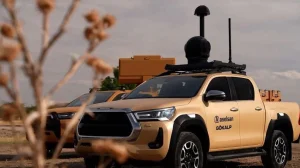
Guns and counter-UAS. ASELSAN’s KORKUT family is the workhorse. European Security & Defence assessed in July 2025 that Türkiye itself operates around 42 KORKUT self-propelled anti-aircraft guns and 14 command vehicles. ASELSAN announced a first international delivery of the KORKUT 150/35 configuration in 2025 without naming the customer — the same disclosure pattern Turkish primes use across sensitive contracts, and one Envanter Medya’s Turkish-language breakdown of KORKUT’s confirmed users and export status tracks system by system. Middle East Eye reported on 11 May 2026, citing Turkish industry sources, that Saudi Arabia and Qatar had both contracted for the lighter KORKUT 100/25, that Kuwait’s defence minister signed a government-to-government protocol covering ASELSAN, HAVELSAN, Baykar, Otokar and Yonca Shipyard, and that Oman had begun asking. Iraq’s deputy army chief of staff has said Baghdad is finalising the purchase of 20 short-range systems, widely expected to be KORKUT vehicles, alongside Korean KM-SAM II batteries — a single customer buying the Turkish bottom layer and the Korean top layer in the same rebuild.
Missiles. The highest tier Türkiye has actually sold is the HİSAR family. Indonesia contracted for HİSAR-O and HİSAR-U derivatives at Indo Defence 2022, fielded locally as Trisula-O and Trisula-U on Czech Tatra chassis. ROKETSAN’s SUNGUR very-short-range missile had not been exported as of mid-2025. This is worth stating precisely, because SİPER is frequently and wrongly credited with the Indonesian order: the Indonesian contract is for HİSAR-derived systems, not for SİPER.
The European route. The most consequential recent move is industrial rather than commercial. On 4 February 2026 Czechoslovak Group’s Excalibur International and ASELSAN announced an EU-based joint venture and unveiled KORKUT integrated onto the Tatra Force 6×6, with production to be transferred to CSG facilities in the Czech Republic and Slovakia. That is a marketing and manufacturing vehicle, not a sale — no Czech or Slovak order has been announced — but it gives a Turkish air defence product an EU-domiciled production address, which is the practical prerequisite for European procurement money.
WHERE TURKISH AIR DEFENCE HAS AND HAS NOT SOLD
DefenceTürkiye chart. Compiled from manufacturer announcements, published contract reporting and open-source assessments, September 2026. “No confirmed customer” means no export contract has been announced by a supplier, by the Turkish government or by a buyer government.
Why the long-range layer has not sold yet
There are four reasons, and only one of them is about the system’s quality.
The Turkish order book comes first. A contract worth more than $1.5 billion signed in December 2023 covers serial production of SİPER Block-1 alongside HİSAR and other air defence missiles, with deliveries to the Turkish Armed Forces running from 2025 to 2029. ASELSAN has disclosed a further run of air defence serial-production contracts since September 2025 whose deliveries extend into the early 2030s. A foreign buyer is not asking for a product off a shelf; it is asking to be inserted into a line the Turkish Air Force has already booked for the rest of the decade.
It is new. Block-1 passed its serial production acceptance tests in August 2025 and a full battery acceptance firing at Sinop in December 2025, entering operational service in January 2026. Buyers of strategic surface-to-air missiles are the most conservative customers in the market; they want a system that somebody else has already fielded, sustained and preferably fired in anger. SİPER has no combat record, and no export reference customer to point at.
It is not being marketed as an export product. This is checkable. ROKETSAN’s public air defence solutions catalogue lists SUNGUR and the HİSAR missiles as products; SİPER does not appear on it — verified on 23 September 2026. Companies that intend to sell a system abroad normally put a page and a brochure behind it first.
Block-2 is not in serial production. The longer-ranged Block-2 missile, stated at more than 150 km and a 30 km ceiling, first fired from the Sinop range in 2023 and has continued in test since. SSB has not announced a serial-production contract or an in-service date for it. A buyer wanting the 150 km class would be buying a development programme.
The “first SİPER export” reports
Since May 2026 a number of aggregator sites and social media accounts have reported that Türkiye completed a first SİPER export to an undisclosed country, with Bangladesh named in follow-on speculation. DefenceTürkiye has not been able to trace those reports to a primary source. There is no announcement from SSB, the Ministry of National Defence, ASELSAN or ROKETSAN; no public disclosure filing has been identified; and no buyer government has confirmed anything.
The contrast with KORKUT is instructive: when ASELSAN made its first international KORKUT delivery, the company announced the delivery and withheld only the customer’s name. Nothing equivalent exists for SİPER. Until it does, the honest position is that Türkiye has not confirmed a long-range air defence export.
WHY IT MATTERS
Türkiye’s drone exports worked because Baykar could sell a cheap, available system into a category the established primes were not serving. The long-range air defence market is the opposite case: the category is oversubscribed, the buyers are conservative, and the winner so far is another middle-power exporter with a longer production record. Whether SİPER converts is the clearest single test of whether the Turkish defence industry can move up the value chain from tactical systems to strategic ones — and of whether “available now” beats “proven” when a country is being hit.
What a buyer would actually be weighing
BUYER VIEW
- Price: undisclosed. No unit or battery price for SİPER has been published, and the $1.5 billion 2023 contract bundles several missile types, so it cannot be used to derive one. Korean and Israeli competitors have public-domain contract totals; Türkiye does not.
- Delivery: the domestic line is committed through 2029. Any export slot is a negotiation about displacing Turkish Air Force deliveries, or about new capacity.
- No third-party veto: this is SİPER’s strongest commercial argument. A long-range SAM bought from the United States or a European supplier carries licence, integration and re-transfer conditions. Türkiye built SİPER precisely because it had experienced those constraints. A buyer taking a Turkish system exchanges one political dependency for another, but a materially lighter one.
- Upgrade path: SSB has stated that Block-2 uses the same ground segment as Block-1 — radars, command and control, launcher and communications — with the missile carrying the extra range. In procurement terms, a Block-1 buyer is buying an infrastructure that a later missile can be dropped into.
- Naval growth: ROKETSAN fired the naval SİPER-1D from the indigenous MİDLAS vertical launcher in September 2025, and the system is planned for the TF-2000 air defence destroyer. A navy buying Turkish frigates has a coherent reason to look at the land system too.
- Industrial participation: Türkiye has a documented record of conceding local assembly and, in a few cases, design rights — see our analysis of what a buyer actually gets from Turkish defence offsets and of how countries contract and finance Turkish weapons.
- What is missing: no combat record, no export reference customer, no published performance data from an independent party, and no public component-provenance statement for the seeker, radar transmit-receive modules or propellants.
This is open-source editorial analysis for readers following the market. DefenceTürkiye does not advise governments or companies on procurement.
Limitations, stated plainly
SİPER is not an S-400 substitute and Turkish officials have not claimed it is. Block-1’s official figure is more than 100 km against aircraft; the Russian and Chinese systems in the same conversation quote two to three times that. The comparison that fits is with the upper-medium tier — the band Barak MX and KM-SAM II occupy — rather than with the longest-ranged systems in the world.
Ballistic missile defence is the other caveat. Görgün has publicly referred to SİPER-A and SİPER-4 developments aimed at ballistic targets, but no fielded Turkish anti-ballistic capability has been demonstrated in public, and a Gulf buyer whose threat is ballistic will read that gap immediately. The Korean system’s appeal in that market rests heavily on its hit-to-kill anti-ballistic design.
Finally, the localisation claim needs care. Görgün said on 18 September 2026 that domestic content across Turkish programmes had reached 83 percent and that close to 1,000 companies work on SİPER. That is an aggregate figure for the sector, not a component-level declaration for this system. Türkiye has not published which subsystems in SİPER are foreign, and a buyer’s export-control lawyers would ask. Our survey of who builds Türkiye’s radars and the profiles of ASELSAN and ROKETSAN set out what is publicly known about the supply chain behind the Çelik Kubbe (Steel Dome) architecture.
Update, 11 October 2026: an architecture-tier export
On 2 October 2026 ASELSAN disclosed a €488.5 million export contract covering integrated air defence systems, radar architecture and fire-control nodes for an undisclosed customer. That sits directly on the argument this page makes. The case set out above is that Turkish air defence exports have come from the lower tiers of the architecture — counter-UAS, guns, short and medium-range missiles — while the long-range layer has not sold. A package described as radar architecture and fire-control nodes is not a bottom-tier sale; it is the layer that ties a national air picture together, and it is the first Turkish export disclosure framed in those terms.
Two cautions keep the rest of this page unchanged. First, the disclosure does not state that the package includes a long-range interceptor, so the data box line above — no confirmed SİPER export customer — stands as written. Second, the customer is undisclosed, which places the contract in the same category this site examined in its guide to Turkish contract disclosure practice. The comparison with South Korea’s position in this market, addressed in the FAQ below, is developed at length in Türkiye vs South Korea: Two Rising Defence Exporters.
The naval dimension of the same question — whether Türkiye can field, and eventually sell, long-range air defence at sea — now has its own page in the TF-2000 destroyer programme, whose central open item is the naval SİPER interceptor.
What comes next
Three things would change the picture. A serial-production contract for Block-2 would give Türkiye a 150 km-class product to offer rather than a development programme. A named export customer — or even an announced delivery with the customer withheld, the KORKUT pattern — would give the system its first reference. And a European order through the CSG joint venture would prove that the industrial route into the EU market works for air defence and not only for armoured vehicles.
Absent those, the realistic expectation is continuity: Turkish air defence exports keep growing fast in counter-drone and gun systems, where the product is cheap, available and in demand; the medium tier moves on the strength of the Indonesian precedent; and the long-range tier stays domestic while the Turkish Air Force absorbs the production run. For readers who want the engineering detail rather than the market picture, Envanter Medya maintains a detailed Turkish-language technical profile of the SİPER system, and our own SİPER platform page covers the architecture, blocks and test history in English.
UPDATE, 4 NOVEMBER 2026 — TWO MORE EXPORT CONTRACTS, STILL NO NAMED CUSTOMER
Since this page was last updated on 11 October, ASELSAN has disclosed two further air-defence-related export contracts to Türkiye’s Public Disclosure Platform, neither of which names the buyer: US$442.5 million on 23 October for radar, counter-drone and command-and-control systems, and US$1.1 billion on 3 November for air defence systems. With the €488.5 million contract of 2 October, that is roughly US$2 billion of air-defence export business disclosed in five weeks.
Two larger figures from the same period are not exports and should not be added to that total: the €2.46 billion hybrid air-defence contract of 5 October and the €523 million contract of 26 October were both signed with Türkiye’s SSB for domestic programmes.
None of this changes the finding above. Every one of the export filings is for the counter-drone, short-range and layered tiers, and every one withholds the customer — the practice examined in why Turkish defence contracts say “customer undisclosed”. SİPER still has no confirmed export customer.
FAQ
Has Türkiye exported SİPER?
No export of SİPER has been confirmed. Reports circulating since May 2026 of a first sale to an undisclosed country have not been matched by any announcement from SSB, the Ministry of National Defence, ASELSAN or ROKETSAN, and no buyer government has confirmed one.
Which countries use Turkish air defence systems?
Indonesia is the confirmed foreign customer for Turkish surface-to-air missiles, operating HİSAR-derived systems as Trisula-O and Trisula-U under a 2022 ROKETSAN contract. ASELSAN announced a first international delivery of the KORKUT 150/35 gun system in 2025 without naming the customer, and Turkish industry sources have told Middle East Eye that Saudi Arabia and Qatar contracted for the KORKUT 100/25. Iraq has said it is finalising 20 short-range systems expected to be Turkish.
Is SİPER comparable to the Patriot?
They occupy the same role in an architecture — long-range area air and missile defence — but not the same maturity or the same market position. Patriot has four decades of service, a large user base and extensive combat use; SİPER entered Turkish service in 2024–26 with no export customer and no combat record. On stated range, Block-1’s 100+ km figure places it below the top of the class.
How much does a Turkish long-range air defence system cost?
It has not been disclosed. The December 2023 Turkish serial-production contract, worth more than $1.5 billion, bundles SİPER with HİSAR and other air defence missiles, so no per-battery figure can be derived from it. By comparison, Saudi Arabia’s KM-SAM II contract was reported at about $3.2 billion for ten batteries.
Can Türkiye sell air defence systems to NATO members?
There is no alliance rule against it, and Slovakia’s purchase of Israel’s Barak MX shows that non-American systems do win NATO orders. The ASELSAN joint venture with Czechoslovak Group, announced in February 2026, is designed to make that easier by placing production inside the EU. No NATO order for a Turkish air defence system has been announced.
Why is South Korea winning this market and Türkiye is not?
Timing and maturity, more than politics. KM-SAM II was in Korean service and available for export when the Gulf demand spike arrived; SİPER was still in acceptance testing. Korea could also offer financing and delivery dates against a proven line. Türkiye’s comparable advantages — price, speed and industrial participation — have so far been decisive in the lower tiers rather than the top one.
Sources
- Lockheed Martin, PAC-3 MSE production framework agreement, January 2026.
- US Defense Security Cooperation Agency congressional notifications: Saudi Arabia, PAC-3 MSE missiles, 30 January 2026; Denmark, IBCS-enabled Patriot, August 2025.
- Eurosam, Aster B1NT firing qualifying SAMP/T NG long-range performance.
- Czechoslovak Group, CSG and ASELSAN joint venture and KORKUT on Tatra Force, 4 February 2026.
- ROKETSAN, air defence solutions catalogue, accessed 23 September 2026.
- Defence Turkey, first firing test of SİPER Block-2, with SSB President Haluk Görgün’s statement on the shared ground segment.
- The Defense Post, SİPER completes serial production testing, August 2025.
- Naval News, SİPER-1D test-fired from MİDLAS, October 2025.
- Middle East Eye, “Gulf turns to Turkey for air defence systems amid Iran threats”, by Ragıp Soylu, 11 May 2026.
- European Security & Defence, Turkish SHORAD developments, July 2025.
- Asian Military Review, Indonesia acquiring ROKETSAN missiles, November 2022.
- Army Recognition, Iraq’s M-SAM II purchase and Iraq’s combined Korean and Turkish air defence plan.
- CZ Defence, Barak MX selected by Slovakia, December 2024.
- DefenceTürkiye, SSB export and localisation figures, 18 September 2026.

[…] No export customer has been announced. The general pattern in this category, however, is that long-range air defence systems become exportable once they have a domestic operational record and a demonstrated production rate, and there is a substantial international market among states that want strategic air defence without the political conditions attached to the established suppliers. Türkiye’s wider defence export performance across drones, armoured vehicles and naval platforms indicates the commercial machinery to pursue such sales exists. Whether SIPER follows that route will depend on production capacity, on national priorities for filling the Turkish Air Force requirement first, and on the export control decisions of the Turkish government. For the commercial picture around that question — which tiers of Turkish air defence have actually sold abroad, who the competing suppliers are and how the reported first SİPER export stands up to scrutiny — see our analysis of Turkish air defence exports and who actually buys them. […]
[…] with Hungary’s HT Division — which puts short-range air defence into the same pattern of Turkish air defence export activity that has so far produced far more agreements than […]