Where Turkish Rocket Artillery Fits in the MLRS Market

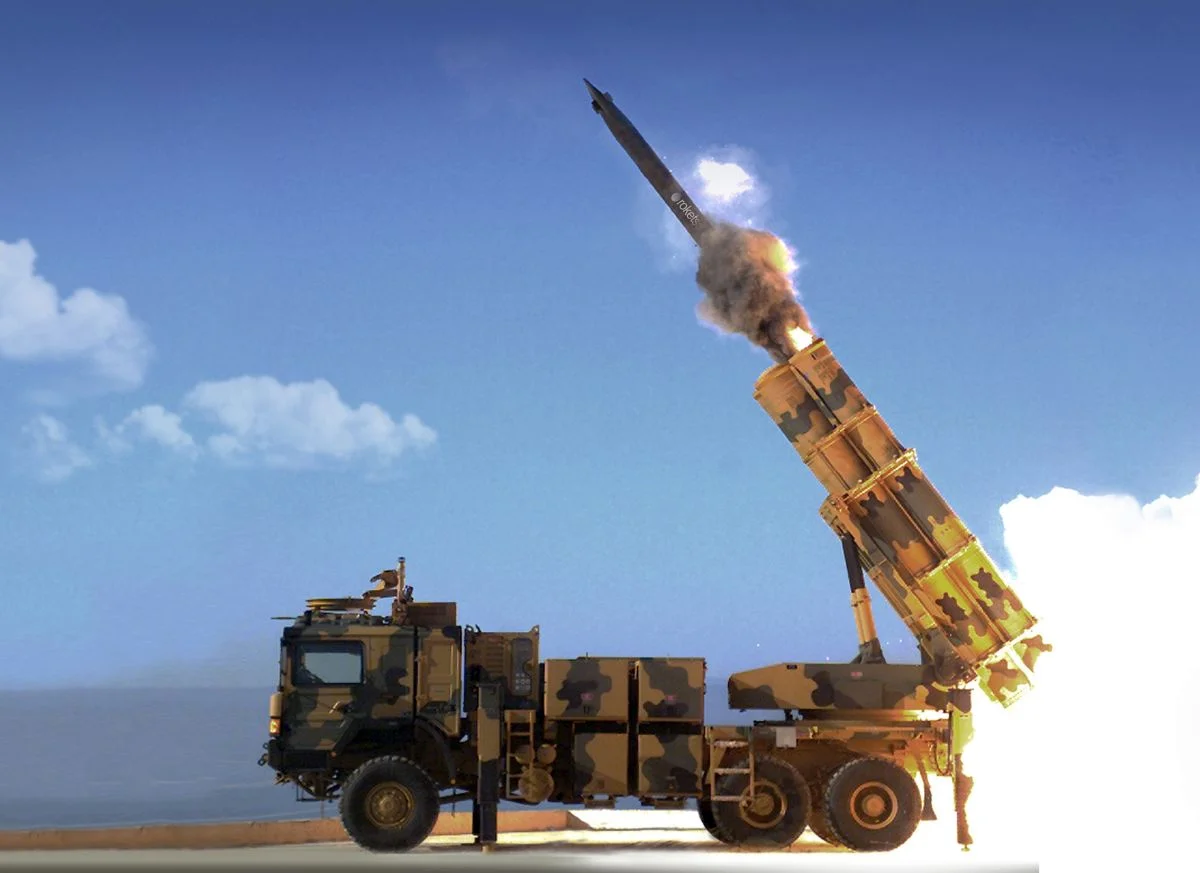
Türkiye builds one of only four launcher families in the world that can fire an entire artillery rocket portfolio — 122 mm unguided rockets up to a 610 mm ballistic missile — from a single vehicle. ROKETSAN’s Multi-Barrel Rocket Launcher covers a published band of 10 km to 280 km, the widest calibre spread any manufacturer currently advertises. Its confirmed export operators are Azerbaijan and Bangladesh. It has not won any of the European rocket artillery orders placed since 2023, a wave that has now committed more than 330 launchers to South Korea’s Hanwha and a run of contracts to Israel’s Elbit Systems. The gap between the product and the order book is the most useful thing to understand about Turkish rocket artillery, and it is not explained by range.
DEFENCETÜRKIYE DATA BOX
Manufacturer: ROKETSAN (Turkish Armed Forces Foundation 55%, MKE 15%, ASELSAN 15%, VakıfBank 10%, other 5%)
System: Multi-Barrel Rocket Launcher (MBRL) family, plus TR-122, TRG-122, TRLG-122, TRG-230, TRLG-230, TRG-300 and KHAN munitions
Category: Multiple launch rocket systems and short-range ballistic missiles
Programme status: In Turkish service; in serial production; marketed for export
Published range band: 10–280 km from one launcher; calibres 122, 230, 300 and 610 mm
Known export customers: Azerbaijan and Bangladesh (both reported, neither announced by ROKETSAN); United Arab Emirates listed in open-source databases
Export status: Exported; no official customer list published; no European or NATO-member order recorded
Current milestone: MBRL and KHAN shown at MSPO 2026 in Kielce, Poland, September 2026
Two ways to build a rocket artillery system, and Türkiye picked one of them
Rocket artillery buyers are choosing between two design philosophies, and the choice shapes everything that follows — ammunition supply, allied resupply, upgrade paths and price.
The American approach standardises the pod rather than the calibre. Lockheed Martin’s HIMARS carries a single six-rocket pod of Guided MLRS, or two Precision Strike Missiles, or one ATACMS, and Lockheed states it “can launch the entire MLRS family of munitions” with “maximum commonality with M270 platform launch systems”. Range is extended by putting a different missile inside the same pod envelope, not by changing the launcher. The tracked M270 carries two of those pods; HIMARS carries one. GMLRS itself comes in a Unitary and an Alternative Warhead variant exceeding 70 km, and an Extended-Range variant reaching 150 km, with more than 60,000 rounds produced.
The second approach makes the launcher multi-calibre. Elbit’s PULS fires 18 Accular 122 mm rockets to 35 km, ten Accular 160 mm to 40 km, four EXTRA to 150 km or two Predator Hawk to 300 km, from two pods on a launcher the company describes as “fully adaptable to existing platforms”. Hanwha’s K239 Chunmoo fires 130 mm, 227 mm and 239 mm rockets from two containers, plus the CTM-290 tactical ballistic missile. ROKETSAN’s MBRL is the most extreme version of the same idea.
ROKETSAN’s own product page lists the MBRL firing TR-122 and TRB-122 unguided rockets, TRG-122 and TRLG-122 guided 122 mm rounds, TRG-230 and TRLG-230 guided 230 mm missiles, the 300 mm TRG-300, and the 610 mm KHAN, at “ranges of 10 km to 280 km”, with a salvo interval of 0.5 to 30 seconds. Pod loads run from two pods of 20 rockets at 122 mm down to a single KHAN round. That is four calibres and five range tiers on one chassis.
The trade-off is the part sales brochures leave out. A multi-calibre launcher gives one unit the whole fire-support stack and frees the buyer from a single ammunition supplier. A standardised pod gives the buyer access to allied stockpiles — a NATO member with HIMARS can draw GMLRS from any other user’s production, and 60,000 rounds exist. Chunmoo sits awkwardly in between, because its 227 mm compatibility means it can take MLRS-family rockets as well as Korean ones. ROKETSAN’s launcher cannot. Nothing in ROKETSAN’s published munition list is interchangeable with anyone else’s launcher, and nothing in anyone else’s inventory fits the MBRL.
What ROKETSAN actually publishes
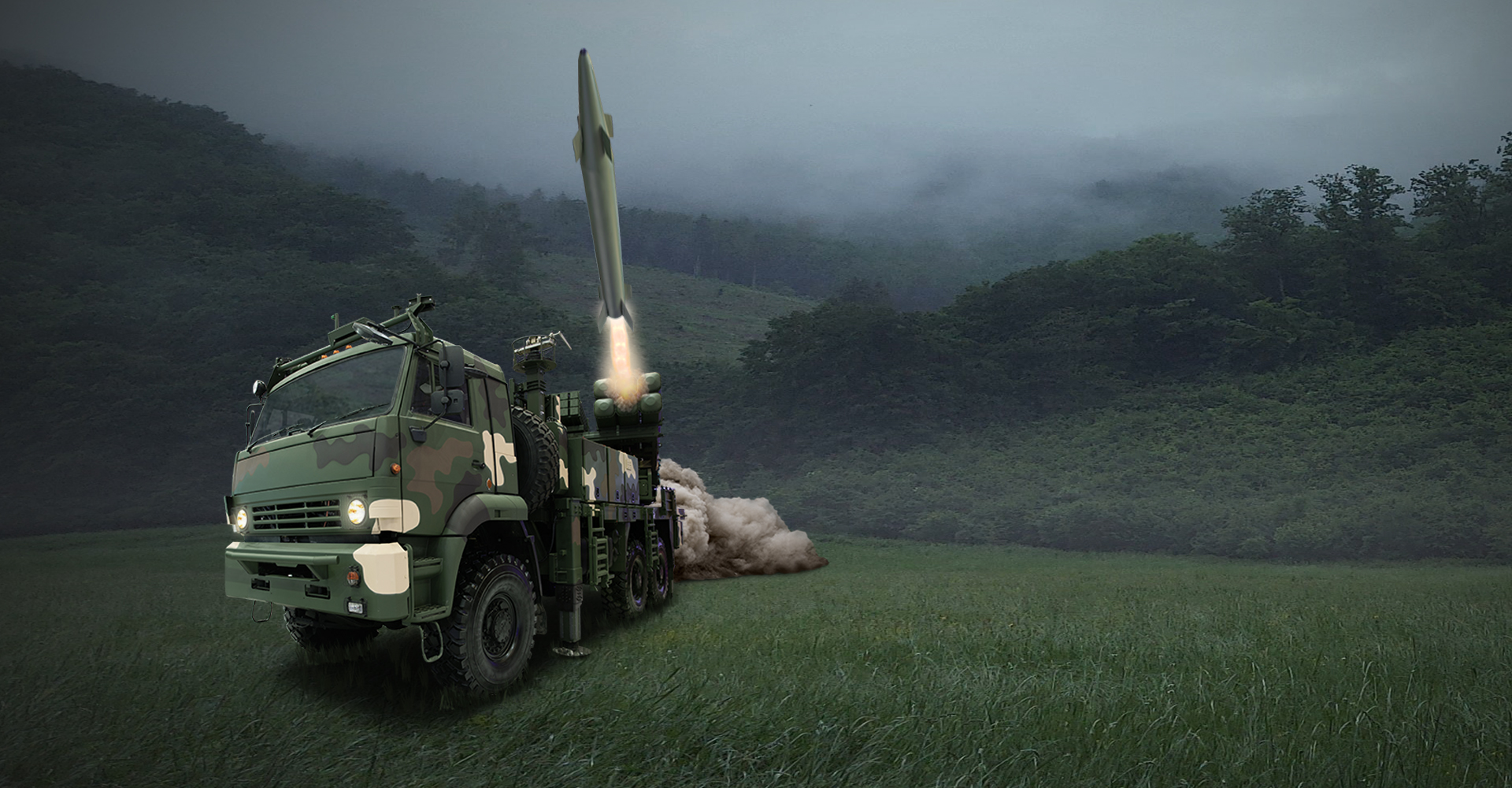
ROKETSAN is unusually specific about its artillery rockets, which makes comparison possible without guesswork. The figures below are taken from the company’s own product pages, not from estimates.
| Munition | Calibre | Published range | Rounds per launcher | Accuracy | Guidance |
|---|---|---|---|---|---|
| TR-122 / TRB-122 | 122 mm | Unguided | 2 × 20 | — | None |
| TRG-122 / TRLG-122 | 122 mm | Guided | 2 × 12 | — | GOLIS / laser |
| TRG-230 | 230 mm | 20–70 km | 2 × 6 | 10 m CEP | GOLIS, anti-jam |
| TRG-300 Block 2 | 300 mm | 20–90 km | 2 × 2 | 10 m CEP | GOLIS, anti-jam |
| TRG-300 Block 1A | 300 mm | 30–120 km | 2 × 2 | 10 m CEP | GOLIS, anti-jam |
| KHAN | 610 mm | 280 km | 2 (8×8 launcher) | 10 m CEP | GOLIS, anti-jam |
Compiled by DefenceTürkiye from ROKETSAN product pages for the MBRL, TRG-230, TRG-300 and KHAN. GOLIS = Go-Onto-Location-In-Space, ROKETSAN’s term for inertial and satellite-aided midcourse navigation to a fixed coordinate. Dashes mark figures ROKETSAN does not publish.
Two details in that table matter more than the headline ranges. The TRG-230 page states the missile can be fired from “unmanned naval vessels” as well as the MBRL, and the TRG-300 page lists Landing Ships Tank among its launch platforms. No other manufacturer in this class currently advertises guided artillery rockets as a payload for uncrewed surface vessels. That is a genuinely distinct niche, and it connects to Türkiye’s separate work on ship-launched ballistic strike weapons.
How the ranges actually stack up
Set the four launcher families against a single scale and the picture is less dramatic than the marketing. Everyone reaches roughly the same places; the difference is how many launcher types it takes to get there.
Published maximum range by launcher family, kilometres (0 to 300 km scale)
ROKETSAN MBRL — 122 to 610 mm, one launcher
Elbit PULS — 122 to 160 mm plus EXTRA and Predator Hawk, one launcher
Hanwha K239 Chunmoo — 130 to 239 mm plus CTM-290, one launcher
HIMARS with GMLRS only — 227 mm pod
HIMARS with ATACMS or PrSM in the same pod bay
Bars show the longest-ranged munition each launcher family publishes: KHAN 280 km, Predator Hawk 300 km, CTM-290 290 km, Extended-Range GMLRS 150 km. ATACMS and PrSM exceed 300 km and run off this scale. Sources: ROKETSAN, Elbit Systems and Lockheed Martin product pages; Chunmoo figures from trade press, as Hanwha does not publish a specification sheet.
WHY IT MATTERS
Rocket artillery is the one segment where a mid-sized exporter can genuinely compete with the United States, because the barrier is production capacity for solid-propellant rockets rather than a stealth airframe or a fighter engine. Türkiye has that capacity and a complete, qualified product line. Over the last three years Europe has spent heavily in exactly this segment and bought almost none of it. For anyone assessing Turkish industry, rocket artillery is the clearest available test of whether a capable product wins orders on its own — and the answer, so far, is no.
Where the systems have actually been sold
ROKETSAN does not publish a customer list for its rocket artillery, and the company’s export statements are given at the corporate level rather than by product. Its general manager, Murat İkinci, has said exports passed $750 million in 2025 with growth above 50 per cent, and has separately described company turnover above $2 billion; he put the customer count at around 40 countries in mid-2025 with a target of 50. Those are management statements, not audited accounts or figures published by the Presidency of Defence Industries, and they cover a portfolio that runs from 70 mm CİRİT rockets to the TAYFUN ballistic missile. None of them tells a buyer how many rocket artillery launchers have been exported.
What can be established from open sources is narrower, and it is worth stating precisely because the status language is routinely blurred elsewhere:
- Azerbaijan has operated the TRG-300 since around 2016 and has been observed firing TRLG-230 from truck-mounted launchers. Neither ROKETSAN nor the Azerbaijani Ministry of Defence has announced a contract; the evidence is parade and exercise imagery. ROKETSAN opened an Azerbaijan representative office in 2025, which its own corporate timeline records.
- Bangladesh is the better-documented case. Army Recognition reported, on the basis of a statement by the Bangladesh Chief of General Staff, that 18 TRG-300 systems had been delivered by June 2021, with a TRG-230 regiment following in 2022. Higher totals of 20 and more than 36 units circulate in secondary databases; the 18 figure is the one traceable to an official statement.
- The United Arab Emirates appears as a TRG-300 operator in open-source databases, with a small number of vehicles. There is no official confirmation from either government.
- Ukraine has been reported by the Ukrainian outlet Militarnyi to have used a ROKETSAN multi-barrel launcher, from open-source imagery. No contract has been announced by either side, and this should not be counted as an export order.
- Turkish-language reference sources add further names. Envanter Medya’s Turkish-language explainer on the ÇNRA modular multi-barrel launcher and its 10–280 km munition set lists Bahrain alongside Azerbaijan as a customer, without a source. DefenceTürkiye has found no official confirmation and does not treat Bahrain as a confirmed operator.
The honest summary is that Turkish rocket artillery has two solid export operators, one or two probable ones, and no published contract values anywhere. For a procurement office trying to benchmark price or delivery performance, that opacity is itself a finding — and it is a pattern across the industry, as our analysis of what Turkish defence contracts actually disclose sets out.
What Europe bought instead, and what it was buying
Between 2023 and 2026 Europe became the most active rocket artillery market in the world, and the orders went to two suppliers.
Hanwha’s Chunmoo has taken the volume. Poland accounts for 290 launchers, with Norway adding 16 under a contract Hanwha values at roughly $922 million, Estonia nine, and Croatia 18 in a €411.8 million contract signed on 10 September 2026 — around 333 launchers in total. Elbit’s PULS has taken the breadth: Germany, the Netherlands and Denmark selected it in 2025, Greece signed a roughly $750 million government-to-government package in April 2026 covering launchers, training rockets, precision rockets of several ranges and loitering munitions, and an unnamed European customer added about $235 million in October 2026.
Read the structure of those deals rather than their values and a pattern appears that has nothing to do with rocket performance.
Poland’s Chunmoo order is built with Polish industry, with Huta Stalowa Wola named as a manufacturer. Greece’s PULS contract was signed state-to-state, with Israel’s Ministry of Defence on one side, and carries technology transfer and work for Greek industry. Germany’s first five EuroPULS launchers came through a Netherlands–Israel government-to-government arrangement. And in March 2026 Elbit did the decisive thing: it formed EuroPULS GmbH, a 50:50 joint venture with KNDS headquartered in Kassel, in which Elbit contributes the launcher and KNDS contributes fire control and its European customer base. The German competition authority cleared it without conditions.
Each winning bid arrived either as a sovereign package with state financing attached, or inside a European prime contractor. ROKETSAN arrived at MSPO 2026 in Kielce with a stand. Defence24’s coverage of that appearance is instructive: it noted the KHAN missile — 610 mm, a range it gave as 80–280 km, a 470 kg warhead, 2.5 tonnes, two rounds per truck launcher — and the TRLG-230, then concluded that the system ROKETSAN most wanted to interest the Polish armed forces in was the SUNGUR air defence missile. The rocket artillery was on display rather than in a bid.
Türkiye already knows how to solve this, which is what makes the gap notable. Turkish Aerospace won Spain’s trainer programme by letting Airbus Defence and Space España prime the contract and take 60 per cent of the industrial work, a trade examined in our analysis of where HÜRJET fits in the advanced jet trainer market. Turkish industry has also shown it will build abroad when a customer requires it, as our survey of Turkish defence factories outside Türkiye documents. Neither model has been applied to rocket artillery. The same structural obstacles recur across Turkish bids, and we have traced three documented cases in why Turkish defence bids lose.
The MTCR line that shapes the top of the range
One constraint explains the specific shape of ROKETSAN’s longest-ranged artillery round, and buyers evaluating KHAN should understand it.
The Missile Technology Control Regime applies its greatest restraint to Category I items: complete rocket systems with capabilities “exceeding a 300km/500kg range/payload threshold”. Türkiye has been inside that regime since 1997, when it attended its first plenary in Tokyo as the newest of 29 members. ROKETSAN publishes KHAN at 280 km, and Defence24 reported a 470 kg warhead at MSPO 2026. Both figures sit just under the Category I line.
That is not an accident and it is not a weakness — it is the same design envelope every MTCR partner works inside, and it is why KHAN can be marketed at a trade show in Poland at all. But it does mean a buyer wanting more than 300 km from a Turkish launcher is asking for an export decision rather than a product, and that the longer-ranged TAYFUN family sits in a different regulatory category entirely. The BORA missile, which sits between the artillery rockets and TAYFUN, occupies the same envelope — ROKETSAN’s own KHAN page still serves BORA-labelled imagery and a BORA-named datasheet, and its MBRL page lists “BORA” as the single-round load where the KHAN page lists KHAN. ROKETSAN’s own 280 km figure and Defence24’s 470 kg figure should be read as the ceiling of what is routinely exportable, not as a technical limit.
BUYER VIEW
Open-source editorial analysis from DefenceTürkiye. DefenceTürkiye does not advise governments; these are the questions the published record leaves open.
Ammunition commonality. No ROKETSAN artillery rocket fits a NATO MLRS-family pod, and no MLRS-family rocket fits the MBRL. In a coalition, that means a separate resupply chain for the life of the system. Ask whether 227 mm compatibility is on offer.
Local production. Rockets are consumables. The question is not whether launchers can be assembled locally but whether rocket motor and warhead production can be, and on what licence terms. ROKETSAN has not published a rocket artillery co-production agreement.
Financing. Every recent European winner came with a state-backed payment structure. Ask what Türkiye’s equivalent is before comparing unit prices.
Host vehicle. ROKETSAN states KHAN can be fired from other tactical wheeled platforms with compatible interfaces, and TRG-230 can be integrated into launchers already in an army’s inventory. That is a real advantage for a buyer with an existing truck fleet — get it specified in writing.
Delivery and support. No contract values or delivery schedules have been published for any rocket artillery export. Benchmarks have to come from the customers themselves.
Where the Turkish offer is genuinely strong
Three things hold up against the competition on published evidence.
The first is portfolio completeness. A buyer dealing with ROKETSAN can source unguided 122 mm saturation rockets, guided 122 mm, two guided 230 mm variants including a laser-guided one, 300 mm at 90 and 120 km and a 610 mm ballistic round, from one supplier and one launcher. Elbit and Hanwha offer narrower sets. The United States does not offer anything below 227 mm in this class at all.
The second is launcher flexibility. ROKETSAN’s published position — that its munitions can be integrated into launchers already in service and onto third-party wheeled platforms — is a meaningful commercial proposition for armies with Soviet-era 122 mm launchers and no appetite for a new vehicle fleet. It is also the kind of flexibility a prime contractor selling a complete system has no incentive to offer.
The third is industrial depth behind the rockets. Türkiye’s solid-propellant and artillery ammunition base is being scaled for reasons that have little to do with rocket artillery exports, including European demand for shells, which we examined in whether Türkiye can supply Europe’s ammunition. Rocket production capacity is the hardest thing to acquire in this segment and the easiest thing for a buyer to verify.
Where it is weak, stated plainly
No European or NATO-member order exists for Turkish rocket artillery. No contract value has been published for any export. No co-production agreement for rockets has been announced. Launcher numbers in Turkish service are not officially published, and the counts that circulate come from commercial databases rather than the Ministry of National Defence. Combat use of the TRG-300 by Turkish forces has been reported in connection with operations in northern Syria, but the Turkish armed forces have not published an operational account, and claims about specific deployments from third-country outlets should be treated as unverified. Taken together, a buyer evaluating Turkish rocket artillery is evaluating a well-documented product with a poorly documented service record — the opposite of the GMLRS position.
What comes next
Three things are worth watching, all of them announced rather than speculative.
Whether ROKETSAN converts its Polish marketing into a bid is the first. Poland buys 122 mm rockets and has committed to Chunmoo at scale; a Turkish 122 mm guided round is a smaller and more plausible entry point than a launcher sale. Second, whether Türkiye forms a European industrial vehicle for rocket artillery on the EuroPULS model — it has the precedent in HÜRJET and has not used it here. Third, the uncrewed naval vessel application for TRG-230, which ROKETSAN already advertises and nobody else does; that is where a Turkish first-mover position is most likely, and it sits alongside Türkiye’s wider artillery programme across howitzers, guided rockets and shell supply.
FAQ
What is Türkiye’s equivalent of HIMARS?
ROKETSAN’s Multi-Barrel Rocket Launcher with TRG-300 rockets is the closest comparison, but the two are not equivalents. HIMARS fires a standardised 227 mm pod and extends range by swapping in ATACMS or PrSM. The Turkish launcher changes calibre instead, from 122 mm up to the 610 mm KHAN, and reaches 280 km with that round against HIMARS’s 150 km with Extended-Range GMLRS or beyond 300 km with ATACMS.
Which countries use Turkish rocket artillery?
Azerbaijan and Bangladesh are the documented operators of the TRG-300 family, with Bangladesh’s delivery of 18 systems by June 2021 traceable to a statement by its Chief of General Staff. The United Arab Emirates is listed in open-source databases. ROKETSAN publishes no customer list, and no European country has ordered the system.
How far can the TRG-300 fire?
ROKETSAN publishes 30–120 km for TRG-300 Block 1A and 20–90 km for Block 2, both with a stated 10 m CEP and anti-jamming capability. The shorter-ranged TRG-230 is published at 20–70 km.
Is KHAN a ballistic missile or an artillery rocket?
ROKETSAN markets KHAN as a munition for its 8×8 multi-barrel launcher, which places it with the artillery rather than with a dedicated missile battery, but at 610 mm, 7.1 m and 2,500 kg it is a short-range ballistic missile by any normal definition. Its published 280 km range and reported 470 kg warhead sit just below the Missile Technology Control Regime’s Category I threshold of 300 km and 500 kg.
Why has Türkiye not won a European rocket artillery contract?
On the published evidence, structure rather than capability. Every European order since 2023 has gone either to a government-to-government package with state financing or to a supplier operating inside a European prime — Hanwha building with Huta Stalowa Wola in Poland, Elbit forming the EuroPULS joint venture with KNDS in Kassel. ROKETSAN has marketed directly, as itself, and has not announced a European partner or a local production offer for rockets.
Can Turkish artillery rockets be fired from launchers a country already owns?
ROKETSAN states that the TRG-230 can be integrated into existing weapon systems in an army’s inventory, and that KHAN can be launched from other tactical wheeled vehicle platforms with compatible interfaces. Neither claim has been demonstrated publicly on a third-party launcher, so a buyer should treat it as an offer to be tested rather than a delivered capability.
How does Turkish rocket artillery compare on price?
It cannot be compared on published evidence. No contract value has been disclosed for any Turkish rocket artillery export, whereas the Croatian Chunmoo contract (€411.8 million for 18 launchers and guided rockets) and the Greek PULS package (roughly $750 million) are public. Any price advantage attributed to Turkish systems in this segment is inference, not record.
Sources
- ROKETSAN product pages: Multi-Barrel Rocket Launcher, TRG-300, TRG-230, KHAN, and About Us (shareholding, corporate timeline).
- Elbit Systems, PULS product page and KNDS and Elbit Systems Launch EuroPULS Joint Venture, March 2026.
- Lockheed Martin, HIMARS and Guided MLRS product pages.
- Hanwha, first contract to supply Chunmoo MRLS to Norway.
- Missile Technology Control Regime, Guidelines and 12th Plenary Meeting, Tokyo, 4–6 November 1997.
- Adam Świerkowski, “280 km zasięgu i 470 kg głowicy. Khan od Roketsana na MSPO 2026”, Defence24, 25 September 2026.
- Breaking Defense, “Greece inks $750M deal with Israel for Elbit’s PULS rocket artillery systems”, April 2026.
- The Defense Post, “Elbit Wins $235M European Contract for PULS Launchers, EXTRA-MR Rockets”, October 2026.
- Defence Industry Europe, Croatian order for 18 Chunmoo launchers, September 2026.
- Army Recognition, “Bangladesh takes delivery of Turkish-made Roketsan TRG-300 MLRS rocket launchers”.
- Envanter Medya, a Turkish-language technical profile of the TRG-300 KAPLAN giving its range, Block versions and reported operators.